Board of Directors, Copper, Environment, finance, Gold, International Finance, Lithium, Mining, Nickel, palladium, platinum, precious-metals, Silver, Uncategorized, Yogi Nelson

Pillar “O”is for Opportunity—Could, Might, Maybe…Show Me!

Opportunity — The Third Pillar of the Mining SCOREcard™

by Yogi Nelson

Welcome to the third pillar of the SCOREcard: O for Opportunity! This is where junior mining investing gets really interesting–potential profits or dollar disaster! No longer is the question what does the company have today. We ask what it might have tomorrow. Keep in mind, the word “might” could mean possibility or strength!

What Are We Really Buying?

Invest in a junior mining company, equals buying an unfinished business. There may be no mine. No revenue. No earnings. Perhaps not even a defined mineral resource. Ouch! If true what am I buying? The big “O”–Opportunity.

Maybe the company has a substantial resource that could become a mine. Or drilling could expand the existing deposit. Perhaps the company controls an entire district containing multiple targets. What if management believes the geology suggests something much larger than anything yet demonstrated. Note the modal verbs in bold, e.g. could, maybe, believes, etc. Are there possibilities? Yes. Could there be value. Yes. Show me–yes!

Existing Value: Show Me What You Have

Start with Existing Value. What has the company already demonstrated? Not press releases? Technical studies from creditable sources. Has it identified a mineral resource? How large is it? What is the grade? How much is inferred, indicated or measured? Has metallurgy been tested? Has the company completed an economic study?

In other words: Show me what you have—not what you hope you have.

This distinction matters. Under established mining disclosure standards, confidence increases as resources move from inferred to indicated to measured. A resource is not automatically a reserve, and mineralization is not automatically an economically viable mine. Sounds like technical or legalse, right? Not to a sophisticated investor using the SCOREcard. They are fundamental.

A million ounces demonstrated through sufficient drilling and geological work are not comparable to management saying, “We think there could be several million ounces here.” Could they be right? Who care! Don’t give equal points for evidence and enthusiasm.

Expansion Value: Can It Get Bigger?

Next comes Expansion Value. Suppose the company has already discovered a legitimate deposit. Excellent. Now I want to know: Is that all there is?

Perhaps the deposit remains open along strike. Maybe it remains open at depth. Maybe additional drilling between existing holes could add ounces or increase geological confidence. Maybe, perhaps, could be, etc. Keep in mind, opportunity without uncertainty wouldn’t be opportunity—it would already be value. That’s the right sentiment.

This is one of the attractions of junior mining. A company can create value not only by finding a deposit but by demonstrating that the deposit is considerably larger than originally believed. But again, show me the evidence.

Where are the existing drill holes? Where is the mineralization open? What geological evidence suggests continuity? Is management drilling logical extensions of something already discovered, or drawing colorful arrows on a presentation? Arrows are cheap. Drill holes are not.

District Value: One Deposit or Something Much Bigger?

District is the word every explorer or junior mining company dreams. A world of multiple deposits. Various types, e.g. gold, copper, and silver. Many deposits. Oh the joy! District Value is the term.

Perhaps the flagship deposit is only the first discovery. Nearby targets may share the same geological structures, alteration patterns or mineralization. There may be multiple deposits capable of eventually sharing roads, power, processing facilities and other infrastructure. The opportunity potentially changes.

“How big can this deposit become?” is the inquiry. That’s a much bigger question. However, big claims require bigger evidence. After all, we all know land packages look wonderful on investor presentations. Thousands of hectares sound impressive. But owning a large amount of dirt doesn’t necessarily mean you own a large amount of value. I want to know why management believes additional deposits exist.

Geophysics? Geochemistry? Surface samples? Historic workings? Previous drilling? Geological analogues?Investors need to take the Missorui motto to heat: Show me the evidence.

Blue Sky: Where Dreams Meet Drill Bits

Finally, we arrive at perhaps the most exciting phrase in junior mining: Blue-sky potential. This is where to quote Linda Ronstadt: “Its so easy to fall in love, its so easy to fall in love…” Everyone loves a blue sky, including your truly. The possibility of a transformational discovery is one of the reasons people invest in junior explorers in the first place.

A few drill holes can sometimes completely change how the market views a company. Red alert–blue sky is also where imagination can outrun evidence. Management presentations are filled with words such as “potential,” “prospective,” “district-scale,” “world-class” and “analogous.” Sure. Maybe.

The Mining SCOREcard™ doesn’t tell me to ignore blue-sky potential. Quite the opposite. I want to identify it. I put it in the correct box: Conceptual Opportunity. Conceptual opportunity deserves consideration, not necessary your dollars.

Not All Ounces Are Created Equal

Opportunity isn’t merely about getting bigger and better. I’ll explain. Suppose additional drilling adds another million ounces of gold. Wonderful. But where are those ounces?

Are they close to existing infrastructure? Are they deeper? Lower grade? Metallurgically complicated? Do they potentially extend mine life? Could they improve project economics? In other words, more isn’t automatically better.

The same principle applies to resource conversion. Drilling that converts inferred resources into higher-confidence categories may not produce a spectacular headline. No giant new discovery. No fireworks. Yet reducing uncertainty can create substantial value. Sometimes proving what you already think you have is just as important as discovering something new.

Catalysts Matter

Does opportunity have a time dimension–it sure does. I want to know what catalyst could cause a re-rate of market value, e.g. drilling, permitting, etc.

I also ask another question: How much money will it take to get there?

A company may have extraordinary geological opportunity but require $50 million of additional exploration before investors know whether the thesis works. Where does that money come from? Remember our first pillar: Strategy & Stewardship. Opportunity does not exist in isolation from capital allocation.

Opportunity Must Be Earned

The Mining SCOREcard™ therefore separates Opportunity into four broad categories:

Existing Value — What has already been demonstrated?

Expansion Value — How much larger or better could the existing deposit become?

District Value — Could the property contain multiple deposits or a much larger mineralized system?

Conceptual Opportunity — What plausible blue-sky potential exists beyond what has been demonstrated?

As we move down that list, potential may increase; certainty decreases. That’s the trade-off. The purpose of the SCOREcard isn’t to eliminate speculation. Junior mining would be pretty boring without speculation! The purpose is to distinguish informed speculation from wishful thinking. We can recognize extraordinary potential without pretending that potential has already become reality. That’s Opportunity and it requires a Show Me attitude!

Sincerely,

Yogi Nelson
Board of Directors, Copper, Gold, Governance, Mining, Nickel, palladium, platinum, Silver, Yogi Nelson

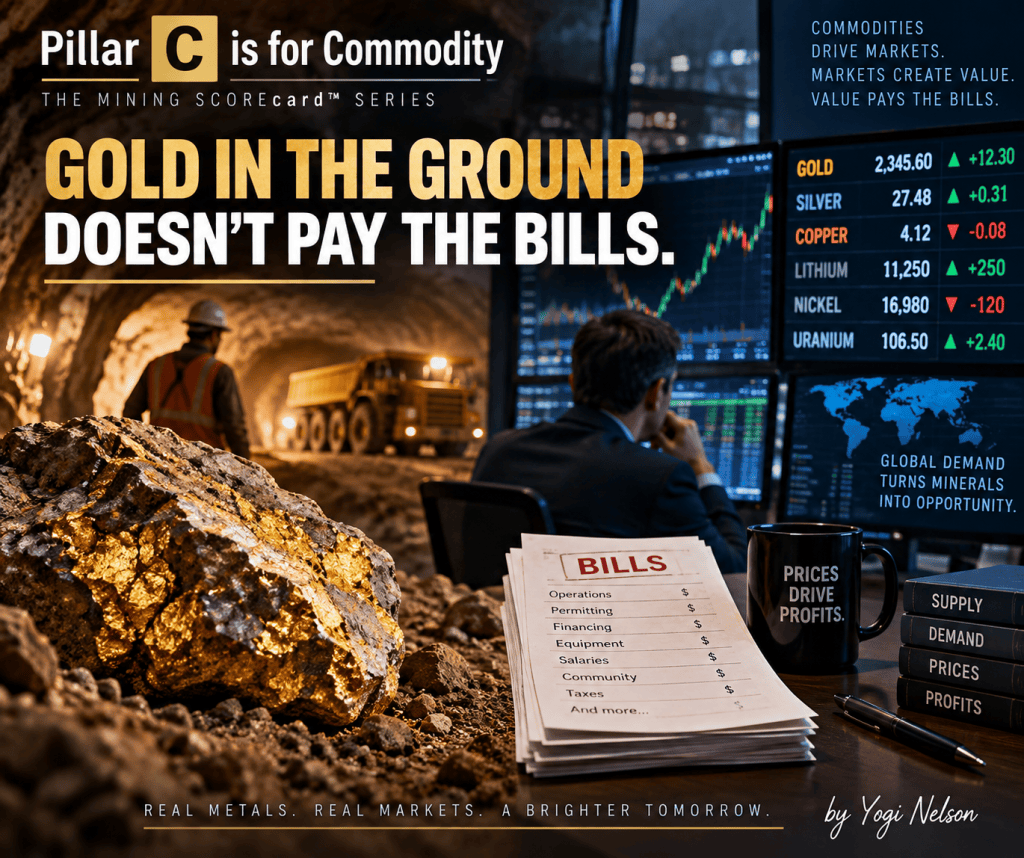
Pillar “C” Is for Commodity: Gold in the Ground Doesn’t Pay the Bills

by Yogi Nelson

Previously, I mentioned the Mining SCOREcard™  starting with Pillar 1: Strategy & Stewardship.  The basic premise: Rocks don’t make decisions. People do.  Now we move onto Pillar 2: “C”, Commodity.

Management may be mining superstars. The geology may be exciting. Drill results may look terrific. All fantastic.  Nevertheless, eventually somebody must be willing to part with their legal tender for the gold, silver, copper, etc.  Unless companies can earn a profit, it’s all a big waste of time and money.  Who needs that?  No one reading these articles!

Start With Simple Questions

Start with the fundamentals:  What exactly is this company trying to find or produce—and why do I want exposure to it?

Gold, silver and copper all come out of mines. But are they identical commodities?  No way! Gold is simultaneously a commodity, monetary asset, investment vehicle and store of value.  Yes, all of those.  Copper, aka Doctor Copper, is fundamentally an industrial metal whose demand is closely connected to construction, manufacturing, electrical infrastructure and economic activity.  What about silver?  Silver lives somewhere in between, combining monetary and investment characteristics with substantial industrial demand. Ultimate combo!

That means investing in a junior gold company is not necessarily the same investment thesis as investing in a junior copper company or silver company.  Before evaluating the company, understand the commodity.

A Great Deposit at the Wrong Price

Prices matter enormously because mining companies do not control commodities prices.  They are subservient to the market–supply and demand. 

Consider.  Apple can raise iPhone prices (and they always do). A restaurant can increase the price of dinner.  Can a gold miner simply announce that it will sell gold at another $500?  Nope! Gold prices are set at the world level not at the gold mine.  That creates an interesting investment problem.

Suppose a junior mining company publishes an economic study showing an attractive project at $3,000 gold. What happens if gold falls to $2,300?  Or suppose a copper project looks marginal at $4.00 copper but extraordinarily profitable at $5.50.  What to do? 

The answer depends partly on the commodity-price assumptions underlying the analysis. This is why I don’t evaluate a mining project only at today’s spot price. Mines can take years—or decades—to discover, permit, finance, construct and operate. Today’s commodity price is important. Tomorrow’s may matter more.

Supply and Demand Still Matter

Commodity markets are often shrouded by narratives, not necessarily false ones.  For instance, Copper is essential for electrification. Silver benefits from solar demand. Gold protects against monetary instability. All narratives may contain considerable truth. But a good story is not enough. I want to understand what could change or reinforce the story.

On the supply side: Where does new production come from? How long does it take to develop new mines? Are ore grades declining? Are major producing jurisdictions becoming politically difficult? Is the industry investing enough capital to replace depleted reserves?

Let’s turn to demand. What industries consume the commodity? How sensitive is that demand to economic growth? Can manufacturers substitute another material? How much demand depends on government policy or subsidies? How important is investment demand?

The purpose isn’t to predict commodity prices perfectly.  I can’t. Who can?  No one. The objective is to understand the forces that could move the commodity market—and therefore the value of the company I am considering.

Don’t Confuse a Commodity Thesis with a Company Thesis

This distinction is particularly important.  I can be extremely bullish on copper and still reject a copper company.  Converserly, can I be neutral on gold and find an unusually attractive gold company?  You bet!

Why?  Simple, a good commodity or strong commodity bull market does not automatically make a good company.

Imagine that I believe copper faces a structural supply deficit over the next decade. Which I do. That’s potentially attractive. But the junior copper company I’m examining has low grades, difficult metallurgy, enormous capital requirements and a project located in a jurisdiction where permitting could take years. My copper thesis may be right while my investment is wrong. The SCOREcard forces me to separate those questions.

Quality Matters Within the Commodity

News flash: two gold deposits containing the same number of ounces can have dramatically different economic value. Grade matters. Metallurgy matters. Recovery matters. Strip ratio matters. Infrastructure matters. Depth matters. Energy costs matter.  What’s more, the relevant variables change depending upon the commodity and deposit type.

A copper porphyry containing billions of tones of relatively low-grade material may potentially support an enormous mine. A narrow-vein underground gold deposit presents a completely different engineering and economic problem. This is why commodity analysis cannot simply be:

Gold? Check.

Copper? Check.

Silver? Check.

The commodity must be examined in the context of how that particular deposit can potentially become an economic mine.

Beware of the Commodity Fashion Show

Mining comes into and out of vogue.  When commodity prices rise, investor enthusiasm tends to follow. Suddenly everybody has the commodity the market wants. Currently, rare earths are the rage. 

A company that was focused on gold yesterday may discover that it has a lithium opportunity today. Tomorrow perhaps uranium becomes fashionable. Next year maybe copper That doesn’t automatically mean something improper is happening. Markets change, and good management should recognize opportunities.

But my antenna goes up. Does management genuinely possess expertise in the commodity? Is the geological opportunity legitimate? Does the company have a coherent strategy? Or has management simply discovered which commodity currently attracts financing? The distinction matters. A commodity bull market can finance a good strategy. It shouldn’t substitute for one.

Price Assumptions Should Survive Bad Weather

If nothing else the Mining SCOREcard™  should encourage skepticism toward economic models that only work when everything goes right.  When does everything go right? 

If a project requires historically exceptional commodity prices to generate acceptable returns, red alert.  I prefer: a project that remains economically interesting under conservative assumptions and becomes spectacular under favorable conditions.  Hope is not a strategy. Commodity markets are volatile. Mining investors should expect  and be violent market turbulence–category 4 and 5 hurricane storms!

Commodity Is About Context

The Commodity pillar therefore asks something much deeper (pun intended!) than: What metal is in the ground, it asks:

What drives demand for that commodity? Where does supply come from? How cyclical is the market? What could substitute for it? What commodity price does the project require? How sensitive are project economics to changes in that price? Does this particular deposit possess characteristics that could allow it to compete through different commodity cycles? Those questions help me distinguish between owning a good geological story and owning an economically resilient mineral asset.

The Second Letter in SCOREcard–“C”

The Mining SCOREcard™ begins with people because people allocate capital and make decisions. Then comes the commodity because even excellent management operates within markets it cannot control.

S — Strategy & Stewardship asks whether I trust the people.

C — Commodity asks whether I understand the market in which those people must compete.

Neither question guarantees investment success. Nothing does.  Asking both may avoid a surprisingly common mistake: falling in love with a mineral deposit without asking whether the world will ultimately pay enough for what comes out of it.

Next, I’ll move to the third pillar of the Mining SCOREcard™:  O — Opportunity.  Because once I understand the people and the commodity, I want to know something else:  How much value could actually be sitting there waiting to be created?

Sincerely,

Yogi Nelson

Artificial Intelligence, Banking, Blockchains, cryptography, Decentralized, Digital Currency, finance, International Finance, Japan, Mining, palladium, Silver, tokenization, Yogi Nelson

Tokenized Metals vs Reality: Why Liquidity Matters More Than Hype

by Yogi Nelson

Champions of tokenization promise many things: transparency, portability, programmability, and global access to assets that once sat quietly in vaults. In the case of precious metals, tokenization holds out an especially attractive vision—gold, silver, and even more exotic metals moving at internet speed rather than banker speed.  But there’s a stubborn, unglamorous problem standing in the way of those champions–liquidity.

It’s true—tokenization can digitize metal. However, it cannot, by itself, guarantee that someone is always there to buy or sell the asset.

This article explores what the liquidity problem actually is, why it matters, why some metals are more liquid than others, and therefore better candidates for tokenization, and what would need to happen for tokenized metals to approach true global volume.  First, we start with the basic question, what is liquidity?

LIQUIDITY IS THE KEY!


What Do We Mean by “Liquidity,” Really?

Liquidity is one of those financial terms that everyone uses and almost no one pauses to define; let’s not be another one of those people.  According to Investopedia, liquidity refers to:

“The degree to which an asset can be quickly bought or sold in the market at a price reflecting its intrinsic value.”

In plain English, liquidity answers three practical questions:

  1. Can I sell this when I want?
  2. Can I sell it in meaningful size?
  3. Can I do so without materially moving the price?

Liquidity is not about whether an asset is valuable. It is about whether that value can be realized efficiently.  As smart investors, we know:  there is no profit until and unless the profit is realized!

Examples of highly liquid assets

  • Cash
  • U.S. Treasury bills
  • Major currencies (USD, EURO, JPY)
  • Large-cap public equities
  • Spot gold in standard bar form

These assets trade constantly, have many buyers and sellers, and allow large transactions with minimal price impact.

Examples of illiquid assets

  • Private equity stakes
  • Fine art
  • Rare collectibles
  • Thinly traded commodities
  • Certain real estate markets
  • Exotic metals like rhodium

These assets may be valuable, even extremely valuable—but converting them into cash can take time, negotiation, and often a price concession.

Liquidity, in short, is not a judgment about worth. It is a measure of market readiness. Period.


Why Liquidity Matters More Than Tokenization

Tokenization solves representation. Liquidity solves usability. This distinction matters more than most marketing materials admit, and for clear conflict of interest reasons!

History is full of assets that were perfectly “ownable” but practically unusable due to liquidity constraints.  Below are just three examples:

  • privately held companies with no secondary market,
  • thinly traded bonds,
  • structured products that looked attractive on paper but could not be exited without loss.

In each case, the problem was not ownership—it was exit. Without sufficient liquidity:

  • prices become unreliable,
  • bid–ask spreads widen,
  • volatility increases,
  • and confidence erodes.

An asset that cannot be exited predictably becomes a theoretical investment, not a functional one. Tokenization does not automatically fix this. A token can make ownership easier to track, transfer, and audit—but if no one is consistently willing to trade, liquidity remains scarce.

This is why liquidity is not a secondary issue. It is the gatekeeper between innovation and adoption. 


The Liquidity Problem in Tokenized Metals

As if one challenge isn’t enough, tokenized metals face a double liquidity challenge.  Let’s go through those two now.

First: the underlying metal.  Not all metals trade the same way.  While I love them all, some are more “equal” than others.  Take for example gold.

Gold enjoys:

  • global spot markets,
  • deep futures markets,
  • central bank participation,
  • standardized bars and settlement norms.

Liquidity already exists. Tokenization plugs into it.  A perfect fit.  What about silver?

Silver is liquid, but thinner:

  • more industrial demand,
  • more volatility,
  • fewer institutional holders.

Tokenization can help—but it cannot smooth silver’s inherent swings.  Silver, being a dual metal, monetary and industrial, is much more volatile.   

Platinum and palladium are:

  • industrially driven,
  • dependent on specific sectors,
  • subject to sudden demand shifts.

Liquidity exists, but it is episodic. 

Rhodium is the extreme case and completely likely unsuitable for tokenization:

  • no meaningful futures market,
  • very thin spot trading,
  • prices that can move violently.

Tokenizing rhodium does not create liquidity. It simply makes scarcity visible in real time.


Problems Caused by Poor Liquidity

Low liquidity is not an abstract inconvenience. It creates concrete problems.  Below are four problems, listed in no particular order of importance, because they are all equally critical.

1. Wide bid–ask spreads

Thin markets punish participation. Buyers pay up; sellers accept discounts.  The worse of both worlds. 

2. Price distortion

In illiquid markets, small trades can create misleading price signals, undermining trust.  Once trust is gone, bringing it back is an uphill climb.

3. Redemption pressure

If token holders cannot sell easily, they may redeem for physical metal instead—stressing vaulting and logistics systems.

4. Institutional hesitation

Institutions care deeply about exit risk. If they cannot move size without disruption, they simply stay away.

Liquidity attracts participants. Participants create liquidity. Without the first step, the cycle never starts.


Why Gold Has a Structural Advantage

Gold begins the liquidity race several laps ahead. Its advantages are not technological; they are historical and institutional and those maybe more important at this stage:

  • centuries of trust,
  • standardized market conventions,
  • global clearing mechanisms,
  • and deep participation.

This is why tokenized gold products have a realistic path to scale. They are not inventing liquidity—they are digitizing access to existing liquidity.  Silver may follow. Other metals face steeper climbs.


Can Tokenized Metals Create New Liquidity?

Sometimes—but not by access alone.  Liquidity is not created by opening the doors. It is created when:

  • pricing is reliable,
  • settlement is predictable,
  • custody is trusted,
  • and exit is assured.

Liquidity is a social and institutional phenomenon, not a purely technical one.


The Role of Market Makers

What the heck is a market maker?  The answer according to Investopedia is: a firm or individual that provides liquidity to a market by continuously offering to buy and sell a particular asset at publicly quoted prices, profiting from the bid–ask spread while helping ensure orderly trading.  If that sounds complicated, try this definition in plain English: a market maker is the party that stands ready to buy when others want to sell—and sell when others want to buy—so markets don’t freeze up.  In essence liquidity is “engineered” by professionals.

Market makers:

  • quote continuous buy and sell prices,
  • absorb short-term imbalances,
  • and take risk so others don’t have to.

In tokenized metals, market makers face unique challenges:

  • fragmented venues,
  • regulatory uncertainty,
  • redemption complexity,
  • and thin underlying markets for non-gold metals.

Without professional market makers, global volume remains aspirational.


Other Essential Players

No man is an island and in tokenized metals liquidity requires an entire ecosystem.  The ecosystem consists of but is not limited to:

  • trusted custodians,
  • independent auditors,
  • compliant exchanges,
  • predictable settlement systems,
  • and regulatory clarity.

Tokenization reduces friction—but it does not replace these foundations.


How Liquidity Could Improve Over Time

A realistic path forward exists:

  1. Focus on metals that already trade.
  2. Encourage institutional participation.
  3. Build predictable redemption systems.
  4. Allow consolidation rather than fragmentation.

Liquidity grows slowly. Then suddenly.  Let’s hope so. 


Final Answer: Can Tokenized Metals Reach Global Volume?

  • Gold: yes, over time
  • Silver: possibly, with patience
  • Other metals: niche, specialized use cases only

Tokenization is not a volume generator. It is a volume amplifier—but only where volume already exists. Liquidity is earned, not engineered.


Closing Thought

Tokenized metals are still early. Tokenization technology is ahead of the market structure and vision is ahead of the plumbing. Enthusiasm is always present where success is found.  But as Larry David, the comedian said–Curb Your Enthusiasm! But that’s not failure. It’s market reality.

Liquidity comes last—not first.  And when it arrives, it will come not because metals were tokenized, but because trust, structure, and participation grew around them.


Until next time,

Yogi Nelson

This article is part of an ongoing, long-form series examining the tokenization of precious metals—one of the few sustained efforts to explore the topic across custody, liquidity, redemption, and market structure over the course of 2026.

Austrian economics, Banking, Blockchains, Decentralized, Digital Currency, finance, International Finance, Mining, palladium, tokenization, Yogi Nelson

Tokenized Palladium: A Digital Asset for a High-Tech Age

Tokenized palladium can provide:
• Transparent, on-chain ownership
• Faster settlement in volatile markets
• Fractional access to a scarce industrial asset
• Improved supply-chain visibility

This article is available in long form at: https://yogapuertorico.wordpress.com/wp-admin/post.php?post=2636&action=edit

—
Yogi Nelson

Austrian economics, Banking, Blockchains, Decentralized, Digital Currency, finance, palladium, precious-metals, tokenization, Uncategorized, Yogi Nelson

Tokenized Palladium: A Digital Asset for a High-Tech Age

by Yogi Nelson


What Is Palladium?


What Is Palladium Used For?

  • Electronics, particularly multilayer ceramic capacitors
  • Chemical processing and industrial catalysts
  • Dentistry and medical devices
  • Hydrogen purification and storage
  • Jewelry, a relatively minor use

Where Is Palladium Mined?

  • Geopolitical and sanctions risk
  • Supply-chain opacity
  • Limited ability to increase production quickly
  • Dependence on the economics of other metals

Palladium’s Price History: A Lesson in Constraint


Why Palladium Is a Serious Tokenization Candidate


Tokenized Palladium vs Traditional Palladium Exposure

  • Direct ownership of physical metal
  • On-chain auditability
  • Reduced reliance on intermediaries
  • Global accessibility without brokerage friction

Industrial and Supply-Chain Use Cases

  • Hedge raw-material costs directly
  • Maintain verified strategic inventories
  • Improve supply-chain traceability
  • Reduce settlement and financing friction

Risks, Constraints, and Realism

  • Demand is sensitive to technological shifts
  • Electric vehicle adoption introduces long-term uncertainty
  • Market size limits liquidity
  • Regulatory clarity remains uneven

Long-Term Outlook: Palladium’s Digital Role


This post is part of an ongoing weekly series on the tokenization of precious metals, published on BlockchainAIForum and LinkedIn, examining custody, regulation, issuer structure, and settlement infrastructure.

Sources

World Platinum Investment Council (WPIC) – Palladium Market Reports
U.S. Geological Survey (USGS) – Mineral Commodity Summaries: Palladium
International Energy Agency (IEA) – Emissions Standards and Technology Transition