
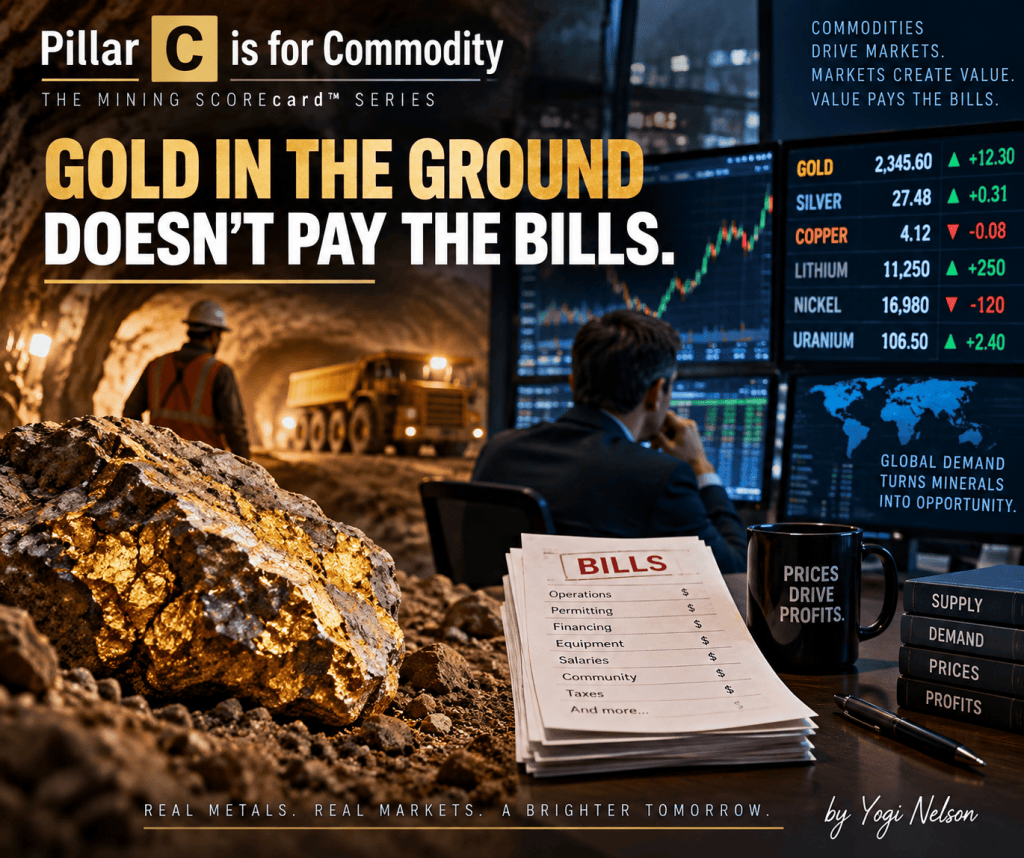
by Yogi Nelson
Previously, I mentioned the Mining SCOREcard™ starting with Pillar 1: Strategy & Stewardship. The basic premise: Rocks don’t make decisions. People do. Now we move onto Pillar 2: “C”, Commodity.
Management may be mining superstars. The geology may be exciting. Drill results may look terrific. All fantastic. Nevertheless, eventually somebody must be willing to part with their legal tender for the gold, silver, copper, etc. Unless companies can earn a profit, it’s all a big waste of time and money. Who needs that? No one reading these articles!
Start With Simple Questions
Start with the fundamentals: What exactly is this company trying to find or produce—and why do I want exposure to it?
Gold, silver and copper all come out of mines. But are they identical commodities? No way! Gold is simultaneously a commodity, monetary asset, investment vehicle and store of value. Yes, all of those. Copper, aka Doctor Copper, is fundamentally an industrial metal whose demand is closely connected to construction, manufacturing, electrical infrastructure and economic activity. What about silver? Silver lives somewhere in between, combining monetary and investment characteristics with substantial industrial demand. Ultimate combo!
That means investing in a junior gold company is not necessarily the same investment thesis as investing in a junior copper company or silver company. Before evaluating the company, understand the commodity.
A Great Deposit at the Wrong Price
Prices matter enormously because mining companies do not control commodities prices. They are subservient to the market–supply and demand.
Consider. Apple can raise iPhone prices (and they always do). A restaurant can increase the price of dinner. Can a gold miner simply announce that it will sell gold at another $500? Nope! Gold prices are set at the world level not at the gold mine. That creates an interesting investment problem.
Suppose a junior mining company publishes an economic study showing an attractive project at $3,000 gold. What happens if gold falls to $2,300? Or suppose a copper project looks marginal at $4.00 copper but extraordinarily profitable at $5.50. What to do?
The answer depends partly on the commodity-price assumptions underlying the analysis. This is why I don’t evaluate a mining project only at today’s spot price. Mines can take years—or decades—to discover, permit, finance, construct and operate. Today’s commodity price is important. Tomorrow’s may matter more.
Supply and Demand Still Matter
Commodity markets are often shrouded by narratives, not necessarily false ones. For instance, Copper is essential for electrification. Silver benefits from solar demand. Gold protects against monetary instability. All narratives may contain considerable truth. But a good story is not enough. I want to understand what could change or reinforce the story.
On the supply side: Where does new production come from? How long does it take to develop new mines? Are ore grades declining? Are major producing jurisdictions becoming politically difficult? Is the industry investing enough capital to replace depleted reserves?
Let’s turn to demand. What industries consume the commodity? How sensitive is that demand to economic growth? Can manufacturers substitute another material? How much demand depends on government policy or subsidies? How important is investment demand?
The purpose isn’t to predict commodity prices perfectly. I can’t. Who can? No one. The objective is to understand the forces that could move the commodity market—and therefore the value of the company I am considering.
Don’t Confuse a Commodity Thesis with a Company Thesis
This distinction is particularly important. I can be extremely bullish on copper and still reject a copper company. Converserly, can I be neutral on gold and find an unusually attractive gold company? You bet!
Why? Simple, a good commodity or strong commodity bull market does not automatically make a good company.
Imagine that I believe copper faces a structural supply deficit over the next decade. Which I do. That’s potentially attractive. But the junior copper company I’m examining has low grades, difficult metallurgy, enormous capital requirements and a project located in a jurisdiction where permitting could take years. My copper thesis may be right while my investment is wrong. The SCOREcard forces me to separate those questions.
Quality Matters Within the Commodity
News flash: two gold deposits containing the same number of ounces can have dramatically different economic value. Grade matters. Metallurgy matters. Recovery matters. Strip ratio matters. Infrastructure matters. Depth matters. Energy costs matter. What’s more, the relevant variables change depending upon the commodity and deposit type.
A copper porphyry containing billions of tones of relatively low-grade material may potentially support an enormous mine. A narrow-vein underground gold deposit presents a completely different engineering and economic problem. This is why commodity analysis cannot simply be:
Gold? Check.
Copper? Check.
Silver? Check.
The commodity must be examined in the context of how that particular deposit can potentially become an economic mine.
Beware of the Commodity Fashion Show
Mining comes into and out of vogue. When commodity prices rise, investor enthusiasm tends to follow. Suddenly everybody has the commodity the market wants. Currently, rare earths are the rage.
A company that was focused on gold yesterday may discover that it has a lithium opportunity today. Tomorrow perhaps uranium becomes fashionable. Next year maybe copper That doesn’t automatically mean something improper is happening. Markets change, and good management should recognize opportunities.
But my antenna goes up. Does management genuinely possess expertise in the commodity? Is the geological opportunity legitimate? Does the company have a coherent strategy? Or has management simply discovered which commodity currently attracts financing? The distinction matters. A commodity bull market can finance a good strategy. It shouldn’t substitute for one.
Price Assumptions Should Survive Bad Weather
If nothing else the Mining SCOREcard™ should encourage skepticism toward economic models that only work when everything goes right. When does everything go right?
If a project requires historically exceptional commodity prices to generate acceptable returns, red alert. I prefer: a project that remains economically interesting under conservative assumptions and becomes spectacular under favorable conditions. Hope is not a strategy. Commodity markets are volatile. Mining investors should expect and be violent market turbulence–category 4 and 5 hurricane storms!
Commodity Is About Context
The Commodity pillar therefore asks something much deeper (pun intended!) than: What metal is in the ground, it asks:
What drives demand for that commodity? Where does supply come from? How cyclical is the market? What could substitute for it? What commodity price does the project require? How sensitive are project economics to changes in that price? Does this particular deposit possess characteristics that could allow it to compete through different commodity cycles? Those questions help me distinguish between owning a good geological story and owning an economically resilient mineral asset.
The Second Letter in SCOREcard–“C”
The Mining SCOREcard™ begins with people because people allocate capital and make decisions. Then comes the commodity because even excellent management operates within markets it cannot control.
S — Strategy & Stewardship asks whether I trust the people.
C — Commodity asks whether I understand the market in which those people must compete.
Neither question guarantees investment success. Nothing does. Asking both may avoid a surprisingly common mistake: falling in love with a mineral deposit without asking whether the world will ultimately pay enough for what comes out of it.
Next, I’ll move to the third pillar of the Mining SCOREcard™: O — Opportunity. Because once I understand the people and the commodity, I want to know something else: How much value could actually be sitting there waiting to be created?
Sincerely,
Yogi Nelson


