
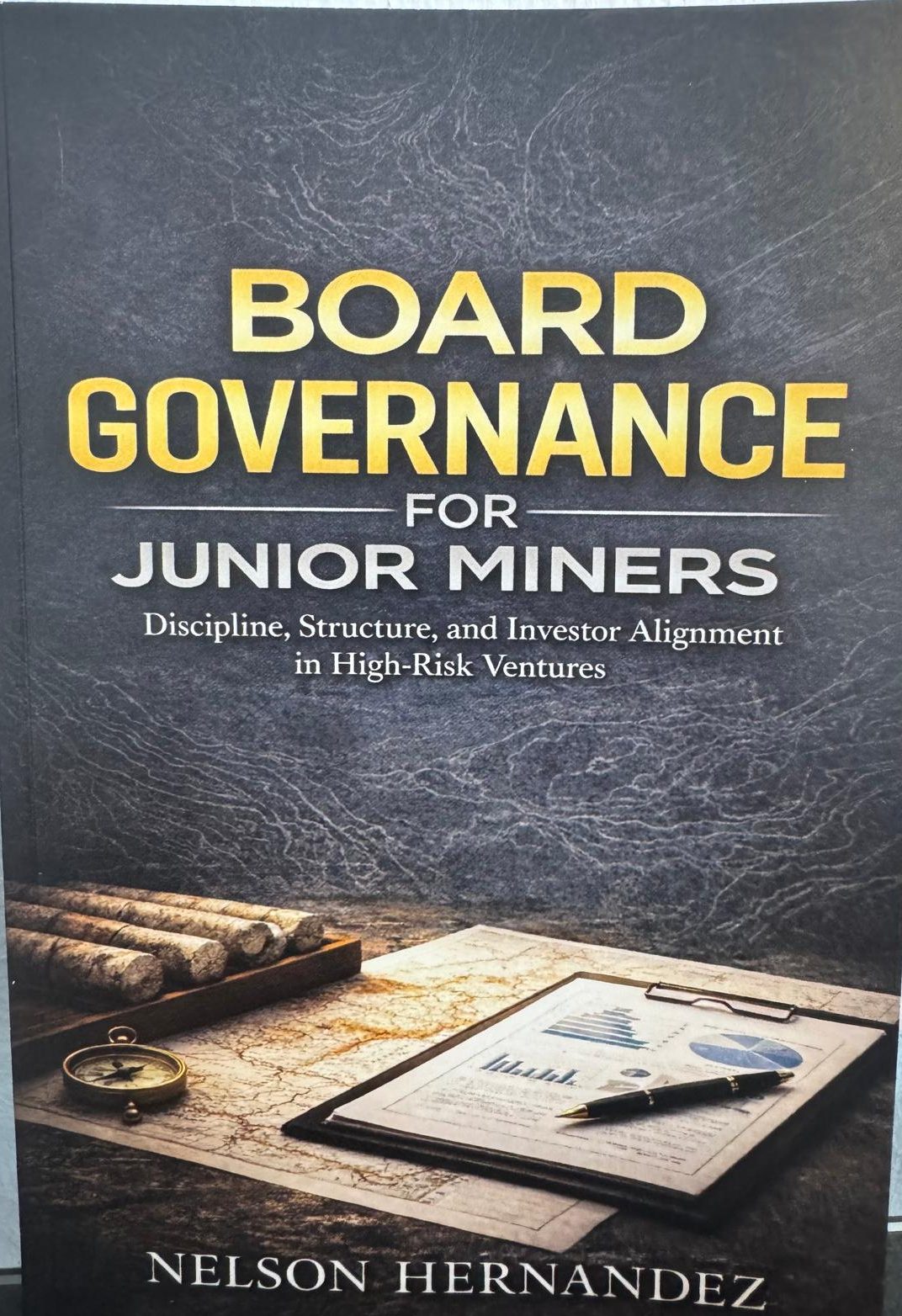
Strategy & Stewardship — The First Pillar of the Mining SCOREcard™
by Yogi Nelson
The question contained in the title of this article is a fundamental question investors must ask themselves when evaluating a junior mining company. Precisely for that reason, in my introductory article to this series, I explained how my interest in gold and junior mining eventually led me to develop the Mining SCOREcard™. The SCOREcard includes a section dedicated exclusively to Strategy and Stewardship. I felt obligated to start with strategy and stewardship because, as I studied the industry, one lesson became increasingly clear: a great mineral deposit does not necessarily make a great investment.
As my son, who was 13 at the time, said to me—obvious! Nevertheless, when we look at junior mining companies, it is remarkably easy to become fascinated by geology. We read about drill intercepts, grades, resource estimates, potential extensions and discoveries that management describes as “world-class” or “transformational.” It’s as if we were hit by falling rocks and we lose perspective!
Having said that, rocks matter. Of course they do—a lot. However, no rock in the history of mining has made a decision. It just sits. In other words, rocks don’t make decisions. People do. Naturally, that is why the first pillar of my Mining SCOREcard™ is S — Strategy & Stewardship.
What Do I Mean by Strategy & Stewardship?
Strategy asks a fairly simple question: Does management have a credible plan for creating shareholder value?
Stewardship asks another: Can I trust these people to manage shareholder capital responsibly while pursuing that plan?
Those questions sound straightforward. Answering them isn’t.
Junior mining companies operate under unusual conditions. Almost none have revenue. Exploration companies may spend millions of dollars without knowing whether they will discover an economically viable deposit. They regularly return to capital markets for additional financing. Consequently, that makes management particularly important.
When I evaluate Strategy & Stewardship, I look at areas including the investment thesis, CEO and executive-team quality, Board composition, management’s discovery or mine-building track record, capital allocation, insider ownership, corporate governance, strategic vision, communication and transparency, and alignment with shareholders.
But the SCOREcard is not intended simply to check boxes. Checking boxes is for junior analysts, but not for senior analysts of junior mining companies. The SCOREcard is about asking questions!
What Exactly Is the Strategy?
Suppose an exploration company tells investors: “We intend to discover a multimillion-ounce gold deposit and sell it to a major mining company.” Is that a strategy? Maybe—maybe not. It all depends. It could be a hope, a dream, or something in between.
A wise investor would ask: How large a deposit? What grade? What metallurgy? In what jurisdiction? At what stage does management intend to sell? What type of company would realistically acquire it? What evidence suggests that management has the experience to get the project to that point?
In other words, “Discover gold and sell the company” may be an aspiration. It isn’t necessarily a strategy.
I want management to explain in plain English the strategy, not just declare it.
Who Is Managing My Money?
I have spent much of my professional career around governance, compliance and public administration. Perhaps because of that background, I tend to look beyond biographies and titles.
A CEO may have 25 years of mining experience. That sounds impressive. But what kind of experience?
Running operations for a major producer is not necessarily the same as managing a cash-constrained junior explorer. Does the CEO know how to allocate scarce exploration capital? Raise money? Manage dilution? Communicate with junior-mining investors? Build and retain a strong geological team?
And where the CEO lacks experience, has management built a team and Board that compensate for those weaknesses?
I don’t expect executives to know everything. In fact, I am impressed by those who are self-aware enough to know what they don’t know.
Capital Allocation May Matter More Than Capital Raising
Junior miners need money. That means dilution is often unavoidable. I therefore don’t automatically consider dilution evidence of poor stewardship. That is not the right question. For my money, I ask: What did management create with the capital it raised?
Imagine a company increases its share count substantially but uses that capital to expand a resource from 500,000 ounces to 3 million ounces and complete a positive economic study.
Was that bad dilution? Not necessarily. The better question is whether management created more value per share than it surrendered through dilution. The distinction is important.
Dilution is not necessarily the enemy. Value-destructive dilution is.
I also want to know who participated in financings and on what terms. A long-term strategic or institutional investor may behave differently from investors chasing short-term momentum. Large investors can also create concentration and influence risks.
Financing changes more than the number of shares outstanding. It can change the character of the shareholder base.
Independence Is More Than a Label
Board independence is essential. A director may officially be described as “independent,” but I want to understand that person’s relationships with management and the company. Don’t fall for the label on the wine; taste the wine to see if it is authentic.
Who nominated the director? Does the director have significant business relationships with the CEO? Does the director receive consulting fees? How are conflicts handled? Are important Board committees genuinely independent? More importantly, is there evidence that directors actually challenge management?
Independence is not merely a director’s label. It is a relationship to management—and ultimately a pattern of behavior.
Promotion Versus Evidence
Junior mining is also a promotional business. Management needs investors. Investors need a reason to provide capital. I therefore expect some salesmanship. Words such as “exceptional,” “transformational” and “world-class” don’t particularly impress me. Instead, I go to the source.
What do the regulatory filings and independent technical reports actually say? Do the grades, widths, continuity, metallurgy and economics support management’s enthusiasm? If management’s presentation is enthusiastic while the technical evidence is strong, I may simply be looking at normal salesmanship. But if management’s language repeatedly outruns the evidence, I have a stewardship problem.
Promotion is not necessarily a governance weakness. Promotion that consistently outruns the evidence is.
Red Flags Are Questions, Not Convictions
Developing the SCOREcard has also reminded me of something about my own analytical approach. I am naturally skeptical, and after 33 years in government and politics, well, what can I say…
When I see excessive compensation, frequent dilution, promotional communications or related-party transactions, my antenna goes up. However, a red flag is not necessarily a verdict. Life has many surprises. Therefore, there may be reasonable explanations. My job as an investor is to identify the concern, develop plausible alternative explanations, examine the evidence and then reach a conclusion.
In other words: Identify the red flag. Develop the innocent explanation. Test both against the evidence. Then score it. That discipline matters because several individually explainable issues can also form a troubling pattern.
High compensation may be explainable. Dilution may be explainable. Promotional communications may be explainable. Related-party transactions may be explainable. But if all four consistently benefit insiders at the expense of shareholders, I may be looking at something very different.
Great Geology Is Not Enough
Let’s return to the reason Strategy & Stewardship is the first pillar of the Mining SCOREcard™. It’s important.
A company can control an extraordinary mineral deposit and still destroy shareholder value through poor financing decisions, excessive dilution, bad acquisitions, weak governance or self-dealing. Conversely, capable and disciplined management can sometimes create substantial shareholder value from an asset that initially appears less spectacular.
The asset and its stewards therefore have to be evaluated separately. For me, the ultimate Strategy & Stewardship question is surprisingly simple: Do I trust these people to allocate my capital intelligently and ethically over the many years it may take to turn geological potential into shareholder value?
If I cannot answer that question satisfactorily, excellent drill results alone may not be enough.
Next week, I will move to the second pillar of the Mining SCOREcard™:
C — Commodity.
Because after deciding whether I trust the people managing my investment, I want to understand exactly what commodity—and what kind of economic opportunity—I am investing in.
Sincerely,
Yogi Nelson

 Governance and Tokenization in the Junior Mining Space