Board of Directors, Mining, Risk Management, Yogi Nelson

Governance as a Force Multiplier: The Discipline That Determines Outcomes

by Yogi Nelson

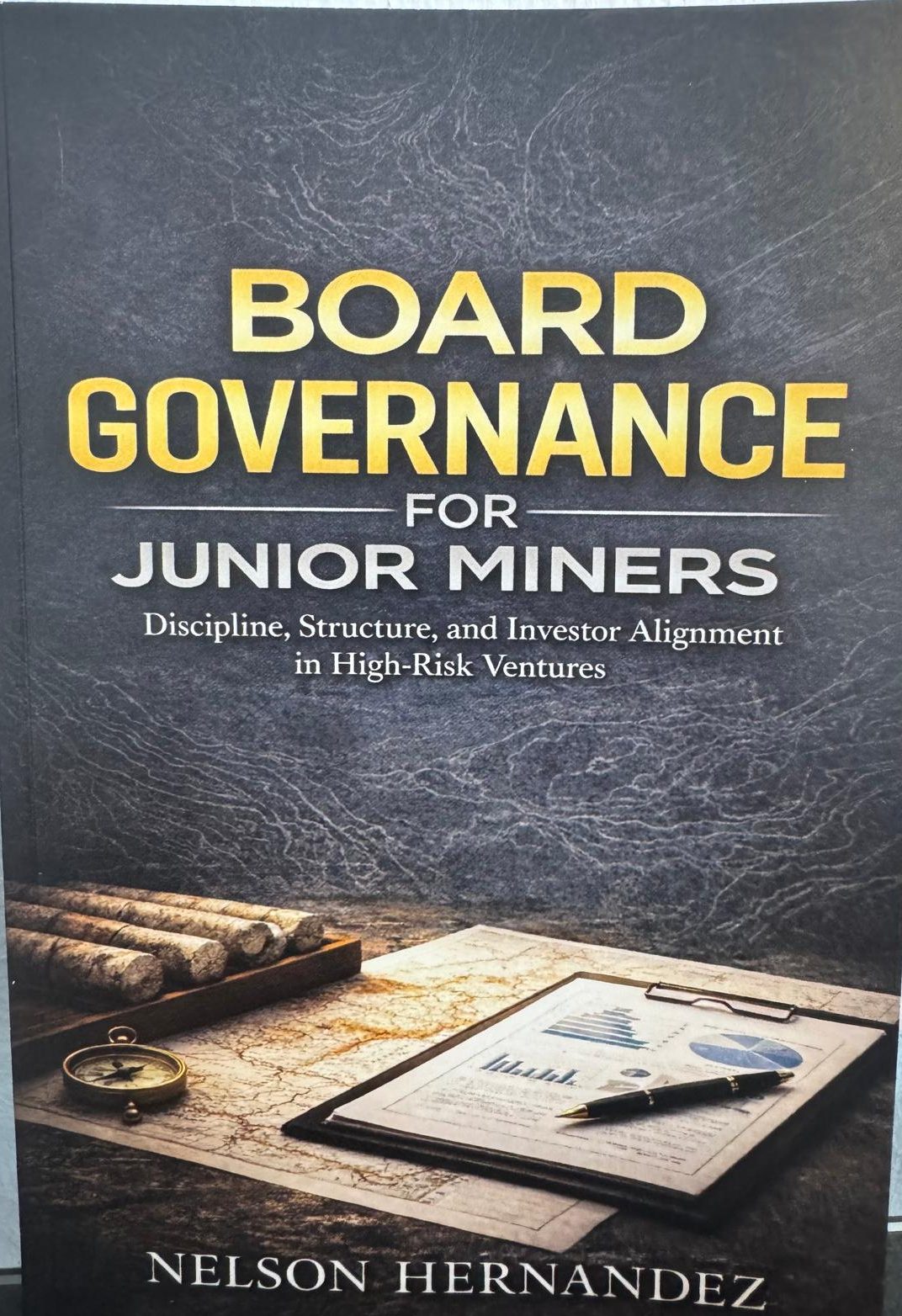
Over the course of these articles (which will soon be published as a book), we have examined governance not as a theoretical construct, but as a practical system of discipline—one that operates quietly in the background, yet determines whether a junior mining company creates value or destroys it. Essentially, a forceful argument in favor of disciplined governance has been presented—an effective one at that.

We began with a simple premise: geology may create opportunity, but governance determines outcomes. That idea has carried through every chapter. But we didn’t leave it at that. Instead, we also explored board composition—not as a checklist of credentials, but as a deliberate assembly of judgment. What else was accomplished?

First, the notion of independence—not as a regulatory requirement, but as a safeguard against groupthink—was highlighted. Second, we discussed capital allocation as a test of discipline, where decisions made under pressure reveal whether fiduciaries are truly acting in the long-term interest of shareholders. Given the comprehensive nature of the book, we didn’t stop there; we continued.

The right people in the room change everything—governance is where discipline begins

For instance, we examined jurisdictional risk and learned that political geography cannot be avoided—it must be governed. Of course, management oversight was emphasized; therefore, we made a point of noting that alignment is not assumed—it must be structured, monitored, and, when necessary, enforced. Was that the end? No, it wasn’t; we carried on and dove into other substantive issues, including technical and engineering considerations.

In the section related to technical complexity and the limits of expertise, we pointed out that board members do not need to be engineers. However, they must know when and how to question engineers. If an engineer cannot explain what he is doing to a board of reasonably intelligent people, the problem is probably with the engineer—not the board. We explored compensation, not as a reward system, but as an instrument that either aligns incentives—or distorts them. In other words, money talks. Last, we discussed transparency and communication, recognizing that trust is not built through promotion, but through consistency and credibility over time.

Regardless of the specific issue, one theme has remained constant: governance is not static. It is not a document, a committee, or a policy manual. It is a behavior.

From Structure to Behavior

Mining is a people business. That may surprise some who think of mining as machines, drills, and equipment. Analysts who fail to consider the people side of the business miss half the story.

A well-structured board does not guarantee good governance. Policies do not enforce themselves. Committees do not think. People do. Governance becomes real only when individuals—directors, executives, and advisors—exercise judgment under conditions of uncertainty. The distinction matters.

A company may have all the formal elements of governance in place—independent directors, audit committees, compensation frameworks—and still fail if those structures are not animated by discipline.

Conversely, a smaller company with fewer formalities but strong, principled leadership can outperform because governance is practiced, not just documented. Governance, therefore, is not defined by what exists on paper, but by what happens in the room.

The Compounding Effect of Discipline

In junior mining, most outcomes are not determined by a single decision. They are the result of a series of decisions made over time—often under pressure and with incomplete information. This is where governance acts as a force multiplier. The direction of that force multiplier depends on discipline.

Good governance does not guarantee success. But it increases the probability of making sound decisions repeatedly. And over time, those probabilities compound. Whether the compounding effect is positive depends on discipline. When it is positive, expect:

  • Capital is allocated more carefully
  • Dilution is managed more thoughtfully
  • Projects are advanced more deliberately
  • Risks are identified earlier
  • Mistakes are corrected faster

The effect is subtle at first. But over multiple cycles—financing, exploration, development—the difference becomes profound. Companies with disciplined governance tend to survive downturns, preserve optionality, and position themselves for opportunity when conditions improve. Those without it often do not.

Governance in Adverse Conditions

It is easy to appear well-governed when markets are strong. (As they say in Puerto Rico, even a pumpkin can roll downhill.) Capital is abundant. Errors are masked. Optimism fills the gaps where discipline should be.

The real test of governance occurs in adverse conditions. When capital is scarce, decisions become harder. Trade-offs become sharper. The consequences of error become more immediate. Staff and board members may turn on each other. Accusations start. Negativity breeds negativity. This is where governance reveals itself.

  • Does the board protect shareholder capital—or rationalize dilution?
  • Does management adjust strategy—or continue pursuing sunk costs?
  • Are risks confronted honestly—or deferred?

In difficult markets, governance is no longer abstract. It becomes visible. And it becomes decisive.

Alignment: The Core of Fiduciary Responsibility

Misalignment is the root cause of most governance failures. Hence, at its core, governance is about alignment.

  • Management and shareholders
  • Short-term decisions and long-term value
  • Incentives and outcomes
  • Risk-taking and accountability

Do not blame intelligence or lack of effort, as those are seldom the fundamental reasons for failure. Misalignment is the culprit.

When incentives reward growth over value, dilution follows. And when oversight is weak, accountability erodes. What happens when boards defer rather than challenge? Small issues become large problems.

Assuming the analysis is correct, it begs the question: what is the solution? The solution is proper alignment—asking uncomfortable questions, resisting easy answers, and staying focused on the prize: long-term value creation.

The Role of Judgment

No framework, no checklist, no policy can substitute for judgment. Governance requires the ability to make decisions when the data is incomplete, the outcomes are uncertain, and the stakes are high. This responsibility cannot be outsourced to a board nor to an AI agent. This is particularly true in junior mining, where technical, financial, and geopolitical variables intersect.

Strong governance recognizes the limits of certainty. Accordingly, it does not seek perfect information, because that rarely exists on a timely basis. Instead, it seeks informed judgment. How does it do so? By creating an environment where that judgment can be exercised independently, rigorously, and without undue influence.

What Endures

The only certainty in life is change. Markets change. Commodity prices rise and fall. Jurisdictions shift. Technologies evolve. While everything changes, the application of certain underlying principles of governance endures. And what are those principles? Discipline, independence, accountability, and alignment.

These are not trends. They are constants. Companies that embed these principles into their decision-making processes are better equipped to navigate uncertainty—not because they can predict outcomes, but because they can respond to them effectively.

A Final Observation

In junior mining, much attention is placed on discovery. That certainly makes sense. After all, discovery creates possibility. Does possibility equal value? No, it does not.

Value is created through a series of disciplined decisions—over time, under uncertainty, and often without recognition. That is the work of governance. It does not generate headlines. It does not appear in drill results—directly. Yet it determines whether opportunity becomes outcome.

Conclusion

Governance is often viewed as a constraint—a set of rules that limits action. In reality, it is the opposite. It is a force multiplier that enhances the quality of decisions, improves the resilience of organizations, and increases the probability of success.

In a sector defined by uncertainty, that is not a small advantage. It is the difference.

Until next time,

Yogi Nelson

Banking, Blockchains, Copper, Digital Currency, finance, Mining, precious-metals, Risk Management, Tether, Yogi Nelson

One Token, Many Metals: The Promise—and Limits—of Digital Metal Baskets

by Yogi Nelson (Nelson Hernandez)

One basket. Multiple metals. A new way to think about exposure.

Multi-metal token baskets could become the digital version of a metals ETF—combining gold, silver, and industrial metals into a single, tokenized instrument.

Simple on the surface. Complex underneath.

They promise:

  • Diversification
  • Transparency
  • Global access

But they also raise important questions:

Who holds the metal?
Where is it stored?
What happens under stress?

Tokenization doesn’t eliminate these issues—it reveals them.

The future of metals may not be just about what you hold…
But how it’s structured.

Until next time,

Yogi Nelson (Nelson Hernandez)

Board of Directors, Environment, Governance, Mining, Risk Management, Yogi Nelson

Governance Before Revenue: Jurisdictional and Cross-Border Risk Oversight

by Yogi Nelson

Why Geography Requires Governance Discipline

Mining spans the globe. Mineral deposits do not appear conveniently inside “stable” jurisdictions with predictable legal systems and transparent regulatory frameworks. Even the so-called “stable” jurisdictions can be unpredictable occasionally. Unfortunately, some of the world’s most promising geological opportunities are located in regions where political systems are evolving, regulatory regimes are complex, and governance expectations vary widely.

Regardless of preference, miners must go where the earth has placed deposits. That is why junior—and major—mining companies must pursue opportunities in emerging markets. Geological potential can be extraordinary. However, the opportunity comes with an additional layer of risk: jurisdictional exposure.

For boards of directors, this reality introduces an important governance responsibility. Geological potential alone cannot guide investment decisions. Boards must ensure that jurisdictional risk receives the same disciplined oversight as exploration strategy, capital allocation, and financial reporting. In other words, geology may attract investors—but governance keeps them invested.

Smart boards evaluate geology and jurisdiction with equal discipline.


The Nature of Jurisdictional Risk

Jurisdictional risk refers to the political, legal, regulatory, and social uncertainties associated with operating in a particular country or region. These risks include, but are not limited to, the following:

  • Political instability
  • Regulatory unpredictability
  • Corruption
  • Weak rule of law
  • Changing tax or royalty regimes
  • Community conflict
  • Criminal gangs
  • Wars

Large multinational mining companies have the resources to support dedicated risk teams—either internally or via outside consultancy—to monitor these factors. Junior mining companies rarely have that luxury. Why? Management teams are smaller and their administrative infrastructure leaner.

That reality places a greater responsibility on the board of directors to ensure that jurisdictional exposure is carefully evaluated and monitored. After all, the greatest geological discovery in the world cannot create shareholder value if the operating environment becomes unstable or hostile.


Anti-Corruption Frameworks

One of the most important governance considerations when operating across borders is corruption risk. Actually, based on my 30+ years working in government in the USA, corruption considerations apply to the USA as well. In this article, however, the focus will be outside the United States. Many jurisdictions where mining occurs have different norms regarding government interaction, permitting processes, and local business practices.

Public companies listed in North America or Europe, however, remain subject to strict anti-corruption laws such as the Foreign Corrupt Practices Act (FCPA) in the United States and the UK Bribery Act. These regulations apply regardless of where the mining activity occurs. Boards must therefore ensure that management implements appropriate compliance structures, including:

Clear anti-corruption policies

Employee training regarding prohibited practices

Documentation of interactions with government officials

Internal reporting procedures for potential violations

These safeguards are not bureaucratic formalities. Violations of anti-corruption laws can result in severe financial penalties, reputational damage, and loss of investor confidence. Governance discipline begins with prevention, not remedy.


Local Partner Due Diligence

Out of necessity and common sense, junior mining companies often work with local partners when entering new jurisdictions. Quality local partners have the expertise to effectively manage permitting processes, land access, community relations, or logistical support that are specific to the task at hand. Such partnerships can be valuable—sometimes essential. Do they come with risk? Yes.

Boards must ensure that management conducts thorough due diligence before entering into agreements with local partners—actually with all partners regardless of jurisdiction. This process typically includes, at a minimum, reviewing:

  • Ownership structures
  • Political connections
  • Business reputation
  • Financial stability
  • Past legal and regulatory issues

Failure to perform adequate due diligence can expose the company to significant legal and reputational risk. In many cases, governance failures in emerging markets do not originate from the mining company itself. But that does not make any material difference. The problem exists. The issue may originate from poorly vetted local intermediaries. Right or wrong, these local intermediaries reflect on the mining company.

In other words, you pick them, you are stuck with them.

A disciplined board ensures that partnerships strengthen operations rather than create vulnerabilities.


Monitoring Geopolitical Exposure

Political environments can change quickly. Elections shift policy priorities. Governments revise mining codes based on election results—or the threat of an election result. National resource strategies evolve. Boards must therefore monitor geopolitical developments continuously rather than assuming that current conditions will remain stable.

Is it wise to contract with politically connected persons? Some might say yes. Prudence says beware. Those on the inside today might be on the outside tomorrow. With that as a note of caution, best practices in oversight often include reviewing:

  • Changes in mining legislation
  • Tax and royalty adjustments
  • Resource nationalism trends
  • Local election outcomes
  • Regional security conditions

While none of these developments are within the control of a mining company, that does not mean they can be ignored. To the contrary, they must be understood. Boards that monitor geopolitical developments proactively are better prepared to adapt when conditions change. Those that ignore these signals often discover the risks only after they materialize.


Community and Social License Considerations

Jurisdictional risk is not limited to government policy. Community relationships play an equally important role in determining whether a mining project can advance successfully. A strong argument can be made that government policy is often the sum of community relations. Establish and maintain healthy community relations and government policy will likely break in favor of the mining company.

Exploration and development activities often occur near local communities that rely on land, water, and environmental stability for their livelihoods. If community concerns are not addressed early, projects can encounter delays, protests, or legal challenges. Once an opposition narrative takes root, weeding it out may be impossible.

Therefore boards should encourage management to maintain transparent and respectful engagement with local communities. Below are a few best practices:

  • Community consultation practices
  • Environmental impact mitigation strategies
  • Local employment and training commitments
  • Community investment initiatives

Responsible engagement strengthens a company’s social license to operate. And social license, while difficult to measure on a balance sheet, can determine whether a project ultimately moves forward. The bottom line is this: establish and maintain healthy community relations and government policy will likely break in favor of the mining company.


Board-Level Oversight of Jurisdictional Exposure

Jurisdictional risk oversight should not be treated as an occasional discussion item. It should be integrated into regular board deliberations. A standing agenda item. The agenda item should consider:

  • Updated country risk assessments
  • Political developments affecting operations
  • Regulatory changes
  • Compliance and anti-corruption reports
  • Community relations updates

These discussions allow the board to understand how external factors may influence the company’s strategic decisions. Importantly, oversight does not mean avoiding emerging markets entirely.

In some cases, for example silver mining, Mexico and Peru cannot be avoided. Many successful mining companies operate in Mexico and Peru. Yes, those jurisdictions may appear complex or uncertain, but with proper board governance smart decisions are possible.

In other words, the objective is not avoidance—it is preparedness.


Governance as Risk Discipline

Mining companies cannot control where mineral deposits occur. What can they control? How responsibly they operate after deciding to enter a jurisdiction.

Strong governance structures provide the discipline necessary to manage complex environments. Boards that take jurisdictional risk seriously encourage management to adopt professional compliance practices, maintain transparent relationships with regulators and communities, and anticipate geopolitical developments.

Companies that ignore these governance responsibilities often encounter difficulties later.

Remember this—markets have long memories when governance failures occur.


Final Thoughts

Many of the world’s most attractive mineral opportunities exist in jurisdictions where political, regulatory, and social dynamics require careful navigation. This may be a considerable understatement. Junior mining companies pursuing these opportunities must therefore match geological ambition with governance discipline. Boards that oversee jurisdictional exposure thoughtfully protect not only the company’s operations but also its credibility in capital markets.

Get the geology right and the project may succeed. Get the governance right and investors stay with you long enough to see it through. In the global mining industry, both are essential.


Until next time,


Yogi Nelson

Blockchains, Copper, Mining, Risk Management, Uncategorized, Yogi Nelson

Governance Before Revenue: Related-Party Transactions and Conflict Discipline

by Yogi Nelson

Why Junior Mining Companies Must Manage Conflicts of Interest with Transparency and Structure

The junior mining industry is built on relationships; is that a blessing or a curse? It all depends. Geologists, financiers, promoters, engineers, and investors often work together across multiple ventures over the course of their careers. It’s not unusual for yesterday’s successful exploration team to reunite to create tomorrow’s even bigger hit! Therefore, the challenge is not the existence of these relationships. The challenge is managing them with discipline.

In the mining sector, an interconnected ecosystem is generally a strength. Experience travels with people, and seasoned professionals often bring trusted partners with them when launching new ventures. For early-stage mining companies, those relationships can accelerate exploration programs, attract capital, and help advance projects efficiently. Unfortunately, the same relationships that make the industry effective can also introduce governance risks today and beyond.

For junior mining companies seeking credibility in capital markets, the careful oversight of related-party transactions is essential. Investors must be confident that decisions involving insiders are evaluated objectively and that the interests of the company—and its shareholders—come first. When directors, officers, or major shareholders conduct business with the company itself, the transaction becomes what regulators and investors refer to as a related-party transaction. These arrangements are common in junior mining companies and are not inherently improper. When managed properly, such arrangements may be legitimate and even beneficial to the company. When poorly governed, they undermine investor trust, damage corporate credibility, and create regulatory scrutiny. For junior mining companies operating in the exploration and development stages, disciplined oversight of related-party transactions is not optional. It is an essential element of responsible governance.

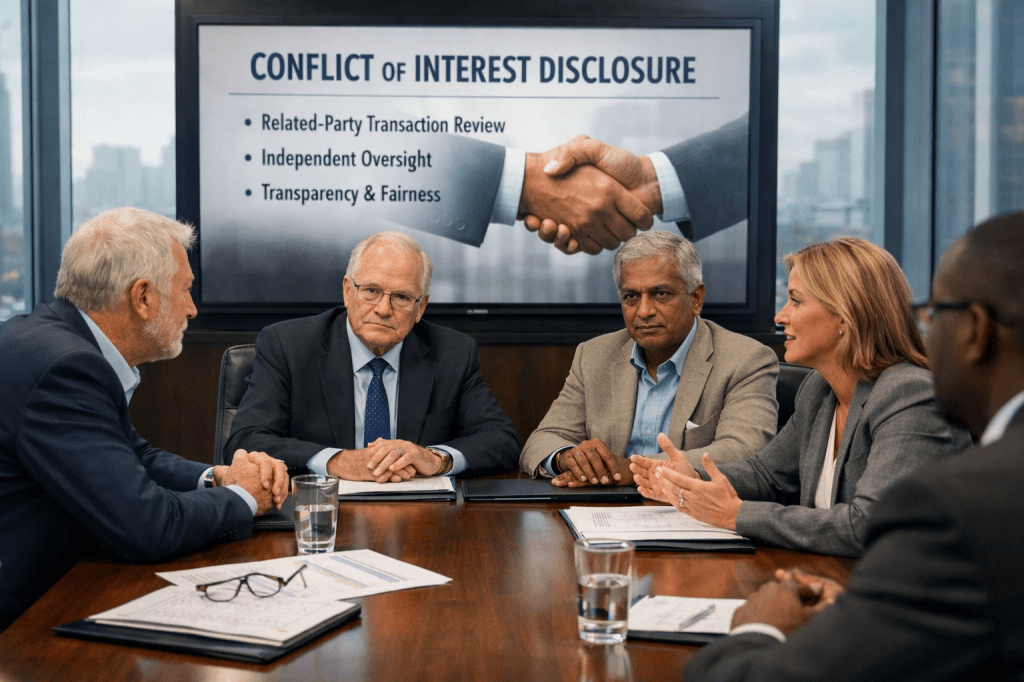
Independent board oversight ensures related-party transactions are evaluated objectively for shareholders' best interests.

Understanding Related-Party Transactions

A related-party transaction occurs when a company conducts business with individuals or entities that have a close relationship with the organization. These relationships can include directors, officers, major shareholders, or businesses controlled by them.

Examples commonly seen in junior mining companies include:

  • Consulting agreements with directors or executives
  • Technical services provided by companies owned by insiders
  • Office leases involving board members or founders
  • Financing arrangements with major shareholders
  • Equipment or service contracts with affiliated firms

These transactions are not inherently improper. For some investors, these transactions could signal a positive indicator because it may mean insiders believe in the company. But as noted twice, it all depends. The governance challenge lies not in avoiding these transactions entirely, but in ensuring that they are conducted transparently, fairly, and in the best interests of the company.

The Importance of Conflict Discipline

Effective governance requires conflict-of-interest discipline. This means recognizing when personal interests intersect with corporate decision-making and establishing procedures that prioritize the company’s integrity rather than personal interests. Conflict discipline is focused on four considerations:

  • Decisions are made in the best interests of the company
  • Financial terms are fair and reasonable
  • Independent oversight is applied where appropriate
  • Investors receive transparent disclosure

Without these safeguards, related-party transactions can create the perception—whether accurate or not—that insiders are benefiting at the expense of shareholders. In capital markets, perception matters—a lot. Investors evaluating junior mining companies are not only assessing geology and project potential. They are also evaluating governance quality. Weak conflict management can raise concerns about transparency and accountability, ultimately affecting investor confidence.

The Role of Independent Directors

Why and how do independent directors play a critical role in reviewing and approving related-party transactions? First, they are not directly involved in management or financially tied to the proposed transaction. Their independence translates into being better positioned to evaluate whether a particular arrangement is fair to the company. Emphasis added—the company.

Typical governance practices include:

  • Requiring full disclosure of potential conflicts
  • Recusal of interested directors from decision-making
  • Independent review by the board or a committee
  • Documentation of the evaluation process

Companies that adopt best practices often empower the audit committee or a special committee of independent directors to review and approve related-party transactions before full board action. This process protects both the company and the individuals involved. It ensures that decisions are evaluated objectively and that governance standards remain intact.

Transparency and Disclosure

As sunshine is a great disinfectant, transparency is one of the most effective safeguards in managing conflicts of interest. Public mining companies are typically required to disclose related-party transactions in their financial statements and regulatory filings. Private companies should do so as well. These disclosures allow investors to understand the nature of the transaction and evaluate whether appropriate governance procedures were followed.

Clear disclosure generally includes:

  • The parties involved in the transaction
  • The financial terms of the arrangement
  • The nature of the relationship
  • The governance process used to approve the transaction

When companies provide clear and transparent disclosure, investors are better able to evaluate the transaction on its merits. Opacity, on the other hand, often raises more concerns than the transaction itself.

Protecting Investor Confidence

Junior mining companies, by definition, depend heavily on investor capital to finance exploration programs and project development. As a rule, exploration companies operate without revenue for extended periods; thus investor trust becomes one of the company’s most valuable assets. Lose it; lose investors.

Strong governance practices—including disciplined oversight of related-party transactions—help protect that trust. Investors are far more comfortable supporting companies that demonstrate:

  • Clear governance policies
  • Independent board oversight
  • Transparent disclosure practices
  • Documented decision-making processes

These practices signal that the company is committed to protecting shareholder interests.

Establishing Clear Policies Early

Many governance challenges in junior mining companies arise not from bad intentions but from the absence of clear procedures. However, good intentions are not sufficient when it comes to capital. Establishing formal policies early in the life of the company is what counts and can prevent confusion and reduce governance risks.

Effective related-party transaction policies typically include:

  • Formal disclosure requirements for directors and officers
  • Independent review of potential conflicts
  • Recusal procedures for interested parties
  • Board documentation of transaction approvals

These policies do not prevent companies from working with experienced insiders or affiliated firms. Instead, they provide a structured framework for evaluating such relationships responsibly. In other words, the objective is not to eliminate relationships—it is to govern them properly.

Governance as a Signal to the Market

In the competitive world of junior mining, governance quality increasingly influences how investors, partners, and strategic acquirers evaluate companies. Moreover, initial quality capital often attracts even stronger investors. Strong conflict management practices send a clear signal to the market: the company understands the importance of transparency, fairness, and disciplined decision-making.

That signal can strengthen investor confidence, reduce perceived governance risk, and ultimately support capital formation. Conversely, poorly managed related-party transactions can create lasting reputational damage that is difficult to repair.

Final Thoughts

Relationships are common in the junior mining sector. Industry participants often collaborate across multiple projects and companies over many years. These relationships can bring valuable expertise and capital to early-stage mining ventures. However, these relationships must be managed with care lest they become a hindrance.

Related-party transactions require clear disclosure, independent oversight, and disciplined governance processes. When handled properly, they can support the growth of a company while maintaining investor trust. When handled poorly, they can erode the very confidence that junior mining companies depend upon.

Governance before revenue is ultimately about stewardship. Stewardship begins with the discipline to manage conflicts of interest with transparency and integrity.

Until next time,


Yogi Nelson

Governance, Mining, Risk Management

Governance as Strategy: A 10-Part Series for Junior Mining Leaders

by Yogi Nelson

Junior mining companies operate in one of the most, perhaps these most, capital-intensive, risk-exposed, and credibility-sensitive sectors in the global economy. They raise money before revenue. Moreover, they make technical promises before production. If that were enough, miners operate in jurisdictions where regulatory, environmental, and political variables can change quickly. And they do all of this, out of necessity, with lean teams and limited administrative and management infrastructure.

In that environment, governance is often viewed as an obligation — a regulatory requirement to satisfy exchanges, securities commissions, or auditors. Too frequently it becomes a checklist exercise. That perspective is shortsighted. In mining governance is not overhead. It is a strategic asset.

Strong governance frameworks help junior mining companies navigate risk, attract investment, and build enduring companies.

Over the next ten weeks, this series will explore how thoughtful governance and disciplined compliance frameworks can materially improve resilience, investor confidence, and long-term value creation in junior mining companies. The objective is not to advocate bureaucracy. To the contrary. It’s to demonstrate how structured oversight strengthens execution, reduces preventable risk, and positions companies for institutional capital.

This series is designed for directors, CEOs, CFOs, compliance officers, and serious investors who understand that governance is inseparable from capital formation. Below is an overview of what readers can expect.


1. Governance as a Value Multiplier in Junior Mining

We begin by reframing governance from a cost center to a value multiplier. Markets reward credibility. Institutions allocate capital where risk is understood and managed. Junior mining companies that articulate clear oversight structures, internal controls, and transparent reporting reduce perceived risk — and perceived risk directly affects valuation. In a business where risks are ubiquitous, strong governance enhances shareholder value.

This article will examine how governance maturity influences financing terms, investor retention, and strategic optionality.

2. Board Composition: Independence Versus Operational Expertise

Junior mining boards are often composed of geologists, founders, or major shareholders. Technical depth is essential — but independence and financial oversight are equally critical.

  • What true board independence means in a small company
  • How to balance technical knowledge with governance competence
  • When adding an independent director materially changes investor perception

The goal is not to replace industry expertise, but to complement it with structured oversight.

3. Audit Committees in Pre-Production Companies

Many early-stage companies view audit committees as formalities. Yet the absence of revenue does not eliminate financial risk–it often increases it!

  • The minimum functional standards for an effective audit committee
  • Oversight of cash management and exploration expenditures
  • Financial disclosure discipline in volatile commodity environments

A disciplined audit function signals seriousness to markets.

4. Internal Controls in Lean Organizations

Junior mining companies may operate with fewer than 25 employees. Segregation of duties can be challenging. Informal processes can emerge. We will explore how to implement practical internal controls without creating administrative burden, including:

  • Cash disbursement controls
  • Contract approval frameworks
  • Documentation protocols
  • Basic fraud prevention mechanisms

Strong controls do not require large teams. They require clarity.

5. Managing Related-Party Transactions in Small Teams

In closely held companies, related-party transactions are common. They are not inherently problematic — but they require transparency and structured oversight.

  • Disclosure best practices
  • Conflict-of-interest policies
  • Board review procedures
  • Protecting both insiders and minority shareholders

Proper handling of related-party matters strengthens trust.

6. CEO Oversight Without Micromanagement

Junior mining CEOs are often founders or highly technical leaders. Boards must support management while maintaining independent oversight.

  • Performance evaluation frameworks
  • Information rights and reporting cadence
  • Constructive challenge versus operational interference
  • Succession planning in early-stage companies

Healthy governance enhances leadership rather than constraining it.

7. ESG Reporting: Substance Versus Marketing

Environmental, social, and governance reporting has become unavoidable. Yet in junior mining, ESG narratives can outpace operational capacity.

  • Aligning ESG disclosures with actual practices
  • Avoiding reputational risk from overstated claims
  • Community engagement documentation
  • Governance oversight of sustainability reporting

Authenticity matters. Markets increasingly detect exaggeration.

8. Crisis Governance: When Exploration Results Disappoint

Commodity cycles fluctuate. Drill programs sometimes fail. Financing windows close unexpectedly.

  • Board protocols during operational setbacks
  • Disclosure discipline in adverse conditions
  • Liquidity oversight during market stress
  • Maintaining investor credibility during downturns

Crisis does not create governance weakness — it reveals it.

9. Jurisdictional Risk and Cross-Border Oversight

Many junior mining companies operate in Latin America, Africa, or other emerging markets. Cross-border operations introduce legal, political, and compliance complexity.

  • Anti-corruption controls
  • Local partner due diligence
  • Regulatory monitoring frameworks
  • Board-level oversight of geopolitical exposure

Risk awareness must extend beyond geology.

10. Governance Readiness for Institutional Capital

The final article in this series will synthesize the prior themes into a practical readiness framework.

Institutional investors assess:

  • Board independence
  • Financial reporting discipline
  • Risk management structures
  • ESG credibility
  • Executive compensation alignment

We will provide a structured checklist that junior mining boards can use to evaluate their governance posture before pursuing larger capital raises.


Why This Series Matters Now

Commodities are in a long-tend bull market. Miners that demonstrate strong governance attract higher quality investors. Investors increasingly differentiate between companies that treat governance as a formality and those that treat it as infrastructure. Junior mining companies do not need bureaucratic systems designed for multinational producers. They do need disciplined oversight tailored to their scale and stage of development.

The purpose of this series is practical: to offer clear frameworks, actionable insights, and governance standards that are achievable — even in lean organizations. Governance does not eliminate geological risk. It does not control commodity prices. But it reduces preventable errors, clarifies accountability, and strengthens credibility. And in capital markets, credibility compounds.

Over the next ten weeks, we will examine how junior mining companies can build governance systems that are proportionate, strategic, and aligned with long-term shareholder value.

The objective is not perfection. It is preparedness.

And in junior mining, preparedness often makes the difference between survival and sustainable growth.

Until next time,

Yogi Nelson