Banking, Blockchains, Copper, Digital Currency, finance, Mining, precious-metals, Risk Management, Tether, Yogi Nelson

One Token, Many Metals: The Promise—and Limits—of Digital Metal Baskets

by Yogi Nelson (Nelson Hernandez)

One basket. Multiple metals. A new way to think about exposure.

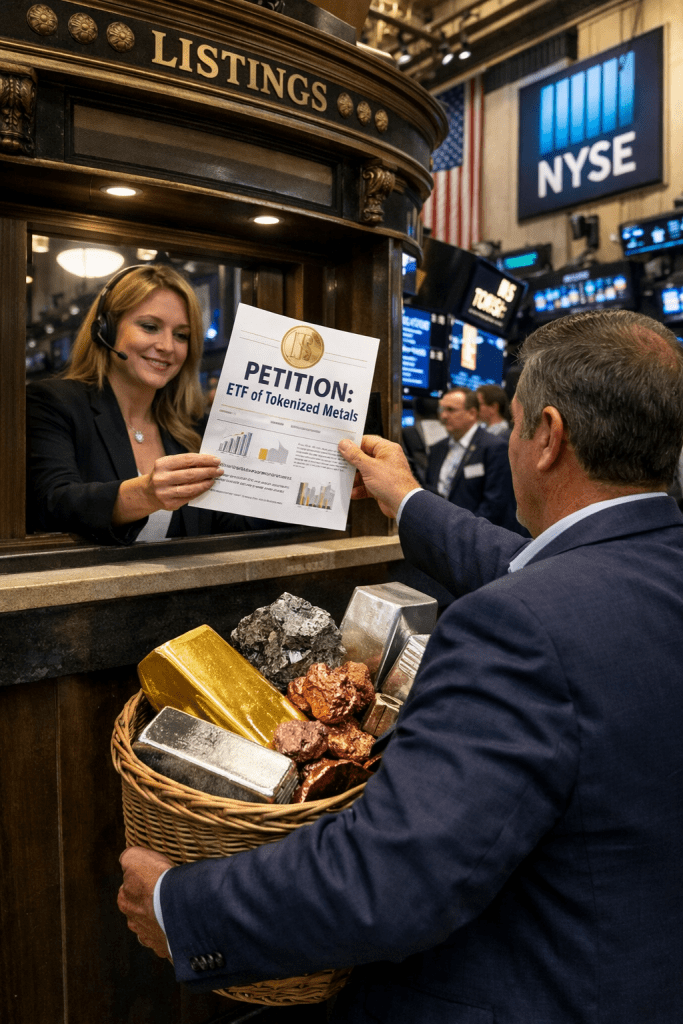
Multi-metal token baskets could become the digital version of a metals ETF—combining gold, silver, and industrial metals into a single, tokenized instrument.

Simple on the surface. Complex underneath.

They promise:

  • Diversification
  • Transparency
  • Global access

But they also raise important questions:

Who holds the metal?
Where is it stored?
What happens under stress?

Tokenization doesn’t eliminate these issues—it reveals them.

The future of metals may not be just about what you hold…
But how it’s structured.

Until next time,

Yogi Nelson (Nelson Hernandez)

Austrian economics, Banking, Blockchains, finance, Governance, International Finance, Mining, tokenization, Yogi Nelson

Industrial Metals Begin Their Blockchain Moment

by Yogi Nelson (Nelson Hernandez)

Much of the conversation around tokenization has focused on gold and, to a lesser extent, silver. That makes sense—both are stores of value, widely recognized, and relatively standardized.

But a quieter shift is now underway.

Industrial metals are beginning to enter the blockchain conversation.

Unlike precious metals, industrial metals—such as copper, aluminum, and nickel—are not stores of value. They are inputs to the real economy, essential to infrastructure, energy systems, and manufacturing.

So why tokenization?

The answer lies in three areas:

  • Supply chain complexity
  • Demand for transparency and provenance
  • The ongoing financialization of commodities

Tokenization offers the potential to improve tracking, reduce settlement friction, and enhance visibility across fragmented global supply chains.

But challenges remain.

Industrial metals lack the standardization of gold. They vary by grade, form, and end use. That makes token design—and trust—more difficult.

Not all metals are equally viable.
Copper and aluminum may be strong candidates. Raw ore and specialized alloys, far less so.

So is this the next frontier—or premature?

Likely both.

Tokenization of industrial metals is not about creating digital money—it is about modernizing the infrastructure of the real economy.

And as always:

Structure—not story—will determine what succeeds.

Artificial Intelligence, Austrian economics, Banking, Blockchains, Decentralized, Digital Currency, finance, International Finance, Mining, precious-metals, Silver, Tether, tokenization, Yogi Nelson

Tokenized Metals vs Reality: Why Liquidity Matters More Than Hype

by Yogi Nelson

Tokenization promises a lot—speed, transparency, global access, and the ability to move physical assets at digital speed. But there’s one uncomfortable question the space doesn’t like to linger on:

Who’s on the other side of the trade?

Liquidity is not about technology. It’s about participation.

An asset can be perfectly tokenized and still be difficult to buy or sell in meaningful size without moving the price. When that happens, confidence erodes quickly—no matter how elegant the blockchain design may be.

This is especially true in tokenized metals.

Gold begins with a structural advantage: deep global markets, standardized bars, central bank participation, and centuries of trust. Silver follows, but with more volatility. Other metals—platinum, palladium, and especially rhodium—face much steeper liquidity challenges that tokenization alone cannot solve.

The hard truth is this: Tokenization digitizes access. Liquidity determines usability.

That’s where market makers, institutional participation, predictable redemption, and market structure come into play. Liquidity isn’t created by opening the doors—it’s earned through trust, depth, and consistent participation.

Technology helps. But economics still has the final say.

If you’re interested in where tokenized metals realistically stand today—and what would need to change for them to reach global volume—I explore the liquidity question in depth in my latest long-form piece.
Yogi Nelson

Part of an ongoing, long-form series examining the tokenization of precious metals—one of the few sustained efforts to explore custody, liquidity, redemption, and market structure throughout 2026.

Artificial Intelligence, Banking, Blockchains, cryptography, Decentralized, Digital Currency, finance, International Finance, Japan, Mining, palladium, Silver, tokenization, Yogi Nelson

Tokenized Metals vs Reality: Why Liquidity Matters More Than Hype

by Yogi Nelson

Champions of tokenization promise many things: transparency, portability, programmability, and global access to assets that once sat quietly in vaults. In the case of precious metals, tokenization holds out an especially attractive vision—gold, silver, and even more exotic metals moving at internet speed rather than banker speed.  But there’s a stubborn, unglamorous problem standing in the way of those champions–liquidity.

It’s true—tokenization can digitize metal. However, it cannot, by itself, guarantee that someone is always there to buy or sell the asset.

This article explores what the liquidity problem actually is, why it matters, why some metals are more liquid than others, and therefore better candidates for tokenization, and what would need to happen for tokenized metals to approach true global volume.  First, we start with the basic question, what is liquidity?

LIQUIDITY IS THE KEY!


What Do We Mean by “Liquidity,” Really?

Liquidity is one of those financial terms that everyone uses and almost no one pauses to define; let’s not be another one of those people.  According to Investopedia, liquidity refers to:

“The degree to which an asset can be quickly bought or sold in the market at a price reflecting its intrinsic value.”

In plain English, liquidity answers three practical questions:

  1. Can I sell this when I want?
  2. Can I sell it in meaningful size?
  3. Can I do so without materially moving the price?

Liquidity is not about whether an asset is valuable. It is about whether that value can be realized efficiently.  As smart investors, we know:  there is no profit until and unless the profit is realized!

Examples of highly liquid assets

  • Cash
  • U.S. Treasury bills
  • Major currencies (USD, EURO, JPY)
  • Large-cap public equities
  • Spot gold in standard bar form

These assets trade constantly, have many buyers and sellers, and allow large transactions with minimal price impact.

Examples of illiquid assets

  • Private equity stakes
  • Fine art
  • Rare collectibles
  • Thinly traded commodities
  • Certain real estate markets
  • Exotic metals like rhodium

These assets may be valuable, even extremely valuable—but converting them into cash can take time, negotiation, and often a price concession.

Liquidity, in short, is not a judgment about worth. It is a measure of market readiness. Period.


Why Liquidity Matters More Than Tokenization

Tokenization solves representation. Liquidity solves usability. This distinction matters more than most marketing materials admit, and for clear conflict of interest reasons!

History is full of assets that were perfectly “ownable” but practically unusable due to liquidity constraints.  Below are just three examples:

  • privately held companies with no secondary market,
  • thinly traded bonds,
  • structured products that looked attractive on paper but could not be exited without loss.

In each case, the problem was not ownership—it was exit. Without sufficient liquidity:

  • prices become unreliable,
  • bid–ask spreads widen,
  • volatility increases,
  • and confidence erodes.

An asset that cannot be exited predictably becomes a theoretical investment, not a functional one. Tokenization does not automatically fix this. A token can make ownership easier to track, transfer, and audit—but if no one is consistently willing to trade, liquidity remains scarce.

This is why liquidity is not a secondary issue. It is the gatekeeper between innovation and adoption. 


The Liquidity Problem in Tokenized Metals

As if one challenge isn’t enough, tokenized metals face a double liquidity challenge.  Let’s go through those two now.

First: the underlying metal.  Not all metals trade the same way.  While I love them all, some are more “equal” than others.  Take for example gold.

Gold enjoys:

  • global spot markets,
  • deep futures markets,
  • central bank participation,
  • standardized bars and settlement norms.

Liquidity already exists. Tokenization plugs into it.  A perfect fit.  What about silver?

Silver is liquid, but thinner:

  • more industrial demand,
  • more volatility,
  • fewer institutional holders.

Tokenization can help—but it cannot smooth silver’s inherent swings.  Silver, being a dual metal, monetary and industrial, is much more volatile.   

Platinum and palladium are:

  • industrially driven,
  • dependent on specific sectors,
  • subject to sudden demand shifts.

Liquidity exists, but it is episodic. 

Rhodium is the extreme case and completely likely unsuitable for tokenization:

  • no meaningful futures market,
  • very thin spot trading,
  • prices that can move violently.

Tokenizing rhodium does not create liquidity. It simply makes scarcity visible in real time.


Problems Caused by Poor Liquidity

Low liquidity is not an abstract inconvenience. It creates concrete problems.  Below are four problems, listed in no particular order of importance, because they are all equally critical.

1. Wide bid–ask spreads

Thin markets punish participation. Buyers pay up; sellers accept discounts.  The worse of both worlds. 

2. Price distortion

In illiquid markets, small trades can create misleading price signals, undermining trust.  Once trust is gone, bringing it back is an uphill climb.

3. Redemption pressure

If token holders cannot sell easily, they may redeem for physical metal instead—stressing vaulting and logistics systems.

4. Institutional hesitation

Institutions care deeply about exit risk. If they cannot move size without disruption, they simply stay away.

Liquidity attracts participants. Participants create liquidity. Without the first step, the cycle never starts.


Why Gold Has a Structural Advantage

Gold begins the liquidity race several laps ahead. Its advantages are not technological; they are historical and institutional and those maybe more important at this stage:

  • centuries of trust,
  • standardized market conventions,
  • global clearing mechanisms,
  • and deep participation.

This is why tokenized gold products have a realistic path to scale. They are not inventing liquidity—they are digitizing access to existing liquidity.  Silver may follow. Other metals face steeper climbs.


Can Tokenized Metals Create New Liquidity?

Sometimes—but not by access alone.  Liquidity is not created by opening the doors. It is created when:

  • pricing is reliable,
  • settlement is predictable,
  • custody is trusted,
  • and exit is assured.

Liquidity is a social and institutional phenomenon, not a purely technical one.


The Role of Market Makers

What the heck is a market maker?  The answer according to Investopedia is: a firm or individual that provides liquidity to a market by continuously offering to buy and sell a particular asset at publicly quoted prices, profiting from the bid–ask spread while helping ensure orderly trading.  If that sounds complicated, try this definition in plain English: a market maker is the party that stands ready to buy when others want to sell—and sell when others want to buy—so markets don’t freeze up.  In essence liquidity is “engineered” by professionals.

Market makers:

  • quote continuous buy and sell prices,
  • absorb short-term imbalances,
  • and take risk so others don’t have to.

In tokenized metals, market makers face unique challenges:

  • fragmented venues,
  • regulatory uncertainty,
  • redemption complexity,
  • and thin underlying markets for non-gold metals.

Without professional market makers, global volume remains aspirational.


Other Essential Players

No man is an island and in tokenized metals liquidity requires an entire ecosystem.  The ecosystem consists of but is not limited to:

  • trusted custodians,
  • independent auditors,
  • compliant exchanges,
  • predictable settlement systems,
  • and regulatory clarity.

Tokenization reduces friction—but it does not replace these foundations.


How Liquidity Could Improve Over Time

A realistic path forward exists:

  1. Focus on metals that already trade.
  2. Encourage institutional participation.
  3. Build predictable redemption systems.
  4. Allow consolidation rather than fragmentation.

Liquidity grows slowly. Then suddenly.  Let’s hope so. 


Final Answer: Can Tokenized Metals Reach Global Volume?

  • Gold: yes, over time
  • Silver: possibly, with patience
  • Other metals: niche, specialized use cases only

Tokenization is not a volume generator. It is a volume amplifier—but only where volume already exists. Liquidity is earned, not engineered.


Closing Thought

Tokenized metals are still early. Tokenization technology is ahead of the market structure and vision is ahead of the plumbing. Enthusiasm is always present where success is found.  But as Larry David, the comedian said–Curb Your Enthusiasm! But that’s not failure. It’s market reality.

Liquidity comes last—not first.  And when it arrives, it will come not because metals were tokenized, but because trust, structure, and participation grew around them.


Until next time,

Yogi Nelson

This article is part of an ongoing, long-form series examining the tokenization of precious metals—one of the few sustained efforts to explore the topic across custody, liquidity, redemption, and market structure over the course of 2026.

Banking, Blockchains, cryptography, Decentralized, Digital Currency, finance, International Finance, precious-metals, Silver, Tether, tokenization, Yogi Nelson

Tokenized Metals Without the Jargon: Why Language Matters More Than Technology

by Yogi Nelson

Every emerging market develops its own language. Tokenized metals are no exception.

Over the past several months, as I’ve written about custody, redemption, proof-of-reserves, vaulting, ETFs, futures, and settlement, I’ve noticed something important:
most confusion in this space doesn’t come from technology — it comes from terminology.

Words like:

  • allocated vs unallocated
  • canonical vs wrapped tokens
  • beneficial ownership
  • settlement finality
  • counterparty risk

are used constantly, often without explanation. And when language is unclear, risk hides in plain sight. That’s why I wrote a new piece for my weekly series:

“Tokenized Metals Without the Jargon: A Practical Glossary.”

It’s not a dictionary. It’s a plain-English guide to the terms that actually matter—what they seem to mean, what they really mean in practice, and why the difference matters when real money and real metal are involved.

As I worked through these concepts, I realized something amusing (and useful):
learning these terms has made me trilingual—English, Spanish, and now the language of tokenization: “Tokenish.”

By the end of the article—and frankly, by the end of the series—you may find yourself fluent too.

If you’re interested in tokenized gold, silver, or real-world assets more broadly, understanding the language is not optional. It’s infrastructure. For the complete glossary visit my blog:


Yogi Nelson

Part of an ongoing weekly series on the tokenization of precious metals, examining ownership, custody, redemption, and settlement.