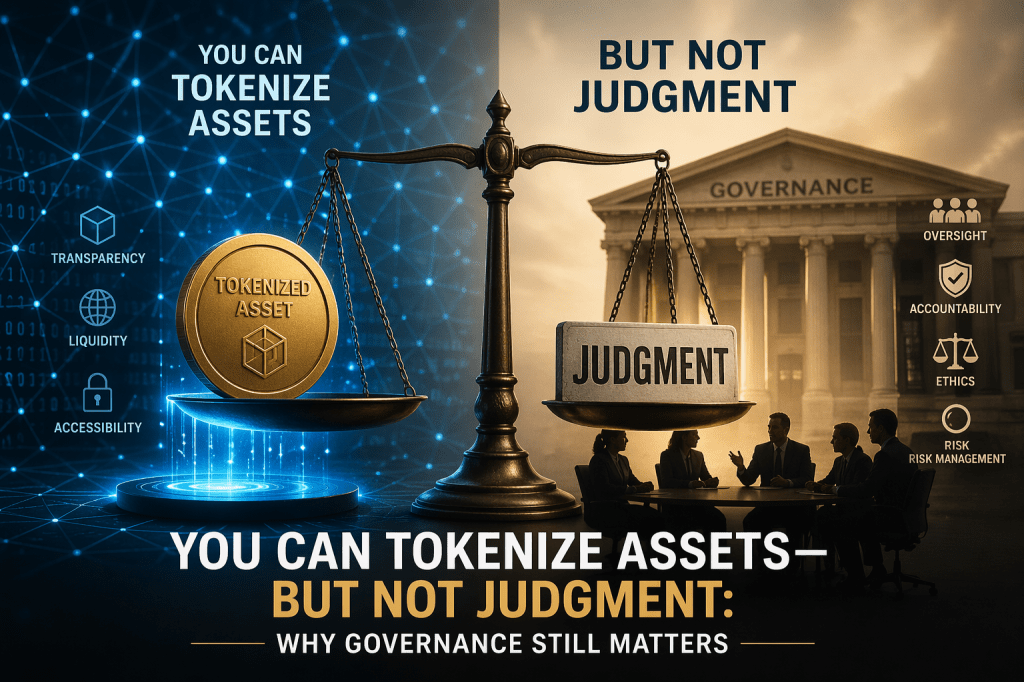
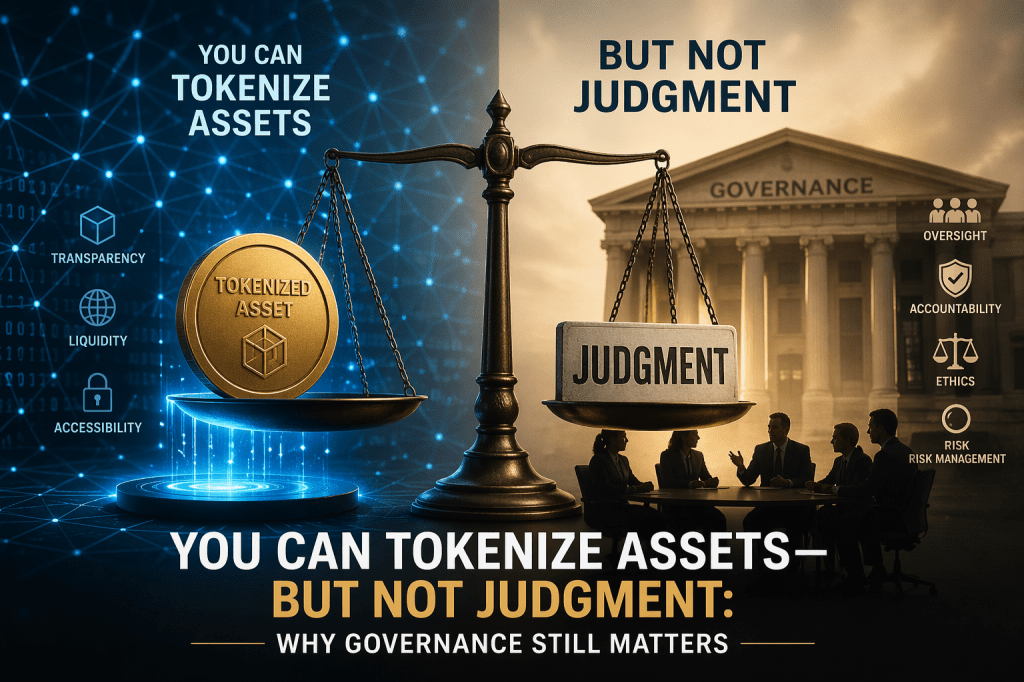
You can tokenize assets. You can tokenize gold, silver, and just about anything of value. But you cannot tokenize judgment. That may be the most important limitation in the entire digital asset conversation.
Tokenization promises transparency, liquidity, and accessibility. It’s a compelling vision—and one that is partially true. But behind every tokenized asset lies something far more fundamental than code: Governance.
Who verifies the asset exists? Who ensures it is properly stored? Who makes capital decisions? Who is accountable when things go wrong?
These are not technical questions. They are governance questions.
The idea of “trustless” systems is often misunderstood. Tokenization doesn’t eliminate trust—it simply shifts it. And without strong governance, that trust becomes more fragile, not less.
As tokenized metals evolve, the real challenge won’t be technological. It will be structural. Investors are not relying on code alone—they are relying on the people, systems, and decisions behind it. Those are governed—not programmed.
Can assets be tokenize? Absolutely yes. The more important question is, can judgement be tokenize? Absolutely not. Ironically, our inability to replace human judgment is the most important limitation in the entire digital asset conversation—because while ownership can be digitized, governance, with its inherently human only elements, cannot be automated away. Decision making requires people. Risk management is a people business. Accountability is evergreen. There is no alternative.
Tokenization has indeed captured the imagination of markets, technologists, and investors alike. By converting real-world assets—such as gold, silver, and other metals—into digital tokens on a blockchain, proponents promise greater transparency, liquidity, and accessibility. It is a compelling vision–one that is also incomplete. Why is that? Because behind every tokenized asset lies something far more fundamental than code: a system of trust, accountability, and decision-making called governance!
What Tokenization Actually Does—and Does Not Do
At its core, tokenization is a method of representation. A token may represent:
A bar of gold in a vault
A share of a mining project
A claim on future production
The blockchain on the other hand provides:
A ledger
Transparency of transactions
Immutable record-keeping
These are important innovations. Nevertheless, neither answer critical questions:
Who verifies that the gold actually exists?
Who ensures it is properly stored and insured?
Who decides how a mining project allocates capital?
Who steps in when something goes wrong?
These are not technical questions. They are governance questions.
The Illusion of “Trustless” Systems
One of the most common narratives in tokenization is the idea of a “trustless” system—one in which technology replaces the need for trust. This is misleading and here’s why.
Tokenized metals still depend on:
Custodians
Auditors
Operators
Issuers
Each of these actors introduces:
Judgment
Incentives
Potential conflicts
Blockchain may reduce certain forms of risk, but it does not eliminate the need to trust: it simply shifts where that trust is placed. What’s worse, without excellence in governance the trust becomes more fragile and opaque–not less.
Where Governance Enters the Equation
Governance is not a theoretical construct. It is a practical framework that answers fundamental questions:
Who is responsible for what?
How are decisions made?
How are risks monitored and managed?
How are stakeholders protected?
In the context of tokenized metals, governance must address several layers:
1. Asset-Level Governance. Is the Underlying Asset:
Real
Properly stored
Independently verified
2. Operational Governance. Are the Entities Involved:
Competent
Accountable
Subject to oversight
3. Financial Governance. How are:
Revenues managed
Costs controlled
Capital allocated
4. Disclosure and Transparency. Are investors receiving:
Accurate information
Timely updates
Balanced reporting
These are the same governance questions that exist in traditional finance. Tokenization does not remove them. It amplifies them.
The Mining Parallel
The tokenization of metals ultimately connects back to physical mining. Before a token can represent gold or copper, that metal must be:
Discovered
Developed
Extracted
Mining is capital-intensive, high-risk, and operationally complex. To paraphrase legendary natural resources investor, Rick Rule, weak governance in mining leads to poor outcomes—regardless of asset quality.
Projects fail not only because of geology, but because of:
Poor capital discipline
Lack of oversight
Conflicts of interest
Weak boards
Tokenization does not fix these problems. If anything, it can obscure them—by placing a digital layer over an imperfect foundation.
Governance as a Value Multiplier
When governance is strong, it does more than reduce risk. It creates value. In tokenized metals, strong governance can:
Increase investor confidence
Improve capital access
Enhance credibility with institutions
Support long-term sustainability
Investors are not simply buying tokens. They are buyingthe integrity of the system behind those tokens and that integrity is built through governance.
The Role of Boards and Oversight
At the center of governance is oversight of management. Boards and governing bodies must ensure that:
Systems are functioning as intended
Risks are identified and addressed
Decisions are aligned with long-term value
In many tokenization discussions, governance is treated as secondary—an afterthought once the technology is in place. What a mistake! To be most effective governance must bedesigned in from the beginning—not added later.
The Risk of Getting It Wrong
The risks of weak governance in tokenized metals are significant:
Misrepresentation of assets
Operational failures
Loss of investor confidence
Regulatory intervention
In a worst-case scenario, technology can accelerate the spread of problems rather than contain them. A flawed system, once tokenized, becomes:
More scalable
More visible
More fragile
Regulation Is Not a Substitute
Commentators may argue that regulation will fill the governance gap. That is not the job of the government, nor should it be. As a former government regulator I understand regulation is important—but it is not sufficient. Regulators:
Set minimum standards
Enforce compliance
They do not:
Run companies
Make daily decisions
Replace effective boards
Building Governance into Tokenization
For tokenized metals to reach their potential, governance must be integrated into the design of the system. This includes:
Clear roles and responsibilities
Independent oversight
Robust audit processes
Transparent reporting
Alignment of incentives
It also requires a shift in mindset, from technology-first, to structure-first.
What This Really Means
Tokenization is a powerful tool. It has the potential to reshape how assets are owned, traded, and accessed. However, it is not even a poor substitute for governance. Rather, it is a layer built on top of governance.
Get the governance right, and tokenization can enhance value, transparency, and trust. Get it wrong, and no amount of technology will compensate. Because in the end investors do not rely on code alone. They rely on the people, structures, and decisions behind it. And guess what? Those are governed–not programmed.
On October 22, 2025, T. Rowe Price — the venerable U.S. asset manager with roughly US $1.7–1.8 trillion under management — submitted a Form S-1 registration statement with the U.S. Securities and Exchange Commission (SEC) for its new T. Rowe Price Active Crypto ETF. This filing marks a significant step: a legacy investment-firm stepping decisively into the digital-asset arena with an actively managed exchange-traded product dedicated to multiple cryptocurrencies. In other words, T. Rowe Price has moved from Baltimore to the Blockchain!
What’s the Fund All About?
The proposed fund — to be listed on NYSE Arca — is structured as a trust offering shares that trade like stocks, representing fractional interests in a diversified crypto-asset portfolio. Let’s breakdown what that means:
Investment Objective: To outperform the FTSE Crypto US Listed Index over a long-term horizon (one year plus). That makes it an active product, not a passive tracker. To pull this off, T. Rowe Price would have needed to build internal staff capacity. Did it? Apparently, yes–the firm posted a senior analyst role in its Middle Office Trade Management for Digital Assets Operations, in Baltimore, 2025.
Active Strategy: The fund may hold between five and fifteen crypto assets under normal conditions. Managers can adjust exposure based on valuation, momentum, and risk analysis. Essentially, only the top 5 – 15 as defined by market cap.
Eligible Assets Only: Holdings must meet strict criteria — commodity tokens traded on compliant markets with adequate surveillance and liquidity. The proposed Clarity Act, making its way through Congress will play an important part regarding eligible assets.
No Leverage or Derivatives: The fund will not employ leverage or inverse positions.
Structure and Custody: Organized as a trust (not a 1940-Act investment company). Shares trade on NYSE Arca, with an indicative value published every 15 seconds.
Why It Matters — From Traditional Funds to Crypto Entry
For the blockchain and crypto community, this filing is a landmark moment. T. Rowe Price’s entry signals that mainstream institutional managers are taking digital assets seriously. Unlike most crypto ETFs that simply track Bitcoin or Ethereum, this one uses active management — giving the portfolio team discretion to select and weight different tokens dynamically. It’s designed as a regulated bridge between traditional finance and blockchain-based assets.
For blockchain infrastructure developers, this move suggests that custody, trading, and compliance systems are finally maturing to meet large-scale institutional standards. Every step toward a product like this strengthens the backbone of the crypto ecosystem.
Potential Benefits and Opportunities
Simplified Access: Investors gain exposure to a diversified basket of crypto assets through a single exchange-listed fund — no self-custody required.
Active Management Edge: Skilled managers can tilt allocations toward assets they believe have stronger fundamentals or momentum.
Diversification: Exposure to up to 15 tokens reduces single-asset risk and allows tactical rotation.
Infrastructure Impact: Large-scale ETFs increase demand for professional custody, reference pricing, blockchain data analytics, and compliance tools.
Legitimacy Signal: A major traditional asset manager’s crypto launch helps normalize digital-asset investing for institutional audiences.
Key Risks — Read the Fine Print
As the S-1 makes clear, this product also carries real risk:
Volatility: Crypto assets remain highly volatile and can experience dramatic drawdowns.
Operational Risk: Eligibility, liquidity, and valuation challenges for newer tokens could affect performance.
Regulatory & Tax Uncertainty: Evolving crypto regulation could impact fund operations, tax treatment, or asset legality.
No 1940-Act Protection: The trust is not a registered investment company, so it lacks certain mutual-fund safeguards.
Index and Benchmark Risk: The FTSE Crypto Index is new; results may differ sharply from passive benchmarks.
What To Watch Next
SEC Approval: Filing does not equal approval. The SEC will review structure, custody, and disclosure rigorously.
Final Details: Investors await the official ticker symbol, expense ratio, and custody provider.
Portfolio Disclosure: How active management plays out — which tokens are chosen and how often rebalanced — will define the fund’s edge.
Infrastructure Ripple Effects: Increased demand for secure custody and compliant trading across multiple token networks.
Competition: The fund joins an expanding lineup of crypto ETFs; differentiation will depend on performance and costs.
Final Thoughts
The T. Rowe Price Active Crypto ETF represents another bridge between the old world of finance and the emerging digital economy. For nearly a century, T. Rowe Price has managed traditional portfolios; now it is turning its analytical discipline toward digital assets. For investors, this product could provide a balanced, regulated entry into crypto exposure. For the blockchain-AI community, it highlights how institutional design — custody, audits, compliance, token vetting — is evolving alongside decentralized innovation. As we await SEC approval, all eyes will be on how T. Rowe Price implements its active strategy and whether it can truly deliver alpha in the notoriously volatile crypto landscape. Did T.Rowe Price wait too long? Time will tell!
Apparently Summer 2025 is crypto IPO season. Circle’s IPO was a booming success. (Circle issues U.S. backed stable coins.). Will Bullish be bullish or will it fall to the bears. Does it deserve the name Bullish? Or is it too premature to ask or know? As this is not financial or investment advice blog, I suggest you conduct your own independent research. In the mean time, enjoy this article.
Bullish, founded in 2020, is an institutionally focused global digital asset platform that provides trading infrastructure, data services, indices, and media through its core brands: Bullish Exchange and CoinDesk. The company seeks to accelerate adoption of stablecoins, digital assets, and blockchain technology by delivering institutional-grade products backed by compliance, liquidity, and technological innovation. With major acquisitions of CoinDesk (2023) and CCData (2024), Bullish has expanded beyond trading to become a diversified service provider at the intersection of exchanges, financial data, and digital asset media.
Business Overview Bullish operates two primary divisions:
1. Trading & Liquidity Infrastructure (Bullish Exchange) – A regulated global exchange for spot, margin, and derivatives trading. – Licensed in Germany, Hong Kong, and Gibraltar, with U.S. and other jurisdictional approvals pending. – Features a global order book, institutional-grade liquidity, risk management tools, and subscription-based liquidity/stablecoin services. – Reported $1.25 trillion+ cumulative trading volume as of March 31, 2025. In 2024, it achieved ~35% and 44% market share in spot trading for Bitcoin and Ethereum respectively among its peer set. – Average daily trading volume in Q1 2025 reached $2.55B in spot and $248M in perpetual futures.
2. Information Services (CoinDesk) – Indices: Offers proprietary multi-asset benchmarks (e.g., CoinDesk 20 Index) and reference rates like the long-established Bitcoin Price Index (XBX). Collectively, indices support $31.9B AUM and $14.3B in trading volume (March 2025). – Data: Provides real-time and historical analytics to over 171,000 professionals, strengthened by CCData’s enhanced market coverage and analytics. – Media & Events: Operates CoinDesk.com (55M+ unique visitors in 2024), podcasts, newsletters, and social media channels. The flagship Consensus conference drew 26,000+ attendees in 2025 and expanded globally with events in Hong Kong and Toronto.
Together, these lines create a synergistic “flywheel” model: data powers indices, indices generate products listed on the exchange, and media amplifies visibility and customer acquisition. Cross-selling and integration remain central to growth.
Management and Governance The company is led by CEO Thomas W. Farley, former President of the NYSE, who has extensive experience scaling exchanges and integrating acquisitions at Intercontinental Exchange (ICE). The management team combines expertise across traditional finance, digital assets, and technology.
Bullish is incorporated in the Cayman Islands (2021) and qualifies as a foreign private issuer under U.S. securities law, giving it exemptions from certain SEC reporting, disclosure, and NYSE governance requirements. For example, it is not bound by U.S. proxy rules or insider reporting standards. However, this could mean less transparency compared to U.S.-based peers.
Financial Overview – 2024 Net Income: $80 million. – Q1 2025 Net Loss: $349 million, reflecting market volatility and strategic investments. – Adjusted EBITDA: $52M (FY 2024); $13M (Q1 2025). – Liquid Assets (March 2025): $1.96B, consisting of $1.73B Bitcoin, $144M stablecoins, $28M cash, $22M ETH, and $33M other tokens. Borrowings totaled $551M.
Bullish emphasizes a conservative treasury strategy to ensure resilience across digital asset price cycles while maintaining flexibility for acquisitions and growth initiatives.
Preliminary Q2 2025 estimates were included, showing continued volatility. Adjusted transaction revenue, adjusted EBITDA, and net income figures were disclosed as non-IFRS guidance but subject to revisions upon final audit.
Market Context and Growth Opportunity Bullish sees digital assets at an early adoption stage, akin to the internet in the 1990s. Bullish argues it is well positioned to capture value across this multi-trillion-dollar addressable market through its integrated services. By mid-2025, the global digital asset market reached $3.4 trillion in capitalization with 17,000+ cryptocurrencies in circulation. Positive industry trends include:
– Rising Market Activity: Bitcoin and Ethereum trading volumes surged in late 2024, and wallet adoption doubled between 2022 and 2024. – Institutional Adoption: Firms such as BlackRock, Fidelity, and Goldman Sachs have entered the sector, with Bitcoin and Ethereum exchange-traded products attracting $44B+ inflows by mid-2025. – Regulatory Clarity: Frameworks such as the EU’s MiCA, U.S. approval of spot BTC and ETH ETFs, and the U.S. GENIUS Act for stablecoins provide legitimacy and growth opportunities. – Technological Advancements: Rapid adoption of stablecoins (>$250B market cap), tokenization, DeFi, and blockchain-based collateral are expanding applications, with projections of $1.6T–$3.7T stablecoin supply by 2030.
Competitive Advantages Bullish highlights several differentiators in its IPO filing: 1. Comprehensive Product Suite: Unified cross-collateralized margin accounts, deep liquidity, and seamless trading infrastructure. 2. Diversified Business Lines: Exchange, data, indices, and media provide multiple revenue streams and reduce volatility. 3. Trust and Compliance: Operates regulated platforms and maintains transparent governance. 4. Technology Leadership: High-performance central limit order book and automated market-making; continuous upgrades to security, scalability, and user experience. 5. Global Reach: Strong institutional presence with 36% YoY client growth in 2024; CoinDesk’s global audience bolsters customer acquisition. 6. Capital Strength: $1.9B+ in digital assets available to support liquidity and expansion. 7. Experienced Leadership: Proven track record in scaling and integrating exchanges.
Growth Strategy Bullish plans to drive expansion through five main levers: – Licensing Footprint Expansion: Actively pursuing U.S., UK, Canadian, and EU approvals, with multiple state money transmitter licenses already secured. – Product Innovation: Continuously launching new trading products (e.g., perpetual futures, indices) and cross-selling into existing customers. – Vertical Integration & Collaboration: Cross-leveraging exchange, data, and media businesses to maximize synergies. – Customer Base Expansion: Moving beyond institutional clients to target active traders (“prosumers”), using CoinDesk’s reach for cost-effective customer acquisition. – Strategic M&A: Future acquisitions will focus on scaling exchange operations, new product development, and geographic expansion, building on the successful integration of CoinDesk and CCData.
Risks and Challenges Bullish identifies multiple risks that investors should weigh: – Regulatory Uncertainty: Digital assets remain under evolving global regulatory scrutiny, which may limit innovation or expansion. – Intense Competition: Competes with both regulated and unregulated platforms, including DeFi, DEXs, and DAOs that may innovate faster. – Volatility in Results: Dependent on adoption rates and price swings of digital assets, which drive trading activity and revenues. – Operational & Security Risks: Potential loss or mismanagement of private keys, cyberattacks, or system disruptions could harm reputation and operations. – Conflicts of Interest: Ownership of CoinDesk as both a news source and business line presents reputational risks. – Dependence on Third Parties: Reliance on external banking, insurance, and service providers introduces vulnerabilities. – Jurisdictional Complexity: Operating in multiple countries creates compliance risks. – Foreign Private Issuer Risks: Exemption from U.S. governance standards may mean less disclosure and oversight than domestic peers. – Geopolitical Factors: PRC oversight of Hong Kong, U.S. HFCAA rules, and other geopolitical risks could negatively affect operations or share value.
Conclusion Bullish positions itself as a next-generation, diversified digital asset leader at the intersection of trading, data, and media. The company has grown rapidly, securing a top-10 position in Bitcoin and Ethereum spot trading, while also building out indices, analytics, and globally recognized events like Consensus. With strong leadership, $1.9B in liquid assets, and a synergistic operating model, Bullish believes it is uniquely positioned to capture growth in the expanding digital assets sector.
However, the IPO also comes with significant risks: regulatory uncertainty, industry volatility, fierce competition, and governance exemptions tied to its foreign private issuer status. Investors are cautioned that while Bullish’s strategy shows promise, its results may remain volatile as the digital asset industry continues to evolve.
The trend is clear–the crypto market exchanges and traditional market exchanges are engaged and eventually heading towards marriage! Why this bold declaration–the news coming from Washington.
In a landmark move on September 2, 2025, staff from the U.S. Securities and Exchange Commission (SEC) and the Commodity Futures Trading Commission (CFTC) issued a joint statement declaring that exchanges registered with either agency are not prohibited from facilitating trading in certain spot crypto asset products. This declaration, emerging from the coordination between the SEC’s Division of Trading and Markets and the CFTC’s Divisions of Market Oversight and Clearing & Risk, marks a clear regulatory pivot in the landscape of U.S. digital asset markets.
Riding the Wave of “Project Crypto” and “Crypto Sprint”
This initiative forms part of broader frameworks known as Project Crypto (by the SEC) and Crypto Sprint (by the CFTC), both born from recommendations of the President’s Working Group on Digital Asset Markets aimed at fostering U.S. leadership in digital finance innovation. The working group’s report consistently called for regulatory clarity to ensure blockchain experimentation thrives on American soil.
Under these programs, the agencies are collaborating to provide a coordinated path forward: emboldening registered venues to offer leveraged, margined, or financed spot retail commodity transactions — including crypto assets — under existing legal authorities.
What’s Allowed, and How It’s Framed
Importantly, the agencies stress that current law already allows certain registered exchanges—namely SEC-registered national securities exchanges (NSEs) and CFTC-registered designated contract markets (DCMs) or foreign boards of trade (FBOTs)—to facilitate trading in select spot crypto commodity products, even with leverage and margin, without needing new legislation.
This is not, however, a new rule or legal exemption. The statement represents staff views only—it carries no binding force and does not change existing statutes. Exchanges must still proceed through the usual regulatory processes, such as filing rule amendments or requesting relief. Nevertheless, its unlikely “staff” would be permitted to take this action without “approval” from the agencies directors. I make this claim as someone who held senior staff positions in the federal government.
What’s Next, and What Market Participants Should Consider
The joint staff statement serves not just as a signal, but as an invitation to market participants. Agencies have pledged to:
Promptly review filings and proposals, encouraging engagement from exchanges seeking to list spot crypto products.
Address operational and structural questions, including around custody, clearing, margin, and settlement.
Support market surveillance and data transparency, encouraging shared price feeds and real-time dissemination of trade data.
Balance innovation with investor protection, remaining open to technological advances while ensuring rigorous oversight.
Legal and compliance professionals advise that any firm planning to launch such offerings should prepare thoroughly by addressing these operational points—effectively a checklist for submission—and engage early with regulators.
Views from the Trenches: Optimism vs. Skepticism
The regulatory move has been widely hailed in the industry as a game-changer—a regulatory green light for mainstream U.S. exchanges to consider crypto listings, potentially including Bitcoin and Ether.
But not everyone sees it that way. Some legal analysts have labeled the statement a “nothingburger”, criticizing its non-binding nature and lack of clarity around how “commodity” versus “security” status will be adjudicated—an unresolved core issue in crypto regulation. I do not agree with those legal analysts–but I’m not an attorney nor is this article legal or financial advice.
Harmonizing Frameworks—Next Up: A Joint Roundtable
This statement represents only the first step. On September 5, 2025, the agencies released a strategic follow-up: a joint statement on regulatory harmonization, announcing a public roundtable on September 29, 2025, to align their frameworks further—spanning product definitions, reporting standards, capital requirements, and coordinated innovation exemptions.
SEC Chair Paul Atkins and CFTC Acting Chair Caroline Pham described the session as a pivotal moment to transform U.S. regulatory coordination into a competitive advantage, enhancing clarity and opening the door to financial innovation. Their remarks signal a shared commitment among regulators to make the U.S. marketplace more efficient, innovative, and investor-friendly.
Implications and Forward Outlook
For the crypto industry, this coordinated stance paves a legal path that could bring regulated exchanges into the fold. Institutional venues like Nasdaq, NYSE, CME Group, and Cboe could consider introducing crypto product offerings—once thought off-limits—if they navigate the filing and operational requirements successfully. That is not a “nothing” burger!
Yet, without binding rules or clarified legal definitions, the shape of this new pathway remains uncertain. Regulatory arbitrage and legal ambiguity could persist unless the agencies deliver clear, binding regulations or frameworks.
Conclusion: Cautious Optimism in a Regulatory Renaissance
The joint statement by SEC and CFTC staff marks a meaningful departure from past reluctance—an encouraging signal that the U.S. is repositioning itself as a hub for blockchain-driven innovation. Market participants now have formal permission to explore spot crypto product offerings—if they comply with existing regulatory expectations.
The upcoming September 29th roundtable offers a critical opportunity to transform this gesture into substantive regulatory reality. For firms, token projects, and exchanges, the message is clear: engage early, act boldly, and help shape the evolving regulatory blueprint for the next era of digital asset markets in the U.S.