Austrian economics, Banking, Blockchains, Board of Directors, Digital Currency, finance, Governance, Mining, Tether, tokenization, Yogi Nelson

Who Can Be Trusted? Custody, Verification, and the Problem of “Proof”

by Yogi Nelson (Nelson Hernandez)

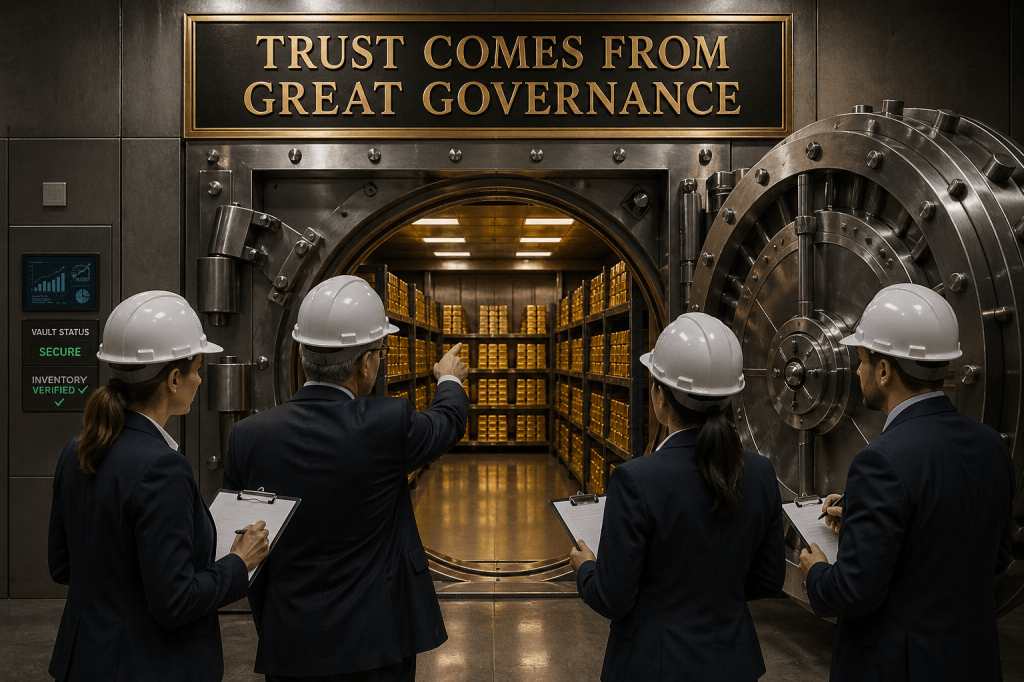
You can own gold tokens on the blockchain. Many people do. You can track every transaction. You can see your balance instantly. It feels precise. Modern. Reliable. But one question changes everything: Where is the metal?

And just as important: Who verifies that it’s actually there?

Tokenization does many things well. It improves efficiency, transparency, and access. But it does not eliminate the need for custody, verification, and governance.

Blockchain can record ownership.

It cannot inspect vaults.
It cannot audit inventory.
It cannot confirm whether assets are unencumbered.

That responsibility falls to custodians, auditors, and governance structures.

“Proof of reserves” helps—but it is not a complete solution. It can confirm consistency, not necessarily reality. At the end of the day, trust has not disappeared. It has simply moved. And that raises a critical point:

Investors are not just buying a token—they are buying a system of trust behind it.

That system must be examined carefully. Because in tokenization, as in investing generally: Precision is not the same as truth.

Until next time,

Yogi Nelson (Nelson Hernandez)

Austrian economics, Banking, Blockchains, Board of Directors, cryptography, Digital Currency, finance, Governance, International Finance, Mining, sec, tokenization, Yogi Nelson

You Can Tokenize Assets—But Not Human Judgment: Why Governance Still Matters

by Yogi Nelson (Nelson Hernandez)

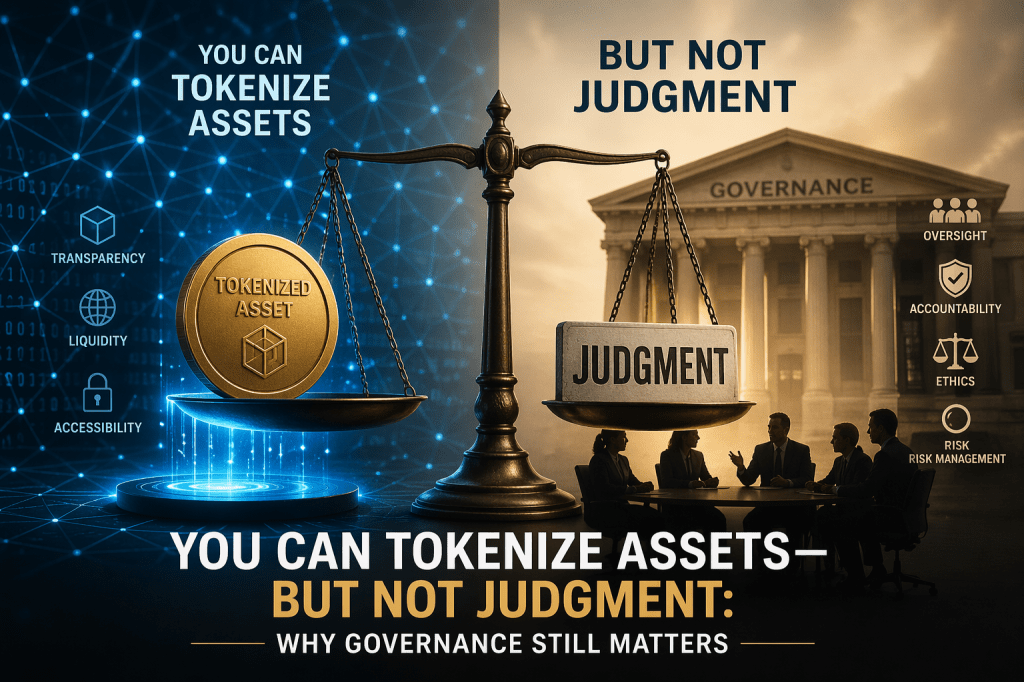
You can tokenize assets. You can tokenize gold, silver, and just about anything of value. But you cannot tokenize judgment. That may be the most important limitation in the entire digital asset conversation.

Tokenization promises transparency, liquidity, and accessibility. It’s a compelling vision—and one that is partially true. But behind every tokenized asset lies something far more fundamental than code: Governance.

Who verifies the asset exists?
Who ensures it is properly stored?
Who makes capital decisions?
Who is accountable when things go wrong?

These are not technical questions. They are governance questions.

The idea of “trustless” systems is often misunderstood. Tokenization doesn’t eliminate trust—it simply shifts it. And without strong governance, that trust becomes more fragile, not less.

As tokenized metals evolve, the real challenge won’t be technological. It will be structural. Investors are not relying on code alone—they are relying on the people, systems, and decisions behind it. Those are governed—not programmed.

Until next time,

Yogi Nelson (Nelson Hernandez)

Austrian economics, Banking, Blockchains, Board of Directors, Decentralized, Digital Currency, Gold, Governance, International Finance, Mining, sec, tokenization, Uncategorized, Yogi Nelson

You Can Tokenize Assets—But Not Human Judgment: Why Governance Still Matters

by Yogi Nelson (Nelson Hernandez)

Tokenization, the Promise and the Gap

Can assets be tokenize? Absolutely yes. The more important question is, can judgement be tokenize? Absolutely not. Ironically, our inability to replace human judgment is the most important limitation in the entire digital asset conversation—because while ownership can be digitized, governance, with its inherently human only elements, cannot be automated away. Decision making requires people. Risk management is a people business. Accountability is evergreen. There is no alternative.

Tokenization has indeed captured the imagination of markets, technologists, and investors alike. By converting real-world assets—such as gold, silver, and other metals—into digital tokens on a blockchain, proponents promise greater transparency, liquidity, and accessibility. It is a compelling vision–one that is also incomplete. Why is that? Because behind every tokenized asset lies something far more fundamental than code: a system of trust, accountability, and decision-making called governance!


What Tokenization Actually Does—and Does Not Do

At its core, tokenization is a method of representation. A token may represent:

  • A bar of gold in a vault
  • A share of a mining project
  • A claim on future production

The blockchain on the other hand provides:

  • A ledger
  • Transparency of transactions
  • Immutable record-keeping

These are important innovations. Nevertheless, neither answer critical questions:

  • Who verifies that the gold actually exists?
  • Who ensures it is properly stored and insured?
  • Who decides how a mining project allocates capital?
  • Who steps in when something goes wrong?

These are not technical questions. They are governance questions.


The Illusion of “Trustless” Systems

One of the most common narratives in tokenization is the idea of a “trustless” system—one in which technology replaces the need for trust. This is misleading and here’s why.

Tokenized metals still depend on:

  • Custodians
  • Auditors
  • Operators
  • Issuers

Each of these actors introduces:

  • Judgment
  • Incentives
  • Potential conflicts

Blockchain may reduce certain forms of risk, but it does not eliminate the need to trust: it simply shifts where that trust is placed. What’s worse, without excellence in governance the trust becomes more fragile and opaque–not less.


Where Governance Enters the Equation

Governance is not a theoretical construct. It is a practical framework that answers fundamental questions:

  • Who is responsible for what?
  • How are decisions made?
  • How are risks monitored and managed?
  • How are stakeholders protected?

In the context of tokenized metals, governance must address several layers:

1. Asset-Level Governance. Is the Underlying Asset:

  • Real
  • Properly stored
  • Independently verified

2. Operational Governance. Are the Entities Involved:

  • Competent
  • Accountable
  • Subject to oversight

3. Financial Governance. How are:

  • Revenues managed
  • Costs controlled
  • Capital allocated

4. Disclosure and Transparency. Are investors receiving:

  • Accurate information
  • Timely updates
  • Balanced reporting

These are the same governance questions that exist in traditional finance. Tokenization does not remove them. It amplifies them.


The Mining Parallel

The tokenization of metals ultimately connects back to physical mining. Before a token can represent gold or copper, that metal must be:

  • Discovered
  • Developed
  • Extracted

Mining is capital-intensive, high-risk, and operationally complex. To paraphrase legendary natural resources investor, Rick Rule, weak governance in mining leads to poor outcomes—regardless of asset quality.

Projects fail not only because of geology, but because of:

  • Poor capital discipline
  • Lack of oversight
  • Conflicts of interest
  • Weak boards

Tokenization does not fix these problems. If anything, it can obscure them—by placing a digital layer over an imperfect foundation.


Governance as a Value Multiplier

When governance is strong, it does more than reduce risk. It creates value. In tokenized metals, strong governance can:

  • Increase investor confidence
  • Improve capital access
  • Enhance credibility with institutions
  • Support long-term sustainability

Investors are not simply buying tokens. They are buying the integrity of the system behind those tokens and that integrity is built through governance.


The Role of Boards and Oversight

At the center of governance is oversight of management. Boards and governing bodies must ensure that:

  • Systems are functioning as intended
  • Risks are identified and addressed
  • Decisions are aligned with long-term value

In many tokenization discussions, governance is treated as secondary—an afterthought once the technology is in place. What a mistake! To be most effective governance must be designed in from the beginning—not added later.


The Risk of Getting It Wrong

The risks of weak governance in tokenized metals are significant:

  • Misrepresentation of assets
  • Operational failures
  • Loss of investor confidence
  • Regulatory intervention

In a worst-case scenario, technology can accelerate the spread of problems rather than contain them. A flawed system, once tokenized, becomes:

  • More scalable
  • More visible
  • More fragile

Regulation Is Not a Substitute

Commentators may argue that regulation will fill the governance gap. That is not the job of the government, nor should it be. As a former government regulator I understand regulation is important—but it is not sufficient. Regulators:

  • Set minimum standards
  • Enforce compliance

They do not:

  • Run companies
  • Make daily decisions
  • Replace effective boards

Building Governance into Tokenization

For tokenized metals to reach their potential, governance must be integrated into the design of the system. This includes:

  • Clear roles and responsibilities
  • Independent oversight
  • Robust audit processes
  • Transparent reporting
  • Alignment of incentives

It also requires a shift in mindset, from technology-first, to structure-first.


What This Really Means

Tokenization is a powerful tool. It has the potential to reshape how assets are owned, traded, and accessed. However, it is not even a poor substitute for governance. Rather, it is a layer built on top of governance.

Get the governance right, and tokenization can enhance value, transparency, and trust. Get it wrong, and no amount of technology will compensate. Because in the end investors do not rely on code alone.
They rely on the people, structures, and decisions behind it.
And guess what? Those are governed–not programmed.

Until next time,


Yogi Nelson (Nelson Hernandez)

Board of Directors, Mining, Risk Management, Yogi Nelson

Governance as a Force Multiplier: The Discipline That Determines Outcomes

by Yogi Nelson

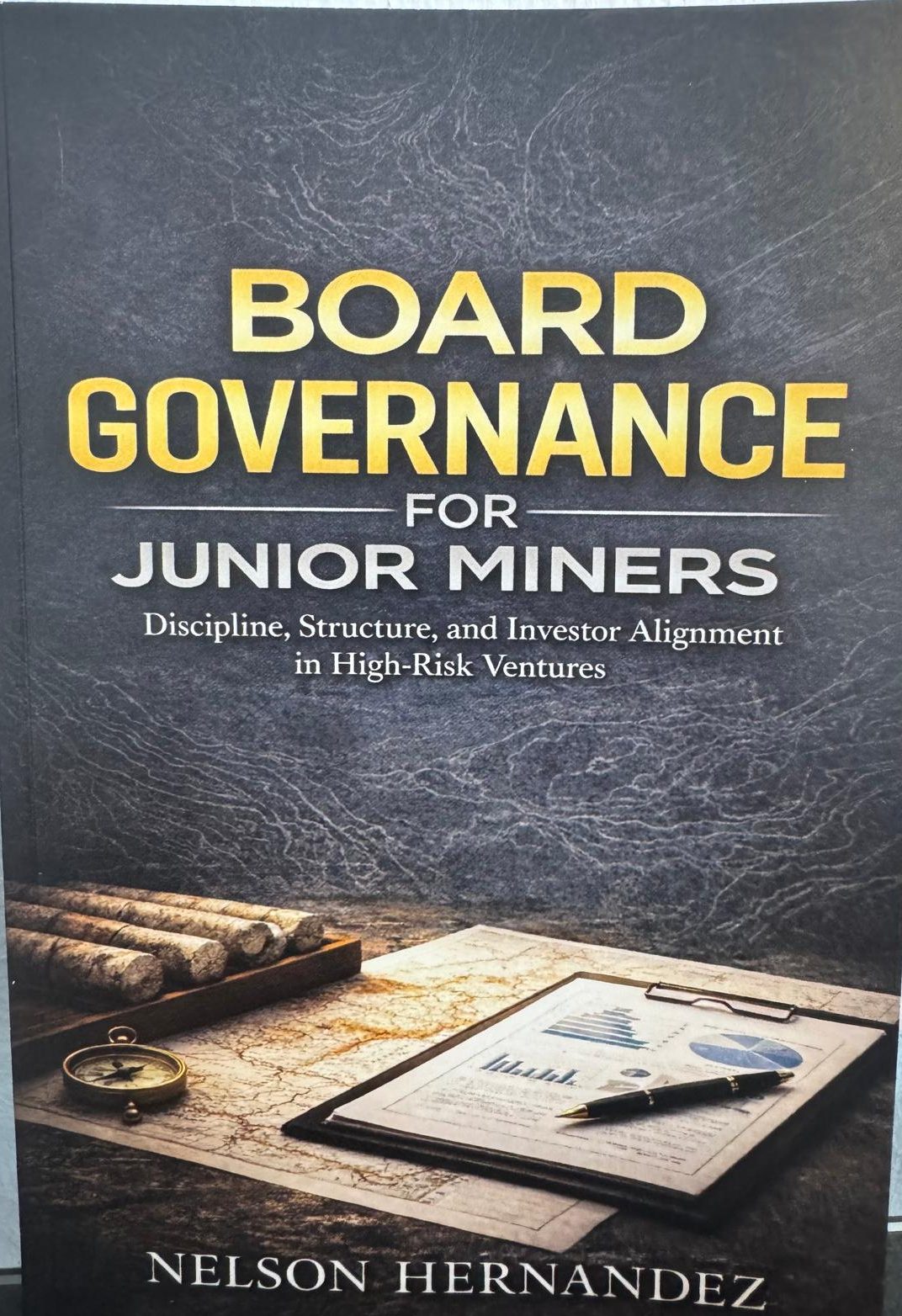
Over the course of these articles (which will soon be published as a book), we have examined governance not as a theoretical construct, but as a practical system of discipline—one that operates quietly in the background, yet determines whether a junior mining company creates value or destroys it. Essentially, a forceful argument in favor of disciplined governance has been presented—an effective one at that.

We began with a simple premise: geology may create opportunity, but governance determines outcomes. That idea has carried through every chapter. But we didn’t leave it at that. Instead, we also explored board composition—not as a checklist of credentials, but as a deliberate assembly of judgment. What else was accomplished?

First, the notion of independence—not as a regulatory requirement, but as a safeguard against groupthink—was highlighted. Second, we discussed capital allocation as a test of discipline, where decisions made under pressure reveal whether fiduciaries are truly acting in the long-term interest of shareholders. Given the comprehensive nature of the book, we didn’t stop there; we continued.

The right people in the room change everything—governance is where discipline begins

For instance, we examined jurisdictional risk and learned that political geography cannot be avoided—it must be governed. Of course, management oversight was emphasized; therefore, we made a point of noting that alignment is not assumed—it must be structured, monitored, and, when necessary, enforced. Was that the end? No, it wasn’t; we carried on and dove into other substantive issues, including technical and engineering considerations.

In the section related to technical complexity and the limits of expertise, we pointed out that board members do not need to be engineers. However, they must know when and how to question engineers. If an engineer cannot explain what he is doing to a board of reasonably intelligent people, the problem is probably with the engineer—not the board. We explored compensation, not as a reward system, but as an instrument that either aligns incentives—or distorts them. In other words, money talks. Last, we discussed transparency and communication, recognizing that trust is not built through promotion, but through consistency and credibility over time.

Regardless of the specific issue, one theme has remained constant: governance is not static. It is not a document, a committee, or a policy manual. It is a behavior.

From Structure to Behavior

Mining is a people business. That may surprise some who think of mining as machines, drills, and equipment. Analysts who fail to consider the people side of the business miss half the story.

A well-structured board does not guarantee good governance. Policies do not enforce themselves. Committees do not think. People do. Governance becomes real only when individuals—directors, executives, and advisors—exercise judgment under conditions of uncertainty. The distinction matters.

A company may have all the formal elements of governance in place—independent directors, audit committees, compensation frameworks—and still fail if those structures are not animated by discipline.

Conversely, a smaller company with fewer formalities but strong, principled leadership can outperform because governance is practiced, not just documented. Governance, therefore, is not defined by what exists on paper, but by what happens in the room.

The Compounding Effect of Discipline

In junior mining, most outcomes are not determined by a single decision. They are the result of a series of decisions made over time—often under pressure and with incomplete information. This is where governance acts as a force multiplier. The direction of that force multiplier depends on discipline.

Good governance does not guarantee success. But it increases the probability of making sound decisions repeatedly. And over time, those probabilities compound. Whether the compounding effect is positive depends on discipline. When it is positive, expect:

  • Capital is allocated more carefully
  • Dilution is managed more thoughtfully
  • Projects are advanced more deliberately
  • Risks are identified earlier
  • Mistakes are corrected faster

The effect is subtle at first. But over multiple cycles—financing, exploration, development—the difference becomes profound. Companies with disciplined governance tend to survive downturns, preserve optionality, and position themselves for opportunity when conditions improve. Those without it often do not.

Governance in Adverse Conditions

It is easy to appear well-governed when markets are strong. (As they say in Puerto Rico, even a pumpkin can roll downhill.) Capital is abundant. Errors are masked. Optimism fills the gaps where discipline should be.

The real test of governance occurs in adverse conditions. When capital is scarce, decisions become harder. Trade-offs become sharper. The consequences of error become more immediate. Staff and board members may turn on each other. Accusations start. Negativity breeds negativity. This is where governance reveals itself.

  • Does the board protect shareholder capital—or rationalize dilution?
  • Does management adjust strategy—or continue pursuing sunk costs?
  • Are risks confronted honestly—or deferred?

In difficult markets, governance is no longer abstract. It becomes visible. And it becomes decisive.

Alignment: The Core of Fiduciary Responsibility

Misalignment is the root cause of most governance failures. Hence, at its core, governance is about alignment.

  • Management and shareholders
  • Short-term decisions and long-term value
  • Incentives and outcomes
  • Risk-taking and accountability

Do not blame intelligence or lack of effort, as those are seldom the fundamental reasons for failure. Misalignment is the culprit.

When incentives reward growth over value, dilution follows. And when oversight is weak, accountability erodes. What happens when boards defer rather than challenge? Small issues become large problems.

Assuming the analysis is correct, it begs the question: what is the solution? The solution is proper alignment—asking uncomfortable questions, resisting easy answers, and staying focused on the prize: long-term value creation.

The Role of Judgment

No framework, no checklist, no policy can substitute for judgment. Governance requires the ability to make decisions when the data is incomplete, the outcomes are uncertain, and the stakes are high. This responsibility cannot be outsourced to a board nor to an AI agent. This is particularly true in junior mining, where technical, financial, and geopolitical variables intersect.

Strong governance recognizes the limits of certainty. Accordingly, it does not seek perfect information, because that rarely exists on a timely basis. Instead, it seeks informed judgment. How does it do so? By creating an environment where that judgment can be exercised independently, rigorously, and without undue influence.

What Endures

The only certainty in life is change. Markets change. Commodity prices rise and fall. Jurisdictions shift. Technologies evolve. While everything changes, the application of certain underlying principles of governance endures. And what are those principles? Discipline, independence, accountability, and alignment.

These are not trends. They are constants. Companies that embed these principles into their decision-making processes are better equipped to navigate uncertainty—not because they can predict outcomes, but because they can respond to them effectively.

A Final Observation

In junior mining, much attention is placed on discovery. That certainly makes sense. After all, discovery creates possibility. Does possibility equal value? No, it does not.

Value is created through a series of disciplined decisions—over time, under uncertainty, and often without recognition. That is the work of governance. It does not generate headlines. It does not appear in drill results—directly. Yet it determines whether opportunity becomes outcome.

Conclusion

Governance is often viewed as a constraint—a set of rules that limits action. In reality, it is the opposite. It is a force multiplier that enhances the quality of decisions, improves the resilience of organizations, and increases the probability of success.

In a sector defined by uncertainty, that is not a small advantage. It is the difference.

Until next time,

Yogi Nelson

Blockchains, finance, Mining, Nickel, tokenization, Yogi Nelson

Tokenized Nickel: A Critical Metal for the Clean Energy Transition

by Yogi Nelson (Nelson Hernandez)

Nickel rarely gets the attention it deserves. It does not carry the mystique of gold or the narrative momentum of lithium. Yet quietly, nickel is becoming one of the most important metals in the global economy.

Why? Because it sits at the intersection of two powerful forces:

  • Industrial production (stainless steel)
  • The clean energy transition (EV batteries)

👉 Roughly 65–70% of nickel goes into stainless steel
👉 But the fastest growth is coming from electric vehicles and energy storage

So the question becomes:

Can nickel be tokenized?

In theory—yes.

Nickel benefits from:

  • Global liquidity (LME markets)
  • Established warehouse systems
  • Broad industrial demand

But in practice, it is more complicated.

Nickel exists in multiple grades and forms, each with different uses and values.
It moves through complex global supply chains.

👉 That makes tokenization less about retail investing…
…and more about industrial efficiency, tracking, and coordination.

If tokenized nickel works, it won’t be because investors demand it.

It will be because the system requires it.

And as always:

Structure—not story—will determine what works.

Yogi Nelson (Nelson Hernandez)