Board of Directors, Mining, Risk Management, Yogi Nelson

Governance as a Force Multiplier: The Discipline That Determines Outcomes

by Yogi Nelson

Over the course of these articles (which will soon be published as a book), we have examined governance not as a theoretical construct, but as a practical system of discipline—one that operates quietly in the background, yet determines whether a junior mining company creates value or destroys it. Essentially, a forceful argument in favor of disciplined governance has been presented—an effective one at that.

We began with a simple premise: geology may create opportunity, but governance determines outcomes. That idea has carried through every chapter. But we didn’t leave it at that. Instead, we also explored board composition—not as a checklist of credentials, but as a deliberate assembly of judgment. What else was accomplished?

First, the notion of independence—not as a regulatory requirement, but as a safeguard against groupthink—was highlighted. Second, we discussed capital allocation as a test of discipline, where decisions made under pressure reveal whether fiduciaries are truly acting in the long-term interest of shareholders. Given the comprehensive nature of the book, we didn’t stop there; we continued.

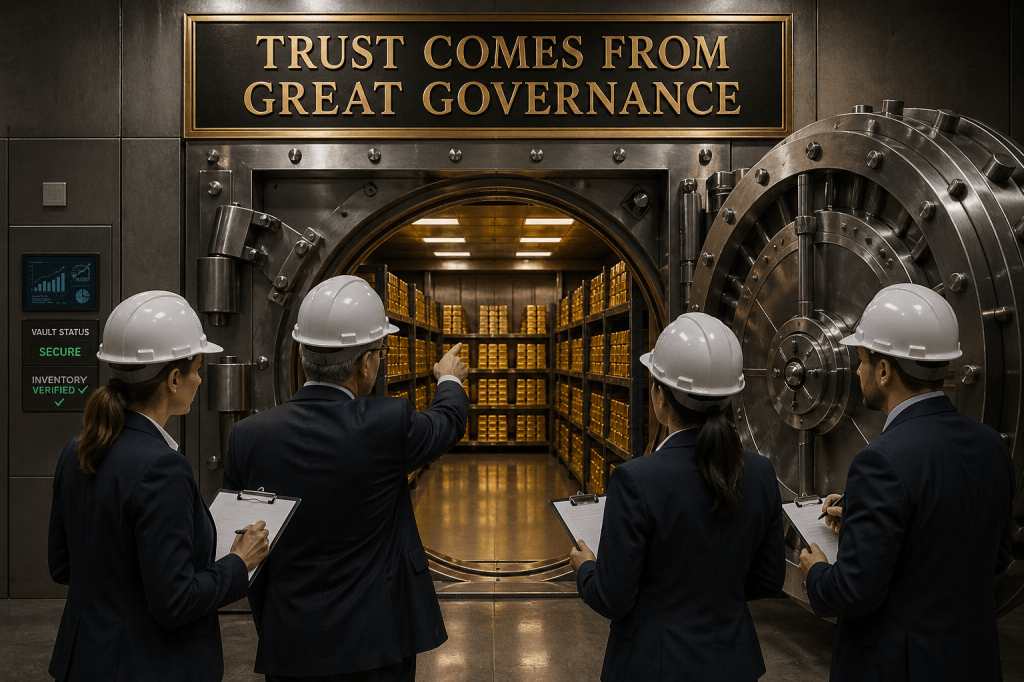
The right people in the room change everything—governance is where discipline begins

For instance, we examined jurisdictional risk and learned that political geography cannot be avoided—it must be governed. Of course, management oversight was emphasized; therefore, we made a point of noting that alignment is not assumed—it must be structured, monitored, and, when necessary, enforced. Was that the end? No, it wasn’t; we carried on and dove into other substantive issues, including technical and engineering considerations.

In the section related to technical complexity and the limits of expertise, we pointed out that board members do not need to be engineers. However, they must know when and how to question engineers. If an engineer cannot explain what he is doing to a board of reasonably intelligent people, the problem is probably with the engineer—not the board. We explored compensation, not as a reward system, but as an instrument that either aligns incentives—or distorts them. In other words, money talks. Last, we discussed transparency and communication, recognizing that trust is not built through promotion, but through consistency and credibility over time.

Regardless of the specific issue, one theme has remained constant: governance is not static. It is not a document, a committee, or a policy manual. It is a behavior.

From Structure to Behavior

Mining is a people business. That may surprise some who think of mining as machines, drills, and equipment. Analysts who fail to consider the people side of the business miss half the story.

A well-structured board does not guarantee good governance. Policies do not enforce themselves. Committees do not think. People do. Governance becomes real only when individuals—directors, executives, and advisors—exercise judgment under conditions of uncertainty. The distinction matters.

A company may have all the formal elements of governance in place—independent directors, audit committees, compensation frameworks—and still fail if those structures are not animated by discipline.

Conversely, a smaller company with fewer formalities but strong, principled leadership can outperform because governance is practiced, not just documented. Governance, therefore, is not defined by what exists on paper, but by what happens in the room.

The Compounding Effect of Discipline

In junior mining, most outcomes are not determined by a single decision. They are the result of a series of decisions made over time—often under pressure and with incomplete information. This is where governance acts as a force multiplier. The direction of that force multiplier depends on discipline.

Good governance does not guarantee success. But it increases the probability of making sound decisions repeatedly. And over time, those probabilities compound. Whether the compounding effect is positive depends on discipline. When it is positive, expect:

  • Capital is allocated more carefully
  • Dilution is managed more thoughtfully
  • Projects are advanced more deliberately
  • Risks are identified earlier
  • Mistakes are corrected faster

The effect is subtle at first. But over multiple cycles—financing, exploration, development—the difference becomes profound. Companies with disciplined governance tend to survive downturns, preserve optionality, and position themselves for opportunity when conditions improve. Those without it often do not.

Governance in Adverse Conditions

It is easy to appear well-governed when markets are strong. (As they say in Puerto Rico, even a pumpkin can roll downhill.) Capital is abundant. Errors are masked. Optimism fills the gaps where discipline should be.

The real test of governance occurs in adverse conditions. When capital is scarce, decisions become harder. Trade-offs become sharper. The consequences of error become more immediate. Staff and board members may turn on each other. Accusations start. Negativity breeds negativity. This is where governance reveals itself.

  • Does the board protect shareholder capital—or rationalize dilution?
  • Does management adjust strategy—or continue pursuing sunk costs?
  • Are risks confronted honestly—or deferred?

In difficult markets, governance is no longer abstract. It becomes visible. And it becomes decisive.

Alignment: The Core of Fiduciary Responsibility

Misalignment is the root cause of most governance failures. Hence, at its core, governance is about alignment.

  • Management and shareholders
  • Short-term decisions and long-term value
  • Incentives and outcomes
  • Risk-taking and accountability

Do not blame intelligence or lack of effort, as those are seldom the fundamental reasons for failure. Misalignment is the culprit.

When incentives reward growth over value, dilution follows. And when oversight is weak, accountability erodes. What happens when boards defer rather than challenge? Small issues become large problems.

Assuming the analysis is correct, it begs the question: what is the solution? The solution is proper alignment—asking uncomfortable questions, resisting easy answers, and staying focused on the prize: long-term value creation.

The Role of Judgment

No framework, no checklist, no policy can substitute for judgment. Governance requires the ability to make decisions when the data is incomplete, the outcomes are uncertain, and the stakes are high. This responsibility cannot be outsourced to a board nor to an AI agent. This is particularly true in junior mining, where technical, financial, and geopolitical variables intersect.

Strong governance recognizes the limits of certainty. Accordingly, it does not seek perfect information, because that rarely exists on a timely basis. Instead, it seeks informed judgment. How does it do so? By creating an environment where that judgment can be exercised independently, rigorously, and without undue influence.

What Endures

The only certainty in life is change. Markets change. Commodity prices rise and fall. Jurisdictions shift. Technologies evolve. While everything changes, the application of certain underlying principles of governance endures. And what are those principles? Discipline, independence, accountability, and alignment.

These are not trends. They are constants. Companies that embed these principles into their decision-making processes are better equipped to navigate uncertainty—not because they can predict outcomes, but because they can respond to them effectively.

A Final Observation

In junior mining, much attention is placed on discovery. That certainly makes sense. After all, discovery creates possibility. Does possibility equal value? No, it does not.

Value is created through a series of disciplined decisions—over time, under uncertainty, and often without recognition. That is the work of governance. It does not generate headlines. It does not appear in drill results—directly. Yet it determines whether opportunity becomes outcome.

Conclusion

Governance is often viewed as a constraint—a set of rules that limits action. In reality, it is the opposite. It is a force multiplier that enhances the quality of decisions, improves the resilience of organizations, and increases the probability of success.

In a sector defined by uncertainty, that is not a small advantage. It is the difference.

Until next time,

Yogi Nelson

Banking, Blockchains, Copper, Digital Currency, finance, Mining, precious-metals, Risk Management, Tether, Yogi Nelson

One Token, Many Metals: The Promise—and Limits—of Digital Metal Baskets

by Yogi Nelson (Nelson Hernandez)

One basket. Multiple metals. A new way to think about exposure.

Multi-metal token baskets could become the digital version of a metals ETF—combining gold, silver, and industrial metals into a single, tokenized instrument.

Simple on the surface. Complex underneath.

They promise:

  • Diversification
  • Transparency
  • Global access

But they also raise important questions:

Who holds the metal?
Where is it stored?
What happens under stress?

Tokenization doesn’t eliminate these issues—it reveals them.

The future of metals may not be just about what you hold…
But how it’s structured.

Until next time,

Yogi Nelson (Nelson Hernandez)

Uncategorized

Environment, Social and Governance (ESG): Substance Over Narrative

by Yogi Nelson

ESG in Junior Mining: From Peripheral Topic to Core Risk

Investors in junior mining demand to know how companies plan to address ESG (environment, social, and governance) issues before writing any checks. Essentially, investors, regulators, communities, and strategic partners expect companies to demonstrate awareness of and solutions to environmental and social risks. Paradoxically, the growing prominence of ESG has introduced a new challenge: the risk that ESG becomes a narrative rather than a discipline–and that’s the worse possible outcome.

For junior mining companies, this risk is particularly acute. Limited resources, early-stage projects, and evolving operational systems can create a gap between what a company aspires to be and what it can currently demonstrate. Expectations versus reality. When that gap is filled with overly confident messaging, ESG shifts from an asset to a liability. Boards must therefore approach ESG not as a communications theme, but as a governance responsibility tied directly to risk, credibility, and project viability.

Credible ESG starts with listening—before claims are made, before decisions are taken.

ESG as a Driver of Capital Access

In today’s market, ESG is increasingly linked to access to capital. Institutional investors, strategic partners, and even certain retail investors place greater emphasis on how companies manage environmental and social risks. That is a fact. For junior miners, this has practical implications:

  • Financing discussions will include ESG-related questions
  • Strategic partners will evaluate community relationships before committing capital
  • Analysts will discount companies perceived to carry elevated ESG risk

A weak or unsubstantiated ESG profile can therefore affect valuation, financing terms, and investor confidence. The bottom line shrinks.

Fortunately, markets are more discerning when compared to yesterday. Investors are increasingly able to distinguish between substantiated ESG practices and promotional language. Companies that rely heavily on narrative without supporting evidence may initially attract attention, but over time they risk losing credibility. Smart boards under credibility is expensive–they don’t sell it cheap.

Boards should recognize that ESG is not simply about signaling alignment with investor expectations. It is about demonstrating operational discipline that supports long-term capital formation.

Authentic ESG Reporting

Credibility begins with alignment between disclosure and reality. Authentic ESG reporting does not require a company to present itself as fully developed or without challenges. To the contrary. Overly polished disclosures often raise concern among experienced investors. Astute investors don”t believe hype. What they look for is whether the company’s statements are:

  • Accurate
  • Balanced
  • Supported by observable practices

Boards should encourage management to clearly distinguish between:

  • Current capabilities and future objectives
  • Established practices and initiatives in development

A company that acknowledges where it is in its ESG journey is often more credible than one that suggests it has already achieved a fully mature profile. Measured disclosure builds trust. Overstatement erodes it.

Governance Oversight of Sustainability Claims

ESG claims must be subjected to rigorous governance. The Board must not adopt two standards: one for ESG and one for all other issues. Consider the following: while some community organizations may not have the expertise to understand geology, drill results, etc., all of them are capable of sniffing out public relations puff pieces. Smart boards do not attempt to mislead investors nor the local community.

Boards do not need to approve every communication, but they must ensure that material ESG statements are grounded in evidence. This requires a disciplined approach to reviewing how ESG is presented in:

  • Investor materials
  • Public filings
  • Corporate presentations
  • Website content

If management asserts that the company has strong community engagement, the board should seek specifics. How frequently does engagement occur? Who participates? What issues have been raised? What actions have been taken? Good governance requires moving from general narrative to verifiable detail. Directors should ask:

  • What supports this claim?
  • Is this statement descriptive or aspirational?
  • Has it been verified internally or externally?
  • Is there documentation behind it?

Permitting, Social License, and Project Viability

In junior mining, ESG is not an abstract concept—it directly affects whether a project can advance. Permitting processes are often influenced by:

  • Environmental considerations
  • Community relationships
  • Local and regional political dynamics

A company that underestimates these factors may face delays, increased costs, or even an inability to proceed. The concept of a “social license to operate” is sometimes discussed loosely, but its practical meaning is clear. Projects that lack community support or encounter persistent opposition can become significantly impaired, regardless of their geological quality.

Boards should therefore view ESG not as a reputational issue, but as a determinant of project feasibility.

The Gap Between Narrative and Field Reality

One of the most common governance risks in ESG arises from a disconnect between head office messaging and field-level reality. What I call, “lost in translation” phenomenon. Here is what often happens.

Management teams may present ESG narratives based on intentions, policies, or limited interactions, while conditions on the ground are more complex. Often far more complex that can be described in a power point slide deck. Community concerns may be evolving, relationships may be uneven, and engagement may be less structured than described. Boards should be attentive to this potential gap by asking probing questions. For instance and actions steps:

  • Direct reporting from operational teams
  • Evidence of consistent engagement practices
  • Confirmation that field realities are accurately reflected in disclosures
  • Site visits

Without this alignment, the company risks presenting a version of itself that cannot be sustained under scrutiny.

The Importance of Community Engagement Documentation

Documentation is what transforms ESG from a concept into a governance practice. Management must document their positive and negative community relations interactions. Boards should ensure the company maintains structured records of:

  • Community meetings and participation (also who didn’t attend who should have because their absence might be equally important)
  • Issues and concerns raised by stakeholders
  • Commitments made by the company
  • Follow-up actions and outcomes

This documentation serves several critical functions:

  • It provides evidence supporting ESG disclosures
  • It creates accountability within management
  • It allows the board to monitor patterns and emerging risks
  • It protects the company in the event of disputes or challenges

Without documentation, ESG claims remain difficult to substantiate.

Avoiding Reputational and Governance Exposure

Reputational exposure often begins with overstatement. Don’t over promise and under deliver. Do the oppose. A company may believe it is strengthening its profile by emphasizing ESG in communications. However, once expectations are established, they can be tested by:

  • Investors
  • Regulators
  • Communities
  • External observers

If claims are found to be exaggerated or unsupported, the consequences can extend beyond ESG:

  • Management credibility may be questioned
  • Board oversight may come under scrutiny
  • Other disclosures may be viewed with skepticism

In extreme cases, misleading ESG statements could contribute to legal or regulatory exposure, particularly if they influence investment decisions. Boards should therefore approach ESG disclosures with the same discipline applied to financial reporting.

Substance Over Narrative in Practice

ESG becomes meaningful when it is integrated into everyday operations and becomes part of the organization’s culture. Boards must look for evidence that sustainability considerations are reflected in:

  • Operational procedures
  • Internal reporting systems
  • Risk management frameworks
  • Incentive structures

Communities and stakeholders evaluate companies based on conduct, not language. They observe whether the company listens, responds, and follows through. Similarly, investors increasingly reward companies that demonstrate consistency and discipline rather than those that rely on broad narratives.

A company that communicates carefully, documents thoroughly, and acts consistently will be viewed as more credible than one that presents an expansive but unsupported ESG profile.

Final Thoughts

For directors of successful junior mining companies, ESG is not a peripheral issue. It is a governance subject that directly affects credibility, capital access, and project viability. The board’s responsibility is to ensure alignment between disclosure and reality, to require evidence behind material claims, and to encourage disciplined, measured communication. In doing so, the board protects both the company’s reputation and its strategic position.

In an environment where markets increasingly distinguish between commitment and marketing, the most effective ESG approach is not the most elaborate. It is the most credible.

Substance over narrative is not simply a communication preference. It is a governance necessity.

Until next time,

Yogi Nelson

Yogi Nelson, Blockchains, tokenization, Gold, Tether, Mining, Copper

One Token, Many Metals: The Promise—and Limits—of Digital Metal Baskets

by Yogi Nelson (Nelson Hernandez)

From Single Metals to Structured Exposure

The first wave of tokenized metals has focused on individual assets—gold, silver, and to a lesser extent, platinum and palladium. These instruments mirror traditional bullion ownership, simply wrapped in a digital format. Do investors think in single assets? Rarely. Instead, they think in portfolios. If that’s true, the next natural question is:

What if tokenized metals could be combined into a single, structured instrument—much like an ETF—offering diversified exposure across multiple metals? In other words, a multi-metal token basket, e.g. a digital equivalent of a metals ETF. Let’s explore that concept next.


What Is a Multi-Metal Token Basket?

At its core, a multi-metal token basket is a single digital token representing proportional ownership in multiple underlying metals. A combo token. For example, a token could represent:

  • 50% gold
  • 25% silver
  • 15% copper
  • 10% platinum

Each component would be backed by physical metal held in custody, with allocations transparently tracked on a blockchain. Rather than holding multiple tokens—or managing separate exposures—investors would hold one instrument with built-in diversification. In effect, it simplifies access while preserving the underlying asset integrity.


What Is a “Digital Metals ETF”?

The term “ETF” is familiar for a reason. Traditional metals ETFs—such as those holding gold or silver—provide investors with exposure without requiring physical custody. They trade on regulated exchanges and offer liquidity, pricing transparency, and ease of access. A digital metals ETF would aim to replicate these benefits—but through tokenization. Same idea; new and better technology.

Instead of shares traded on an exchange like the New York Stock Exchange or NASDAQ, ownership would be represented by blockchain-based tokens. That means settlement could be:

  • Near-instant
  • Cross-border
  • Potentially 24/7

The result is a hybrid ETF with built in diversification of an ETF, that features the flexibility of digital assets.


Why Investors May Find It Attractive

The appeal of a multi-metal token basket is straightforward—but powerful. Consider these five attractions below:

Diversification in a Single Instrument
Instead of allocating separately to gold, silver, and industrial metals, investors gain exposure across the spectrum in one position.

Simplicity
Portfolio construction becomes easier. One token replaces multiple holdings. One instrument replaces multiple transactions.

Accessibility
Tokenized instruments can lower barriers to entry, allowing fractional ownership and global participation. If widely adopted, this would mean more liquidity and more efficient price discovery. Moreover, tokenized assets can be accessed across borders without traditional brokerage constraints.

Transparency
Blockchain-based tracking could provide greater visibility into:

  • Metal reserves
  • Allocation ratios
  • Custody arrangements

Portfolio Flexibility
Depending on structure, baskets could be:

  • Static (fixed allocation)
  • Dynamic (adjusted periodically based on market conditions)

Innovation
Programmability opens the door to:

  • Rebalancing mechanisms
  • Yield overlays
  • Integrated collateralization

In short, it brings institutional-style portfolio construction into a more flexible, digital format.


Where Would It Trade?

This is where things become more complex. A traditional ETF is listed on regulated exchanges such as the New York Stock Exchange or NASDAQ. Is it possible to create a multi-asset ETF of tokenized metals? Yes. Would it be easy; probably not. If the NYSE is not viable, a digital metals ETF could follow one of several paths:

Crypto Exchanges
Platforms such as Coinbase or Kraken could list tokenized baskets.

  • Pros: global access, liquidity, 24/7 trading
  • Cons: regulatory uncertainty, investor protections

Hybrid Platforms
Emerging regulated digital asset exchanges could bridge traditional finance and blockchain.

Tokenized Securities Platforms
Some jurisdictions may allow tokenized ETFs to trade as regulated securities.

The likely outcome is a fragmented landscape initially, with convergence over time.


Limitations

Are there real challenge? Yes—and they should not be overlooked.

Complexity Beneath Simplicity
While the front-end appears simple, the back-end becomes more complex:

  • Multiple metals
  • Multiple custodians
  • Multiple jurisdictions

Custody and Verification
Each component must be:

  • Verified
  • Audited
  • Securely stored

The more assets in the basket, the greater the operational burden.

Regulatory Uncertainty or What is it?

  • A commodity?
  • A security?
  • A hybrid instrument?

Different jurisdictions may answer differently.

Redemption Challenges
Redeeming physical metal from a basket could be:

  • Complicated
  • Costly
  • Limited by thresholds

Correlation Risk
Not all metals behave the same way:

  • Gold may rise during instability
  • Industrial metals may fall

A fixed basket may dilute performance in certain conditions.


When Might This Happen?

The idea is not far-fetched—but timing matters. We are already seeing:

  • Tokenized gold and silver gaining traction
  • Increased institutional interest in real-world assets (RWAs)
  • Regulatory frameworks beginning to evolve

A multi-metal token basket could emerge in stages:

Phase 1: Experimental Products
Niche offerings on crypto platforms

Phase 2: Structured Products
More refined baskets with clearer custody and audit frameworks

Phase 3: Institutional Adoption
Integration into regulated markets and broader portfolios

A realistic timeline:

Early versions within 1–3 years
More mature, widely accepted structures within 5–10 years


Which Blockchain Is Best Suited?

This is not a trivial question. The underlying blockchain must support:

  • Security
  • Transparency
  • Scalability
  • Regulatory compliance

Several candidates stand out:

Ethereum

  • Strong ecosystem
  • Widely adopted
  • High security
  • Potentially higher transaction costs

Polygon

  • Lower costs
  • Faster transactions
  • Built on Ethereum infrastructure

Cardano

  • High speed
  • Low cost
  • Secure
  • Privacy layers

Permissioned Blockchains
Private or consortium chains may appeal to:

  • Institutional investors
  • Regulators
  • Custodians

The likely outcome is a mix of public and permissioned systems, depending on use case.


The Bigger Question: Is This Needed?

Do investors actually need a digital metals ETF? Or is this simply innovation for its own sake—a repackaging of existing structures? The answer likely lies in execution.

If tokenized baskets:

  • Improve transparency
  • Reduce friction
  • Enhance access

Then they add value. If they simply replicate ETFs with added complexity, their adoption may be limited.


Final Thoughts

The evolution from single-metal tokens to multi-metal baskets is logical. It mirrors the broader progression of financial markets:

  • From individual assets
  • To structured products
  • To diversified portfolios

Multi-metal token baskets represent the next step in that journey. They offer:

  • Simplicity at the surface
  • Complexity beneath
  • Opportunity—if executed well

If executed correctly the concept could become a foundational instrument in digital asset markets. On the other hand, get it wrong, and they risk becoming another layer of structure—without meaningful improvement.

The idea is compelling. The execution will determine everything.


Until next time,


Yogi Nelson (Nelson Hernandez)

Blockchains, finance, Mining, Nickel, tokenization, Yogi Nelson

Tokenized Nickel: A Critical Metal for the Clean Energy Transition

by Yogi Nelson (Nelson Hernandez)

Nickel rarely gets the attention it deserves. It does not carry the mystique of gold or the narrative momentum of lithium. Yet quietly, nickel is becoming one of the most important metals in the global economy.

Why? Because it sits at the intersection of two powerful forces:

  • Industrial production (stainless steel)
  • The clean energy transition (EV batteries)

👉 Roughly 65–70% of nickel goes into stainless steel
👉 But the fastest growth is coming from electric vehicles and energy storage

So the question becomes:

Can nickel be tokenized?

In theory—yes.

Nickel benefits from:

  • Global liquidity (LME markets)
  • Established warehouse systems
  • Broad industrial demand

But in practice, it is more complicated.

Nickel exists in multiple grades and forms, each with different uses and values.
It moves through complex global supply chains.

👉 That makes tokenization less about retail investing…
…and more about industrial efficiency, tracking, and coordination.

If tokenized nickel works, it won’t be because investors demand it.

It will be because the system requires it.

And as always:

Structure—not story—will determine what works.

Yogi Nelson (Nelson Hernandez)