Board of Directors, Copper, Gold, Governance, Mining, Nickel, palladium, platinum, Silver, Yogi Nelson

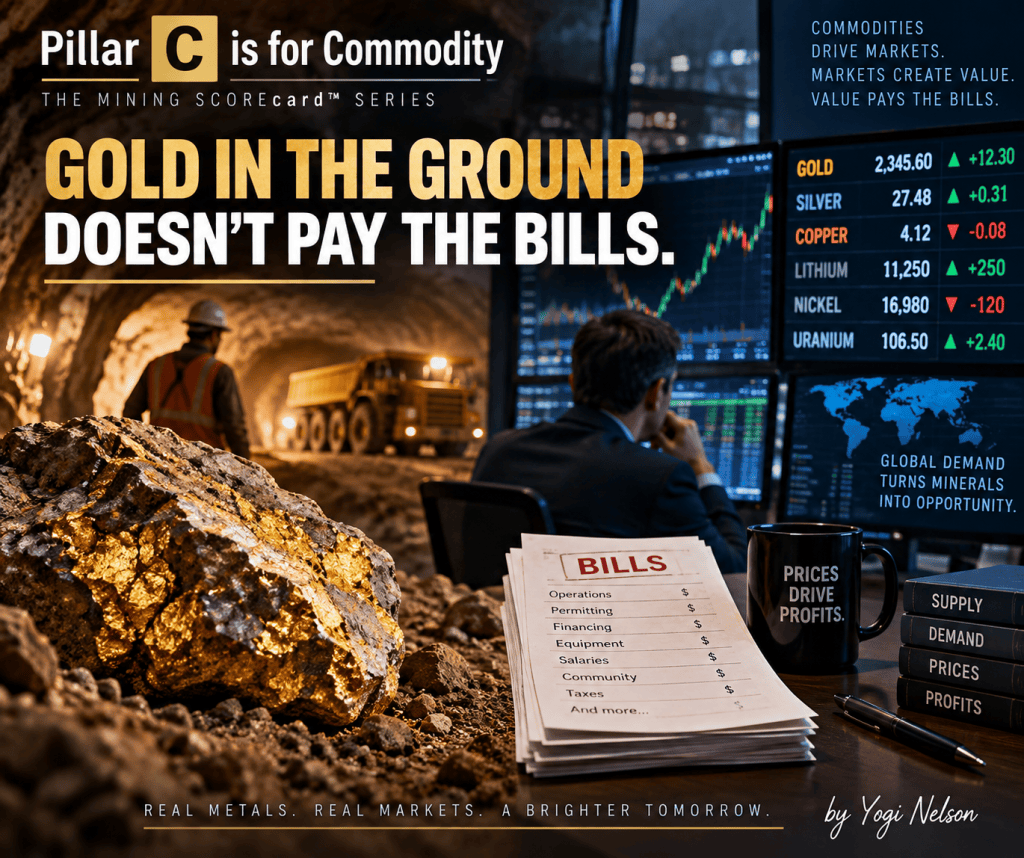
Pillar “C” Is for Commodity: Gold in the Ground Doesn’t Pay the Bills

by Yogi Nelson

Previously, I mentioned the Mining SCOREcard™  starting with Pillar 1: Strategy & Stewardship.  The basic premise: Rocks don’t make decisions. People do.  Now we move onto Pillar 2: “C”, Commodity.

Management may be mining superstars. The geology may be exciting. Drill results may look terrific. All fantastic.  Nevertheless, eventually somebody must be willing to part with their legal tender for the gold, silver, copper, etc.  Unless companies can earn a profit, it’s all a big waste of time and money.  Who needs that?  No one reading these articles!
Start With Simple Questions

Start with the fundamentals:  What exactly is this company trying to find or produce—and why do I want exposure to it?

Gold, silver and copper all come out of mines. But are they identical commodities?  No way! Gold is simultaneously a commodity, monetary asset, investment vehicle and store of value.  Yes, all of those.  Copper, aka Doctor Copper, is fundamentally an industrial metal whose demand is closely connected to construction, manufacturing, electrical infrastructure and economic activity.  What about silver?  Silver lives somewhere in between, combining monetary and investment characteristics with substantial industrial demand. Ultimate combo!

That means investing in a junior gold company is not necessarily the same investment thesis as investing in a junior copper company or silver company.  Before evaluating the company, understand the commodity.

A Great Deposit at the Wrong Price

Prices matter enormously because mining companies do not control commodities prices.  They are subservient to the market–supply and demand. 

Consider.  Apple can raise iPhone prices (and they always do). A restaurant can increase the price of dinner.  Can a gold miner simply announce that it will sell gold at another $500?  Nope! Gold prices are set at the world level not at the gold mine.  That creates an interesting investment problem.

Suppose a junior mining company publishes an economic study showing an attractive project at $3,000 gold. What happens if gold falls to $2,300?  Or suppose a copper project looks marginal at $4.00 copper but extraordinarily profitable at $5.50.  What to do? 

The answer depends partly on the commodity-price assumptions underlying the analysis. This is why I don’t evaluate a mining project only at today’s spot price. Mines can take years—or decades—to discover, permit, finance, construct and operate. Today’s commodity price is important. Tomorrow’s may matter more.

Supply and Demand Still Matter

Commodity markets are often shrouded by narratives, not necessarily false ones.  For instance, Copper is essential for electrification. Silver benefits from solar demand. Gold protects against monetary instability. All narratives may contain considerable truth. But a good story is not enough. I want to understand what could change or reinforce the story.

On the supply side: Where does new production come from? How long does it take to develop new mines? Are ore grades declining? Are major producing jurisdictions becoming politically difficult? Is the industry investing enough capital to replace depleted reserves?

Let’s turn to demand. What industries consume the commodity? How sensitive is that demand to economic growth? Can manufacturers substitute another material? How much demand depends on government policy or subsidies? How important is investment demand?

The purpose isn’t to predict commodity prices perfectly.  I can’t. Who can?  No one. The objective is to understand the forces that could move the commodity market—and therefore the value of the company I am considering.

Don’t Confuse a Commodity Thesis with a Company Thesis

This distinction is particularly important.  I can be extremely bullish on copper and still reject a copper company.  Converserly, can I be neutral on gold and find an unusually attractive gold company?  You bet!

Why?  Simple, a good commodity or strong commodity bull market does not automatically make a good company.

Imagine that I believe copper faces a structural supply deficit over the next decade. Which I do. That’s potentially attractive. But the junior copper company I’m examining has low grades, difficult metallurgy, enormous capital requirements and a project located in a jurisdiction where permitting could take years. My copper thesis may be right while my investment is wrong. The SCOREcard forces me to separate those questions.

Quality Matters Within the Commodity

News flash: two gold deposits containing the same number of ounces can have dramatically different economic value. Grade matters. Metallurgy matters. Recovery matters. Strip ratio matters. Infrastructure matters. Depth matters. Energy costs matter.  What’s more, the relevant variables change depending upon the commodity and deposit type.

A copper porphyry containing billions of tones of relatively low-grade material may potentially support an enormous mine. A narrow-vein underground gold deposit presents a completely different engineering and economic problem. This is why commodity analysis cannot simply be:

Gold? Check.

Copper? Check.

Silver? Check.

The commodity must be examined in the context of how that particular deposit can potentially become an economic mine.

Beware of the Commodity Fashion Show

Mining comes into and out of vogue.  When commodity prices rise, investor enthusiasm tends to follow. Suddenly everybody has the commodity the market wants. Currently, rare earths are the rage. 

A company that was focused on gold yesterday may discover that it has a lithium opportunity today. Tomorrow perhaps uranium becomes fashionable. Next year maybe copper That doesn’t automatically mean something improper is happening. Markets change, and good management should recognize opportunities.

But my antenna goes up. Does management genuinely possess expertise in the commodity? Is the geological opportunity legitimate? Does the company have a coherent strategy? Or has management simply discovered which commodity currently attracts financing? The distinction matters. A commodity bull market can finance a good strategy. It shouldn’t substitute for one.

Price Assumptions Should Survive Bad Weather

If nothing else the Mining SCOREcard™  should encourage skepticism toward economic models that only work when everything goes right.  When does everything go right? 

If a project requires historically exceptional commodity prices to generate acceptable returns, red alert.  I prefer: a project that remains economically interesting under conservative assumptions and becomes spectacular under favorable conditions.  Hope is not a strategy. Commodity markets are volatile. Mining investors should expect  and be violent market turbulence–category 4 and 5 hurricane storms!

Commodity Is About Context

The Commodity pillar therefore asks something much deeper (pun intended!) than: What metal is in the ground, it asks:

What drives demand for that commodity? Where does supply come from? How cyclical is the market? What could substitute for it? What commodity price does the project require? How sensitive are project economics to changes in that price? Does this particular deposit possess characteristics that could allow it to compete through different commodity cycles? Those questions help me distinguish between owning a good geological story and owning an economically resilient mineral asset.

The Second Letter in SCOREcard–“C”

The Mining SCOREcard™ begins with people because people allocate capital and make decisions. Then comes the commodity because even excellent management operates within markets it cannot control.

S — Strategy & Stewardship asks whether I trust the people.

C — Commodity asks whether I understand the market in which those people must compete.

Neither question guarantees investment success. Nothing does.  Asking both may avoid a surprisingly common mistake: falling in love with a mineral deposit without asking whether the world will ultimately pay enough for what comes out of it.

Next, I’ll move to the third pillar of the Mining SCOREcard™:  O — Opportunity.  Because once I understand the people and the commodity, I want to know something else:  How much value could actually be sitting there waiting to be created?

Sincerely,

Yogi Nelson

Yogi Nelson, finance, Gold, Mining, precious-metals, Governance, Risk Management, Copper

The Rocks May “Rock”, But Can Management Roll?

Strategy & Stewardship — The First Pillar of the Mining SCOREcard™

by Yogi Nelson

The question contained in the title of this article is a fundamental question investors must ask themselves when evaluating a junior mining company. Precisely for that reason, in my introductory article to this series, I explained how my interest in gold and junior mining eventually led me to develop the Mining SCOREcard™. The SCOREcard includes a section dedicated exclusively to Strategy and Stewardship. I felt obligated to start with strategy and stewardship because, as I studied the industry, one lesson became increasingly clear: a great mineral deposit does not necessarily make a great investment.

As my son, who was 13 at the time, said to me—obvious! Nevertheless, when we look at junior mining companies, it is remarkably easy to become fascinated by geology. We read about drill intercepts, grades, resource estimates, potential extensions and discoveries that management describes as “world-class” or “transformational.” It’s as if we were hit by falling rocks and we lose perspective!

Having said that, rocks matter. Of course they do—a lot. However, no rock in the history of mining has made a decision. It just sits. In other words, rocks don’t make decisions. People do. Naturally, that is why the first pillar of my Mining SCOREcard™ is S — Strategy & Stewardship.

What Do I Mean by Strategy & Stewardship?

Strategy asks a fairly simple question: Does management have a credible plan for creating shareholder value?

Stewardship asks another: Can I trust these people to manage shareholder capital responsibly while pursuing that plan?

Those questions sound straightforward. Answering them isn’t.

Junior mining companies operate under unusual conditions. Almost none have revenue. Exploration companies may spend millions of dollars without knowing whether they will discover an economically viable deposit. They regularly return to capital markets for additional financing. Consequently, that makes management particularly important.

When I evaluate Strategy & Stewardship, I look at areas including the investment thesis, CEO and executive-team quality, Board composition, management’s discovery or mine-building track record, capital allocation, insider ownership, corporate governance, strategic vision, communication and transparency, and alignment with shareholders.

But the SCOREcard is not intended simply to check boxes. Checking boxes is for junior analysts, but not for senior analysts of junior mining companies. The SCOREcard is about asking questions!

What Exactly Is the Strategy?

Suppose an exploration company tells investors: “We intend to discover a multimillion-ounce gold deposit and sell it to a major mining company.” Is that a strategy? Maybe—maybe not. It all depends. It could be a hope, a dream, or something in between.

A wise investor would ask: How large a deposit? What grade? What metallurgy? In what jurisdiction? At what stage does management intend to sell? What type of company would realistically acquire it? What evidence suggests that management has the experience to get the project to that point?

In other words, “Discover gold and sell the company” may be an aspiration. It isn’t necessarily a strategy.

I want management to explain in plain English the strategy, not just declare it.

Who Is Managing My Money?

I have spent much of my professional career around governance, compliance and public administration. Perhaps because of that background, I tend to look beyond biographies and titles.

A CEO may have 25 years of mining experience. That sounds impressive. But what kind of experience?

Running operations for a major producer is not necessarily the same as managing a cash-constrained junior explorer. Does the CEO know how to allocate scarce exploration capital? Raise money? Manage dilution? Communicate with junior-mining investors? Build and retain a strong geological team?

And where the CEO lacks experience, has management built a team and Board that compensate for those weaknesses?

I don’t expect executives to know everything. In fact, I am impressed by those who are self-aware enough to know what they don’t know.

Capital Allocation May Matter More Than Capital Raising

Junior miners need money. That means dilution is often unavoidable. I therefore don’t automatically consider dilution evidence of poor stewardship. That is not the right question. For my money, I ask: What did management create with the capital it raised?

Imagine a company increases its share count substantially but uses that capital to expand a resource from 500,000 ounces to 3 million ounces and complete a positive economic study.

Was that bad dilution? Not necessarily. The better question is whether management created more value per share than it surrendered through dilution. The distinction is important.

Dilution is not necessarily the enemy. Value-destructive dilution is.

I also want to know who participated in financings and on what terms. A long-term strategic or institutional investor may behave differently from investors chasing short-term momentum. Large investors can also create concentration and influence risks.

Financing changes more than the number of shares outstanding. It can change the character of the shareholder base.

Independence Is More Than a Label

Board independence is essential. A director may officially be described as “independent,” but I want to understand that person’s relationships with management and the company. Don’t fall for the label on the wine; taste the wine to see if it is authentic.

Who nominated the director? Does the director have significant business relationships with the CEO? Does the director receive consulting fees? How are conflicts handled? Are important Board committees genuinely independent? More importantly, is there evidence that directors actually challenge management?

Independence is not merely a director’s label. It is a relationship to management—and ultimately a pattern of behavior.

Promotion Versus Evidence

Junior mining is also a promotional business. Management needs investors. Investors need a reason to provide capital. I therefore expect some salesmanship. Words such as “exceptional,” “transformational” and “world-class” don’t particularly impress me. Instead, I go to the source.

What do the regulatory filings and independent technical reports actually say? Do the grades, widths, continuity, metallurgy and economics support management’s enthusiasm? If management’s presentation is enthusiastic while the technical evidence is strong, I may simply be looking at normal salesmanship. But if management’s language repeatedly outruns the evidence, I have a stewardship problem.

Promotion is not necessarily a governance weakness. Promotion that consistently outruns the evidence is.

Red Flags Are Questions, Not Convictions

Developing the SCOREcard has also reminded me of something about my own analytical approach. I am naturally skeptical, and after 33 years in government and politics, well, what can I say…

When I see excessive compensation, frequent dilution, promotional communications or related-party transactions, my antenna goes up. However, a red flag is not necessarily a verdict. Life has many surprises. Therefore, there may be reasonable explanations. My job as an investor is to identify the concern, develop plausible alternative explanations, examine the evidence and then reach a conclusion.

In other words: Identify the red flag. Develop the innocent explanation. Test both against the evidence. Then score it. That discipline matters because several individually explainable issues can also form a troubling pattern.

High compensation may be explainable. Dilution may be explainable. Promotional communications may be explainable. Related-party transactions may be explainable. But if all four consistently benefit insiders at the expense of shareholders, I may be looking at something very different.

Great Geology Is Not Enough

Let’s return to the reason Strategy & Stewardship is the first pillar of the Mining SCOREcard™. It’s important.

A company can control an extraordinary mineral deposit and still destroy shareholder value through poor financing decisions, excessive dilution, bad acquisitions, weak governance or self-dealing. Conversely, capable and disciplined management can sometimes create substantial shareholder value from an asset that initially appears less spectacular.

The asset and its stewards therefore have to be evaluated separately. For me, the ultimate Strategy & Stewardship question is surprisingly simple: Do I trust these people to allocate my capital intelligently and ethically over the many years it may take to turn geological potential into shareholder value?

If I cannot answer that question satisfactorily, excellent drill results alone may not be enough.

Next week, I will move to the second pillar of the Mining SCOREcard™:

C — Commodity.

Because after deciding whether I trust the people managing my investment, I want to understand exactly what commodity—and what kind of economic opportunity—I am investing in.

Sincerely,

Yogi Nelson

Artificial Intelligence, Banking, Blockchains, cryptography, International Finance, Uncategorized

GENISUS Act: Implications for Stablecoin Issuers

  1. Maintain reserves backing the issuer’s payment stablecoins outstanding on an at least 1 to 1 basis comprising of: U.S. Dollars, demand deposits held in U.S. banks, treasury bills, notes, and bonds of 93 days or less, repurchase agreements of seven days or less, money market funds, Central Bank reserve deposits.  In other words, liquid reserves that are 1-to-1. 
  2. Issuers must also publicly disclose their redemption policy, establish procedures for redemption, and publish monthly composition of the issuer’s reserve. Disclosure!
  3. Monthly compliance certificates from the issuers, CEO and CFO.
  • Issue payment stablecoins
  • Redeem payment stablecoins
  • Manage related reserves
  • Provide custodial or safekeeping services for payment stablecoins
  • Other directly related work.