Board of Directors, Copper, Environment, finance, Gold, International Finance, Lithium, Mining, Nickel, palladium, platinum, precious-metals, Silver, Uncategorized, Yogi Nelson

Pillar “O”is for Opportunity—Could, Might, Maybe…Show Me!

Opportunity — The Third Pillar of the Mining SCOREcard™

by Yogi Nelson

Welcome to the third pillar of the SCOREcard: O for Opportunity! This is where junior mining investing gets really interesting–potential profits or dollar disaster! No longer is the question what does the company have today. We ask what it might have tomorrow. Keep in mind, the word “might” could mean possibility or strength!

What Are We Really Buying?

Invest in a junior mining company, equals buying an unfinished business. There may be no mine. No revenue. No earnings. Perhaps not even a defined mineral resource. Ouch! If true what am I buying? The big “O”–Opportunity.

Maybe the company has a substantial resource that could become a mine. Or drilling could expand the existing deposit. Perhaps the company controls an entire district containing multiple targets. What if management believes the geology suggests something much larger than anything yet demonstrated. Note the modal verbs in bold, e.g. could, maybe, believes, etc. Are there possibilities? Yes. Could there be value. Yes. Show me–yes!

Existing Value: Show Me What You Have

Start with Existing Value. What has the company already demonstrated? Not press releases? Technical studies from creditable sources. Has it identified a mineral resource? How large is it? What is the grade? How much is inferred, indicated or measured? Has metallurgy been tested? Has the company completed an economic study?

In other words: Show me what you have—not what you hope you have.

This distinction matters. Under established mining disclosure standards, confidence increases as resources move from inferred to indicated to measured. A resource is not automatically a reserve, and mineralization is not automatically an economically viable mine. Sounds like technical or legalse, right? Not to a sophisticated investor using the SCOREcard. They are fundamental.

A million ounces demonstrated through sufficient drilling and geological work are not comparable to management saying, “We think there could be several million ounces here.” Could they be right? Who care! Don’t give equal points for evidence and enthusiasm.

Expansion Value: Can It Get Bigger?

Next comes Expansion Value. Suppose the company has already discovered a legitimate deposit. Excellent. Now I want to know: Is that all there is?

Perhaps the deposit remains open along strike. Maybe it remains open at depth. Maybe additional drilling between existing holes could add ounces or increase geological confidence. Maybe, perhaps, could be, etc. Keep in mind, opportunity without uncertainty wouldn’t be opportunity—it would already be value. That’s the right sentiment.

This is one of the attractions of junior mining. A company can create value not only by finding a deposit but by demonstrating that the deposit is considerably larger than originally believed. But again, show me the evidence.

Where are the existing drill holes? Where is the mineralization open? What geological evidence suggests continuity? Is management drilling logical extensions of something already discovered, or drawing colorful arrows on a presentation? Arrows are cheap. Drill holes are not.

District Value: One Deposit or Something Much Bigger?

District is the word every explorer or junior mining company dreams. A world of multiple deposits. Various types, e.g. gold, copper, and silver. Many deposits. Oh the joy! District Value is the term.

Perhaps the flagship deposit is only the first discovery. Nearby targets may share the same geological structures, alteration patterns or mineralization. There may be multiple deposits capable of eventually sharing roads, power, processing facilities and other infrastructure. The opportunity potentially changes.

“How big can this deposit become?” is the inquiry. That’s a much bigger question. However, big claims require bigger evidence. After all, we all know land packages look wonderful on investor presentations. Thousands of hectares sound impressive. But owning a large amount of dirt doesn’t necessarily mean you own a large amount of value. I want to know why management believes additional deposits exist.

Geophysics? Geochemistry? Surface samples? Historic workings? Previous drilling? Geological analogues?Investors need to take the Missorui motto to heat: Show me the evidence.

Blue Sky: Where Dreams Meet Drill Bits

Finally, we arrive at perhaps the most exciting phrase in junior mining: Blue-sky potential. This is where to quote Linda Ronstadt: “Its so easy to fall in love, its so easy to fall in love…” Everyone loves a blue sky, including your truly. The possibility of a transformational discovery is one of the reasons people invest in junior explorers in the first place.

A few drill holes can sometimes completely change how the market views a company. Red alert–blue sky is also where imagination can outrun evidence. Management presentations are filled with words such as “potential,” “prospective,” “district-scale,” “world-class” and “analogous.” Sure. Maybe.

The Mining SCOREcard™ doesn’t tell me to ignore blue-sky potential. Quite the opposite. I want to identify it. I put it in the correct box: Conceptual Opportunity. Conceptual opportunity deserves consideration, not necessary your dollars.

Not All Ounces Are Created Equal

Opportunity isn’t merely about getting bigger and better. I’ll explain. Suppose additional drilling adds another million ounces of gold. Wonderful. But where are those ounces?

Are they close to existing infrastructure? Are they deeper? Lower grade? Metallurgically complicated? Do they potentially extend mine life? Could they improve project economics? In other words, more isn’t automatically better.

The same principle applies to resource conversion. Drilling that converts inferred resources into higher-confidence categories may not produce a spectacular headline. No giant new discovery. No fireworks. Yet reducing uncertainty can create substantial value. Sometimes proving what you already think you have is just as important as discovering something new.

Catalysts Matter

Does opportunity have a time dimension–it sure does. I want to know what catalyst could cause a re-rate of market value, e.g. drilling, permitting, etc.

I also ask another question: How much money will it take to get there?

A company may have extraordinary geological opportunity but require $50 million of additional exploration before investors know whether the thesis works. Where does that money come from? Remember our first pillar: Strategy & Stewardship. Opportunity does not exist in isolation from capital allocation.

Opportunity Must Be Earned

The Mining SCOREcard™ therefore separates Opportunity into four broad categories:

Existing Value — What has already been demonstrated?

Expansion Value — How much larger or better could the existing deposit become?

District Value — Could the property contain multiple deposits or a much larger mineralized system?

Conceptual Opportunity — What plausible blue-sky potential exists beyond what has been demonstrated?

As we move down that list, potential may increase; certainty decreases. That’s the trade-off. The purpose of the SCOREcard isn’t to eliminate speculation. Junior mining would be pretty boring without speculation! The purpose is to distinguish informed speculation from wishful thinking. We can recognize extraordinary potential without pretending that potential has already become reality. That’s Opportunity and it requires a Show Me attitude!

Sincerely,

Yogi Nelson
Austrian economics, Banking, Board of Directors, Gold, Governance, International Finance, Mining, Silver, Yogi Nelson

I Wasn’t Always a “Gold Bug”: How Geopolitics Changed My Thinking About Money

by Yogi Nelson

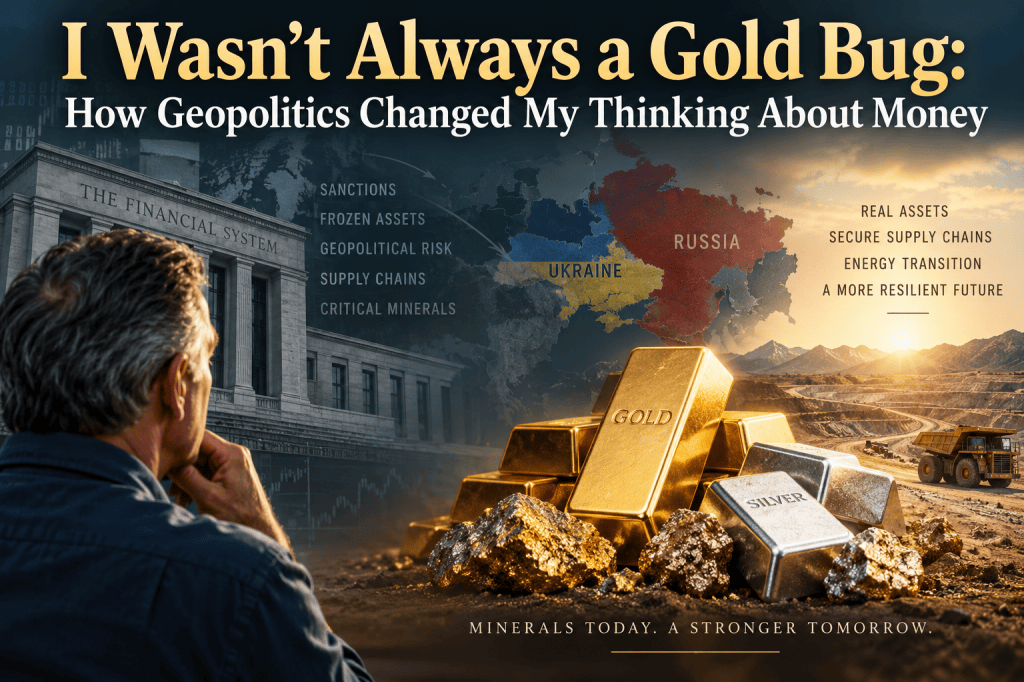
I no longer have complete faith in the USA’s financial system. That is a significant statement from someone who spent years in the federal government as a bank examiner and compliance expert. What triggered the conversion—the ever-growing USA national debt. In other words, I wasn’t always a sound money guy nor a “gold bug.” My evolution has become a much deeper intellectual journey.

The journey began in 2022. As the war between Russia and Ukraine unfolded, one event in particular caught my attention: the decision by the United States and its allies to freeze $300B of Russia’s foreign exchange reserves. Whether one agreed with the war, or the response of the USA and its friends, it demonstrated that assets held within the USA financial system, or under the control of any third party, can be subject to geopolitical risk. Moreover, the geopolitical importance of critical minerals has become increasingly apparent as governments compete to secure resilient supply chains for technologies, defense, and industrial development. When I fully realized the facts, it caused me to think more seriously about owning tangible stores of value such as gold and silver and, eventually, investing in the companies that discover and produce them.

Like many investors, I quickly learned that buying shares of large mining companies is very different from buying physical gold or silver. It’s also not the same as buying gold or silver through an ETF. And it’s definitely not identical to purchasing shares of a junior miner. In the junior mining space, a company can have an outstanding deposit and still become a poor investment. Actually, to be fair, this can happen with large miners, but it is less likely. Conversely, an average deposit, managed by exceptional people with disciplined capital allocation, can create significant long-term value. At that point, I knew I had to study the mining industry more systematically. That’s when the education began in earnest.

I started by reading books such as The Art of Investing in Junior Miners, How to Invest in Gold and Silver, and Mining Is Dead. Long Live Geopolitical Mining, while also working through The Geology of Ore Deposits to deepen my understanding of the technical foundations of mineral deposits. The number of mining articles is too many to mention. And, in July, I attended the Rule Symposium in Florida; it was a fantastic event.

With a background in compliance and audits, I naturally gravitated to those issues within the mining sector. I find that I learn most when I am compelled to explain what I learned after reading about a topic. Hence, I decided to write a book on the topic of board governance in junior mining based on my extensive knowledge of governance issues and what I have learned thus far about mining companies. The book, Board Governance for Junior Miners: Discipline, Structure, Investor Alignment in High-Risk Ventures, is essentially a manual on what makes for great governance in junior mining.

While governance is essential, I came to appreciate that it represents only one dimension of evaluating a mining company. As a result, I began developing what I call the Mining SCOREcard™—a structured framework designed to evaluate junior mining companies across five dimensions:

  • Strategy & Stewardship
  • Commodity
  • Opportunity
  • Risk
  • Execution

The objective is not to predict share prices or recommend specific stocks. Rather, it is to create a disciplined, repeatable process for asking better questions before committing capital.

Over the coming weeks, I’d like to share some of the lessons I’ve learned while building this framework and studying the mining industry. Rather than focusing on market predictions, I’ll explore ideas that I believe remain valuable regardless of where we are in the commodity cycle.

The topics will include:

  1. Why Most Junior Mining Investors Lose Money
  2. The Difference Between Speculation and Analysis
  3. Why Great Deposits Don’t Always Become Great Investments
  4. Five Questions Every Mining Investor Should Ask
  5. Why I Began Developing the Mining SCOREcard™
  6. Lessons Learned While Building a Structured Mining Evaluation Framework

These articles are designed to encourage thoughtful discussion among investors, geologists, mining professionals, and anyone interested in the fascinating intersection of geology, finance, governance, and geopolitics. As always, I welcome your comments, questions, and differing perspectives. Some of the best ideas emerge from thoughtful conversation.

Sincerely,

Yogi Nelson

Banking, Blockchains, cryptography, Digital Currency, Euro, European Central Bank, Uncategorized

Will Europe Adopt a Digital Euro? Key Insights from the ECB

https://www.ecb.europa.eu/euro/digital_euro/progress/html/ecb.deprp202406.en.html

Artificial Intelligence, Blockchains, China, international aid

IS CHINA USING ITS INTERNATIONAL AID TO PROMOTE ITS ARTIFICIAL INTELLIGENCE TECH AND GAIN MARKET DOMINANCE IN DEVELOPING COUNTRIES?

Namaste Yogis.   Welcome to the Blockchain & AI Forum, where your technology questions are answered!   Here no question is too mundane.  As a bonus, a proverb is also included.  Today’s question, was submitted by Marcia in Palmdale, CA and she wants to know is China using its international aid to advance use of its artificial intelligence technology and gain market dominance in developing countries?

Marcia, you came to the right place.  You ask a tough question, fortunately there is an organization headquartered in Santa Monica, CA that researches the subject and their name is RAND.  RAND stands for Research and Development Corporation. Let’s understand RAND then answer your specific question.  

RAND is a non-profit public policy research organization.  RAND was established in 1948 with the intent of providing non-partisan policy research and analysis.  Almost 100% of RAND’s 1,800 research staff members have either a Ph.D. or master’s degree.   With seven offices spread across the globe in the USA, UK, and Australia, RAND has a worldwide audience.  Last year RAND launched 800+ new research projects funded by more than 350 clients.  RAND conducts policy research across 10 subjects, including national security.  Bottom line–RAND is an impressive research organization consisting of brainy people.  Holy nerds, Batman!  Now let’s turn to the question asked by Marcia.

According to RAND, at $85B per year, China is the world leader in development finance.  USA development finance falls a far second at only $45B per year.  RAND says, Chinese tech companies can use this large government funding support to deploy state-of-the-art artificial intelligence (AI) tools in development contracts in recipient countries. And therefore, the AI exports facilitated by these arrangements are likely to bolster China’s growing global AI technology-related supply chains, trade flows, technology standards, and regulatory systems.  In other words, when China provides development finance (aid) to Pakistan, for example, the contract with Pakistan, will include conditions that require Pakistan to use Chinese AI technology.  Holy foot in the door, Batman! 

Given the situation, RAND’s national security team was contracted (they don’t say by whom, but you can safety assume a branch of the U.S. government) to explore two questions:

1.  How can China’s AI exports be systematically tracked and analyzed using reliable data sources?

2.  What would promote a better understanding of the global landscape of China’s AI exports?

China does not participate in the International Aid Transparency Initiative.  Hence, researchers tracked Chinese development finance by receiving countries. Researchers used OCED (Organization for Economic Cooperation and Development) data in their research. The dataset captured all official financial and in-kind commitments from China from 2000–2021 to developing countries.

First, let’s look at the published findings of the 33-page report.   https://www.rand.org/pubs/research_reports/RRA2696-1.html  followed by a few words regarding unpublished findings, as perhaps those too are interesting. 

Reported Findings:

  • Researchers discovered 155 AI applications and AI infrastructure projects that were exported to 64 countries
  • The researchers used GIS to map their findings.  Although Pakistan was the largest beneficiary, the map clearly shows most Chinese aid was dedicated to African nations.   

Unreported Findings:

The report has six blank pages and no explanation for the blank pages is offered. The blank pages are not labeled, “Intentionally Left Blank”.  The pages are simply blank with no explanation whatsoever.  And no mention of what who paid for the report!  Holy mystery, Batman!

I end with a proverb from Pakistan:  The friend appears in hard times, not at big dinners.

Until next time,

Yogi Nelson