Blockchains, Environment, finance, Governance, Mining, Nickel, tokenization, Uncategorized, Yogi Nelson

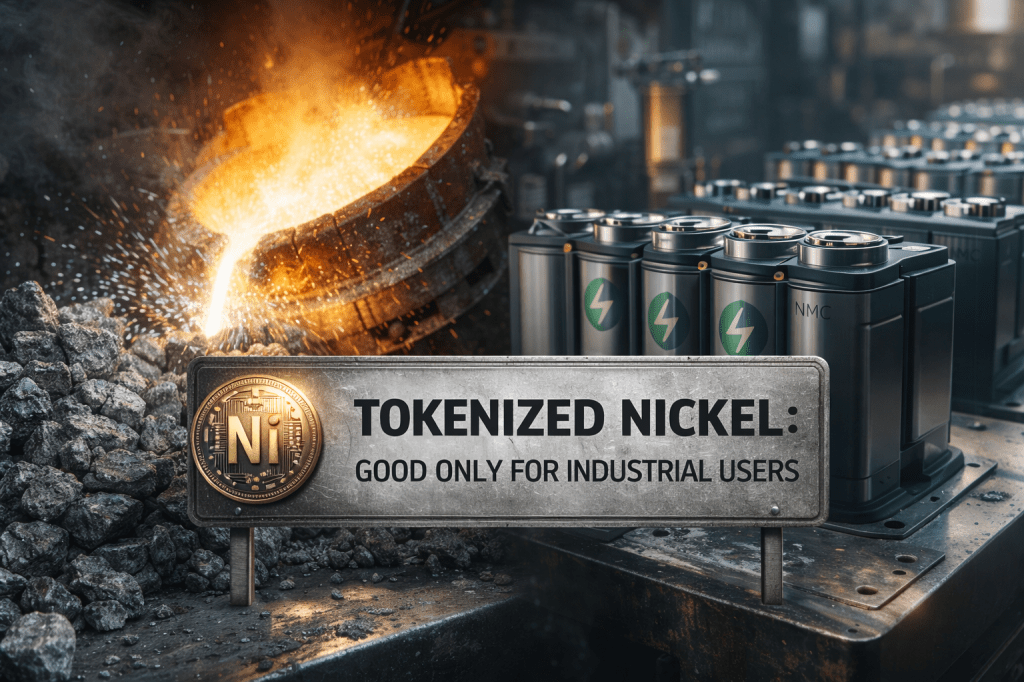
Tokenized Nickel: A Critical Metal for the Clean Energy Transition

by Yogi Nelson (Nelson Hernandez)

Nickel seldom demands the spotlight. It infrequently carries the mystique of gold, the dual identity of silver, or even the growing narrative momentum of copper and lithium. Yet beneath that relative obscurity lies a reality that is becoming increasingly difficult to ignore: nickel is a foundational material in the clean energy transition.

It plays a central role in battery chemistry, industrial production, and the infrastructure of a modern, electrified economy. And as demand accelerates, so too does the complexity of its supply chain. This raises a familiar—but evolving—question:

Can a metal defined by industrial use, chemical variation, and global fragmentation be effectively tokenized on the blockchain?

Or more precisely: Is nickel another candidate for tokenization—or a reminder that not all critical materials are easily digitized? Those questions and others to be answered below, but first what is nickel?


What Is Nickel?

Nickel is a silvery-white metal known for its strength, corrosion resistance, and high-temperature stability. It has been used for over a century in industrial applications, but its importance has grown significantly in recent decades. What are its properties:

  • Resistance to corrosion and oxidation
  • High melting point
  • Strength and durability
  • Ability to form alloys with other metals

Nickel is rarely used in pure form. Instead, it is typically combined with other metals to enhance performance characteristics.


Where Is Nickel Mined?

Nickel production is geographically concentrated, with a few countries dominating global supply.

Major producers in order of production include:

  • Indonesia — the world’s largest producer, with rapidly expanding output
  • Philippines — significant supplier of laterite nickel ore
  • Russia — major producer, particularly of high-grade nickel
  • Canada — stable and high-quality production
  • Australia — significant reserves and mining operations

Nickel is extracted from two primary types of deposits:

  • Sulfide deposits (higher grade, easier to process)
  • Laterite deposits (more abundant, but more complex and energy-intensive to refine)

This distinction matters because:

  • Not all nickel is equal
  • Processing methods affect cost, quality, and usability

What Is Nickel Used For?

Nickel’s value lies in its versatility. Nickel stands as the fifth most commonly used metal behind: iron, copper, aluminum, and silver.

1. Stainless Steel (Primary Use)

Approximately 65–70% of global nickel demand is tied to stainless steel production. When iron is transformed into steel, nickel joins the production process. Nickel is used to improve corrosion resistance, strengthen toughness, and performance at high and low temperatures. Here is a short list of uses:

  • Used in construction
  • Industrial equipment
  • Consumer goods

This is the traditional foundation of nickel demand.


2. Batteries (Fastest Growing Use)

Nickel is a key component in lithium-ion battery chemistries, particularly:

  • Nickel-Manganese-Cobalt (NMC)
  • Nickel-Cobalt-Aluminum (NCA)

Higher nickel content in batteries results in:

  • Increases energy density
  • Extends vehicle range

This is why nickel is central to electric vehicles. Tesla, BYD, and all EV manufacturers need nickel. No nickel no EVs.


3. Energy and Industrial Applications

Nickel is also used in:

  • Aerospace alloys
  • Turbines and power generation
  • Chemical processing equipment

Nickel is both an industrial and strategic material. Recognizing the importance of nickel, the US government listed nickel as a critical mineral in 2022.


Why Nickel Demand Is Rising

Nickel demand is being pulled in two directions simultaneously:

1. Traditional Industrial Demand

  • Infrastructure development
  • Manufacturing growth
  • Stainless steel consumption

2. Energy Transition Demand

  • Electric vehicles
  • Battery storage systems
  • Renewable energy infrastructure

Nickel demand for batteries alone is expected to grow significantly over the next decade, driven by EV adoption and energy storage needs. This creates a dual-demand structure:

  • Stable base demand
  • Rapidly expanding new demand

Why Nickel Is a Candidate for Tokenization

Nickel presents an interesting—but complex—case for tokenization.

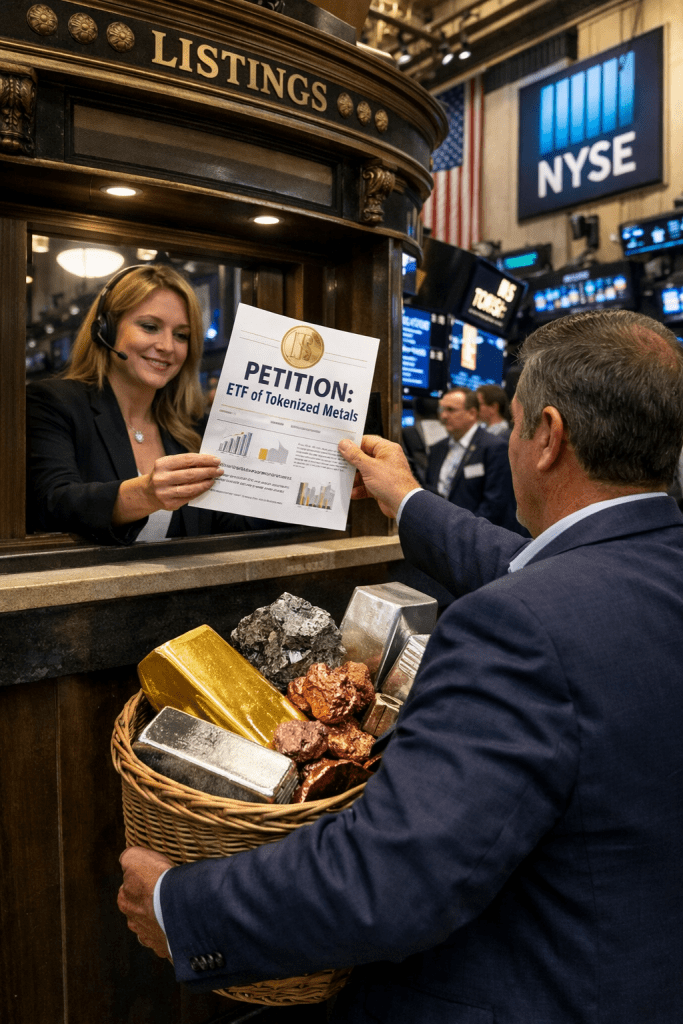
Unlike gold, or even silver to some extent, tokenization is not about preserving value. And as opposed to lithium, nickel is not purely about energy storage. Despite sitting outside of those considerations, there may be reasons for tokenization. Let’s examine those below.


1. Global Liquidity

Nickel is actively traded on major exchanges, including the London Metal Exchange (LME). This provides:

  • Price discovery
  • Market depth
  • Existing financial infrastructure

For tokenization to work effectively liquidity must be present in the market place. The nickel market has liquidity.


2. Industrial Relevance

Nickel is essential across multiple sectors:

  • Construction
  • Manufacturing
  • Energy

This broad utility supports:

  • Consistent demand
  • Ongoing market activity

Liquidity and industrial relevance push the possibility of tokenized nickel toward viability. Let’s go to step three.


3. Warehouse and Inventory Systems

Nickel is already stored in:

  • Exchange-approved warehouses
  • Industrial storage facilities

This creates a potential foundation for:

  • Token-backed inventory models
  • Digitized ownership

Warehouse and inventory systems combined with liquidity and industrial relevance create the environment where tokenization is possible. Yet, there is one more factor–strategic importance. Nickel is valued by major economic and military powers.


4. Strategic Importance

Nickel is a critical mineral, according to the US government, European Union, Canada, Australia, Japan, United Kingdom, India, and China. There may be others, but you get the point. In other words, every major economic power. Russia is missing most likely because they are a major silver producer and therefore are not concerned with securing supply. As a critical mineral that means governments are monitoring supply chains and nations have or will develop supportive policy frameworks.

This increases demand for:

  • Transparency
  • Traceability
  • Verification

How Tokenized Nickel Might Work

Tokenization of nickel would likely follow several possible models.


1. Warehouse-Backed Tokens

  • Each token represents a specific quantity of nickel
  • Stored in verified facilities
  • Audited regularly

Similar to gold—but with more complexity. Sophisticated players only.


2. Supply Chain Tracking

Tokens track nickel through stages:

  • Mining
  • Processing
  • Manufacturing

This could improve:

  • Transparency
  • Efficiency
  • Coordination

3. Contract-Based Tokenization

Tokens tied to:

  • Future production
  • Offtake agreements

This introduces:

  • Financing opportunities
  • Legal complexity

The Case AGAINST Tokenizing Nickel

Variability in Material

Nickel exists in multiple forms and grades:

  • Class 1 nickel (high purity, battery-grade)
  • Class 2 nickel (lower purity, stainless steel use)

This complicates standardization and tokenizations works best under standardized conditions.


Processing Complexity

The value of nickel depends heavily on:

  • Refining method
  • End-use application

Tokens must reflect these differences accurately. The solution might include NFTs.


Supply Chain Fragmentation

Nickel moves through multiple jurisdictions and stages. Tracking this reliably is difficult albeit not impossible.


Limited Retail Investment Appeal

Unlike gold, nickel is not held as an investment asset. Thus, tokenization may be driven more by specialized industry users than investors.


Governance Considerations

As with all tokenized metals, governance is central.

Key issues include:

  • Proof of reserves
  • Audit transparency
  • Legal ownership rights
  • Redemption mechanisms

In nickel, these issues are amplified by:

  • Multiple grades and classifications
  • Complex processing chains
  • Cross-border logistics

Without strong governance, tokenized nickel risks becoming:

  • Technically feasible
  • Practically unreliable

Final Thoughts

Nickel occupies a unique position in the evolving tokenization landscape. Nickel is:

  • Industrial
  • Strategic
  • Increasingly essential

But it is also:

  • Variable
  • Complex
  • Difficult to standardize

Tokenizing nickel is not about creating a new digital asset for investors. It is about improving how a critical material moves through the global economy. If tokenization succeeds it won’t be due to retail market enthusiasm. Nope. It will be because the industrial system demands:

  • Greater efficiency
  • Better transparency
  • Stronger coordination

And as always:

Structure—not story—will determine whether tokenized nickel becomes a meaningful innovation—or simply another digital experiment.


Until next time,


Yogi Nelson (Nelson Hernandez)
Blockchains, Digital Currency, finance, Governance, Lithium, Mining, tokenization, Yogi Nelson

Tokenized Lithium: Web3’s Entry Into the EV Battery Supply Chain

by Yogi Nelson (Nelson Hernandez)

Lithium is not a store of value.
It is not a hedge.

Lithium is energy—stored, deployed, and essential to electrification.

It powers:

  • Electric vehicles
  • Energy storage systems
  • The infrastructure behind renewable energy

And demand is accelerating.

  • Lithium demand is expected to grow more than 4x by 2030
  • EVs now account for 70–80% of total lithium consumption
  • Global EV sales could exceed 40 million units annually by 2030

👉 This is not cyclical.
👉 This is structural.

So the question becomes:

Can lithium be tokenized?

Unlike gold, lithium is not about storing value.
It moves through a complex global supply chain:

Mine → Refinery → Battery → End use

👉 That makes tokenization less about investment…
…and more about transparency, coordination, and verification.

If Web3 has a real role in commodities, lithium may be where it begins.

Not because it is simple—
…but because it is necessary.

And as always:

Structure—not story—will determine what works.

Austrian economics, Banking, Blockchains, finance, Governance, International Finance, Mining, tokenization, Yogi Nelson

Industrial Metals Begin Their Blockchain Moment

by Yogi Nelson (Nelson Hernandez)

Much of the conversation around tokenization has focused on gold and, to a lesser extent, silver. That makes sense—both are stores of value, widely recognized, and relatively standardized.

But a quieter shift is now underway.

Industrial metals are beginning to enter the blockchain conversation.

Unlike precious metals, industrial metals—such as copper, aluminum, and nickel—are not stores of value. They are inputs to the real economy, essential to infrastructure, energy systems, and manufacturing.

So why tokenization?

The answer lies in three areas:

  • Supply chain complexity
  • Demand for transparency and provenance
  • The ongoing financialization of commodities

Tokenization offers the potential to improve tracking, reduce settlement friction, and enhance visibility across fragmented global supply chains.

But challenges remain.

Industrial metals lack the standardization of gold. They vary by grade, form, and end use. That makes token design—and trust—more difficult.

Not all metals are equally viable.
Copper and aluminum may be strong candidates. Raw ore and specialized alloys, far less so.

So is this the next frontier—or premature?

Likely both.

Tokenization of industrial metals is not about creating digital money—it is about modernizing the infrastructure of the real economy.

And as always:

Structure—not story—will determine what succeeds.

Austrian economics, Blockchains, cryptography, Digital Currency, finance, Mining, tokenization, Yogi Nelson

Industrial Metals and the Blockchain: Are They A Match?

by Yogi Nelson (Nelson Hernandez)

Are Industrial Metals Ready to Join the Blockchain World

The conversation around tokenization has, to date, been dominated by precious metals—particularly gold and, to a lesser extent, silver. That focus has been logical. Gold is a store of value, widely recognized, and relatively standardized. Silver, too, has been a store of value for thousands of years and remains so in many parts of the world. Hence, both lend themselves naturally to tokenization. But a quieter shift is now beginning to take shape.

Industrial metals—long defined by their role in production rather than wealth preservation—are starting to enter the blockchain conversation. This development raises an important question: can metals defined by utility, variability, and complex supply chains be effectively tokenized? Or does their very nature resist the structure required for digital representation? Read along to find out, but first we start with a definition: what are industrial metals?

What Are “Industrial Metals”?

Industrial metals are those primarily used in manufacturing, construction, and technology rather than as stores of value, a unit of account, or a medium of exchange. In other words, industrial metals are not money nor currency. While industrial metals don’t function as money, they are the backbone of the real economy. No industrial metals equals no modern society. Consider these common examples:

• Copper  Aluminum

• Nickel  Zinc

• Lead  Tin

What do they all have in common? These metals are essential inputs for:

• Infrastructure and construction 

• Energy systems (including renewables) 

• Electronics and manufacturing 

• Transportation and industrial machinery 

Unlike gold or silver, their value is not driven by monetary psychology; it is driven by economic activity and industrial demand.

Why Industrial Metals Are Now Entering the Tokenization Conversation

Three structural shifts are driving interest in tokenizing industrial metals. Let’s examine each one below.

1. Supply Chain Complexity

Industrial metals move through long, fragmented supply chains:

• Extraction 

• Refining 

• Transportation 

• Storage 

• Delivery 

Each stage introduces friction, opacity, and inefficiency. Tokenization offers the potential to:

• Track ownership more precisely 

• Improve transparency 

• Reduce settlement delays 

In theory, a token could represent a specific quantity of metal at a defined point in the supply chain—creating a more efficient system of transfer and verification. Now, point two.

2. Demand for Transparency and Provenance

As global supply chains come under scrutiny—particularly around environmental and geopolitical issues—there is growing demand for:

• Verified sourcing 

• ESG compliance 

• Chain-of-custody tracking 

Blockchain infrastructure is well-suited to this challenge. Tokenized metals are capable of:

• Recording origin 

• Tracking movement 

• Providing immutable audit trails 

This is particularly relevant for metals used in:

• Electric vehicles 

• Renewable energy systems 

• Advanced manufacturing 

3. Financialization of Commodities

Industrial metals are already heavily traded. Traders often use:

• Spot markets 

• Futures contracts 

• Exchange-traded products 

Tokenization represents a potential next step in the technological evolution—bringing:

• Faster settlement 

• Fractional access 

• New liquidity channels 

However, unlike gold, industrial metals are not typically held for investment. That distinction matters.

How Industrial Metals Might Be Tokenized

We now turn to the “how” in the process. The tokenization of industrial metals can take several forms, each with different implications. Let’s walk through the possibilities.

1. Warehouse-Backed Tokens

The most straightforward model mirrors tokenized gold:

• A token represents a specific quantity of metal 

• Stored in a certified warehouse 

• Backed by documented inventory 

This approach works best when:

• The metal is standardized 

• Storage conditions are stable 

• Inventory is clearly defined 

2. Supply Chain Tokens

A more complex model involves tokenizing metals in motion. This model is much more ambitious—not impossible, just more difficult. If successful, it might look like this:

• Representing metal at various stages (ore, refined, shipped) 

• Linking tokens to logistics data 

• Updating ownership as the metal moves 

3. Production-Linked Tokens

In some cases, tokens could represent:

• Future production 

• Offtake agreements 

• Rights to delivery 

This begins to blur the line between commodities and financial contracts. This, of course, introduces additional layers of risk—a field day for securities lawyers.

Which Industrial Metals Are Strong Candidates?

Not all industrial metals are equally suited for tokenization. Below, they are divided into most viable, moderately viable, and less viable categories based on market structure, standardization, and practical considerations.

Most Viable Candidates

Copper 

• Highly standardized 

• Globally traded 

• Critical for electrification and energy systems 

Strong candidate due to liquidity and uniformity

Aluminum 

• Widely used 

• Standardized forms (ingots, billets) 

• Established global markets 

Suitable for warehouse-backed token models

Nickel 

• Increasing demand (EV batteries) 

• Growing interest in supply chain transparency 

Viable, particularly with ESG tracking

Moderately Viable

Zinc and Tin 

• Smaller markets 

• Less investor attention 

• Still standardized 

Possible, but with limited initial demand

Which Metals Are Less Viable—and Why

Lead 

• Declining industrial relevance 

• Environmental concerns 

Limited investor and institutional interest

Highly Specialized Alloys 

• Non-standardized 

• Variable composition 

• Difficult to verify consistently 

Poor candidates for tokenization

Raw Ore 

• Highly variable 

• Quality differences 

• Requires processing 

Not suitable for direct token representation

The Core Challenge: Standardization vs. Reality

The central issue with industrial metals is not technology—it is standardization. Without standardization, it becomes an uphill climb.

Gold works because:

• One ounce is interchangeable with another 

• Quality is universally defined 

Industrial metals, by contrast:

• Vary by grade 

• Differ by form 

• Depend on end-use requirements 

This creates friction in token design. While tokens can be non-fungible (NFTs), that only adds complexity.

For tokenization to work, the system must answer:

• What exactly does the token represent? 

• Where is the metal located? 

• What are its specifications? 

Without clear answers, the token risks becoming:

• Ambiguous 

• Illiquid 

• Distrusted 

Governance Still Matters

As with precious metals, tokenization does not eliminate the need for governance—it amplifies it.

Key considerations include:

• Custody and storage verification 

• Audit frequency and transparency 

• Legal ownership rights 

• Redemption mechanisms 

In industrial metals, these issues are even more complex due to:

• Supply chain variability 

• Multiple stakeholders 

• Jurisdictional differences 

Without strong governance frameworks, tokenized industrial metals risk becoming:

• Conceptually appealing 

• Practically unreliable 

So—Is This a Real Shift or Premature?

Industrial metals are unlikely to follow the same path as gold or silver. They are not primarily:

• Stores of value 

• Monetary hedges 

They are:

• Inputs 

• Tools 

• Economic enablers 

That distinction means tokenization will likely develop differently. Instead of focusing on investment demand, the more appropriate focus may be efficiency, transparency, and logistics applications.

Final Thoughts

Industrial metals are beginning their blockchain moment—but it will not look like gold’s. This is not about creating digital stores of value. It is about modernizing the infrastructure that supports the real economy using blockchain technology.

The opportunity is significant:

• More transparent supply chains 

• Faster and more efficient transactions 

• Improved verification and trust 

But the challenges are equally real:

• Lack of standardization 

• Complex logistics 

• Greater governance requirements 

As with any emerging system, the outcome will depend not on the technology itself, but on how it is implemented. Tokenization can bring structure to complexity—but only if the underlying system is clearly defined and rigorously governed. In the case of industrial metals, that work is just beginning.

Until next time, 

Yogi Nelson (Nelson Hernandez)
Blockchains, Decentralized, finance, International Finance, Mining, tokenization, Uncategorized, Yogi Nelson

Geopolitics & Tokenization: How Digital Metals Could Reshape Trade in a World of Power Politics

by Yogi Nelson (Nelson Hernandez)

Global trade is no longer governed solely by efficiency. It is increasingly shaped by raw power.

In 2026, geopolitical tensions have re-emerged as a dominant force influencing the flow of commodities, capital, and technology. Conflicts, sanctions, and strategic interventions are no longer isolated events—they are systemic features of a fragmented global order.

Recent developments illustrate this shift clearly. The United States’ military actions in Iran have disrupted petroleum, and critical mineral supply chains, contributing to shortages in key inputs such as oil, tungsten and aluminum, both essential for defense and industrial production.

At the same time, the controversial U.S. operation in January 2026 that resulted in the capture of Venezuelan President Nicolás Maduro sent shockwaves through global energy and metals markets, reinforcing the reality that resource-rich nations are now central battlegrounds in great-power competition.

Markets responded immediately to a fundamental and familiar truth: when geopolitical instability happens possession of hard assets is essential. But beneath these events lies a deeper structural question:

What happens when the physical world of metals intersects with the digital world of tokenization—under conditions of geopolitical stress?


The Fragility of Traditional Supply Chains

For decades, globalization optimized supply chains for cost and efficiency. Today, those same supply chains are revealing their vulnerabilities. Consider one critical reality:

  • China dominates large portions of global mineral processing and refining
  • In certain metals, such as tungsten, China controls up to 80% of production and has demonstrated a willingness to restrict exports

This concentration creates a strategic chokepoint. It is not just about mining ore—it is about refining, smelting, and converting raw materials into usable industrial inputs. In a stable world, this model works. Does it work in a fragmented world? Or does it becomes a risk no country wants to assume?

When conflicts arise—whether in the Middle East, Latin America, or elsewhere—supply disruptions ripple across industries:

  • Defense manufacturing competes with civilian industries
  • Renewable energy supply chains face delays
  • Industrial production costs rise globally

The result is not just volatility. It is uncertainty in access.


Tokenization Enters the Equation

Tokenization—particularly of metals—has often been framed as a financial innovation. A more efficient way to trade, settle, or fractionalize ownership. However, perhaps there is more to the story. In a geopolitical context, is tokenization something more that a financial innovation? Could it be a potential tool for redefining how value is stored, transferred, and verified across borders? While the jury may be out, the potential is in.

At its core, tokenization introduces three critical capabilities:

1. Transparency

Blockchain-based systems can provide near real-time verification of metal ownership, custody, and movement.

2. Portability

Digital tokens representing physical metals can move across jurisdictions faster than the underlying assets.

3. Programmability

Smart contracts allow for conditional transfers, compliance enforcement, and automated settlement.

These features are not just technological—they are geopolitical.


A Fragmenting World Needs New Infrastructure

The global economy appears to be shifting from a single integrated system toward a multi-polar structure. We are seeing early signs of this:

  • Regional alliances reshaping trade flows
  • Sanctions influencing commodity routing
  • Countries seeking alternatives to traditional financial systems

Even China’s position illustrates this complexity. While China is a dominant economic actor and a major buyer of energy and metals, it has shown limits in providing geopolitical protection to its partners. In both Iran and Venezuela, Beijing has maintained economic relationships but avoided direct military engagement, highlighting the distinction between economic influence and security guarantees.

This creates a new dynamic:

  • Countries may trade with one power
  • Depend on another for security
  • And seek neutrality through alternative financial systems

This is where tokenization begins to matter.


Tokenized Metals as a Neutral Layer

Imagine a world where:

  • Gold, silver, or industrial metals are tokenized
  • Ownership is recorded on a distributed ledger
  • Settlement occurs without reliance on a single dominant financial system

In such a system, tokenized metals could function as:

1. A Settlement Mechanism

Countries or companies could settle trade imbalances using tokenized commodities rather than fiat currencies subject to sanctions or political influence.

2. A Store of Value

In unstable regions, tokenized metals could provide a digitally accessible form of hard-asset backing.

3. A Bridge Between Systems

Tokenization could act as a neutral layer connecting different financial ecosystems—Western, Chinese, and emerging markets.

This is not theoretical. It aligns with broader trends already underway:

  • Central banks increasing gold reserves
  • Alternative payment systems emerging
  • Growing interest in real-world assets (RWAs) on blockchain platforms

The China Factor: Control vs. Access

However, tokenization does not eliminate geopolitical realities—it interacts with them.China’s dominance in refining and processing raises a critical question: who controls the underlying asset in a tokenized system?

If a token represents gold, but the gold is refined, stored, or processed within a jurisdiction influenced by a single power, then:

  • The token inherits geopolitical risk
  • Access can still be restricted
  • Supply can still be influenced

In other words: tokenization digitizes ownership—but not sovereignty. This distinction is crucial. A tokenized ounce of gold is only as secure as:

  • The custody framework
  • The jurisdiction
  • The enforceability of redemption rights

Conflict as a Catalyst

Geopolitical stress accelerates change. The current environment—marked by military conflict, resource competition, and shifting alliances—is forcing a rethinking of how trade is conducted.

The war involving Iran has already demonstrated how quickly critical materials can become constrained, affecting both military and civilian supply chains. Similarly, the events in Venezuela have underscored the strategic importance of resource-rich nations and the willingness of major powers to intervene directly when those resources are at stake.

These developments are not isolated. They are signals. Signals that:

  • Supply chains are no longer purely economic
  • Commodities are instruments of power
  • Access to resources is increasingly contested

In such an environment, systems that enhance transparency, flexibility, and neutrality gain relevance.


The Limits of Tokenization

It is important to remain grounded. Tokenization is not a solution to geopolitical conflict. It does not:

  • Prevent wars
  • Eliminate sanctions
  • Replace physical supply chains

What it can do is:

  • Improve visibility
  • Reduce friction in transactions
  • Provide alternative pathways for settlement

While it can’t prevent wars, etc. we can hope that its benefits reduce conflict. In the end tokenization operates within the geopolitical system—not above it.


A Glimpse of the Future

Looking ahead, below are three possible scenarios. Could there by others? Of course.

Scenario 1: Fragmented Adoption

Different regions develop their own tokenized metal systems, aligned with their geopolitical blocs.

Scenario 2: Hybrid Systems

Traditional markets coexist with tokenized platforms, with interoperability gradually increasing.

Scenario 3: Strategic Integration

Tokenization becomes integrated into trade agreements, particularly for resource-rich countries seeking greater control over pricing and distribution.

In each case, the underlying driver remains the same: Trust—who has it, who controls it, and how it is verified.


Final Thoughts

Geopolitics is not returning—it has already returned. Perhaps it never left; it was only temporary hidden. The events of 2026 have made that unmistakably clear.

From conflict-driven supply disruptions to direct interventions in resource-rich nations, the global system is evolving toward one defined by competition, control, and strategic positioning. In this environment, tokenized metals represent more than innovation. They represent a response. To what you ask? To these circumstances:

  • Fragmented trust
  • Constrained supply chains
  • The need for new mechanisms of exchange

Get it right, and tokenization could enhance resilience, transparency, and efficiency in global trade. And if we get it wrong, tokenization becomes just another layer—built on top of the same geopolitical fault lines it aims to navigate. Hardly an improvement.

The future of metals is not just digital. It is geopolitical—and increasingly, the two are becoming inseparable.

Until next time,

Yogi Nelson (Nelson Hernandez)