
by Yogi Nelson (Nelson Hernandez)
Are Industrial Metals Ready to Join the Blockchain World
The conversation around tokenization has, to date, been dominated by precious metals—particularly gold and, to a lesser extent, silver. That focus has been logical. Gold is a store of value, widely recognized, and relatively standardized. Silver, too, has been a store of value for thousands of years and remains so in many parts of the world. Hence, both lend themselves naturally to tokenization. But a quieter shift is now beginning to take shape.
Industrial metals—long defined by their role in production rather than wealth preservation—are starting to enter the blockchain conversation. This development raises an important question: can metals defined by utility, variability, and complex supply chains be effectively tokenized? Or does their very nature resist the structure required for digital representation? Read along to find out, but first we start with a definition: what are industrial metals?
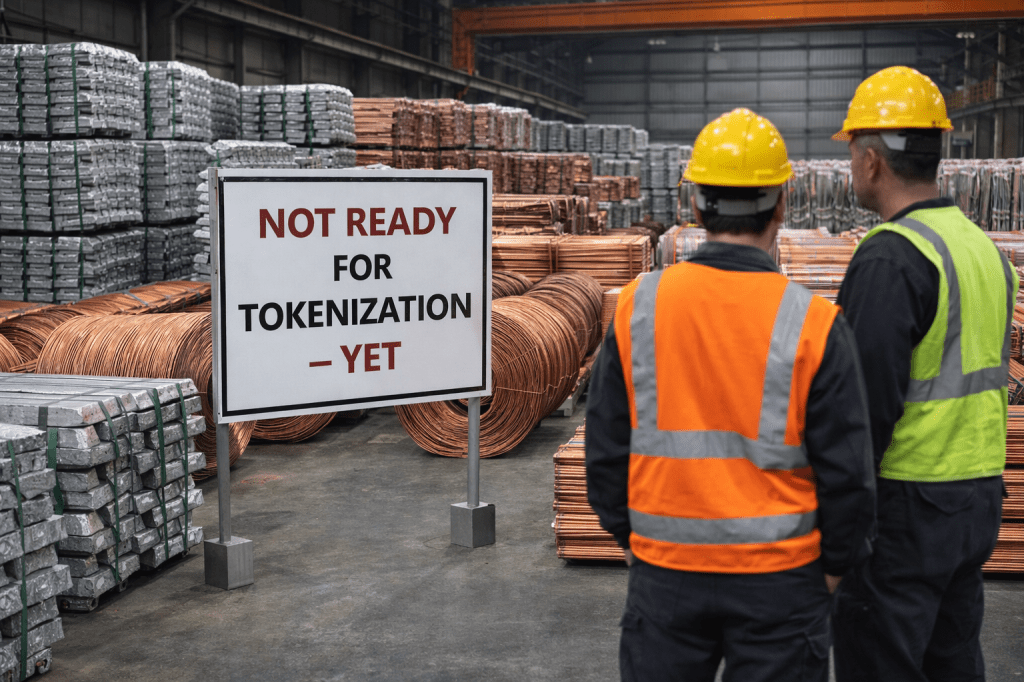
What Are “Industrial Metals”?
Industrial metals are those primarily used in manufacturing, construction, and technology rather than as stores of value, a unit of account, or a medium of exchange. In other words, industrial metals are not money nor currency. While industrial metals don’t function as money, they are the backbone of the real economy. No industrial metals equals no modern society. Consider these common examples:
• Copper Aluminum
• Nickel Zinc
• Lead Tin
What do they all have in common? These metals are essential inputs for:
• Infrastructure and construction
• Energy systems (including renewables)
• Electronics and manufacturing
• Transportation and industrial machinery
Unlike gold or silver, their value is not driven by monetary psychology; it is driven by economic activity and industrial demand.
Why Industrial Metals Are Now Entering the Tokenization Conversation
Three structural shifts are driving interest in tokenizing industrial metals. Let’s examine each one below.
1. Supply Chain Complexity
Industrial metals move through long, fragmented supply chains:
• Extraction
• Refining
• Transportation
• Storage
• Delivery
Each stage introduces friction, opacity, and inefficiency. Tokenization offers the potential to:
• Track ownership more precisely
• Improve transparency
• Reduce settlement delays
In theory, a token could represent a specific quantity of metal at a defined point in the supply chain—creating a more efficient system of transfer and verification. Now, point two.
2. Demand for Transparency and Provenance
As global supply chains come under scrutiny—particularly around environmental and geopolitical issues—there is growing demand for:
• Verified sourcing
• ESG compliance
• Chain-of-custody tracking
Blockchain infrastructure is well-suited to this challenge. Tokenized metals are capable of:
• Recording origin
• Tracking movement
• Providing immutable audit trails
This is particularly relevant for metals used in:
• Electric vehicles
• Renewable energy systems
• Advanced manufacturing
3. Financialization of Commodities
Industrial metals are already heavily traded. Traders often use:
• Spot markets
• Futures contracts
• Exchange-traded products
Tokenization represents a potential next step in the technological evolution—bringing:
• Faster settlement
• Fractional access
• New liquidity channels
However, unlike gold, industrial metals are not typically held for investment. That distinction matters.
How Industrial Metals Might Be Tokenized
We now turn to the “how” in the process. The tokenization of industrial metals can take several forms, each with different implications. Let’s walk through the possibilities.
1. Warehouse-Backed Tokens
The most straightforward model mirrors tokenized gold:
• A token represents a specific quantity of metal
• Stored in a certified warehouse
• Backed by documented inventory
This approach works best when:
• The metal is standardized
• Storage conditions are stable
• Inventory is clearly defined
2. Supply Chain Tokens
A more complex model involves tokenizing metals in motion. This model is much more ambitious—not impossible, just more difficult. If successful, it might look like this:
• Representing metal at various stages (ore, refined, shipped)
• Linking tokens to logistics data
• Updating ownership as the metal moves
3. Production-Linked Tokens
In some cases, tokens could represent:
• Future production
• Offtake agreements
• Rights to delivery
This begins to blur the line between commodities and financial contracts. This, of course, introduces additional layers of risk—a field day for securities lawyers.
Which Industrial Metals Are Strong Candidates?
Not all industrial metals are equally suited for tokenization. Below, they are divided into most viable, moderately viable, and less viable categories based on market structure, standardization, and practical considerations.
Most Viable Candidates
Copper
• Highly standardized
• Globally traded
• Critical for electrification and energy systems
Strong candidate due to liquidity and uniformity
Aluminum
• Widely used
• Standardized forms (ingots, billets)
• Established global markets
Suitable for warehouse-backed token models
Nickel
• Increasing demand (EV batteries)
• Growing interest in supply chain transparency
Viable, particularly with ESG tracking
Moderately Viable
Zinc and Tin
• Smaller markets
• Less investor attention
• Still standardized
Possible, but with limited initial demand
Which Metals Are Less Viable—and Why
Lead
• Declining industrial relevance
• Environmental concerns
Limited investor and institutional interest
Highly Specialized Alloys
• Non-standardized
• Variable composition
• Difficult to verify consistently
Poor candidates for tokenization
Raw Ore
• Highly variable
• Quality differences
• Requires processing
Not suitable for direct token representation
The Core Challenge: Standardization vs. Reality
The central issue with industrial metals is not technology—it is standardization. Without standardization, it becomes an uphill climb.
Gold works because:
• One ounce is interchangeable with another
• Quality is universally defined
Industrial metals, by contrast:
• Vary by grade
• Differ by form
• Depend on end-use requirements
This creates friction in token design. While tokens can be non-fungible (NFTs), that only adds complexity.
For tokenization to work, the system must answer:
• What exactly does the token represent?
• Where is the metal located?
• What are its specifications?
Without clear answers, the token risks becoming:
• Ambiguous
• Illiquid
• Distrusted
Governance Still Matters
As with precious metals, tokenization does not eliminate the need for governance—it amplifies it.
Key considerations include:
• Custody and storage verification
• Audit frequency and transparency
• Legal ownership rights
• Redemption mechanisms
In industrial metals, these issues are even more complex due to:
• Supply chain variability
• Multiple stakeholders
• Jurisdictional differences
Without strong governance frameworks, tokenized industrial metals risk becoming:
• Conceptually appealing
• Practically unreliable
So—Is This a Real Shift or Premature?
Industrial metals are unlikely to follow the same path as gold or silver. They are not primarily:
• Stores of value
• Monetary hedges
They are:
• Inputs
• Tools
• Economic enablers
That distinction means tokenization will likely develop differently. Instead of focusing on investment demand, the more appropriate focus may be efficiency, transparency, and logistics applications.
Final Thoughts
Industrial metals are beginning their blockchain moment—but it will not look like gold’s. This is not about creating digital stores of value. It is about modernizing the infrastructure that supports the real economy using blockchain technology.
The opportunity is significant:
• More transparent supply chains
• Faster and more efficient transactions
• Improved verification and trust
But the challenges are equally real:
• Lack of standardization
• Complex logistics
• Greater governance requirements
As with any emerging system, the outcome will depend not on the technology itself, but on how it is implemented. Tokenization can bring structure to complexity—but only if the underlying system is clearly defined and rigorously governed. In the case of industrial metals, that work is just beginning.
Until next time,
Yogi Nelson (Nelson Hernandez)


