
by Yogi Nelson
Why Junior Mining Boards Must Balance Accountability with Executive Leadership
Leadership in junior mining companies is often highly concentrated. In many small mining companies, the Chief Executive Officer (CEO) is responsible for corporate leadership, raising capital, guiding exploration strategy, managing investor relations, and coordinating technical teams. That’s a heavy load. He (occasionally she, but for the purpose of this article, let’s say he) must do it all.
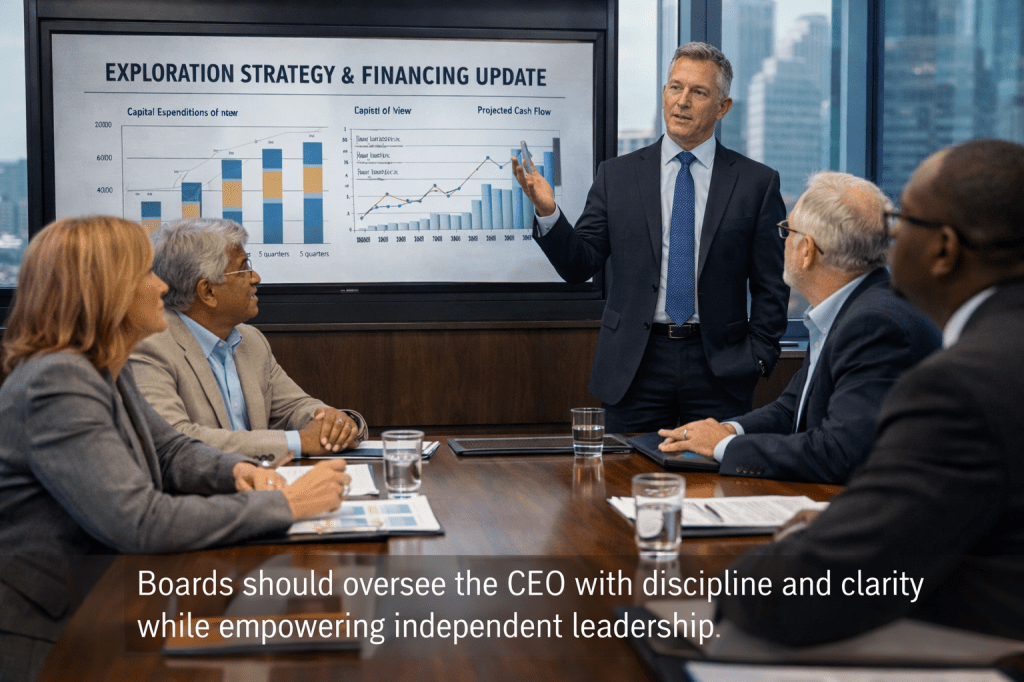
That reality raises an important governance question: How should the board of directors oversee the CEO without undermining his ability to lead? Too little oversight creates risk. Too much oversight creates paralysis. The challenge for boards—particularly in junior mining companies—is finding the balance between accountability and trust. In other words, the Goldilocks spot. Let’s explore that issue today.
The Unique Governance Environment of Junior Mining
Unlike large operating mining companies, junior mining firms typically operate with very lean management teams. Lean being the operative word. The CEO often wears multiple hats: strategist, fundraiser, spokesperson, and operational coordinator. At the same time, the company is spending investor capital long before revenue exists. That reality makes oversight essential.
Keep this point in mind: shareholders invest in junior mining companies largely based on two factors:
- The quality of the geological opportunity.
- The credibility of the management team.
The CEO sits at the center of both. Hence, boards must ensure that the CEO is operating effectively, ethically, and in alignment with shareholder interests. But oversight must be exercised in a way that supports leadership rather than interfering with it.
The Board’s Role: Oversight, Not Operations
A common governance mistake in early-stage companies occurs when directors drift into operational management. This mistake is often made without intent or malice. Nevertheless, it happens. Board members may have deep technical expertise, decades of industry experience, or prior involvement with similar projects. When challenges arise—as they inevitably do in mining—the temptation to intervene directly can be strong. However, boards do not run companies. Management does.
The board’s responsibility is to provide oversight, guidance, and accountability—not to manage daily operations. In practical terms, effective boards focus on questions such as:
- Is the CEO executing the company’s strategy effectively?
- Are investor funds being deployed responsibly?
- Are risks being identified and managed appropriately?
- Is communication with shareholders transparent and credible?
These questions represent governance oversight—not operational control.
Setting Clear Expectations
One of the most effective ways boards can oversee the CEO without micromanaging is by adopting a clear mission statement, governance protocols, and establishing clear expectations from the outset. For example, the board may adopt a formal resolution that includes, but is not limited to:
- Strategic objectives for the company
- Performance expectations for management
- Capital allocation priorities
- Reporting standards for the board
Instead of directors debating individual operational decisions, they can evaluate whether management’s actions align with agreed-upon strategic goals. When expectations are clearly defined, oversight becomes far more constructive. This approach strengthens accountability while preserving management’s ability to execute.
Performance Evaluation
Oversight of the CEO must ultimately include some form of performance evaluation. Please note, there is no need for rigid bureaucracy. However, the board should periodically assess whether the CEO is meeting the company’s strategic and operational objectives. This can be an agenda item during quarterly board meetings, for instance. Key areas of evaluation should include:
- Advancement of exploration programs
- Effectiveness in raising capital
- Quality of investor communications
- Team leadership and organizational development
- Adherence to governance and reporting standards
Items three and four are more challenging to evaluate; therefore creativity may be required. Nevertheless, these evaluations provide an opportunity for constructive feedback and ensure that the board remains engaged in its oversight responsibilities.
Supporting the CEO
Oversight should not be confused with opposition. Strong boards do not exist to second-guess management at every turn. Boards serve as strategic partners who help leadership navigate complex decisions. That’s a big difference.
Junior mining companies operate in a high-risk environment. Results are uncertain. Financing conditions can change quickly. Commodity markets fluctuate. During these periods, a thoughtful board can provide valuable perspective to the CEO. Experienced directors may help management evaluate strategic alternatives, assess risk, or think through financing strategies. This type of support strengthens leadership rather than weakening it.
The Importance of Independent Directors
Independent directors possess a special authority—independence. They are not part of the inner network circle. In fact, they are chosen precisely because they bring an independent voice to the boardroom. Their outsider status means they are well suited to evaluate management performance objectively. Moreover, they serve as an important governance safeguard when difficult decisions arise. Consider the following situations where independent directors are particularly important:
- CEO compensation decisions
- Performance evaluations
- Conflict-of-interest oversight
- Major strategic transactions
- Audit committee leadership
By placing these responsibilities in the hands of independent directors, boards can maintain appropriate oversight while avoiding operational interference. Let’s now turn to the micromanagement trap that directors often fall into.
Avoiding the Trap of Micromanagement
Micromanagement is one of the most common governance pitfalls in smaller companies. It often begins with good intentions. I have personally witnessed this situation. Here is why it happens.
Directors want to help. They want to apply their experience. They want to protect shareholder interests. But when board members begin directing operational decisions—approving minor expenditures, managing staff interactions, or influencing day-to-day activities—the governance structure breaks down. Management becomes hesitant. Decision-making slows. Accountability becomes blurred. In short, micromanagement weakens both the board and the CEO.
Governance as Leadership Discipline
The best junior mining companies understand that governance is not simply a compliance exercise. It is a leadership discipline. Effective boards hold CEOs accountable while also empowering them to lead. They set strategic direction without interfering with execution. They ask difficult questions without undermining management authority. Most importantly, they remain focused on the make-or-break decisions that protect the long-term interests of shareholders.
Final Thoughts
Junior mining companies operate in a challenging environment. There is no way to sugarcoat that reality. Exploration risk is high, capital is precious, and management teams are often small. Under these conditions, the relationship between the board and the CEO becomes critically important.
Too little oversight can expose investors to unnecessary risk. Too much oversight can suffocate leadership. The most effective boards understand that their role is not to manage the company—but to ensure that it is well led. That balance requires discipline.
And like all aspects of governance before revenue, discipline is what ultimately builds credibility with investors and strength within the organization.
Until next time,
Yogi Nelson


