Board of Directors, Governance, Mining, Uncategorized, Yogi Nelson

Governance Before Revenue: The Case for Audit Committees in Junior Mining

by Yogi Nelson

Why Junior Mining Companies Must Establish Financial Oversight Early

In the early life of a junior mining company, nearly every ounce of energy goes toward geology, exploration programs, and financing the next drilling campaign. Teams are small, budgets are tight, and leadership is focused on proving the resource. Governance structures—particularly formal committees—often seem like something that can wait until the company becomes larger or begins generating revenue. In 2026, that assumption is outdated.

One of the most important governance structures a junior mining company can establish early in its development is the Audit Committee. While traditionally associated with large, revenue-producing corporations, audit committees are just as critical—perhaps even more so—for early-stage resource companies.

In fact, establishing an audit committee before revenue begins sends a powerful signal to investors, potential acquisition suitors, and merger candidates: the company takes financial discipline, transparency, and accountability seriously. For junior miners seeking credibility in capital markets, that signal can make a meaningful valuation difference.

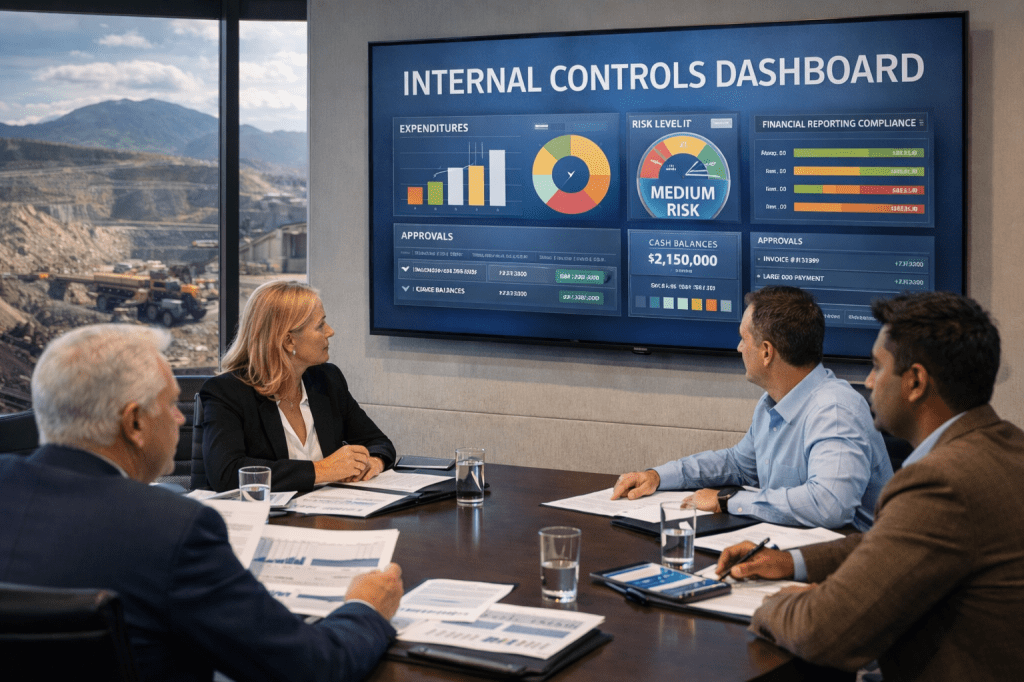
Effective audit committees provide independent financial oversight that strengthens investor confidence in junior mining companies

Why Early Governance Matters in Exploration Companies

Junior mining companies operate in a unique financial environment. Unlike traditional operating businesses, exploration companies often spend years—sometimes a decade or more—raising capital and deploying it into exploration activities before generating any revenue.

During this time, investors are funding geological risk, operational risk, and management execution. With little or no operating income to measure success, investors are compelled to rely heavily on trust across three fundamental factors:

  • Effective and efficient use of funds
  • Accurate financial reporting
  • Management decisions that are subject to appropriate oversight

Without these safeguards, even promising exploration programs can struggle to attract sustained investor support.

Below I will explain why an effective audit committee is the best tool available to reinforce that trust. But first, it is useful to understand the work of an audit committee.

What an Audit Committee Actually Does

An audit committee is a specialized committee of the board of directors responsible for overseeing the company’s financial reporting, internal controls, and relationships with external auditors.

While the responsibilities vary by jurisdiction and listing exchange, the core functions generally include:

  • Overseeing financial statements and disclosures
  • Monitoring internal financial controls
  • Supervising the relationship with independent auditors
  • Reviewing risk management practices
  • Ensuring compliance with regulatory reporting requirements

For larger companies, these duties are often supported by internal finance teams and internal audit departments. Junior mining companies, however, typically operate with much leaner administrative resources. Consequently, audit committees of the board are essential to maintaining the financial integrity of the organization.

Preventing Problems Before They Start

One of the greatest advantages of establishing an audit committee early is that it helps prevent financial problems before they arise. As the old proverb reminds us, an ounce of prevention is worth a pound of cure.

Exploration companies regularly handle significant capital inflows from equity financings. These funds must be allocated across drilling programs, geological studies, environmental compliance, and administrative costs. Without structured oversight, financial reporting processes can become informal or inconsistent—especially during periods of rapid growth or multiple financings.

An engaged audit committee helps ensure that:

  • Financial controls are implemented early
  • Accounting policies are applied consistently
  • Disclosure practices meet regulatory standards
  • Financial risks are identified quickly

This proactive oversight can prevent small issues from becoming major problems. In capital markets, credibility lost is difficult to regain. Early governance safeguards help preserve that credibility.

Building Investor Confidence

Institutional investors increasingly evaluate governance structures when considering investments in junior resource companies. Typically, professional investors analyze three key questions—among others—before committing capital:

  • Is the geology promising?
  • Is the management team capable?
  • Is the governance structure trustworthy?

The presence of a well-structured audit committee directly addresses the third question.

Investors want reassurance that the financial reporting process is independent from management and that qualified directors are overseeing financial matters. When an audit committee includes members with accounting, financial, or capital markets experience, it signals that the company understands the importance of financial transparency.

This can make fundraising significantly easier, particularly when seeking larger institutional investors rather than relying solely on generalist capital.

Exchange Requirements and Best Practices

Many stock exchanges already require listed companies to maintain audit committees composed largely of independent directors. Companies listed on exchanges such as the TSX Venture Exchange, the Toronto Stock Exchange, and U.S. markets must comply with governance rules that include audit committee structures and financial expertise requirements.

However, merely complying with minimum regulatory requirements is not enough.

Best-practice junior miners treat the audit committee not as a regulatory checkbox, but as a strategic governance asset. That means selecting committee members carefully, ensuring they possess relevant financial expertise, and empowering them to actively oversee financial reporting and risk management.

The Value of Financial Expertise

An effective audit committee typically includes at least one member who qualifies as a financial expert—someone with deep experience in accounting, finance, or financial oversight. In the junior mining sector, this expertise can be invaluable.

Exploration companies face complex accounting questions related to:

  • Capitalization of exploration expenses
  • Impairment of mineral assets
  • Share-based compensation structures
  • Flow-through financing arrangements
  • Regulatory reporting obligations

Directors with financial expertise can help the board navigate these complexities and ensure the company’s disclosures remain accurate and compliant. This expertise also strengthens the company’s relationship with external auditors, who rely on audit committees to provide oversight and independence.

Strengthening Internal Controls

One of the most overlooked aspects of junior mining governance is the importance of internal financial controls. Even small organizations must ensure that financial responsibilities are properly separated, documented, and reviewed. Without these safeguards, errors—or worse, financial mismanagement—can occur.

An audit committee plays a critical role in evaluating and strengthening these controls. Typical oversight areas include:

  • Cash management procedures
  • Authorization of expenditures
  • Financial reporting processes
  • Budget monitoring
  • Risk assessment practices

By reviewing these systems regularly, the audit committee helps ensure that the company’s financial operations remain transparent and accountable.

Preparing for Future Growth

Junior mining companies that eventually transition from exploration to development and production face a dramatic increase in operational complexity. Project financing, construction budgets, joint ventures, and revenue recognition—just to name a few—introduce new layers of financial reporting.

Companies that establish strong governance structures early—including an effective audit committee—are far better prepared for this transition. Instead of scrambling to build governance systems during periods of rapid growth, they already have established frameworks for financial oversight and risk management. In other words, early governance creates organizational resilience.

Governance as a Strategic Advantage

In competitive capital markets, governance can become a meaningful differentiator. Hundreds of junior mining companies compete for investor attention each year. While geology and project potential remain primary drivers of valuation, governance quality increasingly influences investor confidence.

Companies that demonstrate disciplined oversight, transparent reporting, and strong board committees stand out from peers that operate with minimal governance infrastructure. Establishing an audit committee before revenue generation sends a clear message:

This company intends to operate with the same financial discipline as much larger organizations.

That message resonates with investors, lenders, and strategic partners alike.

Final Thoughts

Junior mining companies often view governance structures as something to implement later—after discovery success, after financing growth, or after revenue begins. But the companies that build credibility in capital markets are usually the ones that implement governance early, not late.

An effective audit committee strengthens financial oversight, improves transparency, and enhances investor trust during the most fragile stages of a company’s development. For junior mining companies—whether explorers, developers, or producers—operating in high-risk, capital-intensive environments, those advantages are invaluable.

Establishing an audit committee before revenue is not simply a compliance exercise. It is a strategic decision that signals maturity, discipline, and a commitment to responsible stewardship of investor capital.

In the crowded junior mining sector, that commitment can make all the difference.

Until next time,

Yogi Nelson

Governance, Mining, Risk Management

Governance as Strategy: A 10-Part Series for Junior Mining Leaders

by Yogi Nelson

Junior mining companies operate in one of the most, perhaps these most, capital-intensive, risk-exposed, and credibility-sensitive sectors in the global economy. They raise money before revenue. Moreover, they make technical promises before production. If that were enough, miners operate in jurisdictions where regulatory, environmental, and political variables can change quickly. And they do all of this, out of necessity, with lean teams and limited administrative and management infrastructure.

In that environment, governance is often viewed as an obligation — a regulatory requirement to satisfy exchanges, securities commissions, or auditors. Too frequently it becomes a checklist exercise. That perspective is shortsighted. In mining governance is not overhead. It is a strategic asset.

Strong governance frameworks help junior mining companies navigate risk, attract investment, and build enduring companies.

Over the next ten weeks, this series will explore how thoughtful governance and disciplined compliance frameworks can materially improve resilience, investor confidence, and long-term value creation in junior mining companies. The objective is not to advocate bureaucracy. To the contrary. It’s to demonstrate how structured oversight strengthens execution, reduces preventable risk, and positions companies for institutional capital.

This series is designed for directors, CEOs, CFOs, compliance officers, and serious investors who understand that governance is inseparable from capital formation. Below is an overview of what readers can expect.


1. Governance as a Value Multiplier in Junior Mining

We begin by reframing governance from a cost center to a value multiplier. Markets reward credibility. Institutions allocate capital where risk is understood and managed. Junior mining companies that articulate clear oversight structures, internal controls, and transparent reporting reduce perceived risk — and perceived risk directly affects valuation. In a business where risks are ubiquitous, strong governance enhances shareholder value.

This article will examine how governance maturity influences financing terms, investor retention, and strategic optionality.

2. Board Composition: Independence Versus Operational Expertise

Junior mining boards are often composed of geologists, founders, or major shareholders. Technical depth is essential — but independence and financial oversight are equally critical.

  • What true board independence means in a small company
  • How to balance technical knowledge with governance competence
  • When adding an independent director materially changes investor perception

The goal is not to replace industry expertise, but to complement it with structured oversight.

3. Audit Committees in Pre-Production Companies

Many early-stage companies view audit committees as formalities. Yet the absence of revenue does not eliminate financial risk–it often increases it!

  • The minimum functional standards for an effective audit committee
  • Oversight of cash management and exploration expenditures
  • Financial disclosure discipline in volatile commodity environments

A disciplined audit function signals seriousness to markets.

4. Internal Controls in Lean Organizations

Junior mining companies may operate with fewer than 25 employees. Segregation of duties can be challenging. Informal processes can emerge. We will explore how to implement practical internal controls without creating administrative burden, including:

  • Cash disbursement controls
  • Contract approval frameworks
  • Documentation protocols
  • Basic fraud prevention mechanisms

Strong controls do not require large teams. They require clarity.

5. Managing Related-Party Transactions in Small Teams

In closely held companies, related-party transactions are common. They are not inherently problematic — but they require transparency and structured oversight.

  • Disclosure best practices
  • Conflict-of-interest policies
  • Board review procedures
  • Protecting both insiders and minority shareholders

Proper handling of related-party matters strengthens trust.

6. CEO Oversight Without Micromanagement

Junior mining CEOs are often founders or highly technical leaders. Boards must support management while maintaining independent oversight.

  • Performance evaluation frameworks
  • Information rights and reporting cadence
  • Constructive challenge versus operational interference
  • Succession planning in early-stage companies

Healthy governance enhances leadership rather than constraining it.

7. ESG Reporting: Substance Versus Marketing

Environmental, social, and governance reporting has become unavoidable. Yet in junior mining, ESG narratives can outpace operational capacity.

  • Aligning ESG disclosures with actual practices
  • Avoiding reputational risk from overstated claims
  • Community engagement documentation
  • Governance oversight of sustainability reporting

Authenticity matters. Markets increasingly detect exaggeration.

8. Crisis Governance: When Exploration Results Disappoint

Commodity cycles fluctuate. Drill programs sometimes fail. Financing windows close unexpectedly.

  • Board protocols during operational setbacks
  • Disclosure discipline in adverse conditions
  • Liquidity oversight during market stress
  • Maintaining investor credibility during downturns

Crisis does not create governance weakness — it reveals it.

9. Jurisdictional Risk and Cross-Border Oversight

Many junior mining companies operate in Latin America, Africa, or other emerging markets. Cross-border operations introduce legal, political, and compliance complexity.

  • Anti-corruption controls
  • Local partner due diligence
  • Regulatory monitoring frameworks
  • Board-level oversight of geopolitical exposure

Risk awareness must extend beyond geology.

10. Governance Readiness for Institutional Capital

The final article in this series will synthesize the prior themes into a practical readiness framework.

Institutional investors assess:

  • Board independence
  • Financial reporting discipline
  • Risk management structures
  • ESG credibility
  • Executive compensation alignment

We will provide a structured checklist that junior mining boards can use to evaluate their governance posture before pursuing larger capital raises.


Why This Series Matters Now

Commodities are in a long-tend bull market. Miners that demonstrate strong governance attract higher quality investors. Investors increasingly differentiate between companies that treat governance as a formality and those that treat it as infrastructure. Junior mining companies do not need bureaucratic systems designed for multinational producers. They do need disciplined oversight tailored to their scale and stage of development.

The purpose of this series is practical: to offer clear frameworks, actionable insights, and governance standards that are achievable — even in lean organizations. Governance does not eliminate geological risk. It does not control commodity prices. But it reduces preventable errors, clarifies accountability, and strengthens credibility. And in capital markets, credibility compounds.

Over the next ten weeks, we will examine how junior mining companies can build governance systems that are proportionate, strategic, and aligned with long-term shareholder value.

The objective is not perfection. It is preparedness.

And in junior mining, preparedness often makes the difference between survival and sustainable growth.

Until next time,

Yogi Nelson

Blockchains, Environment, finance, Mining, tokenization, Yogi Nelson

Rhodium as a RWA: Rare, Essential, But is it Tokenizable

by Yogi Nelson

Rhodium is one of the rarest metals on Earth—far rarer than gold or silver—and yet it plays a critical role in modern life. Most people never see it, but without rhodium, today’s emissions standards would be nearly impossible to meet.

As real-world assets (RWAs) move onto blockchain rails, it is natural to ask: Can rhodium be tokenized?

After digging into its supply structure, price behavior, and industrial demand, the answer—for now—is not really.

Rhodium is:

  • Almost entirely a byproduct metal
  • Geographically concentrated in a handful of countries
  • Extremely volatile, with thin and opaque spot markets
  • Driven by regulation, not investor demand

Tokenization works best where liquidity, transparency, and broad participation already exist. Rhodium meets none of those conditions today.

That does not mean rhodium has no digital future. In a mature RWA ecosystem, tokenized rhodium may emerge quietly—used by industry players for settlement, inventory finance, or compliance rather than speculation.

Not every metal belongs on a blockchain.
And rhodium reminds us that “not yet” is sometimes the most honest answer.


Yogi Nelson

Uncategorized

Rhodium as an RWA: Rare, Essential, But is it Tokenizable

by Yogi Nelson


What Is Rhodium


What Is Rhodium Used For

  • Chemical processing, where it acts as a catalyst in specialized reactions
  • Electronics, including electrical contacts and thermocouples
  • Glass manufacturing, particularly in high-temperature furnace components
  • Jewelry, almost exclusively as a plating material to enhance durability and reflectivity

Where Is Rhodium Mined

  • Labor disputes in South Africa can disrupt global supply
  • Energy shortages directly affect mining output
  • Geopolitical tensions can restrict exports
  • Environmental regulations can alter production economics

Rhodium’s Price History

  • Thin spot markets
  • Limited liquidity
  • Minimal futures infrastructure
  • Heavy dependence on regulatory demand

Is Rhodium a Viable Candidate for Tokenization

  • Rhodium is high-value and compact, making custody efficient
  • It has industrial relevance, anchoring demand to real-world use
  • Its scarcity creates a compelling digital-scarcity narrative

However, significant obstacles exist:

  • Price discovery is opaque, with limited transparent spot markets
  • Physical settlement infrastructure is underdeveloped
  • Liquidity is thin, making fractionalization less meaningful
  • Regulatory classification is ambiguous, especially for retail access

Tokenized Rhodium Versus Traditional Rhodium Exposure

  • Physical bars held via specialized dealers
  • Indirect exposure through mining equities
  • Occasionally, structured products in select jurisdictions

Tokenization could improve access by:

  • Enabling fractional ownership
  • Providing 24/7 global transferability
  • Integrating rhodium into broader digital portfolios

Industrial and Supply Use Cases

  • Inventory financing tools for manufacturers
  • Supply-chain collateral for automotive producers
  • Hedging instruments tied to emissions-related demand

Restraints, Constraints, and Realism

  • Supply that cannot respond to price incentives
  • Demand driven by regulation rather than consumer choice
  • Extreme volatility unsuitable for many token investors
  • Limited public understanding and trust

Long-Term Outlook: Rhodium’s Digital Role

This post is part of an ongoing weekly series on the tokenization of precious metals, published on BlockchainAIForum and LinkedIn, examining custody, regulation, issuer structure, and settlement infrastructure.

Austrian economics, Banking, Blockchains, Decentralized, finance, International Finance, Mining, platinum, precious-metals, tokenization, Uncategorized

Tokenized Platinum: Built for the Real Economy

by Yogi Nelson


What Makes Platinum Different

  • Extreme scarcity: annual global platinum production averages under 200 metric tons. Annual production of gold is 3,000 metric tons, while silver is approximately 26,000 metric tons.
  • Geographic concentration: roughly three-quarters of supply comes from South Africa, with most of the remainder from Russia. Two nations rather than the 194 worldwide!
  • High production costs: platinum is difficult and expensive to extract and refine
  • Limited substitution: in many applications, platinum has no perfect replacement

Monetary Metal or Industrial Metal? (The Platinum Distinction)

  • Catalytic converters for emissions control
  • Chemical and petroleum refining
  • Medical devices and pharmaceuticals
  • Electronics and data storage
  • Hydrogen fuel cells and clean-energy systems

Why Platinum Is a Natural Fit for Tokenization


Tokenized Platinum vs. Traditional Platinum Products

  • Direct ownership rather than synthetic exposure
  • On-chain transparency of reserves and transfers
  • Programmable compliance and auditability
  • Global reach independent of local financial infrastructure

Real-World Use Cases Beyond Investment


Risks, Constraints, and Realism

  • The market is smaller, increasing volatility
  • Custody standards must remain rigorous
  • Regulatory frameworks vary by jurisdiction
  • Adoption will be gradual rather than explosive

Long-Term Outlook: Platinum’s Quiet Permanence


Sources

World Platinum Investment Council (WPIC) – Platinum Quarterly Market Review
U.S. Geological Survey (USGS) – Mineral Commodity Summaries: Platinum Group Metals
Johnson Matthey – Platinum Group Metals Market Report
International Energy Agency (IEA) – Critical Minerals and Clean Energy Transitions
World Bank – Minerals for Climate Action