

by Yogi Nelson
Why Small Mining Companies Must Build Financial Discipline Early
In the early stages of a junior mining company, whether it be an explorer or developer, the focus is understandably on geology. Management teams concentrate on drilling programs, land packages, resource estimates, and infrastructure. Of course, capital must also be raised. All the while, administrative functions often remain small, lean, and informal.
In many exploration companies, the entire finance function may consist of a single controller, an external accounting firm, and periodic board oversight. Not surprisingly, internal controls are postponed “until the time is right,” meaning when the company grows larger. This approach does not work in 2026.
Internal controls are not simply a feature of large corporations. They must be a foundational element of responsible governance. For junior mining companies operating with limited staff and significant capital inflows from investors, internal controls are often the first line of defense against financial errors, regulatory issues, and reputational damage.
Well-designed controls permit relatively small organizations to operate with the discipline expected of much larger enterprises. The benefits go beyond discipline; they extend to shareholder value creation.
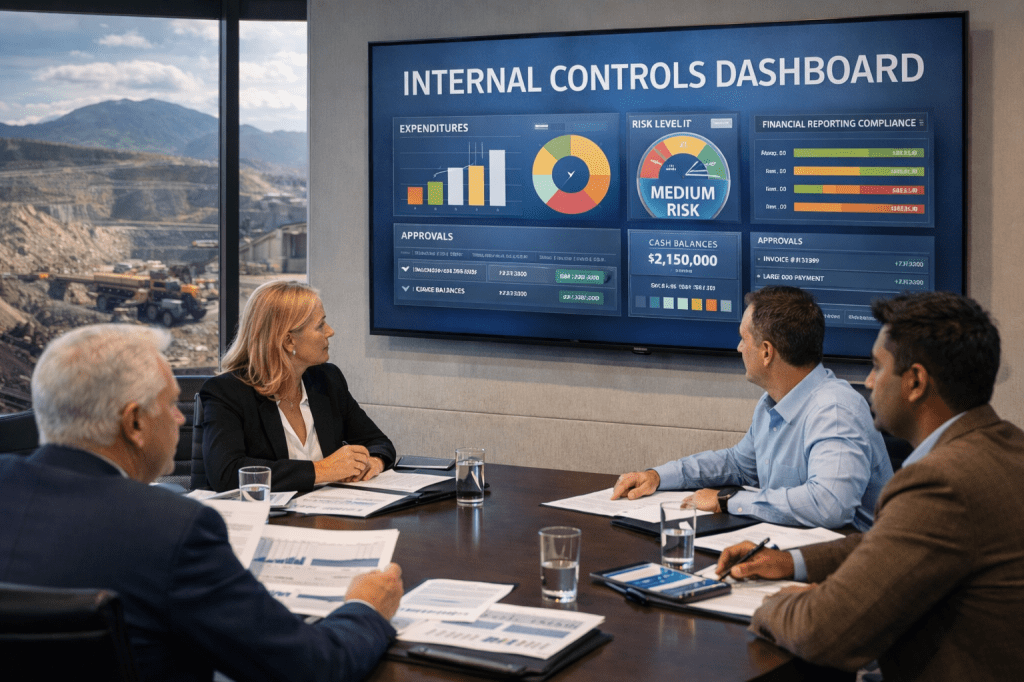
Effective internal controls allow lean mining organizations to maintain financial discipline while advancing exploration programs.
Understanding Internal Controls
Internal controls are the policies, procedures, and oversight mechanisms that ensure a company’s financial activities are conducted properly, transparently, and in accordance with applicable best practices, regulations, and law. At their core, internal controls serve three primary purposes:
- Protect company assets
- Ensure accurate financial reporting
- Promote accountability in decision making
For junior mining companies, these controls are particularly important because exploration and development firms typically operate without operating revenue for extended periods. Instead, they rely on capital raised from investors to fund drilling programs, geological studies, and corporate activities.
That investor capital must be managed carefully and transparently. Strong internal controls demonstrate that the company understands its responsibility as a steward of shareholder funds.
Lean Organizations Face Unique Challenges
Unlike large mining companies with full finance departments, exploration companies operate with extremely lean administrative teams. This creates several governance challenges, which can be resolved as explained below. But first, awareness of the situation is required.
In many junior miners, the same individual may be responsible for multiple functions, such as:
- Approving invoices
- Recording transactions
- Preparing financial statements
- Coordinating with auditors
While this structure may be unavoidable in small organizations, it increases the risk of errors or control gaps. Effective internal controls help mitigate those risks by introducing oversight mechanisms that compensate for limited staffing. Importantly, internal controls do not require large teams or complex bureaucratic systems. What they require is thoughtful design and consistent oversight. Let us begin with certain core principles.
The Principle of Segregation of Duties
One of the most fundamental internal control principles is segregation of duties. This principle ensures that no single individual has complete control over an entire financial transaction from beginning to end. In larger companies, segregation of duties is relatively straightforward because different departments handle different responsibilities. Lean organizations must approach the problem more creatively.
For instance, despite their size, small companies can separate key functions such as:
- Authorization of expenditures
- Processing of payments
- Reconciliation of accounts
- Financial reporting
To give a specific example, management could approve expenditures, while an external accounting firm processes payments and prepares financial records. The audit committee can then review financial statements and reconciliations. This layered oversight structure provides meaningful control even in a small organization.
Cash Management and Capital Stewardship
Junior mining companies regularly raise capital through equity financings. These funds are intended to support exploration programs and advance the company’s projects. Strong internal controls ensure that these funds are deployed responsibly. Cash management controls could include:
- Formal approval processes for expenditures
- Dual authorization for large payments
- Regular bank reconciliations
- Periodic budget reviews
These controls may seem basic, but they play a critical role in maintaining investor confidence. Exploration companies operate on trust. Investors must believe that their capital is being used effectively, efficiently, and in accordance with the company’s stated strategy. Clear and consistent financial controls reinforce that confidence.
The Role of the Board and Audit Committee
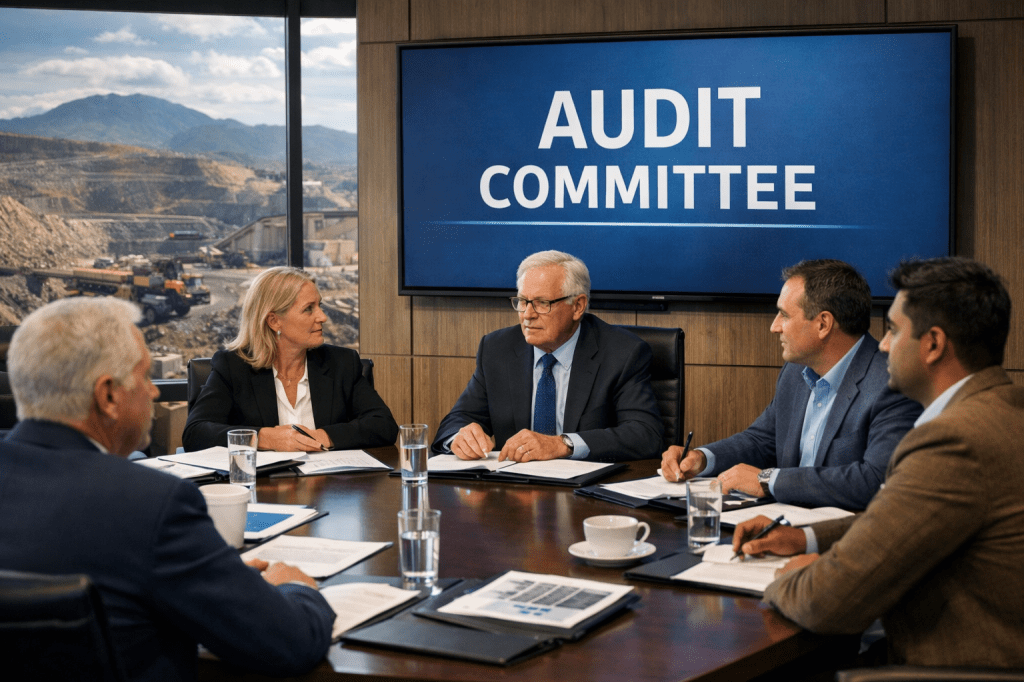
In lean organizations, the board of directors—particularly the audit committee—plays an essential role in overseeing internal controls. Given that administrative teams are small, directors must take an active interest in financial oversight.
The emphasis must be on active oversight.
Typical responsibilities of the audit committee include:
- Reviewing financial statements before publication
- Monitoring internal control systems
- Overseeing relationships with external auditors
- Evaluating financial risks
- Ensuring compliance with regulatory reporting requirements
Directors with financial expertise can provide valuable guidance in establishing and maintaining appropriate controls. This oversight ensures that management remains accountable and that financial reporting remains accurate and transparent.
Preventing Small Problems from Becoming Big Ones
Internal controls are often rightly viewed as defensive tools designed to prevent fraud. While fraud prevention is certainly important, the more common benefit of internal controls is much simpler: preventing mistakes.
Exploration companies handle a wide range of financial transactions, including drilling contracts, geological consulting fees, land payments, environmental studies, and regulatory filings. Without proper controls, administrative errors can occur. A missed payment, an improperly recorded expense, or a misclassified exploration cost can create complications during audits or regulatory filings. Internal controls help catch these issues early—before they become larger problems. As the old proverb reminds us, an ounce of prevention is worth a pound of cure.
Preparing for Institutional Capital
As exploration companies advance their projects, they often seek larger pools of capital. In fact, many junior miners operate with the long-term possibility of becoming a takeover target.
Without speculating about individual business models, it is safe to say that most miners seek to maximize the value of their resource—whether they intend to develop the asset themselves or ultimately sell it after adding value.
Institutional investors—including mining funds, private equity groups, and strategic partners—scrutinize governance practices carefully before committing capital. During due diligence, investors typically examine three governance questions:
- Does the company have credible financial reporting?
- Are internal controls documented and functioning?
- Does the board provide meaningful oversight?
Companies that can demonstrate disciplined financial controls are far more likely to attract institutional investment. In contrast, companies with weak administrative structures may struggle to gain the confidence of larger investors. Strong governance does not guarantee financing, but weak governance can certainly prevent it.
Governance as a Competitive Advantage
Hundreds of junior mining companies compete for investor attention each year. While geology remains the primary driver of long-term value, governance quality increasingly influences investor confidence. Companies that demonstrate financial discipline, transparent reporting, and effective internal controls stand apart from peers operating with informal systems. In practical terms, governance becomes a competitive advantage.
Investors, potential partners, and acquisition candidates are more comfortable engaging with companies that exhibit professional financial oversight. Internal controls signal that the company is serious about managing investor capital responsibly.
Final Thoughts
Junior mining companies often delay building formal control systems until the company becomes larger. Companies that build lasting credibility in capital markets take a different approach. They implement governance structures early. In many respects, they build a company culture based on a mindset of accountability.
Internal controls are not bureaucratic obstacles. They are practical tools that allow lean organizations to operate with professionalism, transparency, and accountability.
For exploration companies operating without revenue and relying on investor capital, those qualities are essential. Strong internal controls demonstrate that management understands its role as a steward of shareholder funds. And in the competitive world of junior mining, that discipline can make a meaningful difference in how investors, partners, and markets evaluate the company.
Governance before revenue is not simply a concept. It is a philosophy of responsible leadership.
Until next time,
Yogi Nelson

 Blockchain & AI Forum