Every emerging market develops its own language. Tokenized metals are no exception.
Over the past several months, as I’ve written about custody, redemption, proof-of-reserves, vaulting, ETFs, futures, and settlement, I’ve noticed something important: most confusion in this space doesn’t come from technology — it comes from terminology.
Words like:
allocated vs unallocated
canonical vs wrapped tokens
beneficial ownership
settlement finality
counterparty risk
are used constantly, often without explanation. And when language is unclear, risk hides in plain sight. That’s why I wrote a new piece for my weekly series:
“Tokenized Metals Without the Jargon: A Practical Glossary.”
It’s not a dictionary. It’s a plain-English guide to the terms that actually matter—what they seem to mean, what they really mean in practice, and why the difference matters when real money and real metal are involved.
As I worked through these concepts, I realized something amusing (and useful): learning these terms has made me trilingual—English, Spanish, and now the language of tokenization: “Tokenish.”
By the end of the article—and frankly, by the end of the series—you may find yourself fluent too.
If you’re interested in tokenized gold, silver, or real-world assets more broadly, understanding the language is not optional. It’s infrastructure. For the complete glossary visit my blog:
— Yogi Nelson
Part of an ongoing weekly series on the tokenization of precious metals, examining ownership, custody, redemption, and settlement.
Tokenized metals sit at the intersection of precious metals, financial infrastructure, and blockchain technology. Each domain brings its own vocabulary—and when combined, confusion often follows. This glossary exists to reduce that confusion.
What follows is a plain-English guide to the most important terms in the tokenized metals space, listed in alphabetical order. Each entry explains not just what a term means, but why it matters in practice and where misunderstandings commonly arise.
Learning these key terms has made me trilingual—English, Spanish, and now the language of tokenization–“tokenish”. Lol! By the end of this series and article, you may find yourself fluent as well.
Allocated Metal
Intuitive Understanding: Allocated metal simply means the gold exists somewhere.
What It Actually Means: Allocated metal refers to specific, identifiable bullion—typically bars—held in custody on behalf of an owner. Each bar is owned outright, recorded individually, and not commingled with other owners’ assets.
Why It Matters: Allocated metal is generally bankruptcy-remote and directly owned. Tokenization does not change this reality; it only represents it digitally. Confusing allocation with mere backing is a common and costly mistake.
Bailment
Common Interpretation: A technical legal term with little relevance to everyday investors.
What It Actually Means: Bailment is a legal relationship in which one party (the bailor) retains ownership of property while another party (the bailee) holds it for safekeeping under defined obligations.
Why It Matters: Many professional bullion custody arrangements rely on bailment. When structured properly, bailment strengthens ownership claims and protects assets if a custodian encounters financial trouble.
Bankruptcy-Remote
At First Glance: Protected in theory if something goes wrong.
What It Actually Means: Bankruptcy-remote assets are legally insulated from the failure of an issuer or custodian through segregation, proper custody agreements, and enforceable ownership documentation.
Why It Matters: “Fully backed” is not enough. Without bankruptcy-remote structures, token holders may still be treated as creditors rather than owners during insolvency proceedings.
Beneficial Ownership
The Intuitive View: Owning the asset.
What It Actually Means: Beneficial ownership refers to the right to enjoy the economic benefits of an asset—such as appreciation or redemption—without necessarily holding legal title directly.
Why It Matters: In tokenized metals, beneficial ownership determines whether a token holder has enforceable rights to physical bullion or merely economic exposure mediated by an issuer.
Canonical Token
Surface Understanding: The “official” version of a token.
What It Actually Means: The canonical token is the issuer-recognized smart contract that directly represents the underlying metal under the issuer’s legal framework. Only canonical tokens are typically redeemable.
Why It Matters: Wrapped or derivative tokens may track value but lack redemption rights. This distinction becomes critical at the moment of physical settlement.
Chain Reconciliation
Common Interpretation: Matching blockchain numbers to vault records.
What It Actually Means: Chain reconciliation is the process of aligning on-chain token balances with off-chain custody records, bar lists, and vault inventories—especially during issuance and redemption.
Why It Matters: This is where digital claims and physical reality are forced to agree. Weak reconciliation is one of the most common failure points in tokenized asset systems.
Chain-of-Custody
At First Glance: A record of who handled the metal.
What It Actually Means: A documented, auditable trail showing how bullion moves through custody, storage, fabrication, transport, and delivery.
Why It Matters: Chain-of-custody protects against loss, substitution, and dispute. Tokenization depends on disciplined off-chain controls to maintain trust.
Counterparty Risk
The Intuitive View: Something blockchain eliminates.
What It Actually Means: Counterparty risk is the risk that another party in the system—issuer, custodian, logistics provider, or bridge—fails to meet its obligations.
Why It Matters: Tokenization does not remove counterparty risk; it redistributes it. Understanding where that risk resides is essential to evaluating any tokenized metal product.
Custodian
Surface Understanding: The company storing the gold.
What It Actually Means: A regulated entity responsible for safeguarding assets under defined legal, compliance, and reporting frameworks.
Why It Matters: The custodian—not the blockchain—ultimately controls physical access to the metal. Tokenization without credible custody is abstraction without anchor.
Delivery Bar / Good Delivery Standard
Common Interpretation: A large bar of gold.
What It Actually Means: A bullion bar meeting recognized industry standards for weight, purity, refinery, and appearance, such as LBMA Good Delivery specifications.
Why It Matters: Redemption often depends on whether metal conforms to delivery standards. Not all gold qualifies equally for settlement.
Liquidity
At First Glance: How fast a token can be sold.
What It Actually Means: The ease with which a token can be traded without materially affecting price, often driven by market depth and exchange integration.
Why It Matters: Liquidity improves tradability but does not guarantee redemption. Highly liquid tokens can still be difficult to convert into physical bullion.
Physical Settlement
The Intuitive View: Receiving metal instead of cash.
What It Actually Means: Settlement in which the underlying physical asset changes hands rather than being cash-settled or financially netted.
Why It Matters: Physical settlement enforces discipline. It is where synthetic exposure ends and ownership is tested.
Proof of Reserves
Surface Understanding: A promise that the gold exists.
What It Actually Means: A process—ideally ongoing—by which an issuer demonstrates that issued tokens are fully backed by physical metal through audits, bar lists, and reconciliation.
Why It Matters: Proof of reserves only matters when it holds up during redemption and stress events.
Redemption
Common Interpretation: Press a button, receive gold.
What It Actually Means: A structured process involving compliance checks, token retirement, custody reconciliation, logistics, insurance, and delivery or pickup.
Why It Matters: Redemption is the enforcement mechanism that separates ownership from exposure.
Rehypothecation
At First Glance: A problem limited to derivatives markets.
What It Actually Means: The reuse or pledging of the same asset to back multiple obligations.
Why It Matters: Unchecked rehypothecation multiplies claims beyond physical supply. Tokenization can reduce—or obscure—this risk depending on structure.
Settlement Finality
The Intuitive View: When a transaction finishes.
What It Actually Means: The point at which ownership transfer is legally irreversible and no longer subject to counterparty or settlement risk.
Why It Matters: Institutions prize finality because it reduces legal, operational, and capital risk. Tokenization aims to compress settlement time without sacrificing certainty.
Synthetic Exposure
Surface Understanding: A type of derivative.
What It Actually Means: Exposure to price movements without ownership of the underlying asset.
Why It Matters: Many investors believe they own metal when they only own exposure. Tokenization’s promise lies in narrowing that gap—not widening it.
Unallocated Metal
Common Interpretation: Metal held in a vault somewhere.
What It Actually Means: A claim on a pool of metal rather than ownership of specific bars.
Why It Matters: Unallocated holders are typically creditors, not owners. Tokenization does not change this unless structure changes.
Vaulting Jurisdiction
At First Glance: Where the vault is located.
What It Actually Means: The legal and regulatory environment governing custody, ownership rights, bankruptcy treatment, and dispute resolution.
Why It Matters: Jurisdiction determines how ownership is enforced when things go wrong.
Wrapped Token
The Intuitive View: The same token on another blockchain.
What It Actually Means: A secondary representation issued by a bridge or protocol, often introducing additional technical and counterparty risk.
Why It Matters: Wrapped tokens may not be directly redeemable and can complicate settlement when it matters most.
Final Thought
Tokenization’s greatest contribution may not be speed or programmability—it may be clarity: clarity about who owns what, where it sits, and how claims are enforced. That clarity starts with language.
Until next time,
Yogi Nelson
This article is part of an ongoing weekly series on the tokenization of precious metals, published on BlockchainAIForum and LinkedIn, examining custody, redemption, issuer structure, and settlement infrastructure.
Tokenized metals promise something powerful: the ability to move between digital ownership and physical bullion. But redemption is not a button you press—it’s a process.
In the real world, redeeming tokenized gold or silver sits at the intersection of:
blockchain transfers
professional vault custody
compliance and documentation
logistics, insurance, and risk transfer
If a token cannot be redeemed through a clear, enforceable workflow, it may still track price—but it begins to resemble synthetic exposure rather than ownership.
A serious redemption process requires:
confirmation of allocated metal
reputable custodians and insured vaults
identity and compliance checks
controlled token retirement or burn
reserve reconciliation
physical picking, packing, and delivery
Across issuers—whether Paxos, Tether Gold, Kinesis, CACHE, Comtech Gold, or T-Gold by SchiffGold—the pattern is consistent:
Redemption is possible, but it is never abstract, instant, or free. It reflects the issuer’s philosophy, compliance posture, and real-world bullion logistics.
For institutions, redemption isn’t about receiving a bar at home. It’s about settlement finality—knowing that a digital claim can be converted into a physical asset with legal certainty, clean audit trails, and minimal counterparty risk.
Tokenization doesn’t eliminate the physical world. It forces the digital world to respect it.
— Yogi Nelson
Part of an ongoing weekly series on the tokenization of precious metals, examining custody, redemption, issuer structure, and settlement infrastructure.
There are three primary ways investors gain exposure to gold today: physical ownership, ETFs, and futures. Each exists for a reason. Each solves a different problem. And each comes with its own tradeoffs.
Tokenized metals add a fourth dimension—not by replacing these structures, but by forcing a more precise question:
Are you buying ownership, or are you buying exposure?
ETFs deliver efficient price exposure, but usually through pooled structures with limited redemption rights. Futures provide price discovery and hedging power, but they are contracts—not assets. Physical gold offers direct ownership, but comes with real-world friction: storage, insurance, and logistics.
Tokenization sits between these models. When structured properly, it can combine digital transferability with claims on physically vaulted metal. When structured poorly, it becomes just another derivative with a new label.
That distinction matters—especially for institutions. What they care about is not speculation, but market plumbing: settlement, custody, collateral mobility, auditability, and counterparty risk. Tokenization becomes interesting only when it improves those foundations.
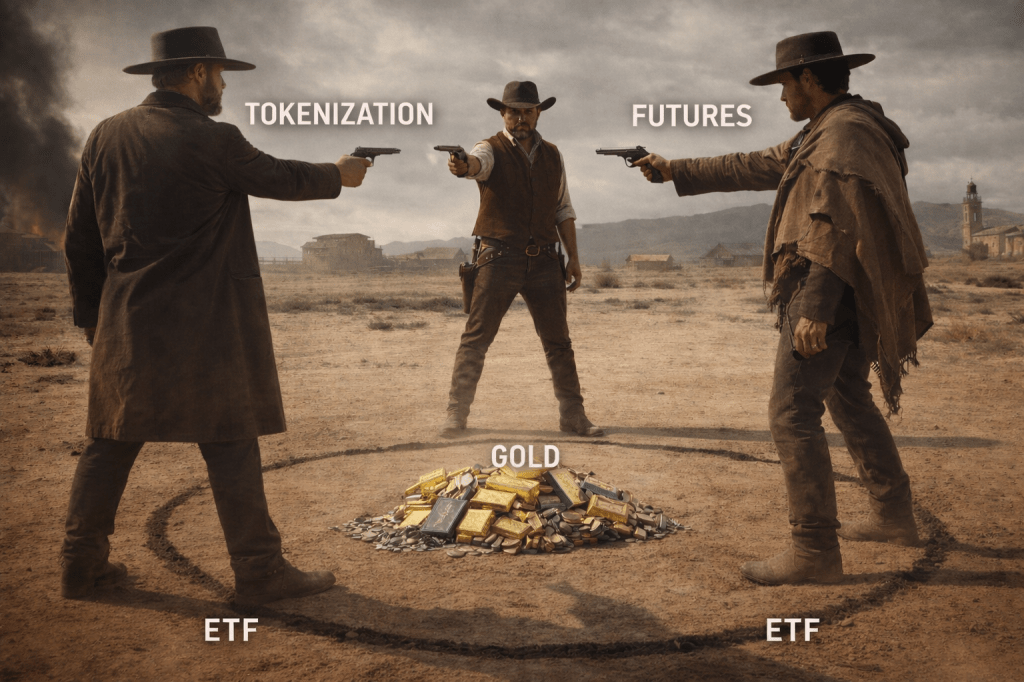
The future of metals is not a shootout between ETFs, futures, and tokenization. It is a question of which structures best serve ownership, transparency, and settlement in a digital economy.
— Yogi Nelson
This post is part of an ongoing weekly series on the tokenization of precious metals, published on BlockchainAIForum and LinkedIn, examining custody, regulation, issuer structure, and settlement infrastructure.
For decades, investors have gained exposure to precious metals and other hard assets through financial instruments designed for liquidity and scale rather than direct ownership. Exchange-traded funds and futures contracts made metals easier to trade, hedge, and price—but they also introduced layers of abstraction that separate investors from the underlying asset.
Tokenized metals reintroduce the question that those instruments largely set aside: what does it actually mean to own a hard asset?
Physical ownership implies custody, storage, insurance, and legal title. ETFs typically offer price exposure through pooled structures, with limited or no direct redemption for most investors. Futures markets facilitate price discovery and risk management, but they are contracts, not ownership vehicles. Tokenization, when structured properly, attempts to bridge these models—combining digital transferability with claims on physically vaulted metal.
This article compares tokenized metals directly with ETFs and futures by focusing on ownership rather than performance. The goal is not to argue that one model replaces the others, but to clarify how each structure works, what rights it confers, and what risks it introduces. Only by understanding these distinctions can investors and institutions evaluate where tokenization meaningfully changes market structure—and where it does not. Let’s now talk hard assets!
Hard Assets: Direct Ownership, Direct Responsibility
Hard assets are tangible, physical assets with intrinsic value. In the metals context, this means gold, silver, platinum, palladium, and other mined materials that must be refined, transported, stored, insured, and legally owned. Land ownership is a hard asset, but outside the scope of this series.
Traditional hard-asset ownership is conceptually simple: you own the metal. That ownership may be expressed through physical possession or through a custodial relationship with a vaulting provider, but the legal title is clear. The asset exists independently of any financial system.
The tradeoff is friction. Friction refers to the operational, financial, and logistical burdens associated with physical ownership—storage fees, insurance costs, transport limitations, slower settlement, and reduced liquidity. These frictions do not negate ownership, but they make hard assets less convenient to use within modern, fast-moving financial markets.
Hard assets provide certainty of ownership, but they do not scale easily in a global, digital system. That limitation is precisely what led to financial intermediaries.
ETFs: Exposure Without Possession
Exchange-traded funds revolutionized access to precious metals. Gold ETFs, in particular, allowed investors to gain exposure to gold prices using familiar brokerage accounts, with tight spreads and deep liquidity. ETFs excel at what they are designed to do:
Provide efficient price exposure
Integrate into regulated financial markets
Support institutional-scale liquidity
However, ETFs fundamentally change the ownership relationship. Most ETF holders do not own specific metal bars. They own shares in a trust or fund that holds metal through custodians and sub-custodians. Physical redemption is usually limited to authorized participants, not retail investors.
In practical terms, ETFs are financial exposure instruments, not ownership instruments. They track price movements effectively, but they intentionally abstract away custody, title, and delivery.
Futures Markets: Contracts, Not Assets
Futures markets serve a different purpose altogether. They are designed for:
Price discovery
Hedging
Risk transfer
Leverage
Futures contracts are agreements to buy or sell an asset at a future date, typically cash-settled or rolled forward. While physical delivery mechanisms exist, the vast majority of futures contracts never result in delivery.
Ownership is not the goal of futures markets. Exposure and risk management are. This makes futures indispensable to global markets, but unsuitable as ownership vehicles.
Global Markets: Scale at the Cost of Transparency
At the highest level, metals trade through global market infrastructure designed to support enormous volume and systemic stability. This infrastructure includes clearinghouses, central counterparties, and settlement networks such as the CME Clearing House, LCH, and international central securities depositories.
These entities perform critical functions: netting trades, managing counterparty risk, enforcing margin requirements, and ensuring settlement finality. Without them, global markets would not function.
However, this scale introduces distance. Ownership chains can involve multiple intermediaries—brokers, custodians, clearing members, and settlement agents—each adding legal and operational layers. End investors often rely on contractual assurances rather than direct visibility into custody or underlying assets.
This architecture prioritizes efficiency and stability, but it does so by design at the expense of transparency and direct ownership clarity.
Where Tokenized Metals Enter the Picture
Tokenization is often misunderstood as simply “putting gold on a blockchain.” In reality, tokenization is about restructuring ownership and settlement, not eliminating markets.
Tokenized metals attempt to:
Represent allocated physical metal digitally
Preserve custody and redemption rights
Enable peer-to-peer transfer
Reduce unnecessary intermediaries
Improve transparency
When designed properly, tokenization does not add another abstraction. It compresses existing layers by creating a single coordinated system that links physical custody, legal ownership, and transferability.
That coordinated system is tokenization implemented via a blockchain. The blockchain serves as the shared ledger that synchronizes ownership records, issuance, transfers, and redemptions, while the physical metal remains securely vaulted off-chain.
Whether tokenization succeeds depends entirely on how well this coordination is executed.
Tokenized Metals vs ETFs and Futures
The comparison becomes clearer when framed through ownership.
Ownership
Hard assets: Direct legal ownership
ETFs: Indirect exposure via fund shares
Futures: Contractual exposure
Tokenized metals: Potential direct ownership via digital representation
Liquidity
Hard assets: Low
ETFs: High
Futures: Very high
Tokenized metals: Variable, developing
Transparency
Hard assets: High at custody level
ETFs: Limited for end holders
Futures: Market-level transparency, not asset-level
Tokenized metals: High if properly designed
Redemption
Hard assets: Immediate
ETFs: Restricted
Futures: Rare
Tokenized metals: Platform-dependent
Taken together, tokenization does not automatically outperform ETFs or futures. Instead, it offers a different balance—trading some of the convenience of ETFs and the leverage of futures for improved ownership clarity, transparency, and settlement flexibility. This is why tokenized metals should not be viewed as replacements, but as alternatives optimized for different priorities.
Is Tokenization Just Another Derivative?
This is the central question—and the answer depends entirely on structure.
If a token:
Is not redeemable
Is backed by unallocated metal
Has opaque custody
Functions purely as price exposure
Then it is simply another derivative, regardless of blockchain branding.
However, tokenization can represent something fundamentally different. Consider the tokenization of land or real estate. When property is tokenized properly, the token does not represent price exposure—it represents legal title or enforceable claims on ownership, recorded digitally.
The same principle applies to metals. When a token represents allocated, uniquely identified metal with enforceable redemption rights, it functions as a digital ownership wrapper, not a derivative.
The distinction is not academic. It determines whether tokenization is merely financial engineering—or a genuine evolution in how ownership is recorded and transferred.
Why Institutions Care About Ownership Structure
Institutions already have access to ETFs and futures. They do not need tokenization for exposure. What they care about instead is market plumbing. And what is market plumbing? Market plumbing refers to the foundational systems that make markets function reliably:
Clearing and settlement
Custody and safekeeping
Collateral mobility
Reconciliation and auditability
Counterparty risk management
Cross-border interoperability
Tokenized metals become interesting to institutions when they improve this plumbing—by reducing settlement times, enhancing transparency, enabling programmable collateral, and simplifying reconciliation. In this sense, tokenization competes not on price or speculation, but on infrastructure efficiency.
Blockchain as Infrastructure, Not Ideology
The most credible tokenized metal platforms treat blockchain as infrastructure, not marketing. Public blockchains provide:
Immutable ownership records
Transparent issuance and supply tracking
Programmable transfer and settlement
Reduced reconciliation complexity
They do not replace vaults, insurers, or auditors. They coordinate them. This is what differentiates tokenization from earlier financial abstractions. ETFs and futures abstract ownership. Tokenization, at its best, re-architects it.
Global Markets Are Not Being Replaced
Tokenization will not replace ETFs, futures, or global commodity markets. Those systems exist because they solve real problems at scale. What tokenization can do is:
Offer alternatives for ownership-centric use cases
Complement existing markets
Improve settlement and transparency at the margins
Over time, those margins matter.
Conclusion: Understanding How Ownership Really Works
Hard assets, ETFs, futures, and tokenized metals are not competitors in a zero-sum sense. They are different tools, optimized for different purposes.
Tokenization does not eliminate abstraction. It challenges unnecessary abstraction. Its success will depend not on blockchain enthusiasm, but on custody, redemption, audits, and legal clarity. In that sense, tokenized metals are not a rebellion against markets—they are an evolution within them.
Understanding how ownership really works is the first step toward deciding where tokenization truly belongs.
Until next time,
Yogi Nelson
This article is part of an ongoing weekly series on the tokenization of precious metals, published on BlockchainAIForum and LinkedIn, examining custody, regulation, issuer structure, and settlement infrastructure.