“A token isn’t gold; the structure behind it is—and that’s where the real competition in tokenized metals is happening.” Yogi Nelson
Tokenization is no longer theoretical. By 2026, it has become a defining theme across finance—from equities and bonds to commodities. When it comes to precious metals, however, how tokenization is implemented matters far more than the token itself.
A token is not gold. The structure behind the token is the asset.
That means custody, audits, redemption rights, regulatory posture, and market integration matter far more than marketing claims.
In reviewing the leading tokenized gold issuers operating today, one thing becomes clear: there is no single “winner.” Instead, each issuer is running a different race—toward a different vision of what tokenized metals should be.
Here’s how the field lines up:
CACHE Gold → transparency and auditability
Comtech Gold → trade and settlement infrastructure
Kinesis → re-monetizing gold and silver as money
Paxos (PAXG) → institutional compliance and regulatory clarity
T-Gold (SchiffGold) → sound-money preservation
Tether Gold (XAUT) → liquidity and global reach
Tokenization is not a template. It’s a toolkit.
Some issuers optimize for institutions. Others for velocity, trade finance, or individual ownership. The common thread is this: tokenization is shifting precious metals from static holdings toward programmable financial infrastructure.
That is the real story—and why issuer design now matters more than the token symbol itself.
“A token isn’t gold; the structure behind it is—and that’s where the real competition in tokenized metals is happening”. Yogi Nelson
Coinbase CEO, Brian Armstrong, and Larry Fink, Blackrock CEO, both agree–tokenization of assets is the theme for 2026. Both understand tokenization has moved from theory to practice. Tokenization of gold is at the forefront of this tsunami. Yet regulatory posture, and market integration matter far more than marketing claims.
This article provides a clear, structured comparison of the leading tokenized precious metal issuers operating in 2026. The goal is not to rank them by hype or price performance, but to evaluate them by structure, credibility, and long-term viability.
Why Issuer Structure Matters More Than the Token Itself
Tokenized precious metals are often discussed as if the token is the asset. It is not. The real asset is the legal and custodial framework behind the token. Please remember this!
Considering a tokenized purchase? Here are a few questions to ask when conducting your due diligence:
Who holds the metal, and where?
Is the metal fully allocated and segregated?
Who audits the reserves, and how often?
What legal rights does a token holder actually have?
Can the token be redeemed for physical metal?
Is the issuer regulated — and in which jurisdictions?
In 2026, the strongest issuers are those that treat tokenization as financial infrastructure, not merely as a crypto product. I can’t emphasize this point enough. With that as background, let’s examine the best-known gold token issuers. They are listed in alphabetical order, not from “best” to “worse”.
CACHE Gold approaches tokenization from a simple but demanding premise: trust must be visible. Rather than leading with liquidity or ideological framing, CACHE positions transparency and auditability as its core value proposition.
Each CGT token represents allocated physical gold stored in professional vaults across multiple jurisdictions. CACHE publishes detailed bar lists and emphasizes independent third-party audits, reinforcing the principle that token holders should be able to verify backing without relying on institutional reputation alone. Trust but verify!
Tokenization here functions as a disclosure mechanism. The blockchain is not used to create financial complexity, but to make existing bullion practices more observable and accountable. This appeals to users who are less interested in DeFi composability and more concerned with proof-of-reserves discipline. Smart idea.
The tradeoff is scale. CACHE operates within a smaller ecosystem, with lower secondary-market liquidity and fewer exchange integrations than the largest issuers. Its design prioritizes clarity over velocity.
Best suited for: investors who value strong transparency, auditability, and vault diversification over liquidity or speculative activity.
Comtech Gold (CGO): Tokenization Built for Trade and Settlement
Comtech Gold represents a distinctly utilitarian vision of tokenized metals. Rather than framing gold as an investment product, Comtech positions tokenized gold as commercial infrastructure—designed to support commodity trade, collateralization, and settlement in regulated environments. They found a nice niche.
CGO tokens are issued within commodity-exchange and trade-finance frameworks, particularly in emerging and trade-focused jurisdictions. Gold is held with approved custodians, and token issuance aligns closely with existing regulatory regimes governing physical commodities.
Tokenization here improves settlement efficiency, traceability, and operational speed without attempting to disrupt the logic of trade markets. Comtech does not pursue broad retail adoption or DeFi composability; its focus is narrow by design.
This specialization limits visibility among Western retail investors and reduces global liquidity. But within its intended domain, Comtech’s approach is structurally coherent.
Best suited for: trade finance, commodity settlement, and emerging-market use cases where regulatory alignment and real-economy integration matter most.
Kinesis (KAU, KAG): Tokenized Metals as a Monetary System
Kinesis treats tokenization not as a feature, but as monetary architecture. Its gold (KAU) and silver (KAG) tokens are designed to circulate, settle, and function as money rather than static investment instruments.
Each token is backed by allocated physical metal stored in professional vaults across multiple jurisdictions. What distinguishes Kinesis is its yield-sharing model, which redistributes transaction fees to users who hold and actively use the metals. This design emphasizes velocity—a deliberate attempt to restore monetary function to precious metals. Back to the future?
Tokenization in Kinesis is therefore systemic. The blockchain coordinates ownership, settlement, and incentive distribution, creating an ecosystem where metals are meant to move.
This ambition introduces complexity. Users must understand system mechanics, fee flows, and governance. Institutional adoption has been slower than for simpler, custody-centric issuers.
Best suited for: users who believe precious metals should function as money, not merely as stores of value–an uphill climb.
Paxos remains one of the most institutionally credible issuers in the tokenized metals space, largely because it separates bullion standards from financial regulation with precision.
Each PAXG token represents ownership of one fine troy ounce of allocated physical gold. The gold conforms to London Bullion Market Association (LBMA) Good Delivery standards, ensuring bullion quality and refinery credibility. Importantly, LBMA sets market standards; it does not regulate issuers.
Regulatory oversight applies instead to Paxos itself, which operates under supervision by the New York Department of Financial Services (NYDFS). This dual structure—LBMA-standard bullion combined with NYDFS-regulated issuance—has made PAXG particularly attractive to institutions requiring legal clarity and compliance discipline.
PAXG emphasizes traceability, auditability, and redemption integrity. Each token can be linked to a specific gold bar, and attestations confirm full backing.
The tradeoff is flexibility. PAXG is gold-only, closely tied to U.S. regulatory jurisdiction, and less optimized for crypto-native experimentation.
Best suited for: institutions and regulated investors prioritizing legal certainty and bullion-market credibility.
T-Gold (SchiffGold): Sound-Money Tokenization with a Preservation Bias
Schiff Gold’s T-Gold reflects a philosophy-driven approach to tokenization. Rather than treating gold as a financial primitive to be re-engineered, T-Gold positions tokenization as a modern wrapper around traditional bullion ownership.
T-Gold represents allocated physical gold held with professional custodians, integrated into SchiffGold’s broader bullion ecosystem. The emphasis is preservation, ownership, and monetary discipline rather than yield or liquidity engineering.
Tokenization here improves portability and auditability without altering gold’s role as sound money. This clarity appeals strongly to investors already aligned with macro-oriented or anti-debasement narrative–a growing segment of the market.
Liquidity and secondary-market integration remain more limited than with larger issuers, and institutional settlement use cases are not the primary focus.
Best suited for: investors who prioritize sound-money principles and long-term wealth preservation.
Tether Gold (XAUT): Liquidity-First Tokenization at Global Scale
Tether’s XAUT represents a liquidity-first approach to tokenized gold. Each token corresponds to one fine troy ounce of allocated gold held in Swiss vaults, with redemption mechanisms available for larger holders.
What distinguishes XAUT is distribution and market depth. It is widely integrated across exchanges, wallets, and crypto-native platforms, often exhibiting greater secondary-market liquidity than competing gold tokens.
XAUT operates largely outside U.S. regulatory frameworks, offering flexibility and global reach but less formal oversight. Tokenization here is pragmatic: gold is treated as a stable, functional asset that can move at internet speed.
Best suited for: globally distributed, crypto-native users who value liquidity and accessibility over regulatory conservatism.
Key Comparison Themes
Across issuers, several patterns emerge:
Custody quality is table stakes; allocation and segregation are non-negotiable.
Redemption rights distinguish true tokenization from synthetic exposure.
Regulatory posture shapes who can use a token—and how.
Narrative coherence matters; the strongest issuers know why they tokenize.
Conclusion: Tokenization Is a Toolkit, not a Template
There is no single “best” tokenized precious metal issuer in 2026. Instead, there are clear leaders within distinct philosophies:
CACHE → transparency and auditability
Comtech Gold → trade and settlement
Kinesis → monetary re-engineering
Paxos → institutional compliance
T-Gold → sound-money preservation
Tether Gold → liquidity and reach
Tokenization is no longer about digitizing metal for novelty. It is about how metal-backed trust is structured, verified, and deployed in a programmable financial world.
That is the real story—and why issuer design now matters more than the token itself.
For most of modern history, gold-backed money has been declared obsolete. And yet, whenever trust in global monetary architecture becomes strained, gold has a way of quietly re-entering the conversation.
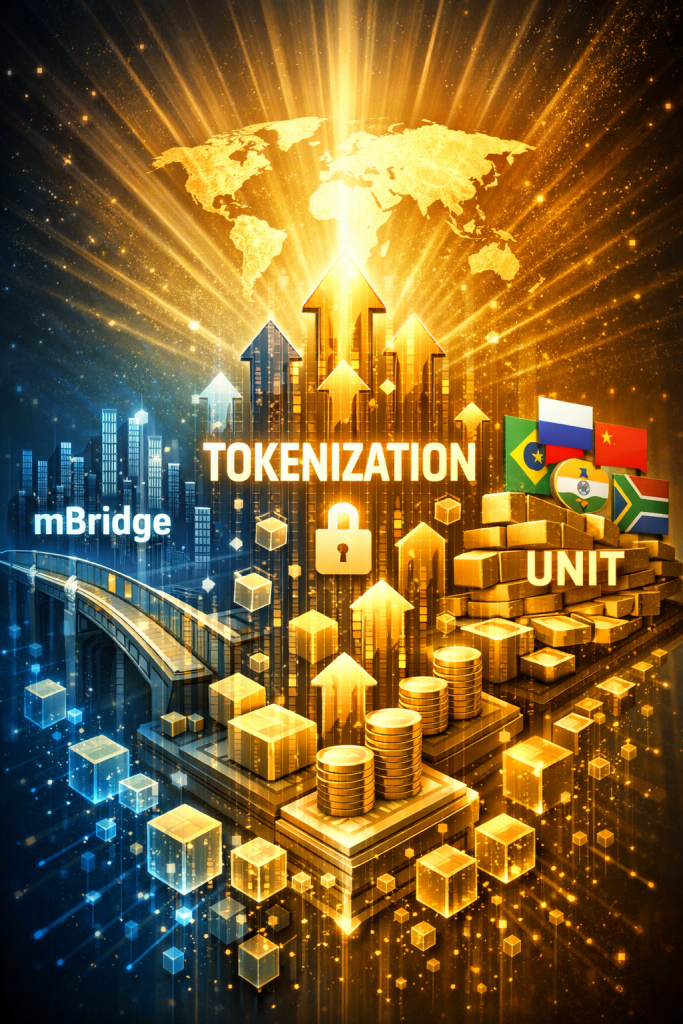
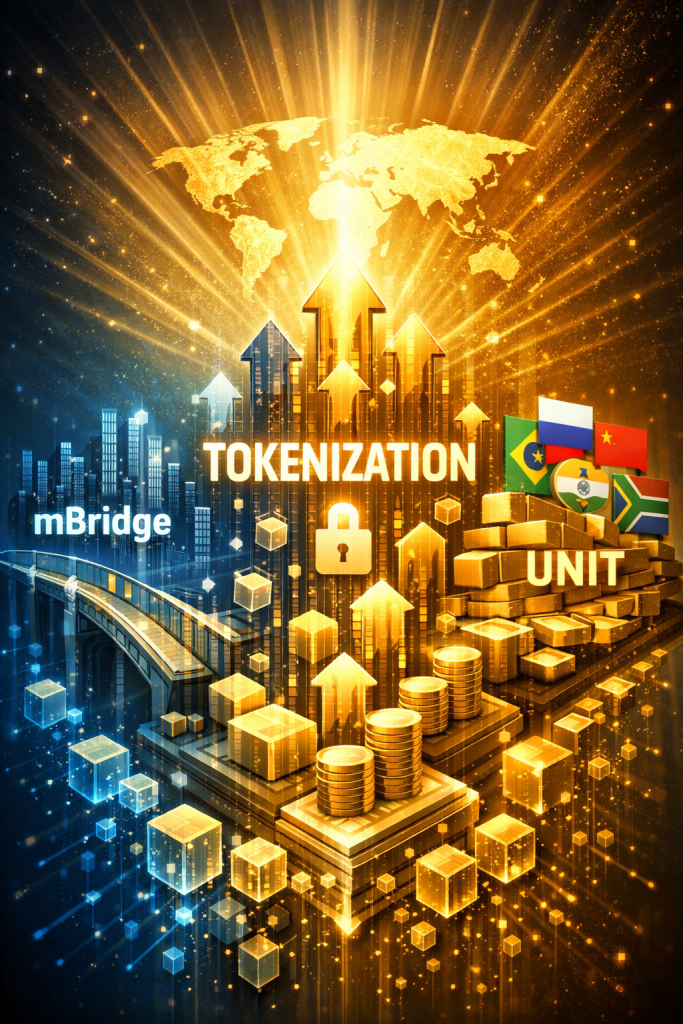
That appears to be happening again—this time through the combined emergence of mBridge, the proposed UNIT, and tokenization.
The distinction matters:
The UNIT is best understood as a trade settlement and accounting unit, reportedly backed by a mix of gold and participating fiat currencies within the BRICS bloc.
mBridge is not money at all. It is infrastructure—a blockchain-based settlement rail designed to move value directly between central banks without relying on correspondent banking networks like SWIFT.
Tokenization is the force multiplier. It enables verification, transparency, and enforceability—turning gold backing from a political promise into something that can be digitally confirmed.
Individually, each is interesting. Together, they suggest a system-level shift.
This does not overthrow the U.S. dollar. It does not replace SWIFT overnight. But it does introduce functional competition:
Alternative settlement rails
A gold-referenced unit for trade
A verification layer previous gold-backed systems never had
Historically, gold-backed money failed not because gold was flawed—but because trust was discretionary and opaque.
Tokenization changes that.
Whether or not the UNIT is ever fully tokenized remains to be seen. But the direction is clear: in a multipolar, digital world, global settlement may increasingly depend on systems that are verifiable, programmable, and less reliant on political assurances.
Tokenization may not be the headline—but it may be what rewires the system.
Today, gold is once again being repositioned—not as a domestic currency, but as international settlement infrastructure. This time, however, it is being paired with something previous systems lacked: blockchain-based verification and settlement rails.
The emerging combination of gold, the proposed UNIT, and the mBridge settlement system, strengthened by tokenization, represents a new and potentially powerful evolution of gold-backed money—one designed for a multipolar, digital world.
This is not a return to the gold standard. It is something more modern, more flexible, and more structural.
Gold’s Role Has Always Been About Trust
Gold earned its monetary role long before central banks existed. Its appeal was never ideological. Gold worked because it was scarce, durable, and politically neutral. It allowed settlement between parties that did not trust one another.
As economies expanded, gold’s form changed. Coins gave way to paper claims redeemable for metal. Later, convertibility faded, but gold remained central as a reserve asset—anchoring confidence rather than enforcing discipline.
Each transition reflected the constraints of the era. What remained constant was gold’s function as trust infrastructure. That function is being revisited today.
Why the Current System Is Being Questioned
The modern global monetary system is built around two pillars:
The U.S. dollar as the dominant settlement and reserve currency
SWIFT as the primary global financial messaging network
This system is efficient, liquid, and deeply entrenched. But it also creates structural asymmetries. Nations that do not control the system (90%+ of the world) remain dependent on it for trade settlement, reserves, and cross-border payments.
For the BRICS nations—Brazil, Russia, India, China, and South Africa—those asymmetries have become increasingly visible:
Trade volumes have grown faster than monetary influence
Sanctions and payment restrictions have highlighted vulnerability
Correspondent banking adds cost, delay, and political exposure
The response has not been to abandon fiat currencies or dismantle existing systems. Instead, BRICS policymakers have explored parallel architectures—systems that coexist with the current order but reduce dependency on it. Gold naturally reenters the picture here.
The UNIT: Gold-Referenced Settlement Money
The proposed UNIT is not a retail currency and not a replacement for national money. It is best understood as a trade settlement and accounting unit, designed primarily for use within BRICS trade corridors.
Publicly discussed models describe the UNIT as being backed by a hybrid structure:
40% gold
60% fiat currency, divided evenly among the five founding members
This design is intentional. Gold provides neutrality and credibility. Fiat components preserve flexibility and continuity with existing monetary systems.
The UNIT does not seek to dethrone the dollar globally, at least not yet. Instead, it challenges the dollar’s default role in BRICS trade settlement, offering an alternative reference unit that reduces reliance on any single sovereign currency. But money alone does not create a system. Settlement requires infrastructure. This is where mBridge enters the story.
mBridge: The Settlement Rail
mBridge is not money. It is infrastructure—a blockchain-based, multi-CBDC settlement platform designed to enable direct value transfer between central banks and large institutions.
Unlike SWIFT, which transmits payment instructions, mBridge is designed to settle value itself. It reduces the need for correspondent banks, shortens settlement times, and increases transparency.
The distinction is critical:
SWIFT answers the question: Who should pay whom?
mBridge answers the question: Has payment occurred?
mBridge does not replace SWIFT outright. But it introduces a parallel settlement pathway, particularly attractive to countries seeking to reduce exposure to existing financial chokepoints.
On its own, mBridge is a powerful tool. Combined with a gold-referenced unit like the UNIT, it becomes something more and when tokenization is dropped into the mix, a challenger appears on the horizon.
Tokenization: The Force Multiplier
Gold-backed systems historically failed for predictable reasons: opacity, centralized control, and political override. Trust depended on promises rather than proof. Tokenization changes that equation.
Tokenization allows physical gold held in sovereign vaults to be:
Digitally represented
Cryptographically verified
Independently audited
Programmatically referenced in settlement
In a UNIT–mBridge framework, tokenization could serve as the verification layer that binds money and infrastructure together. Rather than relying on declarations that gold exists, tokenization allows systems to prove it.
How the System Could Work in Tandem
In combination, the components align naturally:
Gold provides neutral, non-sovereign credibility
The UNIT provides a shared settlement and accounting unit
mBridge provides the blockchain-based settlement rail
Tokenization provides verification, transparency, and enforcement
Under such a framework:
Gold remains physically stored within national vaults
Each nation retains sovereign custody over its reserves
Tokenized representations confirm the existence and allocation of gold
mBridge settles obligations using verified balances
The UNIT functions as the accounting and pricing reference
This structure does not eliminate fiat currencies. It operates above them, coordinating settlement without replacing domestic monetary systems.
Challenge or Revolution?
It is important to be precise. This system does not overthrow the dollar or dismantle SWIFT overnight. Instead, it introduces functional competition:
Competition to SWIFT in settlement infrastructure
Competition to the dollar in specific trade corridors
Competition based on architecture, not ideology
Tokenization is what makes this competition real. Without it, the UNIT is an accounting idea and mBridge is an experiment. With it, they become a coherent, auditable system. This is how monetary systems change—not through abrupt replacement, but through parallel adoption.
Why Gold Fits This Moment
Gold is uniquely suited to this role:
Central banks already hold it
Custody practices are established
It is not consumed or degraded
It functions naturally as collateral
Unlike other commodities, gold does not need to circulate to be useful. Its credibility increases when it remains immobile and verified. Tokenization allows gold to be digitally active without being physically mobile.
Historical Continuity, Not Regression
Seen in historical context, this evolution is logical:
Gold as physical money
Gold as paper backing
Gold as reserve asset
Gold as digitally verified settlement anchor
Each stage reflects technological capability and political reality. Tokenization does not restore the gold standard. It modernizes gold’s role as trust infrastructure.
The UNIT and mBridge are not anomalies. They are contemporary expressions of an ancient instinct: when trust is uneven, systems seek neutral anchors.
Conclusion: Tokenization as the Enabler
Gold-backed money has always depended on credibility. What has changed is how credibility can be demonstrated. By combining gold, the UNIT, mBridge, and tokenization, BRICS nations are exploring a system where backing is verifiable, settlement is direct, and trust is structural rather than discretionary.
This does not replace existing systems. It pressures them. It offers alternatives. And once alternatives exist, they tend to persist.
Tokenization is not the headline. It is the enabler—the quiet force that allows gold-backed settlement to function in a digital, multipolar world.
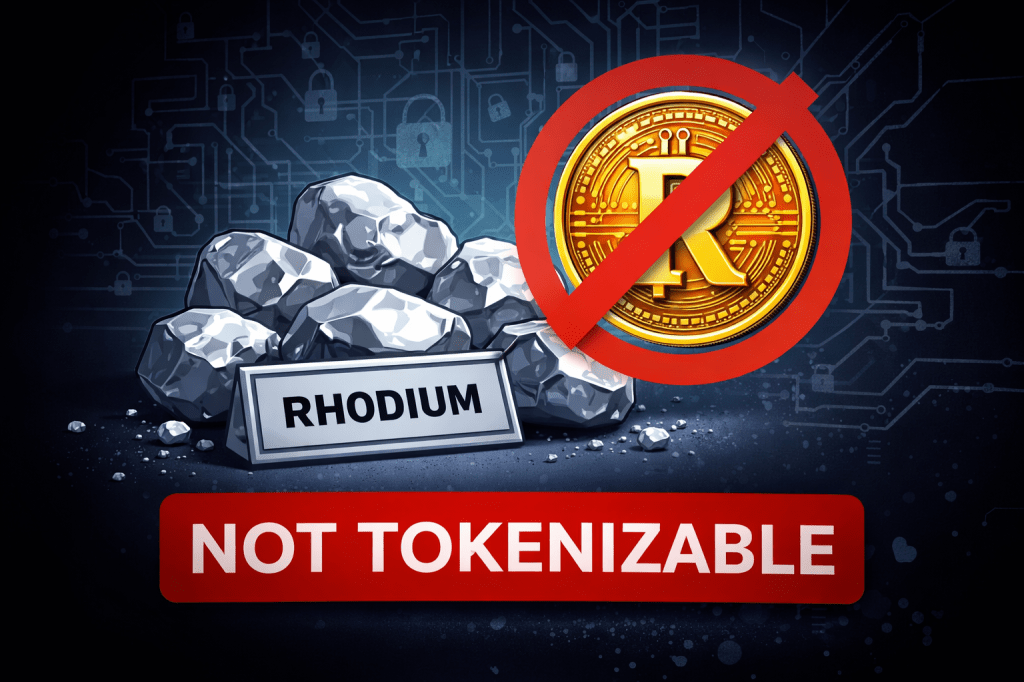
Rhodium is one of the rarest metals on Earth—far rarer than gold or silver—and yet it plays a critical role in modern life. Most people never see it, but without rhodium, today’s emissions standards would be nearly impossible to meet.
As real-world assets (RWAs) move onto blockchain rails, it is natural to ask: Can rhodium be tokenized?
After digging into its supply structure, price behavior, and industrial demand, the answer—for now—is not really.
Rhodium is:
Almost entirely a byproduct metal
Geographically concentrated in a handful of countries
Extremely volatile, with thin and opaque spot markets
Driven by regulation, not investor demand
Tokenization works best where liquidity, transparency, and broad participation already exist. Rhodium meets none of those conditions today.
That does not mean rhodium has no digital future. In a mature RWA ecosystem, tokenized rhodium may emerge quietly—used by industry players for settlement, inventory finance, or compliance rather than speculation.
Not every metal belongs on a blockchain. And rhodium reminds us that “not yet” is sometimes the most honest answer.



 Blockchain & AI Forum