Welcome to the BlockchainAIForum
Investing is changing at lightning speed thanks to blockchain technology. One of the most exciting innovations is tokenized stocks. But what exactly are they? How do they work? Why do some investors love them while others worry? Let’s break it down step by step!
🪙 What Are Tokenized Stocks?
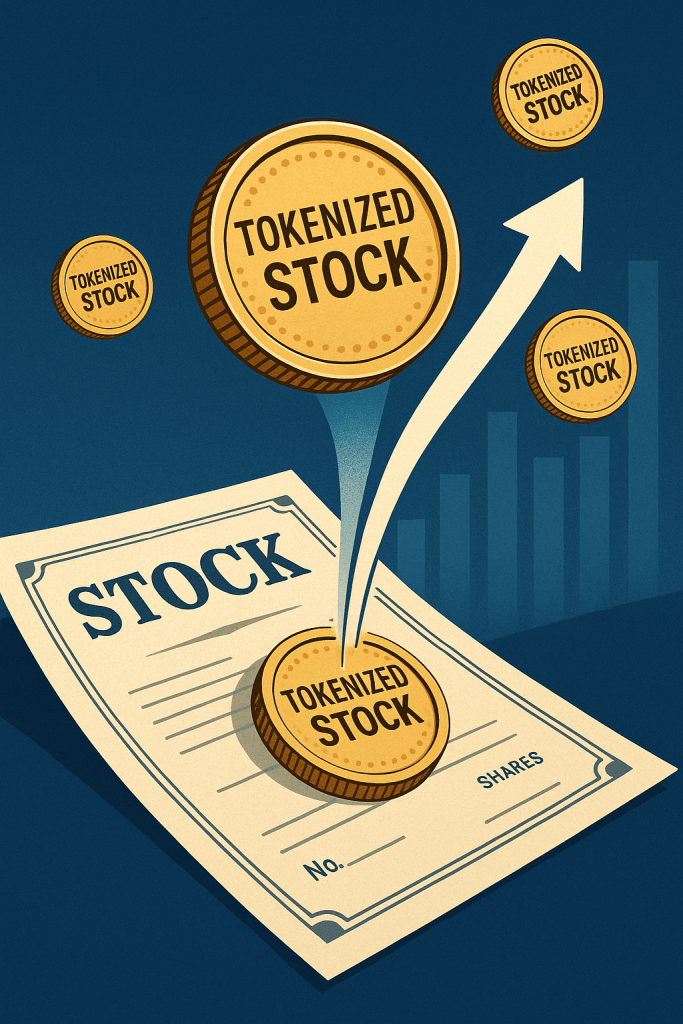
Tokenized stocks are digital representations of real-world stocks on a blockchain. Imagine buying shares of Apple or Tesla—but instead of going through a traditional brokerage, you receive tokens on a blockchain that mirror the value of those stocks. Each token typically represents one share (or even a fraction of one share) of a company. These tokens can be traded on blockchain-based platforms just like cryptocurrencies.
🛠️ How Do Tokenized Stocks Work? (Step by Step)
Let’s go through it from start to finish:
1️⃣ Underlying Asset
A real-world stock (for example, Tesla stock) exists and is held in custody by a licensed broker or institution. This entity ensures that the tokens are backed 1:1 by real shares.
2️⃣ Token Creation
A blockchain platform issues tokens representing these shares. Smart contracts automate issuing, transferring, and recording ownership.
3️⃣ Buying and Selling
Investors buy these tokens on crypto exchanges that support them, trading them much like Bitcoin or Ethereum.
4️⃣ Fractional Ownership
Unlike traditional stocks that might require buying whole shares, tokenized stocks allow fractional ownership. You can buy 0.1 of an Apple share, making investing more accessible.
5️⃣ Settlement on the Blockchain
Transactions settle on-chain, recording ownership changes immediately or within minutes instead of days.
💡 Advantages of Tokenized Stocks
- ✅ 24/7 Trading
Unlike traditional stock markets that close overnight and on weekends, tokenized stocks can trade at any time. - ✅ Global Access
Anyone with an internet connection and a crypto wallet can invest, opening markets to investors in regions without traditional brokerages. - ✅ Fractional Shares
Tokenization lowers the barrier to entry. Instead of buying a whole $1000 share, you can invest $10. - ✅ Faster Settlement
Blockchain-based settlement can be near-instant, reducing counterparty risk and eliminating some middlemen. - ✅ Improved Transparency
All transactions are recorded on-chain, enhancing traceability and auditability.
⚠️ Disadvantages of Tokenized Stocks
- ❌ Regulatory Uncertainty
Regulators are still figuring out how to treat these assets. This uncertainty can lead to sudden changes in availability. - ❌ Counterparty Risk
Tokens are only as good as the custodian holding the real shares. If that custodian is dishonest or goes bankrupt, the backing can vanish. - ❌ Limited Platforms
Not all exchanges support tokenized stocks. Liquidity can be limited compared to traditional markets. - ❌ Jurisdictional Restrictions
Many tokenized stocks cannot legally be sold in certain countries (for example, the U.S.) due to securities laws.
⚖️ The State of Regulations
Regulation is the biggest wild card in the future of tokenized stocks.
- In the United States, the SEC generally considers these tokens securities. Selling them without proper licenses can be illegal.
- Some platforms have previously offered tokenized stocks without full regulatory approval, drawing heightened scrutiny.
- The European Union is taking a more controlled approach. The EU’s MiCA (Markets in Crypto-Assets) framework sets rules for digital assets, but tokenized stocks may fall under existing securities laws.
- Countries like Switzerland and Singapore have clearer guidelines encouraging innovation while protecting investors.
In short, the landscape is fragmented. Companies issuing tokenized stocks must navigate a patchwork of local laws and face the risk of regulatory crackdowns.
🌍 Real‑World Example: Robinhood’s Tokenized Stocks in Europe
In June 2025, Robinhood made headlines by launching tokenized U.S. stocks and ETFs for users in the European Union and European Economic Area. Through a partnership with the Arbitrum blockchain, Robinhood offers over 200 stock and ETF tokens, including major companies like Apple, Nvidia, and Microsoft, as well as private firms such as OpenAI and SpaceX.
🎁 Launch Incentive & Scope
Robinhood incentivized early adoption by giving European users who onboarded before July 7, 2025, €5 worth of OpenAI and SpaceX tokenized shares. However, these tokens are backed by a special purpose vehicle (SPV) and do not confer actual ownership, voting rights, or dividends.
🚀 Market Impact & Strategy
Robinhood’s stock price surged as much as 12–13%, hitting record highs after the announcement. Analysts see this move as a major revenue expansion opportunity, with the potential to scale globally as regulation evolves. Robinhood is also developing its own Layer 2 blockchain optimized for tokenized real-world assets.
🧾 Key Considerations
- Synthetic Exposure: These tokens offer price exposure but do not represent real equity. OpenAI, for example, publicly distanced itself from the offering, clarifying it was launched without its authorization.
- Regulatory Scrutiny: Authorities such as Lithuania’s central bank and the European Securities and Markets Authority (ESMA) are reviewing the offering to ensure compliance with securities laws.
Robinhood’s European launch shows both the promise of tokenized stocks—greater accessibility, 24/7 trading—and the complexities of regulation and legal frameworks.
🔮 The Future of Tokenized Stocks
Tokenized stocks aim to democratize investing, making it cheaper, faster, and more global. If regulators can agree on consistent, investor-friendly rules, tokenized stocks could become as mainstream as ETFs.
But challenges remain. The sector will need:
- Stronger custodial frameworks
- Clearer, harmonized regulations
- Greater public awareness and education
📌 Conclusion
Tokenized stocks are a compelling example of blockchain reshaping traditional finance. By enabling fractional, 24/7, globally accessible trading, they break down old barriers. But they also introduce new risks—especially around regulation and custodial integrity.
As the technology matures, we may see the best of both worlds: the reliability of traditional markets combined with the innovation of blockchain. For now, investors should stay informed, understand the risks, and watch the evolving regulatory landscape carefully.
Until next time,
Yogi Nelson