Blockchains, Environment, finance, Governance, Mining, Nickel, tokenization, Uncategorized, Yogi Nelson

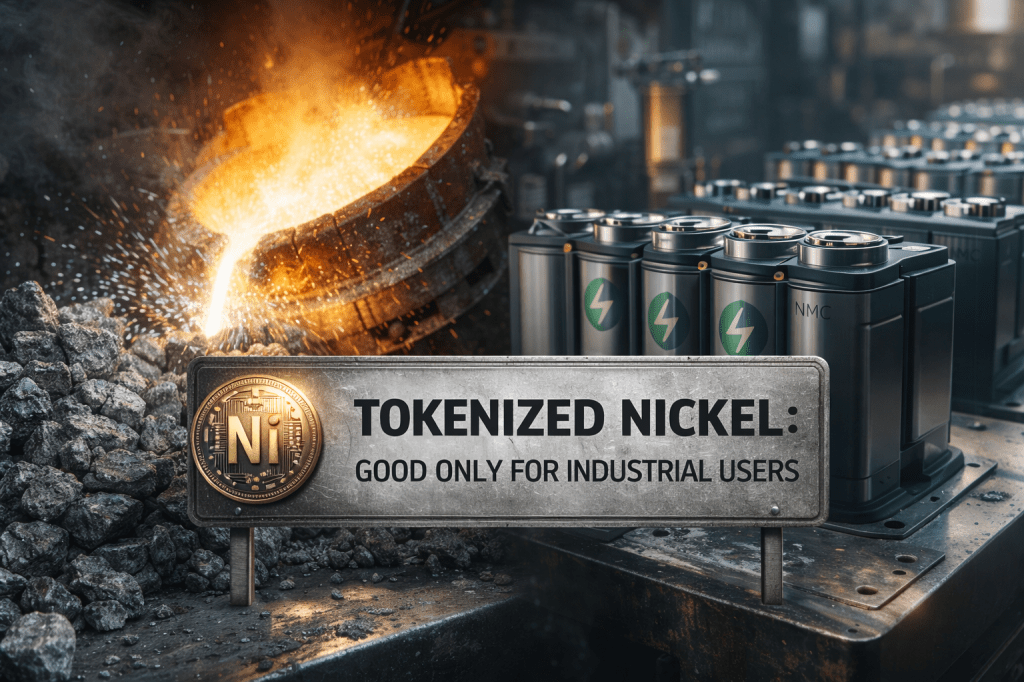
Tokenized Nickel: A Critical Metal for the Clean Energy Transition

by Yogi Nelson (Nelson Hernandez)

Nickel seldom demands the spotlight. It infrequently carries the mystique of gold, the dual identity of silver, or even the growing narrative momentum of copper and lithium. Yet beneath that relative obscurity lies a reality that is becoming increasingly difficult to ignore: nickel is a foundational material in the clean energy transition.

It plays a central role in battery chemistry, industrial production, and the infrastructure of a modern, electrified economy. And as demand accelerates, so too does the complexity of its supply chain. This raises a familiar—but evolving—question:

Can a metal defined by industrial use, chemical variation, and global fragmentation be effectively tokenized on the blockchain?

Or more precisely: Is nickel another candidate for tokenization—or a reminder that not all critical materials are easily digitized? Those questions and others to be answered below, but first what is nickel?


What Is Nickel?

Nickel is a silvery-white metal known for its strength, corrosion resistance, and high-temperature stability. It has been used for over a century in industrial applications, but its importance has grown significantly in recent decades. What are its properties:

  • Resistance to corrosion and oxidation
  • High melting point
  • Strength and durability
  • Ability to form alloys with other metals

Nickel is rarely used in pure form. Instead, it is typically combined with other metals to enhance performance characteristics.


Where Is Nickel Mined?

Nickel production is geographically concentrated, with a few countries dominating global supply.

Major producers in order of production include:

  • Indonesia — the world’s largest producer, with rapidly expanding output
  • Philippines — significant supplier of laterite nickel ore
  • Russia — major producer, particularly of high-grade nickel
  • Canada — stable and high-quality production
  • Australia — significant reserves and mining operations

Nickel is extracted from two primary types of deposits:

  • Sulfide deposits (higher grade, easier to process)
  • Laterite deposits (more abundant, but more complex and energy-intensive to refine)

This distinction matters because:

  • Not all nickel is equal
  • Processing methods affect cost, quality, and usability

What Is Nickel Used For?

Nickel’s value lies in its versatility. Nickel stands as the fifth most commonly used metal behind: iron, copper, aluminum, and silver.

1. Stainless Steel (Primary Use)

Approximately 65–70% of global nickel demand is tied to stainless steel production. When iron is transformed into steel, nickel joins the production process. Nickel is used to improve corrosion resistance, strengthen toughness, and performance at high and low temperatures. Here is a short list of uses:

  • Used in construction
  • Industrial equipment
  • Consumer goods

This is the traditional foundation of nickel demand.


2. Batteries (Fastest Growing Use)

Nickel is a key component in lithium-ion battery chemistries, particularly:

  • Nickel-Manganese-Cobalt (NMC)
  • Nickel-Cobalt-Aluminum (NCA)

Higher nickel content in batteries results in:

  • Increases energy density
  • Extends vehicle range

This is why nickel is central to electric vehicles. Tesla, BYD, and all EV manufacturers need nickel. No nickel no EVs.


3. Energy and Industrial Applications

Nickel is also used in:

  • Aerospace alloys
  • Turbines and power generation
  • Chemical processing equipment

Nickel is both an industrial and strategic material. Recognizing the importance of nickel, the US government listed nickel as a critical mineral in 2022.


Why Nickel Demand Is Rising

Nickel demand is being pulled in two directions simultaneously:

1. Traditional Industrial Demand

  • Infrastructure development
  • Manufacturing growth
  • Stainless steel consumption

2. Energy Transition Demand

  • Electric vehicles
  • Battery storage systems
  • Renewable energy infrastructure

Nickel demand for batteries alone is expected to grow significantly over the next decade, driven by EV adoption and energy storage needs. This creates a dual-demand structure:

  • Stable base demand
  • Rapidly expanding new demand

Why Nickel Is a Candidate for Tokenization

Nickel presents an interesting—but complex—case for tokenization.

Unlike gold, or even silver to some extent, tokenization is not about preserving value. And as opposed to lithium, nickel is not purely about energy storage. Despite sitting outside of those considerations, there may be reasons for tokenization. Let’s examine those below.


1. Global Liquidity

Nickel is actively traded on major exchanges, including the London Metal Exchange (LME). This provides:

  • Price discovery
  • Market depth
  • Existing financial infrastructure

For tokenization to work effectively liquidity must be present in the market place. The nickel market has liquidity.


2. Industrial Relevance

Nickel is essential across multiple sectors:

  • Construction
  • Manufacturing
  • Energy

This broad utility supports:

  • Consistent demand
  • Ongoing market activity

Liquidity and industrial relevance push the possibility of tokenized nickel toward viability. Let’s go to step three.


3. Warehouse and Inventory Systems

Nickel is already stored in:

  • Exchange-approved warehouses
  • Industrial storage facilities

This creates a potential foundation for:

  • Token-backed inventory models
  • Digitized ownership

Warehouse and inventory systems combined with liquidity and industrial relevance create the environment where tokenization is possible. Yet, there is one more factor–strategic importance. Nickel is valued by major economic and military powers.


4. Strategic Importance

Nickel is a critical mineral, according to the US government, European Union, Canada, Australia, Japan, United Kingdom, India, and China. There may be others, but you get the point. In other words, every major economic power. Russia is missing most likely because they are a major silver producer and therefore are not concerned with securing supply. As a critical mineral that means governments are monitoring supply chains and nations have or will develop supportive policy frameworks.

This increases demand for:

  • Transparency
  • Traceability
  • Verification

How Tokenized Nickel Might Work

Tokenization of nickel would likely follow several possible models.


1. Warehouse-Backed Tokens

  • Each token represents a specific quantity of nickel
  • Stored in verified facilities
  • Audited regularly

Similar to gold—but with more complexity. Sophisticated players only.


2. Supply Chain Tracking

Tokens track nickel through stages:

  • Mining
  • Processing
  • Manufacturing

This could improve:

  • Transparency
  • Efficiency
  • Coordination

3. Contract-Based Tokenization

Tokens tied to:

  • Future production
  • Offtake agreements

This introduces:

  • Financing opportunities
  • Legal complexity

The Case AGAINST Tokenizing Nickel

Variability in Material

Nickel exists in multiple forms and grades:

  • Class 1 nickel (high purity, battery-grade)
  • Class 2 nickel (lower purity, stainless steel use)

This complicates standardization and tokenizations works best under standardized conditions.


Processing Complexity

The value of nickel depends heavily on:

  • Refining method
  • End-use application

Tokens must reflect these differences accurately. The solution might include NFTs.


Supply Chain Fragmentation

Nickel moves through multiple jurisdictions and stages. Tracking this reliably is difficult albeit not impossible.


Limited Retail Investment Appeal

Unlike gold, nickel is not held as an investment asset. Thus, tokenization may be driven more by specialized industry users than investors.


Governance Considerations

As with all tokenized metals, governance is central.

Key issues include:

  • Proof of reserves
  • Audit transparency
  • Legal ownership rights
  • Redemption mechanisms

In nickel, these issues are amplified by:

  • Multiple grades and classifications
  • Complex processing chains
  • Cross-border logistics

Without strong governance, tokenized nickel risks becoming:

  • Technically feasible
  • Practically unreliable

Final Thoughts

Nickel occupies a unique position in the evolving tokenization landscape. Nickel is:

  • Industrial
  • Strategic
  • Increasingly essential

But it is also:

  • Variable
  • Complex
  • Difficult to standardize

Tokenizing nickel is not about creating a new digital asset for investors. It is about improving how a critical material moves through the global economy. If tokenization succeeds it won’t be due to retail market enthusiasm. Nope. It will be because the industrial system demands:

  • Greater efficiency
  • Better transparency
  • Stronger coordination

And as always:

Structure—not story—will determine whether tokenized nickel becomes a meaningful innovation—or simply another digital experiment.


Until next time,


Yogi Nelson (Nelson Hernandez)

Blockchains, Digital Currency, finance, Governance, Lithium, Mining, tokenization, Yogi Nelson

Tokenized Lithium: Web3’s Entry Into the EV Battery Supply Chain

by Yogi Nelson (Nelson Hernandez)

Lithium is not a store of value.
It is not a hedge.

Lithium is energy—stored, deployed, and essential to electrification.

It powers:

  • Electric vehicles
  • Energy storage systems
  • The infrastructure behind renewable energy

And demand is accelerating.

  • Lithium demand is expected to grow more than 4x by 2030
  • EVs now account for 70–80% of total lithium consumption
  • Global EV sales could exceed 40 million units annually by 2030

👉 This is not cyclical.
👉 This is structural.

So the question becomes:

Can lithium be tokenized?

Unlike gold, lithium is not about storing value.
It moves through a complex global supply chain:

Mine → Refinery → Battery → End use

👉 That makes tokenization less about investment…
…and more about transparency, coordination, and verification.

If Web3 has a real role in commodities, lithium may be where it begins.

Not because it is simple—
…but because it is necessary.

And as always:

Structure—not story—will determine what works.

Austrian economics, Board of Directors, Governance, Mining, Uncategorized, Yogi Nelson

Governance Before Revenue: Discipline During Financing Rounds

by Yogi Nelson

Why Junior Mining Boards Must Exercise Discipline When Raising Capital

Junior mining companies live on capital. No capital; no life. Unlike operating businesses that generate revenue from the sale of products, junior miners rely almost entirely on investor funding to advance their projects. Drilling programs, geological surveys, environmental studies, and technical reports all require capital long before a mine ever produces its first ounce of metal. The implication is clear: financing rounds are not simply financial events. They are governance events.

When a junior mining company raises capital—whether through private placements, strategic investments, or institutional participation—the board of directors must exercise disciplined oversight to ensure the financing process protects both the company and its shareholders.

Financing is the mother’s milk of exploration companies. Poor governance during financing rounds, however, can damage credibility in ways that are difficult, if not impossible, to repair.

In junior mining, financing is inevitable. Governance discipline determines whether it builds value—or erodes it.

Capital Formation in the Junior Mining Sector

Capital markets are the engine that powers the junior mining industry. Exploration companies raise funds repeatedly over the life cycle of a project. Early-stage drilling programs may require modest financing, while later phases, such as development, demand larger capital injections. Regardless of the phase, each financing round presents difficult questions for management and the board. Consider these examples:

  • How should the financing be structured?
  • What price should the shares be issued at?
  • Should insiders participate in the financing?
  • How much dilution is acceptable?
  • Which investors should be invited to participate?

These questions transcend financial decisions. They are governance decisions that affect fairness, transparency, shareholder trust, and thus long-term viability.

Pricing Discipline and Fairness

The price at which new shares are issued is a sensitive decision fraught with opportunities and pitfalls. In junior mining markets, financings are often priced at a discount to the prevailing market price. This practice can be necessary to attract investors, particularly in volatile commodity markets or during periods of weak market sentiment. However, the board must ensure that pricing decisions are reasonable and defensible.

Issuing shares at excessively discounted prices may dilute existing shareholders unnecessarily and raise questions about who benefits: new investors or the company? That is why directors should carefully evaluate:

  • Market conditions at the time of the financing
  • Comparable financings within the sector
  • The company’s capital requirements
  • The potential dilution impact on existing shareholders

Governance discipline requires that pricing decisions reflect the best interests of the company—not convenience.

Insider Participation

Financing rounds frequently include participation from insiders such as directors, officers, and major shareholders. And do not get me wrong—insider participation can be viewed positively. When insiders invest their own capital alongside other investors, it may signal confidence in the company’s prospects. Nevertheless, insider participation introduces governance considerations that must be handled carefully.

Boards must ensure that:

  • Insider participation is fully disclosed
  • Pricing and allocation decisions are fair
  • Conflicts of interest are properly managed
  • Independent directors review the transaction

Transparent governance processes help ensure that insider participation strengthens investor confidence rather than undermining it.

Allocation of Shares

Another governance challenge during financing rounds involves the allocation of shares among participating investors. This is a big deal and must be handled with care.

In highly oversubscribed financings, management may have significant discretion in deciding which investors receive allocations. Therefore, these decisions can have long-term implications for the company’s shareholder base. For example, the board may wish to encourage participation from:

  • Long-term institutional investors
  • Strategic partners
  • Industry specialists
  • Investors with expertise in the mining sector

Conversely, allocating significant shares to short-term speculators may create future volatility in the company’s shareholder base. Boards should therefore remain attentive to how capital is allocated and whether the resulting shareholder structure supports the company’s long-term objectives.

Disclosure and Transparency

Financing transactions must be accompanied by clear and accurate disclosure. Investors participating in a financing round expect transparency regarding the terms of the offering, the use of proceeds, and any participation by insiders. This is a non-negotiable standard. At a minimum, typical disclosure should include:

  • The price and size of the financing
  • The use of proceeds
  • Participation by directors or officers
  • Any special warrants or conversion features
  • Regulatory approvals required for the transaction

Transparent disclosure is not simply a regulatory obligation. It is a key element of market credibility. And never lose sight of why quality disclosures are essential: investors are far more likely to support companies that communicate financing decisions openly and clearly.

The Board’s Oversight Responsibility

Although management typically negotiates financing arrangements, the board of directors must exercise strict oversight over the process. Board oversight must include reviewing the structure of the financing, evaluating its fairness, and ensuring that conflicts of interest are properly managed.

In many cases, and to augment credibility with the market, independent directors may take the lead in reviewing the financing to ensure that the interests of existing shareholders are protected. Financing deals raise dozens of questions, but at a minimum the board should ask fundamental questions during financing discussions:

  • Does the financing structure serve the long-term interests of the company?
  • Are the terms fair to existing shareholders?
  • Have conflicts of interest been properly disclosed and addressed?
  • Is the company raising the appropriate amount of capital relative to its needs?

Avoiding Governance Pitfalls

Financing rounds can expose junior mining companies to several governance pitfalls if not managed carefully. The possible scenarios are almost endless. Nevertheless, the pitfalls generally fall into several categories. For example: Are existing shareholders being diluted excessively? Is there preferential treatment of insider investors? Are disclosure practices transparent or opaque? Is there proper alignment between financing size and project needs?

If those questions—or similar ones—cannot be answered in the affirmative, the company may be headed toward a governance pitfall. And remember: credibility is elusive once lost.

Governance and Market Reputation

Junior mining companies, in many respects, are no different from any other startup company—they depend heavily on investor confidence. Exploration companies may raise capital many times before a project reaches development or production. For this reason, reputation in capital markets is one of a company’s most valuable assets. Do not waste it.

Companies that demonstrate disciplined governance during financing rounds build credibility with investors, analysts, and industry participants. Conversely, companies that conduct poorly structured financings may find it increasingly difficult to attract capital in the future. In other words, governance during financing rounds influences not only the current financing—but also the company’s ability to raise capital in the years ahead.

Final Thoughts

Financing rounds are among the most consequential decisions that junior mining boards will oversee. Get it right and thrive; get it wrong and watch value slide. While management may lead the capital raising process, the board bears responsibility for ensuring that the financing is structured fairly, disclosed transparently, and aligned with the long-term interests of shareholders.

In the junior mining industry, capital is precious. So is credibility. Boards that exercise governance discipline during financing rounds protect both. In a sector where companies depend on investor trust long before revenue arrives, that discipline can make all the difference.

Until next time,


Yogi Nelson

Austrian economics, Banking, Blockchains, finance, Governance, International Finance, Mining, tokenization, Yogi Nelson

Industrial Metals Begin Their Blockchain Moment

by Yogi Nelson (Nelson Hernandez)

Much of the conversation around tokenization has focused on gold and, to a lesser extent, silver. That makes sense—both are stores of value, widely recognized, and relatively standardized.

But a quieter shift is now underway.

Industrial metals are beginning to enter the blockchain conversation.

Unlike precious metals, industrial metals—such as copper, aluminum, and nickel—are not stores of value. They are inputs to the real economy, essential to infrastructure, energy systems, and manufacturing.

So why tokenization?

The answer lies in three areas:

  • Supply chain complexity
  • Demand for transparency and provenance
  • The ongoing financialization of commodities

Tokenization offers the potential to improve tracking, reduce settlement friction, and enhance visibility across fragmented global supply chains.

But challenges remain.

Industrial metals lack the standardization of gold. They vary by grade, form, and end use. That makes token design—and trust—more difficult.

Not all metals are equally viable.
Copper and aluminum may be strong candidates. Raw ore and specialized alloys, far less so.

So is this the next frontier—or premature?

Likely both.

Tokenization of industrial metals is not about creating digital money—it is about modernizing the infrastructure of the real economy.

And as always:

Structure—not story—will determine what succeeds.

Board of Directors, Governance, Mining, Uncategorized, Yogi Nelson

Governance Before Revenue: The Case for Audit Committees in Junior Mining

by Yogi Nelson

Why Junior Mining Companies Must Establish Financial Oversight Early

In the early life of a junior mining company, nearly every ounce of energy goes toward geology, exploration programs, and financing the next drilling campaign. Teams are small, budgets are tight, and leadership is focused on proving the resource. Governance structures—particularly formal committees—often seem like something that can wait until the company becomes larger or begins generating revenue. In 2026, that assumption is outdated.

One of the most important governance structures a junior mining company can establish early in its development is the Audit Committee. While traditionally associated with large, revenue-producing corporations, audit committees are just as critical—perhaps even more so—for early-stage resource companies.

In fact, establishing an audit committee before revenue begins sends a powerful signal to investors, potential acquisition suitors, and merger candidates: the company takes financial discipline, transparency, and accountability seriously. For junior miners seeking credibility in capital markets, that signal can make a meaningful valuation difference.

Effective audit committees provide independent financial oversight that strengthens investor confidence in junior mining companies

Why Early Governance Matters in Exploration Companies

Junior mining companies operate in a unique financial environment. Unlike traditional operating businesses, exploration companies often spend years—sometimes a decade or more—raising capital and deploying it into exploration activities before generating any revenue.

During this time, investors are funding geological risk, operational risk, and management execution. With little or no operating income to measure success, investors are compelled to rely heavily on trust across three fundamental factors:

  • Effective and efficient use of funds
  • Accurate financial reporting
  • Management decisions that are subject to appropriate oversight

Without these safeguards, even promising exploration programs can struggle to attract sustained investor support.

Below I will explain why an effective audit committee is the best tool available to reinforce that trust. But first, it is useful to understand the work of an audit committee.

What an Audit Committee Actually Does

An audit committee is a specialized committee of the board of directors responsible for overseeing the company’s financial reporting, internal controls, and relationships with external auditors.

While the responsibilities vary by jurisdiction and listing exchange, the core functions generally include:

  • Overseeing financial statements and disclosures
  • Monitoring internal financial controls
  • Supervising the relationship with independent auditors
  • Reviewing risk management practices
  • Ensuring compliance with regulatory reporting requirements

For larger companies, these duties are often supported by internal finance teams and internal audit departments. Junior mining companies, however, typically operate with much leaner administrative resources. Consequently, audit committees of the board are essential to maintaining the financial integrity of the organization.

Preventing Problems Before They Start

One of the greatest advantages of establishing an audit committee early is that it helps prevent financial problems before they arise. As the old proverb reminds us, an ounce of prevention is worth a pound of cure.

Exploration companies regularly handle significant capital inflows from equity financings. These funds must be allocated across drilling programs, geological studies, environmental compliance, and administrative costs. Without structured oversight, financial reporting processes can become informal or inconsistent—especially during periods of rapid growth or multiple financings.

An engaged audit committee helps ensure that:

  • Financial controls are implemented early
  • Accounting policies are applied consistently
  • Disclosure practices meet regulatory standards
  • Financial risks are identified quickly

This proactive oversight can prevent small issues from becoming major problems. In capital markets, credibility lost is difficult to regain. Early governance safeguards help preserve that credibility.

Building Investor Confidence

Institutional investors increasingly evaluate governance structures when considering investments in junior resource companies. Typically, professional investors analyze three key questions—among others—before committing capital:

  • Is the geology promising?
  • Is the management team capable?
  • Is the governance structure trustworthy?

The presence of a well-structured audit committee directly addresses the third question.

Investors want reassurance that the financial reporting process is independent from management and that qualified directors are overseeing financial matters. When an audit committee includes members with accounting, financial, or capital markets experience, it signals that the company understands the importance of financial transparency.

This can make fundraising significantly easier, particularly when seeking larger institutional investors rather than relying solely on generalist capital.

Exchange Requirements and Best Practices

Many stock exchanges already require listed companies to maintain audit committees composed largely of independent directors. Companies listed on exchanges such as the TSX Venture Exchange, the Toronto Stock Exchange, and U.S. markets must comply with governance rules that include audit committee structures and financial expertise requirements.

However, merely complying with minimum regulatory requirements is not enough.

Best-practice junior miners treat the audit committee not as a regulatory checkbox, but as a strategic governance asset. That means selecting committee members carefully, ensuring they possess relevant financial expertise, and empowering them to actively oversee financial reporting and risk management.

The Value of Financial Expertise

An effective audit committee typically includes at least one member who qualifies as a financial expert—someone with deep experience in accounting, finance, or financial oversight. In the junior mining sector, this expertise can be invaluable.

Exploration companies face complex accounting questions related to:

  • Capitalization of exploration expenses
  • Impairment of mineral assets
  • Share-based compensation structures
  • Flow-through financing arrangements
  • Regulatory reporting obligations

Directors with financial expertise can help the board navigate these complexities and ensure the company’s disclosures remain accurate and compliant. This expertise also strengthens the company’s relationship with external auditors, who rely on audit committees to provide oversight and independence.

Strengthening Internal Controls

One of the most overlooked aspects of junior mining governance is the importance of internal financial controls. Even small organizations must ensure that financial responsibilities are properly separated, documented, and reviewed. Without these safeguards, errors—or worse, financial mismanagement—can occur.

An audit committee plays a critical role in evaluating and strengthening these controls. Typical oversight areas include:

  • Cash management procedures
  • Authorization of expenditures
  • Financial reporting processes
  • Budget monitoring
  • Risk assessment practices

By reviewing these systems regularly, the audit committee helps ensure that the company’s financial operations remain transparent and accountable.

Preparing for Future Growth

Junior mining companies that eventually transition from exploration to development and production face a dramatic increase in operational complexity. Project financing, construction budgets, joint ventures, and revenue recognition—just to name a few—introduce new layers of financial reporting.

Companies that establish strong governance structures early—including an effective audit committee—are far better prepared for this transition. Instead of scrambling to build governance systems during periods of rapid growth, they already have established frameworks for financial oversight and risk management. In other words, early governance creates organizational resilience.

Governance as a Strategic Advantage

In competitive capital markets, governance can become a meaningful differentiator. Hundreds of junior mining companies compete for investor attention each year. While geology and project potential remain primary drivers of valuation, governance quality increasingly influences investor confidence.

Companies that demonstrate disciplined oversight, transparent reporting, and strong board committees stand out from peers that operate with minimal governance infrastructure. Establishing an audit committee before revenue generation sends a clear message:

This company intends to operate with the same financial discipline as much larger organizations.

That message resonates with investors, lenders, and strategic partners alike.

Final Thoughts

Junior mining companies often view governance structures as something to implement later—after discovery success, after financing growth, or after revenue begins. But the companies that build credibility in capital markets are usually the ones that implement governance early, not late.

An effective audit committee strengthens financial oversight, improves transparency, and enhances investor trust during the most fragile stages of a company’s development. For junior mining companies—whether explorers, developers, or producers—operating in high-risk, capital-intensive environments, those advantages are invaluable.

Establishing an audit committee before revenue is not simply a compliance exercise. It is a strategic decision that signals maturity, discipline, and a commitment to responsible stewardship of investor capital.

In the crowded junior mining sector, that commitment can make all the difference.

Until next time,

Yogi Nelson