
by Yogi Nelson
Every metal has a unique story. The story of gold is money. The silver story is about versatility, monetary and industrial. Platinum will eloquently explain its necessity in industrial processes. Palladium too has its story. Follow along and listen to palladium as it recites how its story is centered on technology, regulation, mother nature, and fragility.
It turns out few people outside mining, automotive engineering, or commodities trading think much about palladium. Why would they? Palladium is literally, an inside-the-machines story! Yet during the last 20 years, palladium often, albeit quietly, traded at prices higher than gold. Why? Was it monetary demand? No. Could tradition explain? No, try again. It’s because modern technology—and modern regulation—left the world with no easy substitute.
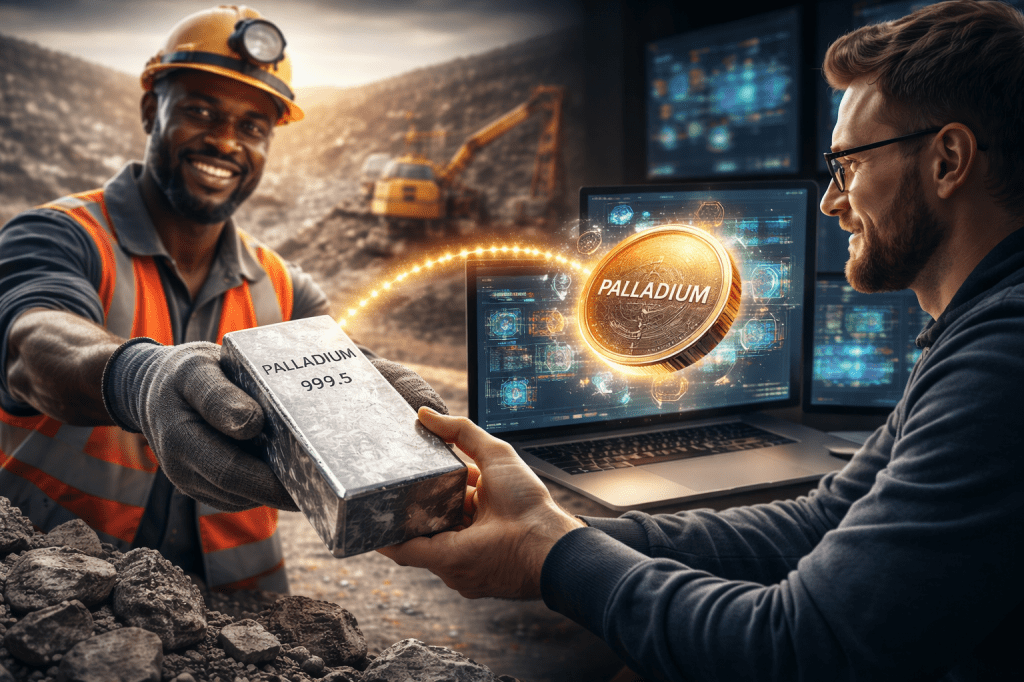
As blockchain technology matures and real-world asset tokenization expands beyond obvious candidates, palladium deserves a closer look, much closer. Again, not as a monetary metal, nor a general industrial metal, but as a high-tech constraint metal—one whose supply, demand, and price behavior reveal exactly why tokenization exists in the first place. Let’s not get ahead of the story. We need to start with the basics–what is palladium.
What Is Palladium?
Palladium is a silvery-white precious metal belonging to the platinum-group metals (PGMs), alongside platinum, rhodium, iridium, ruthenium, and osmium. I call them the “UM” family! Palladium is chemically stable, highly catalytic, and resistant to corrosion—properties that make it ideal for industrial applications where efficiency matters and margins are thin. Do you see where this is going?
Unlike gold or silver, palladium has no historical monetary role. Discovered in 1803 by William Hyde Wollaston while refining platinum ore from South America, it never circulated as coinage or reserve money. Palladium’s value has always been functional. That distinction matters. Palladium is not concerned with narratives or sentimentality. Palladium say: physics and chemistry make me who I am.
What Is Palladium Used For?
The vast majority of palladium demand (approximately 80%) comes from one place: emissions control. Palladium is a critical component in catalytic converters for gasoline-powered vehicles, where it helps transform toxic exhaust gases into less harmful emissions. (Prior to catalytic converters palladium was used in: electronics, dentistry, medicine, chemical catalytics, jewelry as reflected below). As governments tightened emissions standards across North America, Europe, and Asia, palladium demand surged. Given the environmental damage caused by gasoline-powered vehicles, I say, hurray for palladium!
While emissions control dominate, there are other uses, including:
- Electronics, particularly multilayer ceramic capacitors
- Chemical processing and industrial catalysts
- Dentistry and medical devices
- Hydrogen purification and storage
- Jewelry, a relatively minor use
Even so, palladium remains deeply tied to automotive production and environmental regulation. When gasoline vehicle demand rises, palladium demand follows. When supply tightens, due to geopolitical events or disruptions in the few productive mines, prices can move sharply. Electric vehicles (EVs) may pose a long-term threat to palladium demand. However, slower-than-expected EV adoption and stricter emission rules, along with rising hybrid vehicle sales, sustain significant demand for palladium. In other words, palladium isn’t about to disappear any time soon.
Where Is Palladium Mined?
If scarcity gives metals value, concentration gives them risk. Palladium is no exception. Palladium production is extraordinarily concentrated. Roughly 80% of global supply comes from just two countries: Russia and South Africa. Russia alone accounts for a significant share of primary palladium production, largely as a byproduct of nickel and platinum mining. Given palladium is mined as a byproduct, production decisions are driven by nickel and platinum economics rather than palladium demand itself. This rigidity explains much of palladium’s historical volatility—and why transparency matters so deeply in this market.
Palladium as a byproduct creates several layers of vulnerability, including:
- Geopolitical and sanctions risk
- Supply-chain opacity
- Limited ability to increase production quickly
- Dependence on the economics of other metals
Palladium’s Price History: A Lesson in Constraint
Palladium prices can experience dramatic changes! Ups, downs, a real roller coaster. In fact, in the late 2010s, palladium prices surged well above gold, driven by tightening emissions standards, strong automotive demand, and constrained supply growth. At its peak, palladium traded at more than twice the price of gold—an almost unthinkable outcome for a metal few people could easily identify.
Then came gigantic price reversals. Technology shifted. Electric vehicles gained momentum. Recycling increased. Demand softened. Prices fell sharply. Volatility is not a flaw in the palladium market. It’s the defining feature. Now that we know what palladium is, how it’s used, where it comes from, we turn to the BIG question: why is palladium a tokenization candidate?
Why Palladium Is a Serious Tokenization Candidate
Let me answer the question directly with the following observations: tokenization works best where markets are opaque, fragmented, and slow to adapt. Palladium fits that description perfectly.
Transparency Where It Matters Most
Physical palladium inventories are difficult to track and often reported with delays. Tokenization allows specific, assayed, vaulted palladium to be represented on-chain, with ownership and inventory visible in near real time.
In a market where supply disruptions have immediate consequences, visibility is not a luxury—it is infrastructure.
Liquidity Without Distortion
Palladium markets are relatively small, and large trades can move prices. Tokenization enables fractional ownership and broader participation without forcing physical delivery or disrupting industrial supply chains. Tokenization is liquidity without leverage.
Faster Settlement in a Volatile Market
In fast-moving markets, slow settlement amplifies risk. Blockchain-based settlement reduces transaction times from days to minutes, limiting counterparty exposure during sharp price swings. For palladium, which is a relatively small market, this is especially important.
Tokenized Palladium vs Traditional Palladium Exposure
Today, palladium exposure typically comes through futures contracts, exchange-traded products, or mining equities. These instruments provide price exposure, but they remain abstractions layered atop clearinghouses, custodians, and jurisdictional complexity.
Tokenized palladium offers something different and more importantly, better:
- Direct ownership of physical metal
- On-chain auditability
- Reduced reliance on intermediaries
- Global accessibility without brokerage friction
Where traditional instruments offer price exposure, tokenization offers asset exposure. A critical distinction during periods of market stress.
Industrial and Supply-Chain Use Cases
Tokenized palladium is not primarily an investment concept. The strongest case for tokenized palladium falls to automotive manufacturers, chemical processors, and industrial users. Here is how they could use it:
- Hedge raw-material costs directly
- Maintain verified strategic inventories
- Improve supply-chain traceability
- Reduce settlement and financing friction
As ESG reporting and regulatory scrutiny increase, on-chain tracking of critical materials becomes a competitive advantage rather than a novelty.
Risks, Constraints, and Realism
Only two sure bets in life: death and taxes. Tokenized palladium is neither of those, therefore it is not risk-free. Below are four risks:
- Demand is sensitive to technological shifts
- Electric vehicle adoption introduces long-term uncertainty
- Market size limits liquidity
- Regulatory clarity remains uneven
Tokenization does not eliminate these risks–but it does force transparency. Ownership is explicit. Inventory is verifiable. Prices respond faster to reality. Markets become less forgiving—but more honest. A reasonable trade-off.
Long-Term Outlook: Palladium’s Digital Role
Will palladium become a household name? Don’t count on it. Besides, by its very nature, palladium doesn’t seek the spotlight; it does not aspire to monetary status or cultural symbolism. Palladium is the sensible sister, dedicated to solving technical problems efficiently and quietly. That makes palladium a strong representative of the next phase of tokenization.
As real-world asset tokenization matures, attention will shift from symbolic assets to functional ones. From narratives to necessities. From ideology to infrastructure. A tokenized future is one in which palladium belongs.
The facts all point in one direction: palladium is shaped by high-tech, regulation, and Mother Nature. In such a world, an asset that can be tokenized benefits immensely from transparency, speed, and verifiability–in other words, tokenization on the blockchain.
To conclude, tokenized palladium is not about hype. It is about alignment—between physical reality and digital systems.
Until next time,
Yogi Nelson
This post is part of an ongoing weekly series on the tokenization of precious metals, published on BlockchainAIForum and LinkedIn, examining custody, regulation, issuer structure, and settlement infrastructure.
Sources
World Platinum Investment Council (WPIC) – Palladium Market Reports
U.S. Geological Survey (USGS) – Mineral Commodity Summaries: Palladium
International Energy Agency (IEA) – Emissions Standards and Technology Transition

 Blockchain & AI Forum