Every emerging market develops its own language. Tokenized metals are no exception.
Over the past several months, as I’ve written about custody, redemption, proof-of-reserves, vaulting, ETFs, futures, and settlement, I’ve noticed something important: most confusion in this space doesn’t come from technology — it comes from terminology.
Words like:
allocated vs unallocated
canonical vs wrapped tokens
beneficial ownership
settlement finality
counterparty risk
are used constantly, often without explanation. And when language is unclear, risk hides in plain sight. That’s why I wrote a new piece for my weekly series:
“Tokenized Metals Without the Jargon: A Practical Glossary.”
It’s not a dictionary. It’s a plain-English guide to the terms that actually matter—what they seem to mean, what they really mean in practice, and why the difference matters when real money and real metal are involved.
As I worked through these concepts, I realized something amusing (and useful): learning these terms has made me trilingual—English, Spanish, and now the language of tokenization: “Tokenish.”
By the end of the article—and frankly, by the end of the series—you may find yourself fluent too.
If you’re interested in tokenized gold, silver, or real-world assets more broadly, understanding the language is not optional. It’s infrastructure. For the complete glossary visit my blog:
— Yogi Nelson
Part of an ongoing weekly series on the tokenization of precious metals, examining ownership, custody, redemption, and settlement.
Why Junior Mining Companies Must Establish Financial Oversight Early
In the early life of a junior mining company, nearly every ounce of energy goes toward geology, exploration programs, and financing the next drilling campaign. Teams are small, budgets are tight, and leadership is focused on proving the resource. Governance structures—particularly formal committees—often seem like something that can wait until the company becomes larger or begins generating revenue. In 2026, that assumption is outdated.
One of the most important governance structures a junior mining company can establish early in its development is the Audit Committee. While traditionally associated with large, revenue-producing corporations, audit committees are just as critical—perhaps even more so—for early-stage resource companies.
In fact, establishing an audit committee before revenue begins sends a powerful signal to investors, potential acquisition suitors, and merger candidates: the company takes financial discipline, transparency, and accountability seriously. For junior miners seeking credibility in capital markets, that signal can make a meaningful valuation difference.
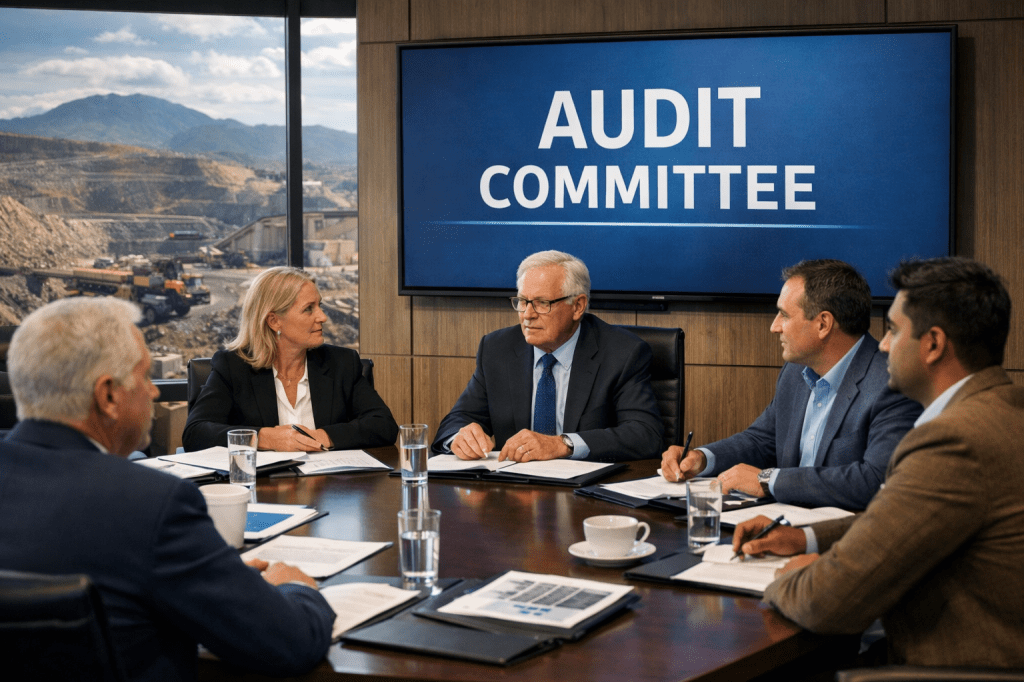
Effective audit committees provide independent financial oversight that strengthens investor confidence in junior mining companies
Why Early Governance Matters in Exploration Companies
Junior mining companies operate in a unique financial environment. Unlike traditional operating businesses, exploration companies often spend years—sometimes a decade or more—raising capital and deploying it into exploration activities before generating any revenue.
During this time, investors are funding geological risk, operational risk, and management execution. With little or no operating income to measure success, investors are compelled to rely heavily on trust across three fundamental factors:
Effective and efficient use of funds
Accurate financial reporting
Management decisions that are subject to appropriate oversight
Without these safeguards, even promising exploration programs can struggle to attract sustained investor support.
Below I will explain why an effective audit committee is the best tool available to reinforce that trust. But first, it is useful to understand the work of an audit committee.
What an Audit Committee Actually Does
An audit committee is a specialized committee of the board of directors responsible for overseeing the company’s financial reporting, internal controls, and relationships with external auditors.
While the responsibilities vary by jurisdiction and listing exchange, the core functions generally include:
Overseeing financial statements and disclosures
Monitoring internal financial controls
Supervising the relationship with independent auditors
Reviewing risk management practices
Ensuring compliance with regulatory reporting requirements
For larger companies, these duties are often supported by internal finance teams and internal audit departments. Junior mining companies, however, typically operate with much leaner administrative resources. Consequently, audit committees of the board are essential to maintaining the financial integrity of the organization.
Preventing Problems Before They Start
One of the greatest advantages of establishing an audit committee early is that it helps prevent financial problems before they arise. As the old proverb reminds us, an ounce of prevention is worth a pound of cure.
Exploration companies regularly handle significant capital inflows from equity financings. These funds must be allocated across drilling programs, geological studies, environmental compliance, and administrative costs. Without structured oversight, financial reporting processes can become informal or inconsistent—especially during periods of rapid growth or multiple financings.
An engaged audit committee helps ensure that:
Financial controls are implemented early
Accounting policies are applied consistently
Disclosure practices meet regulatory standards
Financial risks are identified quickly
This proactive oversight can prevent small issues from becoming major problems. In capital markets, credibility lost is difficult to regain. Early governance safeguards help preserve that credibility.
Building Investor Confidence
Institutional investors increasingly evaluate governance structures when considering investments in junior resource companies. Typically, professional investors analyze three key questions—among others—before committing capital:
Is the geology promising?
Is the management team capable?
Is the governance structure trustworthy?
The presence of a well-structured audit committee directly addresses the third question.
Investors want reassurance that the financial reporting process is independent from management and that qualified directors are overseeing financial matters. When an audit committee includes members with accounting, financial, or capital markets experience, it signals that the company understands the importance of financial transparency.
This can make fundraising significantly easier, particularly when seeking larger institutional investors rather than relying solely on generalist capital.
Exchange Requirements and Best Practices
Many stock exchanges already require listed companies to maintain audit committees composed largely of independent directors. Companies listed on exchanges such as the TSX Venture Exchange, the Toronto Stock Exchange, and U.S. markets must comply with governance rules that include audit committee structures and financial expertise requirements.
However, merely complying with minimum regulatory requirements is not enough.
Best-practice junior miners treat the audit committee not as a regulatory checkbox, but as a strategic governance asset. That means selecting committee members carefully, ensuring they possess relevant financial expertise, and empowering them to actively oversee financial reporting and risk management.
The Value of Financial Expertise
An effective audit committee typically includes at least one member who qualifies as a financial expert—someone with deep experience in accounting, finance, or financial oversight. In the junior mining sector, this expertise can be invaluable.
Exploration companies face complex accounting questions related to:
Capitalization of exploration expenses
Impairment of mineral assets
Share-based compensation structures
Flow-through financing arrangements
Regulatory reporting obligations
Directors with financial expertise can help the board navigate these complexities and ensure the company’s disclosures remain accurate and compliant. This expertise also strengthens the company’s relationship with external auditors, who rely on audit committees to provide oversight and independence.
Strengthening Internal Controls
One of the most overlooked aspects of junior mining governance is the importance of internal financial controls. Even small organizations must ensure that financial responsibilities are properly separated, documented, and reviewed. Without these safeguards, errors—or worse, financial mismanagement—can occur.
An audit committee plays a critical role in evaluating and strengthening these controls. Typical oversight areas include:
Cash management procedures
Authorization of expenditures
Financial reporting processes
Budget monitoring
Risk assessment practices
By reviewing these systems regularly, the audit committee helps ensure that the company’s financial operations remain transparent and accountable.
Preparing for Future Growth
Junior mining companies that eventually transition from exploration to development and production face a dramatic increase in operational complexity. Project financing, construction budgets, joint ventures, and revenue recognition—just to name a few—introduce new layers of financial reporting.
Companies that establish strong governance structures early—including an effective audit committee—are far better prepared for this transition. Instead of scrambling to build governance systems during periods of rapid growth, they already have established frameworks for financial oversight and risk management. In other words, early governance creates organizational resilience.
Governance as a Strategic Advantage
In competitive capital markets, governance can become a meaningful differentiator. Hundreds of junior mining companies compete for investor attention each year. While geology and project potential remain primary drivers of valuation, governance quality increasingly influences investor confidence.
Companies that demonstrate disciplined oversight, transparent reporting, and strong board committees stand out from peers that operate with minimal governance infrastructure. Establishing an audit committee before revenue generation sends a clear message:
This company intends to operate with the same financial discipline as much larger organizations.
That message resonates with investors, lenders, and strategic partners alike.
Final Thoughts
Junior mining companies often view governance structures as something to implement later—after discovery success, after financing growth, or after revenue begins. But the companies that build credibility in capital markets are usually the ones that implement governance early, not late.
An effective audit committee strengthens financial oversight, improves transparency, and enhances investor trust during the most fragile stages of a company’s development. For junior mining companies—whether explorers, developers, or producers—operating in high-risk, capital-intensive environments, those advantages are invaluable.
Establishing an audit committee before revenue is not simply a compliance exercise. It is a strategic decision that signals maturity, discipline, and a commitment to responsible stewardship of investor capital.
In the crowded junior mining sector, that commitment can make all the difference.
Tokenized metals sit at the intersection of precious metals, financial infrastructure, and blockchain technology. Each domain brings its own vocabulary—and when combined, confusion often follows. This glossary exists to reduce that confusion.
What follows is a plain-English guide to the most important terms in the tokenized metals space, listed in alphabetical order. Each entry explains not just what a term means, but why it matters in practice and where misunderstandings commonly arise.
Learning these key terms has made me trilingual—English, Spanish, and now the language of tokenization–“tokenish”. Lol! By the end of this series and article, you may find yourself fluent as well.
Allocated Metal
Intuitive Understanding: Allocated metal simply means the gold exists somewhere.
What It Actually Means: Allocated metal refers to specific, identifiable bullion—typically bars—held in custody on behalf of an owner. Each bar is owned outright, recorded individually, and not commingled with other owners’ assets.
Why It Matters: Allocated metal is generally bankruptcy-remote and directly owned. Tokenization does not change this reality; it only represents it digitally. Confusing allocation with mere backing is a common and costly mistake.
Bailment
Common Interpretation: A technical legal term with little relevance to everyday investors.
What It Actually Means: Bailment is a legal relationship in which one party (the bailor) retains ownership of property while another party (the bailee) holds it for safekeeping under defined obligations.
Why It Matters: Many professional bullion custody arrangements rely on bailment. When structured properly, bailment strengthens ownership claims and protects assets if a custodian encounters financial trouble.
Bankruptcy-Remote
At First Glance: Protected in theory if something goes wrong.
What It Actually Means: Bankruptcy-remote assets are legally insulated from the failure of an issuer or custodian through segregation, proper custody agreements, and enforceable ownership documentation.
Why It Matters: “Fully backed” is not enough. Without bankruptcy-remote structures, token holders may still be treated as creditors rather than owners during insolvency proceedings.
Beneficial Ownership
The Intuitive View: Owning the asset.
What It Actually Means: Beneficial ownership refers to the right to enjoy the economic benefits of an asset—such as appreciation or redemption—without necessarily holding legal title directly.
Why It Matters: In tokenized metals, beneficial ownership determines whether a token holder has enforceable rights to physical bullion or merely economic exposure mediated by an issuer.
Canonical Token
Surface Understanding: The “official” version of a token.
What It Actually Means: The canonical token is the issuer-recognized smart contract that directly represents the underlying metal under the issuer’s legal framework. Only canonical tokens are typically redeemable.
Why It Matters: Wrapped or derivative tokens may track value but lack redemption rights. This distinction becomes critical at the moment of physical settlement.
Chain Reconciliation
Common Interpretation: Matching blockchain numbers to vault records.
What It Actually Means: Chain reconciliation is the process of aligning on-chain token balances with off-chain custody records, bar lists, and vault inventories—especially during issuance and redemption.
Why It Matters: This is where digital claims and physical reality are forced to agree. Weak reconciliation is one of the most common failure points in tokenized asset systems.
Chain-of-Custody
At First Glance: A record of who handled the metal.
What It Actually Means: A documented, auditable trail showing how bullion moves through custody, storage, fabrication, transport, and delivery.
Why It Matters: Chain-of-custody protects against loss, substitution, and dispute. Tokenization depends on disciplined off-chain controls to maintain trust.
Counterparty Risk
The Intuitive View: Something blockchain eliminates.
What It Actually Means: Counterparty risk is the risk that another party in the system—issuer, custodian, logistics provider, or bridge—fails to meet its obligations.
Why It Matters: Tokenization does not remove counterparty risk; it redistributes it. Understanding where that risk resides is essential to evaluating any tokenized metal product.
Custodian
Surface Understanding: The company storing the gold.
What It Actually Means: A regulated entity responsible for safeguarding assets under defined legal, compliance, and reporting frameworks.
Why It Matters: The custodian—not the blockchain—ultimately controls physical access to the metal. Tokenization without credible custody is abstraction without anchor.
Delivery Bar / Good Delivery Standard
Common Interpretation: A large bar of gold.
What It Actually Means: A bullion bar meeting recognized industry standards for weight, purity, refinery, and appearance, such as LBMA Good Delivery specifications.
Why It Matters: Redemption often depends on whether metal conforms to delivery standards. Not all gold qualifies equally for settlement.
Liquidity
At First Glance: How fast a token can be sold.
What It Actually Means: The ease with which a token can be traded without materially affecting price, often driven by market depth and exchange integration.
Why It Matters: Liquidity improves tradability but does not guarantee redemption. Highly liquid tokens can still be difficult to convert into physical bullion.
Physical Settlement
The Intuitive View: Receiving metal instead of cash.
What It Actually Means: Settlement in which the underlying physical asset changes hands rather than being cash-settled or financially netted.
Why It Matters: Physical settlement enforces discipline. It is where synthetic exposure ends and ownership is tested.
Proof of Reserves
Surface Understanding: A promise that the gold exists.
What It Actually Means: A process—ideally ongoing—by which an issuer demonstrates that issued tokens are fully backed by physical metal through audits, bar lists, and reconciliation.
Why It Matters: Proof of reserves only matters when it holds up during redemption and stress events.
Redemption
Common Interpretation: Press a button, receive gold.
What It Actually Means: A structured process involving compliance checks, token retirement, custody reconciliation, logistics, insurance, and delivery or pickup.
Why It Matters: Redemption is the enforcement mechanism that separates ownership from exposure.
Rehypothecation
At First Glance: A problem limited to derivatives markets.
What It Actually Means: The reuse or pledging of the same asset to back multiple obligations.
Why It Matters: Unchecked rehypothecation multiplies claims beyond physical supply. Tokenization can reduce—or obscure—this risk depending on structure.
Settlement Finality
The Intuitive View: When a transaction finishes.
What It Actually Means: The point at which ownership transfer is legally irreversible and no longer subject to counterparty or settlement risk.
Why It Matters: Institutions prize finality because it reduces legal, operational, and capital risk. Tokenization aims to compress settlement time without sacrificing certainty.
Synthetic Exposure
Surface Understanding: A type of derivative.
What It Actually Means: Exposure to price movements without ownership of the underlying asset.
Why It Matters: Many investors believe they own metal when they only own exposure. Tokenization’s promise lies in narrowing that gap—not widening it.
Unallocated Metal
Common Interpretation: Metal held in a vault somewhere.
What It Actually Means: A claim on a pool of metal rather than ownership of specific bars.
Why It Matters: Unallocated holders are typically creditors, not owners. Tokenization does not change this unless structure changes.
Vaulting Jurisdiction
At First Glance: Where the vault is located.
What It Actually Means: The legal and regulatory environment governing custody, ownership rights, bankruptcy treatment, and dispute resolution.
Why It Matters: Jurisdiction determines how ownership is enforced when things go wrong.
Wrapped Token
The Intuitive View: The same token on another blockchain.
What It Actually Means: A secondary representation issued by a bridge or protocol, often introducing additional technical and counterparty risk.
Why It Matters: Wrapped tokens may not be directly redeemable and can complicate settlement when it matters most.
Final Thought
Tokenization’s greatest contribution may not be speed or programmability—it may be clarity: clarity about who owns what, where it sits, and how claims are enforced. That clarity starts with language.
Until next time,
Yogi Nelson
This article is part of an ongoing weekly series on the tokenization of precious metals, published on BlockchainAIForum and LinkedIn, examining custody, redemption, issuer structure, and settlement infrastructure.
Tokenized metals promise something powerful: the ability to move between digital ownership and physical bullion. But redemption is not a button you press—it’s a process.
In the real world, redeeming tokenized gold or silver sits at the intersection of:
blockchain transfers
professional vault custody
compliance and documentation
logistics, insurance, and risk transfer
If a token cannot be redeemed through a clear, enforceable workflow, it may still track price—but it begins to resemble synthetic exposure rather than ownership.
A serious redemption process requires:
confirmation of allocated metal
reputable custodians and insured vaults
identity and compliance checks
controlled token retirement or burn
reserve reconciliation
physical picking, packing, and delivery
Across issuers—whether Paxos, Tether Gold, Kinesis, CACHE, Comtech Gold, or T-Gold by SchiffGold—the pattern is consistent:
Redemption is possible, but it is never abstract, instant, or free. It reflects the issuer’s philosophy, compliance posture, and real-world bullion logistics.
For institutions, redemption isn’t about receiving a bar at home. It’s about settlement finality—knowing that a digital claim can be converted into a physical asset with legal certainty, clean audit trails, and minimal counterparty risk.
Tokenization doesn’t eliminate the physical world. It forces the digital world to respect it.
— Yogi Nelson
Part of an ongoing weekly series on the tokenization of precious metals, examining custody, redemption, issuer structure, and settlement infrastructure.
There are three primary ways investors gain exposure to gold today: physical ownership, ETFs, and futures. Each exists for a reason. Each solves a different problem. And each comes with its own tradeoffs.
Tokenized metals add a fourth dimension—not by replacing these structures, but by forcing a more precise question:
Are you buying ownership, or are you buying exposure?
ETFs deliver efficient price exposure, but usually through pooled structures with limited redemption rights. Futures provide price discovery and hedging power, but they are contracts—not assets. Physical gold offers direct ownership, but comes with real-world friction: storage, insurance, and logistics.
Tokenization sits between these models. When structured properly, it can combine digital transferability with claims on physically vaulted metal. When structured poorly, it becomes just another derivative with a new label.
That distinction matters—especially for institutions. What they care about is not speculation, but market plumbing: settlement, custody, collateral mobility, auditability, and counterparty risk. Tokenization becomes interesting only when it improves those foundations.
The future of metals is not a shootout between ETFs, futures, and tokenization. It is a question of which structures best serve ownership, transparency, and settlement in a digital economy.
— Yogi Nelson
This post is part of an ongoing weekly series on the tokenization of precious metals, published on BlockchainAIForum and LinkedIn, examining custody, regulation, issuer structure, and settlement infrastructure.





 Blockchain & AI Forum