

by Yogi Nelson
Welcome to the BlockchainAIForum
The Silent Crisis of Language Loss
Linguistics was perhaps my favorite course at UCLA, outside of my major. Now that I am fully bilingual (English/Spanish) I appreciate languages all the more. Sadly, according to UNESCO, nearly 3,000 of the 7,000 languages spoken today are endangered. When a language dies, we lose more than words—we lose culture, identity, history, and unique worldviews. Language extinction is not just a linguistic issue; it is a humanitarian, cultural, and intellectual emergency.
Yet, amid this somber trend, a surprising ally has emerged: artificial intelligence. By combining linguistic data with machine learning, AI technologies are helping linguists, activists, and communities revive, preserve, and revitalize languages that might otherwise be lost forever. A big thumbs up for AI!
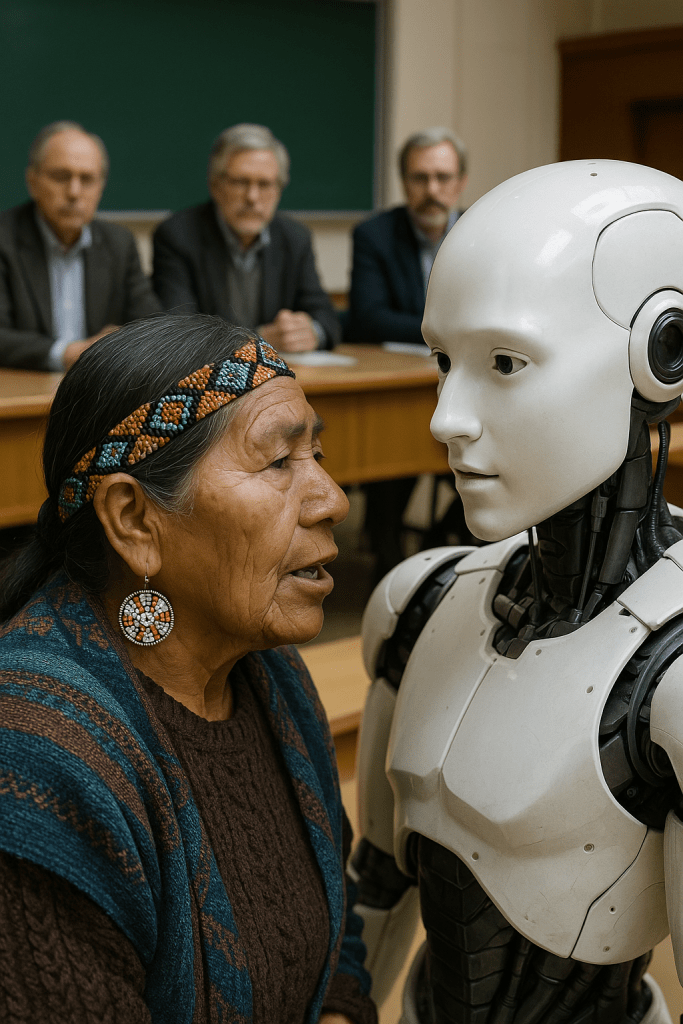
AI as the Unexpected Hero
AI’s applications in language preservation range from documentation to real-time translation and learning tools. Its capacity to process vast quantities of linguistic data at scale and speed makes it uniquely suited to the challenge. A report by Apolitical highlights how AI can assist in phonetic transcription, text-to-speech synthesis, and pattern recognition in oral languages that lack written forms. This is particularly valuable for Indigenous languages that are at high risk of extinction and often lack sufficient resources for traditional preservation methods (Apolitical, 2023).
Language Documentation and Digitization
One of AI’s most impactful roles is in automating the documentation of endangered languages. In collaboration with linguists and local speakers, AI systems can transcribe audio recordings, identify grammatical patterns, and store this data in accessible databases. For example, researchers at Dartmouth College are using AI to create digital corpora of endangered languages, incorporating video, audio, and written materials. These databases help in both linguistic research and language learning, empowering communities to pass their heritage to future generations (Dartmouth University, 2023). AI models can also fill in linguistic gaps using predictive techniques, enabling linguists to reconstruct partially lost grammar or vocabulary. While this work must be handled with care to avoid misrepresentation, it can offer valuable starting points for revitalization.
Reviving Oral Traditions
Many endangered languages are primarily oral. This poses a major challenge for preservation, as traditional language models rely heavily on text. AI-driven speech recognition and synthesis technologies are now being trained on oral languages, allowing researchers to create spoken dictionaries and learning apps tailored to specific dialects.
Deepgram’s article *Reviving Lost Tongues* discusses how voice AI can listen to native speakers, learn unique phonetic features, and generate accurate digital representations. This technology is particularly impactful in remote regions, where connectivity and educational resources are limited (Deepgram, 2024). In turn, AI-generated learning platforms can teach these languages to new generations, often through mobile apps, chatbots, and interactive audio tools. As these platforms evolve, they are becoming increasingly immersive and engaging, helping young people reconnect with ancestral tongues.
Community Empowerment Through Technology
It is essential that AI-driven language preservation efforts are inclusive and community-led. Technology must not replace native speakers; it should empower them. Collaborations between AI researchers and Indigenous communities are crucial. These partnerships ensure that cultural context is preserved, and that AI systems respect linguistic diversity without standardizing or homogenizing it. Community-driven datasets, ethical data governance, and open-source tools are key to achieving this.
Blockchain can also support this mission by providing decentralized ownership of linguistic data. Communities can retain control over how their language resources are shared, monetized, or used in research—fostering sovereignty and trust.
Challenges and Ethical Considerations
Despite its promise, AI in language preservation is not without challenges. Bias in training data, insufficient representation of rare languages, and ethical concerns about data usage all require careful management. There is also a risk that AI models may reinforce colonial hierarchies if not developed in consultation with Indigenous peoples.
Moreover, building high-quality datasets for AI training demands time, funding, and access—resources that are often scarce in endangered-language communities. Sustainable investment, interdisciplinary collaboration, and ethical AI design are therefore essential.
The Future: A World Rich in Voices
The use of AI to preserve and revitalize dying languages is still in its early stages, but it offers a transformative path forward. By supporting documentation, education, and community empowerment, AI tools can breathe new life into languages on the brink of extinction. In the words of a researcher cited by Dartmouth University, “Each language is a world. When we save one, we preserve a way of understanding the human experience.”
Until next time,
Yogi Nelson
p.s. Happy Birthday to my son Marcel–who will soon be a father also! He has decided to dedicated 2026 to be the year of improving his Spanish speaking abilities and I couldn’t be happier!
Sources
– AI: The Unexpected Hero in the Battle to Save Dying Languages, Apolitical, 2023.
– Language Preservation Efforts Get an AI Boost, Dartmouth University, 2023.
–UNESCO Atlas of the World’s Languages in Danger.
– Reviving Lost Tongues: How AI Battles Language Extinction, Deepgram, 2024.



 Blockchain & AI Forum