If you learn via traditional academic methods, as do I, and are interested in acquiring knowledge about blockchain and crypto, this article is for you. As blockchain transforms industries from finance to supply chain, specialized certificate and diploma programs have emerged to equip professionals with skills in cryptography, smart contracts, and decentralized applications. Below are some of the USA’s most notable offerings, featuring MIT, Carnegie Mellon, UC Berkeley, Northeastern, UCLA Extension, Cornell, and industry certifications. Did I fail to note one or more outstanding programs–of course. The list is not comprehensive, just a start. A university not listed but worthy of a mention–University of Nicosia, located in Cypress. It was the first university in the world to offer a Masters in Blockchain and Crypto! I completed three courses from there plus the MIT program. Enjoy!
Blockchain Fundamentals Professional Certificate – UC Berkeley (edX)
Format: Online, self-paced via edX. Curriculum: Covers Bitcoin mechanics, Ethereum, and enterprise platforms like Quorum, Ripple, Tendermint, and Hyperledger. Strengths: Prestigious academic foundation; flexible, foundational credential for broad technical literacy.
Graduate Certificate in Blockchain and Smart Contract Engineering – Northeastern University
Format: On-campus (Boston), full-time or part-time. Curriculum: Ethereum, smart contract development, crypto-engineering, and blockchain security. Strengths: Hands-on technical training with pathways into master’s programs and co-op experiences.
Blockchain Essentials Certificate – Cornell University (eCornell)
Format: 100% online, instructor-led; typically completed in three months. Curriculum: Four courses — Blockchain Fundamentals, Blockchain for Business, Smart Contracts and DApps, Blockchain in Financial Services. Strengths: Blends technical literacy with business application; taught by Cornell faculty engaged in blockchain research.
Format: Professional, non-credit continuing education. Curriculum: Blockchain fundamentals, enterprise DLT strategy, DeFi, DAOs, governance, legal/regulatory issues, and implementation. Strengths: Targets executives and managers needing governance insight and strategic integration capabilities.
MIT Blockchain & Crypto Certifications
a) Blockchain: Disruptive Technology – MIT Professional Education: Online, 8 weeks; covers encryption, consensus, Ethereum, smart contracts, and strategy. b) Blockchain Technologies: Business Innovation and Application – MIT Sloan Executive Education: 6 weeks; focuses on cryptoeconomics, decentralized platforms, governance. c) Blockchain and Crypto Applications: From DeFi to Web 3 – MIT Sloan Executive Education: 6 weeks; focuses on DeFi, NFTs, Web3, and regulation.
Carnegie Mellon University (CMU) Blockchain Courses
Blockchain Fundamentals (Heinz College): Cryptography, consensus, governance, programming. Foundations of Blockchains (ECE 18-435): Consensus protocols, mechanism design, and security proofs. Basics of Cryptocurrencies, Blockchains, and Applications: Executive-level overview. Blockchain and SQL Fundamentals (MSCF Program): SQL plus blockchain programming for finance. Strengths: CMU integrates blockchain into graduate, undergraduate, and executive programs.
Comparative Table
Program / Certificate
Format & Level
Focus
Ideal For
UC Berkeley – Blockchain Fundamentals (edX)
Online / Professional
Technical foundations, enterprise platforms
Learners seeking reputable, flexible credential
Northeastern University
On-campus / Graduate
Smart contracts, Ethereum, blockchain engineering
Developers, engineers, technical specialists
Cornell University (eCornell)
Online / Professional
Business + technical literacy, DeFi, industry cases
When I entered crypto in 2020, the idea that a project would voluntarily limit its token supply took a moment to process. If the US dollar has an infinite supply, which it does, and all fiat currencies are unlimited also, why would a crypto project have a limited supply? With a background in traditional finance and banking, this was a new concept for me to process. I’m glad I did–it led to a deeper understanding. After reading this article hopefully you also will better appreciate the limited money supply thesis based on Austrian economics.
One of the defining characteristics of many blockchain projects is their decision to implement a fixed or limited token supply. Bitcoin famously caps its maximum issuance at 21 million coins, while Cardano limits its ADA supply to 45 billion units. This scarcity-centric design is not accidental. Rather, it draws heavily from economic theories—particularly those of the Austrian school of economics—and seeks to replicate the stability and credibility once associated with sound money like gold and silver.
The Austrian School of Economics and Sound Money
The Austrian school emphasizes free markets, minimal government intervention, and the intrinsic value of money. Thinkers such as Carl Menger, Ludwig von Mises, and Friedrich Hayek argued that money should arise organically from the market and maintain value through scarcity, durability, and divisibility.
Austrian economists rejected the idea of government-controlled fiat money, which can be inflated at will by central banks. Given the debasement of the U.S. dollar would you disagree? They argued that sound money—money backed by hard assets like gold or silver—provides a check on political manipulation. When currency supply is limited, governments cannot debase it through unchecked printing, preserving purchasing power and protecting savers.
It is this principle of scarcity-backed trust that Bitcoin and other blockchain projects attempt to re-create in digital form. By fixing supply in advance, blockchains aim to engineer monetary systems that are resistant to manipulation, inflation, and short-term political incentives.
Why Limited Supply Matters in Blockchain Design
Scarcity Creates Value: Just as gold’s rarity underpins its value, cryptocurrencies with limited supply derive scarcity-driven appeal. Bitcoin’s 21 million cap ensures that no more coins can ever be created beyond the programmed maximum.
Predictable Monetary Policy: Traditional currencies rely on central banks to manage inflation and interest rates. Blockchains like Bitcoin instead employ algorithmic monetary policy, where issuance schedules and maximum supply are transparently coded.
Resistance to Inflation: By fixing supply, blockchain projects create systems where inflation cannot erode purchasing power. Bitcoin’s deflationary design means that as adoption increases, demand pressure could increase value rather than diminish it.
Incentivizing Early Adoption: Limited supply also creates incentives for early participation. While this can raise issues of inequality, it has proven a powerful bootstrapping mechanism for network adoption.
Bitcoin: The Original Case Study
When Satoshi Nakamoto launched Bitcoin in 2009, he embedded Austrian economics deeply into its DNA. The 21 million cap was designed to mimic the scarcity of gold, but with more precision and predictability. Bitcoin’s issuance schedule—the halving cycle every 210,000 blocks—mirrors the decreasing rate at which new gold is mined. This ensures that Bitcoin’s inflation rate asymptotically approaches zero, reinforcing its narrative as digital gold.
Other Projects Following the Scarcity Model
Cardano (ADA): Fixed supply at 45 billion tokens.
Litecoin (LTC): Hard cap of 84 million coins, designed as silver to Bitcoin’s gold.
Ethereum (ETH) & Polkadot (DOT): Contrasting models with no fixed supply, opting for dynamic or inflationary mechanisms.
Critiques of the Limited Supply Approach
Deflationary Spiral Risk: Hoarding instead of spending.
Inequality Concerns: Early adopters often accumulate disproportionate wealth.
Lack of Elasticity: Cannot expand supply in crises like fiat systems can.
Why Scarcity Narratives Resonate Today
Despite criticisms, limited-supply tokens resonate in an era of monetary expansion and fiat uncertainty. Events such as the 2008 financial crisis and COVID-19 pandemic expanded money supplies dramatically. By framing tokens as digital sound money, blockchain projects connect with the intuitive idea that value should be tied to scarcity, not unlimited printing.
Conclusion: Digital Scarcity as a New Monetary Standard?
The decision by Bitcoin, Cardano, and other blockchain projects to cap their token supply is more than a technical feature—it is a philosophical statement. Rooted in Austrian economics, it seeks to restore trust in money through scarcity, predictability, and resistance to manipulation. Whether this model ultimately proves superior to fiat flexibility remains a subject of fierce debate. But the idea of scarcity as value has struck a chord, fueling the growth of blockchain and shaping its monetary experiments. In an uncertain global financial landscape, the allure of limited supply tokens may continue to define the narrative of crypto as the sound money of the 21st century.
An oracle is a service that provides external data to a blockchain. It tells the blockchain what’s going on in the real world so that smart contracts can act on that data. But of course there is more to the story and if you stay with me for three minutes, you will gain a deeper understanding. Let’s dive in.
Why Do Blockchains Need Oracles?
Blockchains are closed systems. They are deliberately isolated from the outside world to remain secure and tamper-proof. However, many blockchain applications—especially smart contracts—need real-world data to function. Examples include:
– Sports scores for betting apps – Weather conditions for crop insurance – Stock prices for decentralized finance (DeFi) – Currency exchange rates for cross-border payments
⚙️ How Do Oracles Work?
Oracles act like data messengers, feeding smart contracts the trusted information they need. Perhaps think of an oracle as a messenger. Let’s walk through a simple example: A decentralized insurance contract pays out to farmers if rainfall in a certain area is below a specified threshold. Here’s how oracles help:
1. Smart Contract Request: The insurance contract sends a request for weather data. 2. Oracle Receives Request: The oracle picks up the request and fetches the required data (e.g., from a weather API). 3. Data Is Verified: The data is often verified or corroborated across multiple sources to ensure it is accurate. 4. Data Is Delivered: The oracle sends the verified data back to the smart contract. 5. Action Is Taken: Based on the data, the smart contract executes its logic—e.g., issuing a payout.
🔐 The Problem with Centralized Oracles
If you use just one oracle to provide this data, you create a central point of failure. What if that oracle lies, is hacked, or goes offline? Suddenly, the whole smart contract system becomes compromised. This defeats the purpose of using decentralized technology in the first place. Hence, decentralized oracles are the solution—bringing multiple data sources and multiple oracles together to reach consensus and maintain integrity.
🌐 Enter Chainlink: The Leading Oracle Network
Chainlink is the most widely adopted decentralized oracle network in the blockchain space. Launched in 2017 by Sergey Nazarov and Steve Ellis, Chainlink was designed to solve the “oracle problem”—how to bring secure and reliable off-chain data onto the blockchain without introducing a point of failure.
🧩 How Chainlink Works
Chainlink operates through a decentralized network of nodes that provide external data to smart contracts. Here’s a high-level overview:
📝 1. Request Initiation. A smart contract emits a request for data. Chainlink picks it up.
👥 2. Oracle Selection. Chainlink matches the request to a set of independent oracles. These nodes are chosen based on reputation and performance metrics.
📡 3. Data Aggregation. Each oracle retrieves data from external sources (APIs, IoT devices, market data feeds, etc.). Then, Chainlink aggregates all the responses to eliminate outliers and produce a trustworthy data point.
💎 4. Result Delivery. The final data is delivered back to the smart contract, triggering its execution.
🪙 5. Incentives and Penalties. Oracles earn LINK tokens as payment for honest work. Malicious or inaccurate nodes are penalized by losing stake or reputation.
🛡️ Why Chainlink Stands Out
– Decentralization: No single point of failure; multiple nodes verify the data. – Data Quality: Chainlink uses multiple premium data providers and APIs. – Security: Nodes stake LINK tokens, aligning their incentives with accuracy. – Wide Adoption: Used by projects like Aave, Synthetix, Compound, and even Google Cloud for blockchain integrations. – Cross-Chain Compatibility: With its Cross-Chain Interoperability Protocol (CCIP), Chainlink can facilitate oracle services across multiple blockchains.
🧠 Chainlink Use Cases
– DeFi: Real-time price feeds for assets (e.g., ETH/USD), interest rates, and lending protocols. – Insurance: Weather data or flight status for automated claims processing. – Gaming: Random number generation (RNG) for fairness in blockchain-based games. – Enterprise: Secure off-chain data feeds from traditional institutions like banks and cloud services.
🔮 The Future of Oracles and Chainlink
Oracles will be crucial to the next phase of blockchain innovation. As smart contracts evolve beyond simple logic to govern real-world activities, oracles will need to deliver ever-more reliable, real-time data. Chainlink’s future lies not just in being an oracle, but in becoming a full-fledged interoperability layer between blockchains and the world. Chainlink is leading the charge in:
– Verifiable randomness – Proof of reserves – Secure cross-chain communication – Zero-knowledge data oracles
🧭 Final Thoughts
Oracles are the unsung heroes of the blockchain world—essential yet often misunderstood. Without them, smart contracts would be powerful but blind. Chainlink provides the vision, security, and scalability that modern decentralized applications (dApps) demand. As Web3 grows, Chainlink’s decentralized oracle network is poised to become a foundational infrastructure—powering everything from finance to insurance to gaming. If you’re building or investing in blockchain projects, understanding oracles—and Chainlink—is no longer optional. It’s essential.
My oracle message is stay informed and until next time,
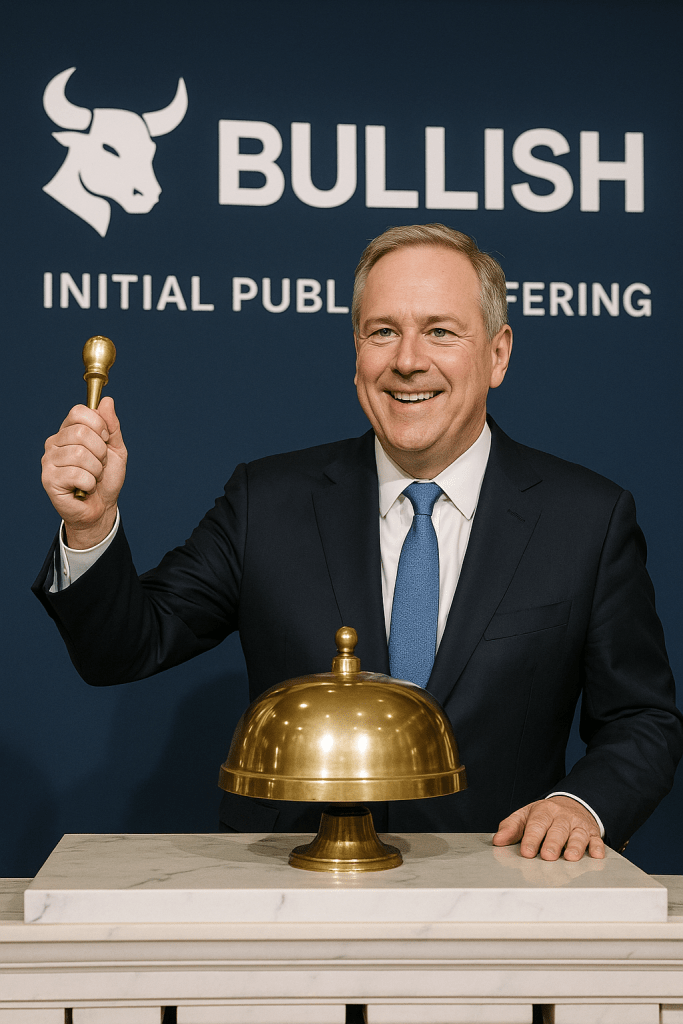
Apparently Summer 2025 is crypto IPO season. Circle’s IPO was a booming success. (Circle issues U.S. backed stable coins.). Will Bullish be bullish or will it fall to the bears. Does it deserve the name Bullish? Or is it too premature to ask or know? As this is not financial or investment advice blog, I suggest you conduct your own independent research. In the mean time, enjoy this article.
Bullish, founded in 2020, is an institutionally focused global digital asset platform that provides trading infrastructure, data services, indices, and media through its core brands: Bullish Exchange and CoinDesk. The company seeks to accelerate adoption of stablecoins, digital assets, and blockchain technology by delivering institutional-grade products backed by compliance, liquidity, and technological innovation. With major acquisitions of CoinDesk (2023) and CCData (2024), Bullish has expanded beyond trading to become a diversified service provider at the intersection of exchanges, financial data, and digital asset media.
Business Overview Bullish operates two primary divisions:
1. Trading & Liquidity Infrastructure (Bullish Exchange) – A regulated global exchange for spot, margin, and derivatives trading. – Licensed in Germany, Hong Kong, and Gibraltar, with U.S. and other jurisdictional approvals pending. – Features a global order book, institutional-grade liquidity, risk management tools, and subscription-based liquidity/stablecoin services. – Reported $1.25 trillion+ cumulative trading volume as of March 31, 2025. In 2024, it achieved ~35% and 44% market share in spot trading for Bitcoin and Ethereum respectively among its peer set. – Average daily trading volume in Q1 2025 reached $2.55B in spot and $248M in perpetual futures.
2. Information Services (CoinDesk) – Indices: Offers proprietary multi-asset benchmarks (e.g., CoinDesk 20 Index) and reference rates like the long-established Bitcoin Price Index (XBX). Collectively, indices support $31.9B AUM and $14.3B in trading volume (March 2025). – Data: Provides real-time and historical analytics to over 171,000 professionals, strengthened by CCData’s enhanced market coverage and analytics. – Media & Events: Operates CoinDesk.com (55M+ unique visitors in 2024), podcasts, newsletters, and social media channels. The flagship Consensus conference drew 26,000+ attendees in 2025 and expanded globally with events in Hong Kong and Toronto.
Together, these lines create a synergistic “flywheel” model: data powers indices, indices generate products listed on the exchange, and media amplifies visibility and customer acquisition. Cross-selling and integration remain central to growth.
Management and Governance The company is led by CEO Thomas W. Farley, former President of the NYSE, who has extensive experience scaling exchanges and integrating acquisitions at Intercontinental Exchange (ICE). The management team combines expertise across traditional finance, digital assets, and technology.
Bullish is incorporated in the Cayman Islands (2021) and qualifies as a foreign private issuer under U.S. securities law, giving it exemptions from certain SEC reporting, disclosure, and NYSE governance requirements. For example, it is not bound by U.S. proxy rules or insider reporting standards. However, this could mean less transparency compared to U.S.-based peers.
Financial Overview – 2024 Net Income: $80 million. – Q1 2025 Net Loss: $349 million, reflecting market volatility and strategic investments. – Adjusted EBITDA: $52M (FY 2024); $13M (Q1 2025). – Liquid Assets (March 2025): $1.96B, consisting of $1.73B Bitcoin, $144M stablecoins, $28M cash, $22M ETH, and $33M other tokens. Borrowings totaled $551M.
Bullish emphasizes a conservative treasury strategy to ensure resilience across digital asset price cycles while maintaining flexibility for acquisitions and growth initiatives.
Preliminary Q2 2025 estimates were included, showing continued volatility. Adjusted transaction revenue, adjusted EBITDA, and net income figures were disclosed as non-IFRS guidance but subject to revisions upon final audit.
Market Context and Growth Opportunity Bullish sees digital assets at an early adoption stage, akin to the internet in the 1990s. Bullish argues it is well positioned to capture value across this multi-trillion-dollar addressable market through its integrated services. By mid-2025, the global digital asset market reached $3.4 trillion in capitalization with 17,000+ cryptocurrencies in circulation. Positive industry trends include:
– Rising Market Activity: Bitcoin and Ethereum trading volumes surged in late 2024, and wallet adoption doubled between 2022 and 2024. – Institutional Adoption: Firms such as BlackRock, Fidelity, and Goldman Sachs have entered the sector, with Bitcoin and Ethereum exchange-traded products attracting $44B+ inflows by mid-2025. – Regulatory Clarity: Frameworks such as the EU’s MiCA, U.S. approval of spot BTC and ETH ETFs, and the U.S. GENIUS Act for stablecoins provide legitimacy and growth opportunities. – Technological Advancements: Rapid adoption of stablecoins (>$250B market cap), tokenization, DeFi, and blockchain-based collateral are expanding applications, with projections of $1.6T–$3.7T stablecoin supply by 2030.
Competitive Advantages Bullish highlights several differentiators in its IPO filing: 1. Comprehensive Product Suite: Unified cross-collateralized margin accounts, deep liquidity, and seamless trading infrastructure. 2. Diversified Business Lines: Exchange, data, indices, and media provide multiple revenue streams and reduce volatility. 3. Trust and Compliance: Operates regulated platforms and maintains transparent governance. 4. Technology Leadership: High-performance central limit order book and automated market-making; continuous upgrades to security, scalability, and user experience. 5. Global Reach: Strong institutional presence with 36% YoY client growth in 2024; CoinDesk’s global audience bolsters customer acquisition. 6. Capital Strength: $1.9B+ in digital assets available to support liquidity and expansion. 7. Experienced Leadership: Proven track record in scaling and integrating exchanges.
Growth Strategy Bullish plans to drive expansion through five main levers: – Licensing Footprint Expansion: Actively pursuing U.S., UK, Canadian, and EU approvals, with multiple state money transmitter licenses already secured. – Product Innovation: Continuously launching new trading products (e.g., perpetual futures, indices) and cross-selling into existing customers. – Vertical Integration & Collaboration: Cross-leveraging exchange, data, and media businesses to maximize synergies. – Customer Base Expansion: Moving beyond institutional clients to target active traders (“prosumers”), using CoinDesk’s reach for cost-effective customer acquisition. – Strategic M&A: Future acquisitions will focus on scaling exchange operations, new product development, and geographic expansion, building on the successful integration of CoinDesk and CCData.
Risks and Challenges Bullish identifies multiple risks that investors should weigh: – Regulatory Uncertainty: Digital assets remain under evolving global regulatory scrutiny, which may limit innovation or expansion. – Intense Competition: Competes with both regulated and unregulated platforms, including DeFi, DEXs, and DAOs that may innovate faster. – Volatility in Results: Dependent on adoption rates and price swings of digital assets, which drive trading activity and revenues. – Operational & Security Risks: Potential loss or mismanagement of private keys, cyberattacks, or system disruptions could harm reputation and operations. – Conflicts of Interest: Ownership of CoinDesk as both a news source and business line presents reputational risks. – Dependence on Third Parties: Reliance on external banking, insurance, and service providers introduces vulnerabilities. – Jurisdictional Complexity: Operating in multiple countries creates compliance risks. – Foreign Private Issuer Risks: Exemption from U.S. governance standards may mean less disclosure and oversight than domestic peers. – Geopolitical Factors: PRC oversight of Hong Kong, U.S. HFCAA rules, and other geopolitical risks could negatively affect operations or share value.
Conclusion Bullish positions itself as a next-generation, diversified digital asset leader at the intersection of trading, data, and media. The company has grown rapidly, securing a top-10 position in Bitcoin and Ethereum spot trading, while also building out indices, analytics, and globally recognized events like Consensus. With strong leadership, $1.9B in liquid assets, and a synergistic operating model, Bullish believes it is uniquely positioned to capture growth in the expanding digital assets sector.
However, the IPO also comes with significant risks: regulatory uncertainty, industry volatility, fierce competition, and governance exemptions tied to its foreign private issuer status. Investors are cautioned that while Bullish’s strategy shows promise, its results may remain volatile as the digital asset industry continues to evolve.
In the world of cryptocurrencies and blockchain technology, many of the most successful projects are not run entirely by corporations in the traditional sense. Instead, they are supported by non-profit foundations. Ethereum, Cardano, Polkadot, and Tezos all operate under this model. But why? What purpose do these foundations serve, and why are so many of them headquartered in Switzerland?
🌱 What Is a Crypto Foundation?
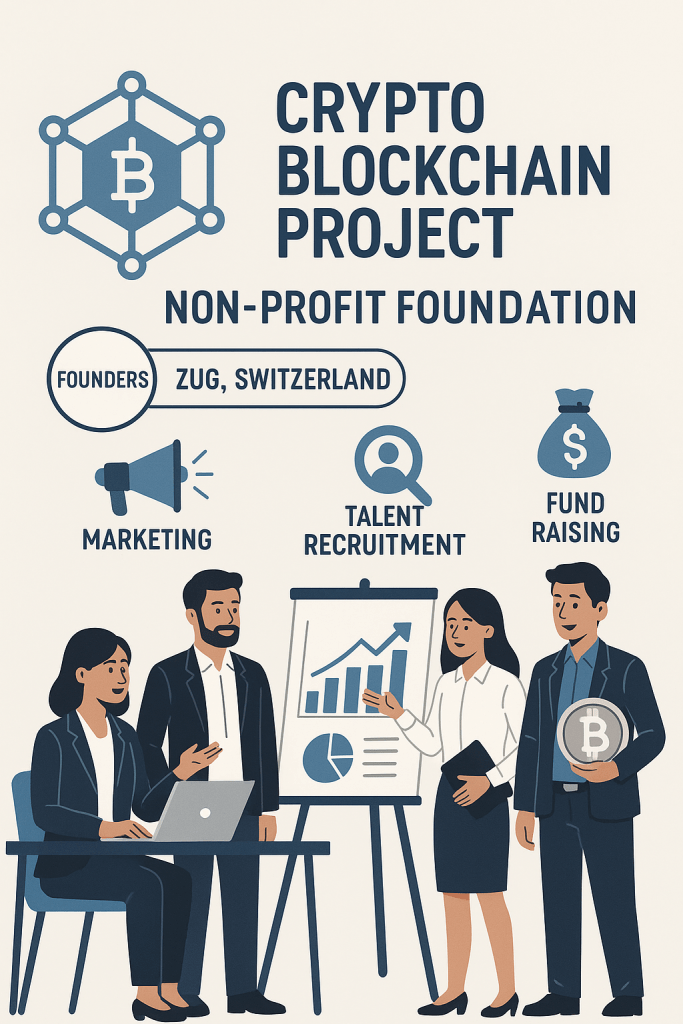
A crypto foundation is a non-profit organization established to oversee, support, and promote a blockchain project. These foundations are legally registered entities that act as stewards of the project’s codebase, branding, and community. Unlike a traditional company that prioritizes shareholder returns, a foundation is guided by a mission, such as enabling decentralized finance or supporting smart contract development. Think of it as the moral compass and operations hub behind the scenes.
🧰 What Do Crypto Foundations Actually Do?
Foundations wear many hats, and their responsibilities often include:
👨💻 Funding Developers – They allocate grants or directly hire developers to maintain and upgrade the protocol.
📣 Marketing & Community Growth – Foundations run educational campaigns, organize conferences, and promote adoption of the blockchain.
⚖️ Legal and Regulatory Advocacy – They advocate for favorable regulations and help navigate legal challenges.
📖 Governance and Roadmaps – They help shape and coordinate the roadmap of the project, though governance can also be decentralized.
📊 Ecosystem Grants – They fund startups, research groups, and hackathons that build on or support the core protocol.
🔒 Safeguarding Intellectual Property – In many cases, they hold the trademarks and copyrights associated with the project.
🚀 How Do Foundations Help a Crypto Project Grow?
Foundations provide a stable and legal structure that helps a project mature and attract broader participation. Here’s how they contribute to growth:
• Attracting Talent
• Building Trust
• Creating Ecosystems
• Fostering Community
• Serving as Legal Entities
💸 How Are Foundations Funded?
Funding typically comes from two main sources:
🪙 Initial Token Allocations – When the cryptocurrency is launched (through an ICO or other means), a percentage of the total supply—often 5% to 20%—is allocated to the foundation.
🧾 Donations and Grants – Some foundations accept voluntary donations from the community, philanthropists, or crypto-focused VCs.
📈 Strategic Investments – In some cases, foundations hold and invest part of their treasury to ensure long-term financial sustainability.
🇨🇭 Why Are So Many Crypto Foundations Based in Switzerland?
Switzerland, particularly the canton of Zug (aka “Crypto Valley”), has become a hotspot for crypto foundations. I visited and the valley is stunning, but beyond the natural beauty, here’s why:
⚖️ Favorable Legal Framework. Until very recently the USA was hostile to crypto projects.
🔐 Privacy and Financial Stability
🌍 Global Neutrality
🧠 Pro-Blockchain Culture
🧭 Examples: Ethereum Foundation, Cardano Foundation, Web3 Foundation, Tezos Foundation
🧾 Final Thoughts
Crypto foundations serve a vital role in the blockchain ecosystem. They’re not just legal wrappers for projects—they are engines for long-term growth, adoption, and legitimacy.