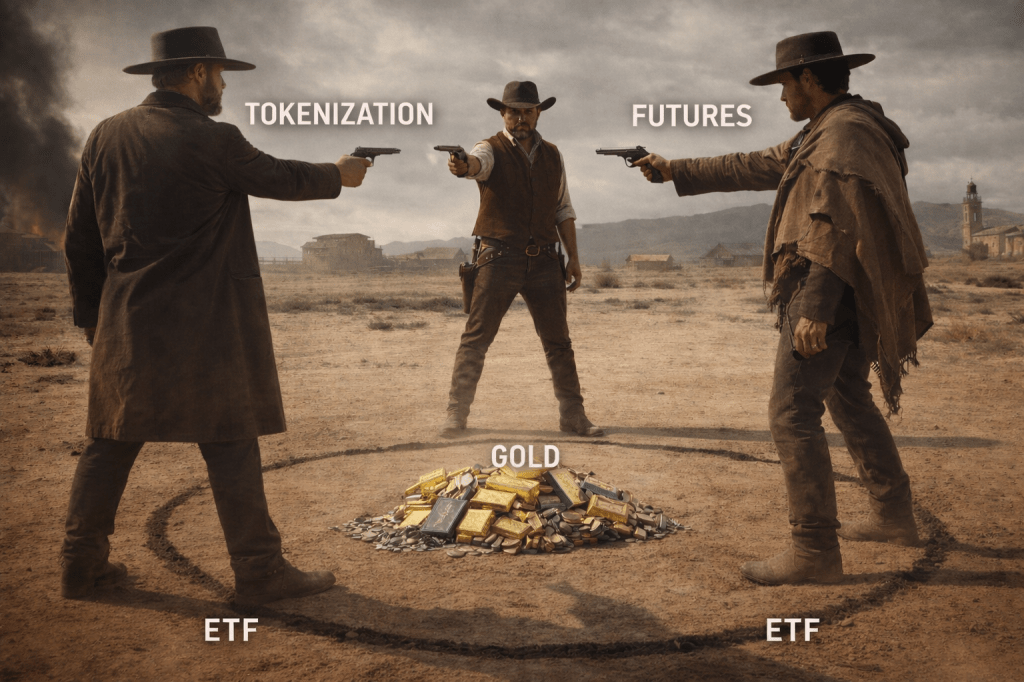
There are three primary ways investors gain exposure to gold today: physical ownership, ETFs, and futures. Each exists for a reason. Each solves a different problem. And each comes with its own tradeoffs.
Tokenized metals add a fourth dimension—not by replacing these structures, but by forcing a more precise question:
Are you buying ownership, or are you buying exposure?
ETFs deliver efficient price exposure, but usually through pooled structures with limited redemption rights. Futures provide price discovery and hedging power, but they are contracts—not assets. Physical gold offers direct ownership, but comes with real-world friction: storage, insurance, and logistics.
Tokenization sits between these models. When structured properly, it can combine digital transferability with claims on physically vaulted metal. When structured poorly, it becomes just another derivative with a new label.
That distinction matters—especially for institutions. What they care about is not speculation, but market plumbing: settlement, custody, collateral mobility, auditability, and counterparty risk. Tokenization becomes interesting only when it improves those foundations.
The future of metals is not a shootout between ETFs, futures, and tokenization. It is a question of which structures best serve ownership, transparency, and settlement in a digital economy.
— Yogi Nelson
This post is part of an ongoing weekly series on the tokenization of precious metals, published on BlockchainAIForum and LinkedIn, examining custody, regulation, issuer structure, and settlement infrastructure.
When it comes to precious metals, owners live by the old Russian proverb–trust by verify. That’s what this article is about. Tokenization promises efficiency, portability, and programmability. But when it comes to precious metals, those benefits are meaningless without trust. A token may move at internet speed, but gold and silver remain physical assets—bound by gravity, custody, and law.
That reality forces an essential question: how do tokenized metals remain trustworthy?
Building Trust with Blockchains
The answer does not lie in blockchains alone. It rests on a three-part foundation that predates crypto by decades—sometimes centuries: vaulting, insurance, and proof-of-reserves. Tokenization does not replace these pillars; it depends on them. When implemented correctly, blockchain technology enhances transparency and coordination. When implemented poorly, it merely hides old risks behind new interfaces.
This article examines how credible tokenized metal platforms use vaulting, insurance, and proof-of-reserves to earn trust—and why each component is non-negotiable.
Why Trust Is the Central Challenge in Tokenized Metals
Unlike native digital assets, tokenized metals represent something that exists outside the blockchain. A crypto native would say: it lives off-chain. In other words, a gold token is only as good as the metal it references. This makes tokenized metals structurally different from cryptocurrencies that rely solely on code and consensus.
History provides a cautionary backdrop. Gold-backed instruments have failed before. It wasn’t because gold was flawed. The issues where custody was opaque, audits were weak, and promises outpaced proof. A deadly combo. Tokenization revives these old questions in a new format:
Where is the metal stored?
Who controls it?
What happens if something goes wrong?
And how do holders know the metal actually exists?
The credibility of tokenized metals depends on how convincingly platforms answer these questions—not rhetorically, but structurally.
Vaulting: Where Trust Begins
Vaulting is the physical anchor of tokenized metals. Without credible vaulting, tokenization collapses into abstraction; an uncomfortable place to live.
Professional Vaulting vs. Self-Custody
Serious tokenized metal issuers rely on professional, third-party vaulting companies rather than self-custody. These are specialized firms whose sole business is the secure storage of precious metals. Examples include vault operators in London, Zurich, Singapore, New York, and Toronto—jurisdictions with long-standing bullion market infrastructure.
Professional vaults offer:
Armed security and restricted access
Continuous surveillance
Environmental controls
Formal chain-of-custody procedures
Legal segregation of client assets
This differs fundamentally from crypto custody. Gold cannot be stored in a wallet or secured by private keys alone. It requires physical security, legal documentation, and insurance-backed responsibility. Third-party vaulting introduces separation of duties—an essential trust feature and risk management practice in any serious financial system.
Allocated and Segregated Storage: Why the Details Matter
The distinction between allocated, segregated, and unallocated metal is one of the most important—and most misunderstood—concepts in tokenized metals.
Allocated storage means specific metal bars are assigned to token holders (or to a defined token pool).
Segregated storage means those bars are physically separated from other clients’ assets and from the custodian’s balance sheet.
Unallocated storage represents a general claim on metal rather than ownership of specific bars.
In allocated systems, each gold bar is uniquely identified by:
Refiner name
Serial number
Weight
Purity
These identifiers are recorded in bar lists maintained by vault operators and auditors. In credible tokenized systems, outstanding token supply is reconciled against these bar lists. This is not theoretical bookkeeping—it is how institutional bullion markets have operated for decades.
Tokenization does not change this process. It simply adds a digital ownership layer on top of it, making discrepancies easier to detect. Once recorded on a blockchain, any change is relative easy for an auditor to detect, thus making internal fraud much easier to discover.
Jurisdiction Matters More Than Many Realize
Vaulting is not just a physical decision; it is a legal and geopolitical one. The jurisdiction in which metal is stored determines how ownership is treated under law, especially in edge cases such as insolvency, disputes, or government intervention.
Jurisdiction affects:
Property rights and bailment law
Bankruptcy treatment of stored assets
Regulatory oversight of vault operators
Government seizure or capital control risk
Legal recourse available to token holders
Some platforms diversify vaulting across multiple countries to reduce concentration risk. Others deliberately choose jurisdictions with centuries-old bullion traditions. Token holders may never visit the vault, but jurisdiction quietly shapes their risk profile. For example, a large family office may want to diversify jurisdictions as a hedge against a black swan event.
Insurance: Planning for the Unthinkable
Even the best vaults acknowledge a basic reality: risk cannot be eliminated, only managed. Insurance is the final backstop.
Who Provides Vault Insurance
Professional bullion vaults typically carry insurance underwritten by major global insurers such as:
Lloyd’s of London
AXA
Chubb
These policies generally cover theft, physical damage, and certain catastrophic events up to the full replacement value of stored metals. Insurance is usually held at the vault level rather than by the token issuer directly.
What Insurance Does—and Does Not—Do
Insurance protects against physical loss, not structural failure. It does not cover:
Fraud by issuers
Misrepresentation of reserves
Government confiscation
Market price fluctuations
Insurance is effective only when paired with sound custody, governance, and transparency. It is a backstop—not a substitute for trust.
Proof-of-Reserves: From Promises to Verification
If vaulting and insurance protect the metal, proof-of-reserves protects credibility.
How Audits Actually Work
Proof-of-reserves typically relies on independent third-party audits conducted on a regular schedule—often quarterly or monthly, with some platforms publishing more frequent attestations. The more often, the better.
Audit firms commonly involved include:
BDO
Grant Thornton
Deloitte
Auditors verify:
Physical bar lists at vaults
Serial numbers, weights, and purity
Consistency between physical inventory and token supply
Custodial documentation and controls
A best practice is for auditors involves physical inspections. However, some auditors rely on vault operator confirmations and internal controls. No audit is perfect, but regular, independent verification materially reduces risk. Tokenization strengthens this process by allowing on-chain token supply to be reconciled in real time against off-chain audit data.
Blockchain’s Role: Enhancing, Not Replacing, Trust
Blockchains are excellent at tracking digital ownership and transfers. They are not inherently capable of confirming physical reality. In tokenized metals, blockchain’s role is coordination and transparency—not magic.
Platforms commonly use or experiment with established blockchains such as:
Ethereum (for its maturity and liquidity)
Polygon (for lower transaction costs)
Stellar (for asset issuance and settlement)
Avalanche (for institutional and subnet use cases)
Blockchain enables:
Transparent tracking of token supply
Immutable transaction history
Programmable issuance and redemption
Easier detection of discrepancies
When used responsibly, blockchain makes vaulting and audits more visible and harder to manipulate. It does not replace them.
Redemption Rights: The Ultimate Trust Test
Redemption is where theory meets reality.
How Redemption Typically Works
Redemption mechanisms vary, but generally involve:
Token holder initiates a redemption request
Tokens are burned or locked on-chain
Platform coordinates with vault or dealer
Metal is either delivered or made available for pickup
Legal title transfers to the redeemer
Some platforms require minimum redemption thresholds (often several ounces or bars) due to logistics and cost. Others allow smaller redemptions via partner dealers.
Even if most holders never redeem, the ability to do so disciplines the entire system. A token without a credible redemption pathway deserves deep scrutiny, perhaps even distrust.
Why This Matters Beyond Retail Investors
Tokenized metals are increasingly discussed not just for individuals, but for institutions—and institutions operate under far stricter standards.
For institutional adoption, platforms must demonstrate:
Clear legal ownership structures
Bankruptcy-remote custody
Regular, independent audits
Defined redemption mechanics
Regulatory clarity
Operational resilience
These are the same standards applied to traditional custody, collateral, and settlement systems. Tokenization does not lower the bar—it raises it by increasing visibility. This is why vaulting, insurance, and proof-of-reserves are not retail concerns; they are systemic requirements.
Conclusion: Tokenization Does Not Create Trust—It Reveals It
Tokenization is often framed as a revolution. In precious metals, it is better understood as a stress test.
It does not make gold trustworthy. Gold already earned that status over millennia. Tokenization simply forces platforms to prove that their claims are as solid as the metal they represent.
Vaulting, insurance, and proof-of-reserves are not optional features. They are the foundation. Blockchain technology, when used responsibly, strengthens that foundation by making trust more observable and harder to fake.
In tokenized metals, the future does not belong to the fastest platforms or the flashiest interfaces. It belongs to those that treat trust as infrastructure—and build accordingly.
Until next time,
Yogi Nelson
This article is part of an ongoing weekly series on the tokenization of precious metals, published on BlockchainAIForum and LinkedIn, examining the topic across custody, regulation, issuer structure, and settlement infrastructure.
For hundreds of years, perhaps more, silver has lived in gold’s long shadow as a store of value. That’s why some folks call silver “poor man’s gold”. Silver stackers don’t mind being called “poor”. Lol! And yes, it’s true silver is more volatile than gold. And it’s also true silver has often been overlooked except during brief moments of speculative frenzy. Fine. But the question we face today is what will tokenized silver mean for utility, value, use, and price? Since tokenized silver is clearly a possibility, let’s explore all those questions and more. Remember, tokenized silver is not merely about price appreciation. It is about structure, accessibility, industrial relevance, and a monetary metal finally finding a digital form that suits its dual identity.
Silver’s Dual Personality: Money and Machine
Silver is unique among precious metals because it straddles two worlds. On one side, it is a monetary metal with thousands of years of history as coinage, savings, and settlement. On the other, it is an industrial metal embedded in the modern economy—electronics, solar panels, medical devices, electric vehicles, and advanced manufacturing all depend on it. A combo all investors love.
This dual role has long complicated silver’s investment narrative. Gold is a safe haven; it often thrives when fear rises and trust erodes. Silver responds to monetary stress, industrial cycles, technological adoption, and supply bottlenecks. The result is volatility—sometimes dramatic, sometimes punishing. For instance, in 1980 silver surged to $50 only to crash to $10 by 1982.
Yet that same complexity makes silver a natural candidate for tokenization. Does a blockchain ask whether an asset is “purely monetary” or “purely industrial?” Nope. Blockchains only ask whether ownership can be clearly defined, transparently recorded, and efficiently transferred. Silver checks every box. Read on, to understand why silver lagged gold in tokenization.
Why Silver Lagged Gold in Early Tokenization
Destiny ensured that gold was always going to be tokenization’s first success in the metals space. Central banks hold it. Vaulting standards are globally harmonized. The market is deep, liquid, and culturally entrenched. In other words, silver can’t compete with gold’s resume. Moreover, unlike gold, silver production is a by-product of other mining activities. While silver has a greater retail base, which means coins are preferred, industrial users care about delivery timing and purity specifications rather than symbolism.
Early tokenization projects prioritized simplicity and that gave gold the advantage. One token equals one ounce of vaulted gold, audited and insured. Silver’s logistical reality—greater bulk, higher storage costs per dollar of value, and more complex industrial flows—made it a less obvious starting point. But tokenization technology has matured. Smart contracts now accommodate fractional ownership, batch settlement, and multi-use claims. Custody providers have expanded their silver vaulting capabilities. What once looked like friction now looks like opportunity.
The Industrial Case for Tokenized Silver
Silver’s industrial demand is no longer a footnote; it is the headline. Solar energy alone consumes a meaningful and growing share of global silver supply. Each photovoltaic panel requires silver paste for conductivity. As nations push for electrification, grid upgrades, and renewable deployment, silver demand becomes structural rather than cyclical. It may sound unbelievable, but true–there are hundreds of millions of people around the world without reliable electricity. They want it, and silver is required.
Tokenization introduces a powerful new mechanism here. Industrial users can hedge future silver needs using tokenized inventory. Manufacturers can settle supply contracts on-chain. Producers can tokenize output before it leaves the ground, creating pre-financing structures that reduce reliance on debt.
This is where silver begins to differentiate itself from gold in the RWA universe. Gold is stored. Detractors say it only collects dust. Silver is used. Tokenization allows the same ounce to move fluidly between investment, collateral, and consumption states without leaving the digital ledger.
Accessibility: Silver’s Hidden Advantage
Gold’s price per ounce (about $4,400) is both a strength and a barrier. It conveys seriousness, but limits participation to the wealthy. Silver’s lower unit cost makes it inherently more accessible to the 99%—especially when paired with fractionalized tokens.
For younger investors, emerging-market savers, and on-chain participants accustomed to granular positions, tokenized silver feels intuitive. It aligns with the ethos of decentralized finance: small units, high velocity, global reach. This accessibility matters. Tokenization is not only about efficiency; it’s also about democratization. Silver has always been the people’s metal. Tokenization creates a 21st century distribution channel to the natural union of silver and blockchain.
Trust, Custody, and the Importance of Standards
Let’s be honest, no discussion of tokenized metals is complete without addressing trust. The promise of tokenization collapses if the underlying metal is not real, allocated, and verifiable. Tokenization adheres to the old Russian proverb: trust but verify.
Silver investors, perhaps more than gold investors, are acutely aware of paper claims, re-hypothecation, and opaque inventories. Are the Commodities Exchange (COMEX) and the London Bullion Market Association (LBMA) trustworthy institutions? Silver investors wary; hence, they will gravitate to a technology based on zero trust where independent audits, clear redemption rights, and transparent reporting are transparent and the industry standards. Tokenization embeds the standards into code. This is big!
Here is the takeaway: The winners in this space will be those who understand that blockchain is a trust amplifier, not a trust substitute.
Monetary Reset Narratives and Silver’s Optionality
Plain and simple, gold dominates conversations about monetary reset, de-dollarization, and central-bank accumulation. Silver is rarely mentioned in the same breath, yet history tells a more nuanced story. For centuries, silver was money—not a derivative of gold, but a parallel standard. In fact, in the U.S. Constitution, Article 1, Section 10, Clause 1, says: “No State shall … make any thing but gold and silver coin a tender in payment of debts.” That was then what about now? India, the world’s most populous nation, has announced its bank can accept silver as collateral. Some things never go out of fashion!
In a world where sovereign currencies face structural debt burdens and confidence erosion, silver’s optionality becomes valuable. It offers monetary exposure with embedded industrial demand. Tokenization enhances this optionality by making silver portable, programmable, and interoperable with digital financial systems.
If gold is the anchor, silver may be the bridge.
Silver vs. Gold Tokens: Complement, Not Competition
It is tempting to frame tokenized silver as a challenger to tokenized gold. That framing misses the point. These assets serve different functions within a tokenized portfolio.
Gold tokens excel as long-term reserves, collateral for large settlements, and institutional balance-sheet assets. Silver tokens shine in liquidity, payments experimentation, industrial hedging, and retail participation. Together, they form a digital precious-metals stack that mirrors their historical relationship—distinct, complementary, and mutually reinforcing.
In this sense, silver’s underdog status becomes an advantage. It is not burdened by expectations of perfection. It is free to innovate, and innovators change the world.
Risks and Realism
No asset story is complete without acknowledging risk. Silver remains volatile. Industrial demand can fluctuate. Tokenization introduces regulatory complexity, especially across jurisdictions. Custody failures or poorly designed token structures could undermine confidence.
Moreover, tokenized silver must avoid the trap of becoming merely “paper silver on a blockchain.” Without clear redemption mechanisms and enforceable legal claims, digital representations add little value. Yet these risks are not unique to silver. They are the growing pains of an emerging asset class. What matters is design discipline.
Conclusion
Is 2026 the year tokenized silver breaks out? I conclude yes, because of three powerful forces: 1) the long-term digitization of assets trend; 2) will electrification of the global economy march forward; 3) and the search for trustworthy stores of value outside fragile monetary systems. If those powerful forces occur, tokenized silver begins in 2026.
Until next time,
Yogi Nelson
*** This article is part of an ongoing weekly series examining the tokenization of precious metals—covering custody, standards, regulation, issuer structure, settlement infrastructure, and market design. The series is published on BlockchainAIForum and LinkedIn and is among the few sustained, multi-metal editorial projects focused on tokenized metals as financial infrastructure rather than product promotion.
Dating back thousands of years, well before the ancient Roman Empire, gold has maintained its role as a store of value. That’s impressive. That begs the question: what properties does gold have that allow it to endure while paper money always fails? The answer is—gold combines scarcity, durability, and universal recognition.
In 2026, and beyond, gold’s properties won’t change—of that I am sure. Nevertheless, major change is afoot—of that I am sure also. Am I contradicting myself? Not at all. The evolution of gold in 2026, and beyond, will be the manner and infrastructure used to own, transfer, and verify it—of that I am confident also.
As discussed in Week One, tokenization does not alter the nature of an asset—it changes how ownership is represented and transferred. It’s an update, not a revolution. In other words, tokenized gold applies all the same properties to fully backed physical gold, allowing it to function within modern digital financial systems without losing its physical foundation.
Tokenized Gold in Practice: T-Gold
Tokenized gold is no longer theoretical. Platforms such as T-Gold (by Peter Schiff) illustrate how this model works in practice. T-Gold uses blockchain technology (Ethereum) to digitally represent ownership of fully allocated physical gold.
On T-Gold, a client can purchase tokenized gold through the digital platform. Each token represents a defined quantity of physical, investment-grade gold held in professional, insured vaults. The gold remains stationary; ownership changes are recorded digitally. This distinction mirrors a core theme from Week One: custody and ownership do not need to move together. The token is not a derivative or a paper promise. It represents ownership of allocated gold, expressed through a digital record.
In practical terms, T-Gold allows clients to:
Acquire physical gold without handling or transport
Hold gold in divisible digital units
Transfer ownership efficiently
Retain the option of physical redemption, subject to platform terms
The result is gold ownership that combines physical backing with digital efficiency. Point on the scoreboard!
A Second Reference Point: Paxos Gold (PAXG)
Paxos Gold (PAXG) provides a second, widely recognized example of institutional-grade tokenized gold. Paxos decided to go with the most used layer one blockchain—Ethereum.
Each PAXG token represents one fine troy ounce of gold, allocated to specific London Good Delivery bars stored in LBMA-approved vaults. Token holders can verify the serial numbers of the bars backing their tokens and, under defined conditions, redeem tokens for physical metal. Trust and verify!
As outlined in Week One, transparency and auditability are non-negotiable requirements for credible real-world asset tokenization. PAXG demonstrates how those requirements are implemented in practice through allocation, reporting, and regulated custody.
Why Traditional Gold Ownership Is Operationally Limited
Physical gold ownership is risky. With physical ownership, a multitude of weak points are introduced. For example, you could have disasters in storage, insurance, security, and transport. That’s why I can’t imagine storing gold at home.
Paper gold products, on the other hand, reduce some frictions—but at what costs? With paper you have counterparty risk, opacity, and a lack of direct claims on specific bars.
Is there a solution to the dilemma? Yes, tokenization.
Why Blockchain Fits Gold
Tokenization, as framed in Week One, separates physical custody from ownership transfer. Gold remains physical; ownership becomes digital. This separation reduces friction without weakening asset integrity. A perfect solution. Moreover, blockchain systems provide verifiable ownership records, fine-grained divisibility, near-instant settlement, and cross-border transferability. These characteristics align closely with the functional goals described in Week One for modernizing hard assets without financial abstraction.
Applied to gold, blockchain improves how ownership is recorded and transferred—nothing more, and nothing less, at a reasonable price. Winner!
Why Gold Leads Tokenized Hard Assets
Gold is emerging as the lead tokenized hard asset. It’s not hard to understand why if you consider what I explained in Week One—gold has global acceptance, deep liquidity, high value density, mature custody infrastructure, and established legal treatment. T-Gold and Paxos Gold demonstrate the broader principle: blockchain can enhance hard assets without turning them into abstractions.
Could others follow? Sure. Over the course of 2026, I will cover the other possible candidates, including silver, copper, or farmland. Gold, rightly, is the pioneer—but others will most likely trail not far behind.
Is Big Money Open to Tokenization
BlackRock Asset Management and Franklin Templeton are tokenizing financial assets in record volume. In fact, BlackRock CEO, Larry Fink, has spoken openly about the tokenization of all assets. Therefore, why doubt that tokenization of gold is not inevitable? Already, we see tokenized gold is increasingly used within institutional and regulated environments, including digital custody platforms, on-chain settlement systems, collateral frameworks, and portfolio allocation tools. Basically, tokenization is evolving as infrastructure, not disruption. Tokenized gold improves efficiency while remaining compatible with existing financial systems. Great combo!
Due Diligence Never Goes Out of Style
Tokenization does not eliminate risk. Custodian quality, vault jurisdiction, audit transparency, legal enforceability of redemption rights, and blockchain governance all remain critical considerations. These risks align with the asset-layer framework introduced in Week One: weaknesses in the physical, legal, or digital layer undermine the entire structure.
Conclusion
As this series continues, the same framework introduced in Week One, and reinforced here in Week Two, will be applied to silver, copper, and other metals. However, I started with gold as it remains the benchmark—the asset that shows how traditional value can function in a digital system. Gold remains unchanged. What changes is how ownership is recorded and transferred. Technology enhances asset clarity, a necessity in today’s world!
Until next time,
Yogi Nelson
Selected Sources
This article is part of an ongoing weekly series examining the tokenization of precious metals—covering custody, standards, regulation, issuer structure, settlement infrastructure, and market design. The series is published on BlockchainAIForum and LinkedIn and is among the few sustained, multi-metal editorial projects focused on tokenized metals as financial infrastructure rather than product promotion.
Tokenized metals sound straightforward: you acquire a digital token representing gold or silver, and you redeem it for physical bullion when desired. In practice, redemption is absolutely possible—but it is not universal, instantaneous, or frictionless. No way! Redemption sits at the intersection of blockchain mechanics, professional vaulting, compliance obligations, and real-world logistics.
This article explains how redemption typically works, step by step, and where nuance matters. It also examines how different tokenized metal issuers approach redemption in practice. The issuer examples below are listed in alphabetical order.
Why Redemption Exists (and Why It Matters)
Redemption is the ultimate trust test. If a tokenized metal product cannot be converted into physical bullion through a clear, enforceable process, the token may still track price—but it begins to resemble synthetic exposure rather than ownership.
Even if most holders never redeem, the existence of redemption:
Anchors the token to physical reality
Disciplines issuers to maintain reserves and procedures
Reduces the risk of “paper gold” problems migrating into token form
Redemption answers one essential question: Can digital ownership be converted into physical control under real-world rules?
Before You Redeem: What to Confirm Up Front (and How to Confirm It)
This is the due diligence section. Most redemption headaches come from skipping these checks.
1) Allocated vs Unallocated
Do not assume “backed by gold” means allocated. Here’s how to confirm it:
Read the issuer’s legal terms, not just the marketing page. Look for explicit language such as “allocated,” “segregated,” “specific bars,” or “direct ownership interest in physical bullion.”
Look for bar list language: credible allocated systems often publish (or can provide) bar lists with identifiers such as refiner, serial number, weight, and purity.
Confirm whether the metal is on the custodian’s balance sheet. Unallocated structures often operate like a claim on a pool. Allocated structures generally aim to be bankruptcy-remote through custody/bailment frameworks.
A practical rule: if you cannot find any clarity about bar-level identification or allocation, assume it may be unallocated until proven otherwise.
2) Custodian Quality: How to Evaluate
Custody is the center of gravity in tokenized metals. Assess the custodian using the same mindset institutions use:
Reputation and specialization: Is the custodian a recognized bullion vault operator or a generic storage provider?
Jurisdiction: Where is the vault located? Jurisdiction affects legal enforceability, bankruptcy treatment, and dispute remedies.
Audit access and reporting: Does the custodian support third-party audits and bar-list reconciliation?
Insurance coverage clarity: Is there clear documentation that the stored bullion is insured, by whom, and for what categories of loss?
High-quality custody is boring by design. It should feel procedural, controlled, and document-heavy. If custody feels vague, that is a signal.
3) Compliance Requirements
Compliance can surprise crypto-native users. It should not. You are redeeming a high-value physical asset. Typical compliance requirements include:
KYC (Know Your Customer): verifying identity (government ID, address verification, sometimes proof-of-funds).
AML (Anti-Money Laundering): issuer review of transactions to ensure the redemption is not linked to illicit activity.
Sanctions screening: confirming the person and destination are not prohibited.
Shipping restrictions: some jurisdictions have import rules or restrictions on precious metals shipments.
How to stay compliant:
Use your own verified account; do not “redeem for a friend.”
Keep transaction records and invoices.
Do not route tokens through questionable mixers or obscure hops right before redemption.
Ensure the delivery destination is legally permissible (customs and duties matter).
Compliance is not there to annoy you; it is there because issuers that ignore it do not survive.
The Step-By-Step Redemption Process
Step 1: Choose Your Redemption Outcome
Most issuers support one or more of the following:
A) Insured Delivery
This is the most intuitive option: bullion arrives at your address.
But “insured delivery” is a chain of real-world responsibilities:
The issuer or logistics partner packages bullion using tamper-evident procedures.
A carrier transports it under insured conditions (insurance may be carried by the vault, carrier, issuer, or third-party policy depending on the arrangement).
Delivery often requires signature, ID verification, or secure drop protocols.
Costs usually include:
handling/processing fees
shipping fees
insurance premiums
sometimes fabrication fees if the redemption requires specific minted products
Important nuance: insured does not mean “risk-free.” Insurance coverage has definitions and exclusions. You should know when liability shifts (more on that in Step 9).
B) Vault Pickup
Vault pickup can reduce shipping complexity and cost, but it introduces operational burden:
You may need a scheduled appointment and identity verification at the vault.
Some vaults require specific authorization letters from the issuer.
There may be restrictions on how bullion can be transported out.
Vault pickup is best for:
those traveling near the vault
larger redemptions where shipping costs are significant
individuals who prefer to control transport
It also introduces personal security considerations. Leaving a vault with bullion is not a theoretical risk. It is a real-world one.
C) Conversion to an Allocated Vault Account
This is often overlooked. In many systems, “redemption” can mean converting your token claim into a direct allocated vault holding without shipping. This is popular among:
institutions
high-net-worth holders
anyone who wants ownership clarity without delivery risk
Step 2: Confirm Token Eligibility and Network (Canonical vs Wrapped Tokens)
This step avoids a common and painful mistake.
A canonical token is the issuer’s “official” token contract that represents the underlying metal according to the issuer’s terms.
A wrapped token is a derivative representation issued by another protocol or bridge. It may track the canonical token, but it is not necessarily redeemable by the issuer.
Example conceptually:
You might hold “wrapped XAUT” on a DeFi platform.
The issuer may only redeem the original XAUT held in eligible form.
Practical takeaway: redemption almost always requires you to hold the canonical token in a wallet/account format the issuer can recognize.
Step 3: Open or Verify a Redemption Account
Expect identity verification. Even if you acquired tokens anonymously, physical delivery forces compliance.
Step 4: Request a Redemption Quote
Before you select bars vs coins, the issuer typically needs:
your verified identity status
your destination country/state
your preferred delivery method
your redemption quantity
whether you want specific formats
Then you receive:
an itemized fee estimate
available product formats
processing timeline
terms of risk transfer and insurance
This is effectively your “term sheet” for physical settlement. Read it like one.
Only after that quote phase do you select:
bar vs coin format
weight sizes
delivery vs pickup option
Step 5: Lock the Redemption Order
Pricing may be locked at:
the moment you confirm the quote, or
the moment tokens are received, or
the moment the bullion leaves the vault
This matters in volatile markets.
Step 6: Transfer or Retire Tokens
Redemption requires that the digital claim be removed from circulation in a controlled way.
Mechanically, one of three models is used:
Transfer-to-issuer model
Send tokens to an issuer-controlled redemption address.
Issuer confirms receipt on-chain.
Issuer later burns/locks/marks tokens as redeemed internally.
Smart-contract burn/lock model
Send tokens to a contract that programmatically locks or burns them.
The contract emits an event that triggers off-chain fulfillment.
Partner/dealer model
Transfer tokens to an authorized dealer or partner.
The partner executes redemption through its custody channels.
Why this matters: the issuer must ensure redeemed tokens cannot be resold while physical bullion is being delivered. That is the core integrity requirement.
Step 7: Off-Chain Verification and Reserve Reconciliation
Once tokens are received/retired, the issuer must reconcile:
token supply changes
reserve records
custody documentation
internal controls
This is where proof-of-reserves discipline becomes operational. In other words, reserve verification stops being a periodic report and becomes an active process that must hold up under transaction pressure.
A serious issuer must be able to show, in operational terms:
which inventory is being released
how it matches allocation records
how token supply changes reflect the release
who approved and documented the transaction
If this step is weak, redemption becomes the moment where a system breaks.
Step 8: Picking, Fabrication, and Packing
If you redeem for a standard bar that already exists in inventory, the process may be “pick and pack.”
If you redeem for coins or specific branded bars:
metal may need to be fabricated (minted)
the product may require assay verification
packaging must preserve chain-of-custody
serial documentation may be generated or confirmed
This is why minimum redemption sizes exist. Logistics and fabrication do not scale down smoothly. The hidden truth: redemption is often less about blockchain and more about inventory management.
Step 9: Delivery or Vault Pickup
When I say “risk transfers from issuer to holder,” I mean there is a contractual moment when liability shifts. For delivery, that moment might be:
when the vault hands the package to the carrier
when the carrier confirms delivery
when you sign for receipt
The issuer’s terms should specify:
who bears risk in transit
what insurance covers
how claims are handled
what happens if delivery fails
For pickup, risk may transfer:
the moment the vault releases the bullion to you
This is not fine print trivia. It determines who eats the loss in a rare but real adverse event.
Step 10: Final Documentation
Keep records:
redemption confirmations
invoices
shipping docs
serial/bar docs (if provided)
These can matter for tax, insurance, resale, and audit questions later.
Real-World Issuer Examples (Alphabetical Order; Not Ranked)
CACHE Gold (CGT): CACHE emphasizes transparency, audits, and bar-level visibility. Redemption is conventional, structured, and logistics-driven.
Comtech Gold: Comtech’s model leans institutional and commerce-oriented. Redemption typically aligns with regulated commodity settlement pathways, not retail convenience.
Kinesis (KAU/KAG): Kinesis integrates redemption into a broader “metals as money” system. Redemption exists, but the design emphasizes circulation and settlement within the ecosystem.
Paxos Gold (PAXG): PAXG focuses on disciplined custody, formal procedures, and regulatory posture. Redemption is strong but not designed for casual users.
T-Gold (SchiffGold): T-Gold uses tokenization as a modern wrapper around traditional bullion acquisition and custody workflows. Redemption mirrors bullion reality, not crypto convenience.
Tether Gold (XAUT): XAUT is widely distributed and liquid; physical redemption exists but generally favors larger holders and structured processes.
From a compliance perspective, finality strengthens:
audit trails
demonstrable ownership
controlled custody
clear redemption rights
Institutions do not embrace tokenization because it is modern. They embrace it when it produces cleaner, faster, more verifiable finality than legacy settlement systems.
Final Thought: Redemption Is the Bridge
Tokenized metals do not promise magic. They offer a bridge:
blockchain for ownership transfer
vaults for physical custody
audits for verification
redemption for enforceability
When that bridge is well built, tokenization earns trust.
This article is part of an ongoing weekly series on the tokenization of precious metals, published on BlockchainAIForum and LinkedIn, examining custody, regulation, issuer structure, and settlement infrastructure.