

by Yogi Nelson
Welcome to the BlockchainAIForum
The trend is clear–the crypto market exchanges and traditional market exchanges are engaged and eventually heading towards marriage! Why this bold declaration–the news coming from Washington.
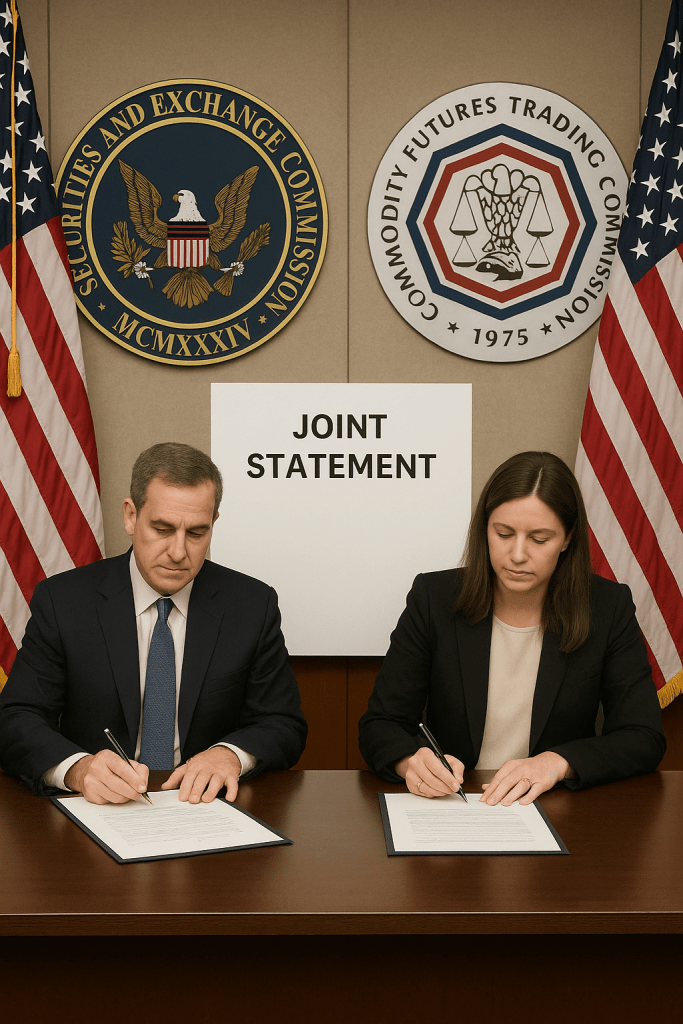
In a landmark move on September 2, 2025, staff from the U.S. Securities and Exchange Commission (SEC) and the Commodity Futures Trading Commission (CFTC) issued a joint statement declaring that exchanges registered with either agency are not prohibited from facilitating trading in certain spot crypto asset products. This declaration, emerging from the coordination between the SEC’s Division of Trading and Markets and the CFTC’s Divisions of Market Oversight and Clearing & Risk, marks a clear regulatory pivot in the landscape of U.S. digital asset markets.
Riding the Wave of “Project Crypto” and “Crypto Sprint”
This initiative forms part of broader frameworks known as Project Crypto (by the SEC) and Crypto Sprint (by the CFTC), both born from recommendations of the President’s Working Group on Digital Asset Markets aimed at fostering U.S. leadership in digital finance innovation. The working group’s report consistently called for regulatory clarity to ensure blockchain experimentation thrives on American soil.
Under these programs, the agencies are collaborating to provide a coordinated path forward: emboldening registered venues to offer leveraged, margined, or financed spot retail commodity transactions — including crypto assets — under existing legal authorities.
What’s Allowed, and How It’s Framed
Importantly, the agencies stress that current law already allows certain registered exchanges—namely SEC-registered national securities exchanges (NSEs) and CFTC-registered designated contract markets (DCMs) or foreign boards of trade (FBOTs)—to facilitate trading in select spot crypto commodity products, even with leverage and margin, without needing new legislation.
This is not, however, a new rule or legal exemption. The statement represents staff views only—it carries no binding force and does not change existing statutes. Exchanges must still proceed through the usual regulatory processes, such as filing rule amendments or requesting relief. Nevertheless, its unlikely “staff” would be permitted to take this action without “approval” from the agencies directors. I make this claim as someone who held senior staff positions in the federal government.
What’s Next, and What Market Participants Should Consider
The joint staff statement serves not just as a signal, but as an invitation to market participants. Agencies have pledged to:
- Promptly review filings and proposals, encouraging engagement from exchanges seeking to list spot crypto products.
- Address operational and structural questions, including around custody, clearing, margin, and settlement.
- Support market surveillance and data transparency, encouraging shared price feeds and real-time dissemination of trade data.
- Balance innovation with investor protection, remaining open to technological advances while ensuring rigorous oversight.
Legal and compliance professionals advise that any firm planning to launch such offerings should prepare thoroughly by addressing these operational points—effectively a checklist for submission—and engage early with regulators.
Views from the Trenches: Optimism vs. Skepticism
The regulatory move has been widely hailed in the industry as a game-changer—a regulatory green light for mainstream U.S. exchanges to consider crypto listings, potentially including Bitcoin and Ether.
But not everyone sees it that way. Some legal analysts have labeled the statement a “nothingburger”, criticizing its non-binding nature and lack of clarity around how “commodity” versus “security” status will be adjudicated—an unresolved core issue in crypto regulation. I do not agree with those legal analysts–but I’m not an attorney nor is this article legal or financial advice.
Harmonizing Frameworks—Next Up: A Joint Roundtable
This statement represents only the first step. On September 5, 2025, the agencies released a strategic follow-up: a joint statement on regulatory harmonization, announcing a public roundtable on September 29, 2025, to align their frameworks further—spanning product definitions, reporting standards, capital requirements, and coordinated innovation exemptions.
SEC Chair Paul Atkins and CFTC Acting Chair Caroline Pham described the session as a pivotal moment to transform U.S. regulatory coordination into a competitive advantage, enhancing clarity and opening the door to financial innovation. Their remarks signal a shared commitment among regulators to make the U.S. marketplace more efficient, innovative, and investor-friendly.
Implications and Forward Outlook
For the crypto industry, this coordinated stance paves a legal path that could bring regulated exchanges into the fold. Institutional venues like Nasdaq, NYSE, CME Group, and Cboe could consider introducing crypto product offerings—once thought off-limits—if they navigate the filing and operational requirements successfully. That is not a “nothing” burger!
Yet, without binding rules or clarified legal definitions, the shape of this new pathway remains uncertain. Regulatory arbitrage and legal ambiguity could persist unless the agencies deliver clear, binding regulations or frameworks.
Conclusion: Cautious Optimism in a Regulatory Renaissance
The joint statement by SEC and CFTC staff marks a meaningful departure from past reluctance—an encouraging signal that the U.S. is repositioning itself as a hub for blockchain-driven innovation. Market participants now have formal permission to explore spot crypto product offerings—if they comply with existing regulatory expectations.
The upcoming September 29th roundtable offers a critical opportunity to transform this gesture into substantive regulatory reality. For firms, token projects, and exchanges, the message is clear: engage early, act boldly, and help shape the evolving regulatory blueprint for the next era of digital asset markets in the U.S.
Until next time,
Yogi Nelson




 Blockchain & AI Forum