There are three primary ways investors gain exposure to gold today: physical ownership, ETFs, and futures. Each exists for a reason. Each solves a different problem. And each comes with its own tradeoffs.
Tokenized metals add a fourth dimension—not by replacing these structures, but by forcing a more precise question:
Are you buying ownership, or are you buying exposure?
ETFs deliver efficient price exposure, but usually through pooled structures with limited redemption rights. Futures provide price discovery and hedging power, but they are contracts—not assets. Physical gold offers direct ownership, but comes with real-world friction: storage, insurance, and logistics.
Tokenization sits between these models. When structured properly, it can combine digital transferability with claims on physically vaulted metal. When structured poorly, it becomes just another derivative with a new label.
That distinction matters—especially for institutions. What they care about is not speculation, but market plumbing: settlement, custody, collateral mobility, auditability, and counterparty risk. Tokenization becomes interesting only when it improves those foundations.
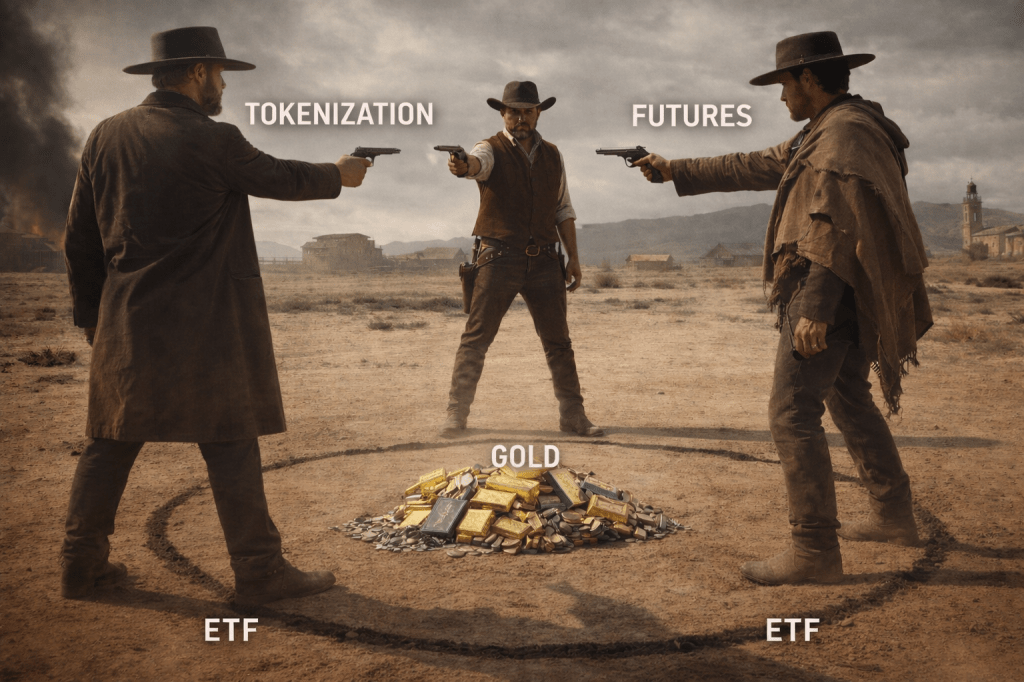
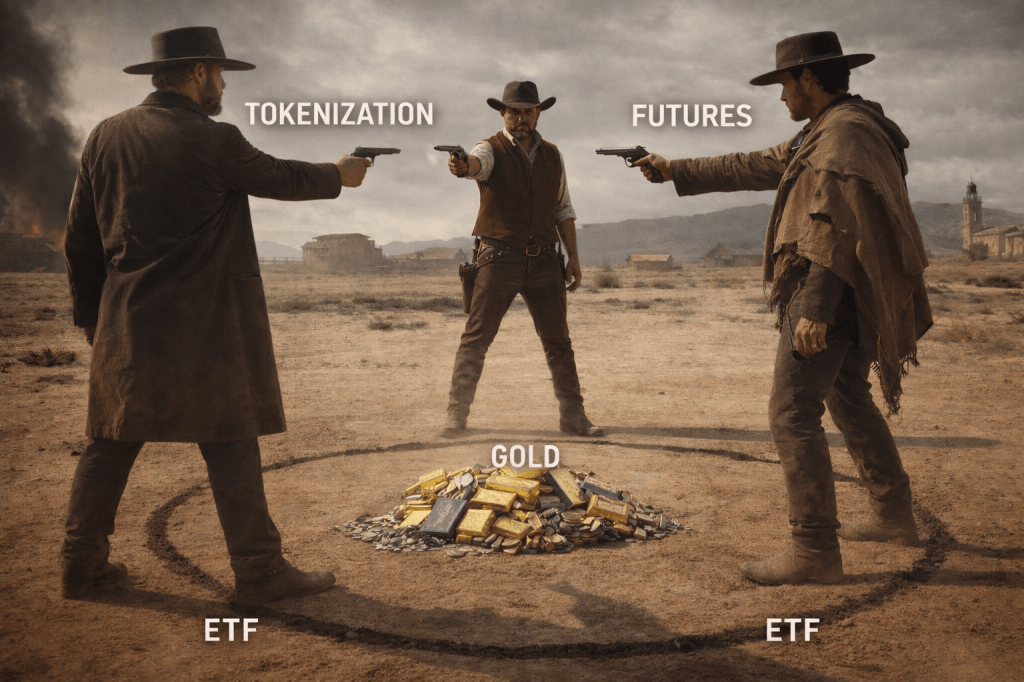
The future of metals is not a shootout between ETFs, futures, and tokenization. It is a question of which structures best serve ownership, transparency, and settlement in a digital economy.
— Yogi Nelson
This post is part of an ongoing weekly series on the tokenization of precious metals, published on BlockchainAIForum and LinkedIn, examining custody, regulation, issuer structure, and settlement infrastructure.
For decades, investors have gained exposure to precious metals and other hard assets through financial instruments designed for liquidity and scale rather than direct ownership. Exchange-traded funds and futures contracts made metals easier to trade, hedge, and price—but they also introduced layers of abstraction that separate investors from the underlying asset.
Tokenized metals reintroduce the question that those instruments largely set aside: what does it actually mean to own a hard asset?
Physical ownership implies custody, storage, insurance, and legal title. ETFs typically offer price exposure through pooled structures, with limited or no direct redemption for most investors. Futures markets facilitate price discovery and risk management, but they are contracts, not ownership vehicles. Tokenization, when structured properly, attempts to bridge these models—combining digital transferability with claims on physically vaulted metal.
This article compares tokenized metals directly with ETFs and futures by focusing on ownership rather than performance. The goal is not to argue that one model replaces the others, but to clarify how each structure works, what rights it confers, and what risks it introduces. Only by understanding these distinctions can investors and institutions evaluate where tokenization meaningfully changes market structure—and where it does not. Let’s now talk hard assets!
Hard Assets: Direct Ownership, Direct Responsibility
Hard assets are tangible, physical assets with intrinsic value. In the metals context, this means gold, silver, platinum, palladium, and other mined materials that must be refined, transported, stored, insured, and legally owned. Land ownership is a hard asset, but outside the scope of this series.
Traditional hard-asset ownership is conceptually simple: you own the metal. That ownership may be expressed through physical possession or through a custodial relationship with a vaulting provider, but the legal title is clear. The asset exists independently of any financial system.
The tradeoff is friction. Friction refers to the operational, financial, and logistical burdens associated with physical ownership—storage fees, insurance costs, transport limitations, slower settlement, and reduced liquidity. These frictions do not negate ownership, but they make hard assets less convenient to use within modern, fast-moving financial markets.
Hard assets provide certainty of ownership, but they do not scale easily in a global, digital system. That limitation is precisely what led to financial intermediaries.
ETFs: Exposure Without Possession
Exchange-traded funds revolutionized access to precious metals. Gold ETFs, in particular, allowed investors to gain exposure to gold prices using familiar brokerage accounts, with tight spreads and deep liquidity. ETFs excel at what they are designed to do:
Provide efficient price exposure
Integrate into regulated financial markets
Support institutional-scale liquidity
However, ETFs fundamentally change the ownership relationship. Most ETF holders do not own specific metal bars. They own shares in a trust or fund that holds metal through custodians and sub-custodians. Physical redemption is usually limited to authorized participants, not retail investors.
In practical terms, ETFs are financial exposure instruments, not ownership instruments. They track price movements effectively, but they intentionally abstract away custody, title, and delivery.
Futures Markets: Contracts, Not Assets
Futures markets serve a different purpose altogether. They are designed for:
Price discovery
Hedging
Risk transfer
Leverage
Futures contracts are agreements to buy or sell an asset at a future date, typically cash-settled or rolled forward. While physical delivery mechanisms exist, the vast majority of futures contracts never result in delivery.
Ownership is not the goal of futures markets. Exposure and risk management are. This makes futures indispensable to global markets, but unsuitable as ownership vehicles.
Global Markets: Scale at the Cost of Transparency
At the highest level, metals trade through global market infrastructure designed to support enormous volume and systemic stability. This infrastructure includes clearinghouses, central counterparties, and settlement networks such as the CME Clearing House, LCH, and international central securities depositories.
These entities perform critical functions: netting trades, managing counterparty risk, enforcing margin requirements, and ensuring settlement finality. Without them, global markets would not function.
However, this scale introduces distance. Ownership chains can involve multiple intermediaries—brokers, custodians, clearing members, and settlement agents—each adding legal and operational layers. End investors often rely on contractual assurances rather than direct visibility into custody or underlying assets.
This architecture prioritizes efficiency and stability, but it does so by design at the expense of transparency and direct ownership clarity.
Where Tokenized Metals Enter the Picture
Tokenization is often misunderstood as simply “putting gold on a blockchain.” In reality, tokenization is about restructuring ownership and settlement, not eliminating markets.
Tokenized metals attempt to:
Represent allocated physical metal digitally
Preserve custody and redemption rights
Enable peer-to-peer transfer
Reduce unnecessary intermediaries
Improve transparency
When designed properly, tokenization does not add another abstraction. It compresses existing layers by creating a single coordinated system that links physical custody, legal ownership, and transferability.
That coordinated system is tokenization implemented via a blockchain. The blockchain serves as the shared ledger that synchronizes ownership records, issuance, transfers, and redemptions, while the physical metal remains securely vaulted off-chain.
Whether tokenization succeeds depends entirely on how well this coordination is executed.
Tokenized Metals vs ETFs and Futures
The comparison becomes clearer when framed through ownership.
Ownership
Hard assets: Direct legal ownership
ETFs: Indirect exposure via fund shares
Futures: Contractual exposure
Tokenized metals: Potential direct ownership via digital representation
Liquidity
Hard assets: Low
ETFs: High
Futures: Very high
Tokenized metals: Variable, developing
Transparency
Hard assets: High at custody level
ETFs: Limited for end holders
Futures: Market-level transparency, not asset-level
Tokenized metals: High if properly designed
Redemption
Hard assets: Immediate
ETFs: Restricted
Futures: Rare
Tokenized metals: Platform-dependent
Taken together, tokenization does not automatically outperform ETFs or futures. Instead, it offers a different balance—trading some of the convenience of ETFs and the leverage of futures for improved ownership clarity, transparency, and settlement flexibility. This is why tokenized metals should not be viewed as replacements, but as alternatives optimized for different priorities.
Is Tokenization Just Another Derivative?
This is the central question—and the answer depends entirely on structure.
If a token:
Is not redeemable
Is backed by unallocated metal
Has opaque custody
Functions purely as price exposure
Then it is simply another derivative, regardless of blockchain branding.
However, tokenization can represent something fundamentally different. Consider the tokenization of land or real estate. When property is tokenized properly, the token does not represent price exposure—it represents legal title or enforceable claims on ownership, recorded digitally.
The same principle applies to metals. When a token represents allocated, uniquely identified metal with enforceable redemption rights, it functions as a digital ownership wrapper, not a derivative.
The distinction is not academic. It determines whether tokenization is merely financial engineering—or a genuine evolution in how ownership is recorded and transferred.
Why Institutions Care About Ownership Structure
Institutions already have access to ETFs and futures. They do not need tokenization for exposure. What they care about instead is market plumbing. And what is market plumbing? Market plumbing refers to the foundational systems that make markets function reliably:
Clearing and settlement
Custody and safekeeping
Collateral mobility
Reconciliation and auditability
Counterparty risk management
Cross-border interoperability
Tokenized metals become interesting to institutions when they improve this plumbing—by reducing settlement times, enhancing transparency, enabling programmable collateral, and simplifying reconciliation. In this sense, tokenization competes not on price or speculation, but on infrastructure efficiency.
Blockchain as Infrastructure, Not Ideology
The most credible tokenized metal platforms treat blockchain as infrastructure, not marketing. Public blockchains provide:
Immutable ownership records
Transparent issuance and supply tracking
Programmable transfer and settlement
Reduced reconciliation complexity
They do not replace vaults, insurers, or auditors. They coordinate them. This is what differentiates tokenization from earlier financial abstractions. ETFs and futures abstract ownership. Tokenization, at its best, re-architects it.
Global Markets Are Not Being Replaced
Tokenization will not replace ETFs, futures, or global commodity markets. Those systems exist because they solve real problems at scale. What tokenization can do is:
Offer alternatives for ownership-centric use cases
Complement existing markets
Improve settlement and transparency at the margins
Over time, those margins matter.
Conclusion: Understanding How Ownership Really Works
Hard assets, ETFs, futures, and tokenized metals are not competitors in a zero-sum sense. They are different tools, optimized for different purposes.
Tokenization does not eliminate abstraction. It challenges unnecessary abstraction. Its success will depend not on blockchain enthusiasm, but on custody, redemption, audits, and legal clarity. In that sense, tokenized metals are not a rebellion against markets—they are an evolution within them.
Understanding how ownership really works is the first step toward deciding where tokenization truly belongs.
Until next time,
Yogi Nelson
This article is part of an ongoing weekly series on the tokenization of precious metals, published on BlockchainAIForum and LinkedIn, examining custody, regulation, issuer structure, and settlement infrastructure.
That tension is where trust either holds—or breaks.
In tokenized metals, the blockchain is not the source of trust. The foundation remains physical and legal: professional vaulting, insurance, and proof-of-reserves. Tokenization does not replace these pillars; it exposes them.
Credible platforms answer hard questions:
Where is the metal actually stored?
Is it allocated and uniquely identified?
Who insures it—and for what risks?
How often are reserves audited?
Can tokens be redeemed for physical metal?
Building Trust with Blockchains
Blockchain adds transparency and coordination, but it cannot confirm physical reality on its own. That requires vault operators, insurers, auditors, and clear legal structures working together.
For institutions, this is not optional. Custody standards, audit discipline, redemption mechanics, and jurisdictional clarity are prerequisites—not features.
Tokenization does not create trust. It reveals whether trust already exists.
This is why the future of tokenized metals belongs not to the fastest platforms, but to those that treat trust as infrastructure—and build accordingly.
— Yogi Nelson
This post is part of an ongoing weekly series on the tokenization of precious metals, published on BlockchainAIForum and LinkedIn, examining custody, regulation, issuer structure, and settlement infrastructure.
When it comes to precious metals, owners live by the old Russian proverb–trust by verify. That’s what this article is about. Tokenization promises efficiency, portability, and programmability. But when it comes to precious metals, those benefits are meaningless without trust. A token may move at internet speed, but gold and silver remain physical assets—bound by gravity, custody, and law.
That reality forces an essential question: how do tokenized metals remain trustworthy?
Building Trust with Blockchains
The answer does not lie in blockchains alone. It rests on a three-part foundation that predates crypto by decades—sometimes centuries: vaulting, insurance, and proof-of-reserves. Tokenization does not replace these pillars; it depends on them. When implemented correctly, blockchain technology enhances transparency and coordination. When implemented poorly, it merely hides old risks behind new interfaces.
This article examines how credible tokenized metal platforms use vaulting, insurance, and proof-of-reserves to earn trust—and why each component is non-negotiable.
Why Trust Is the Central Challenge in Tokenized Metals
Unlike native digital assets, tokenized metals represent something that exists outside the blockchain. A crypto native would say: it lives off-chain. In other words, a gold token is only as good as the metal it references. This makes tokenized metals structurally different from cryptocurrencies that rely solely on code and consensus.
History provides a cautionary backdrop. Gold-backed instruments have failed before. It wasn’t because gold was flawed. The issues where custody was opaque, audits were weak, and promises outpaced proof. A deadly combo. Tokenization revives these old questions in a new format:
Where is the metal stored?
Who controls it?
What happens if something goes wrong?
And how do holders know the metal actually exists?
The credibility of tokenized metals depends on how convincingly platforms answer these questions—not rhetorically, but structurally.
Vaulting: Where Trust Begins
Vaulting is the physical anchor of tokenized metals. Without credible vaulting, tokenization collapses into abstraction; an uncomfortable place to live.
Professional Vaulting vs. Self-Custody
Serious tokenized metal issuers rely on professional, third-party vaulting companies rather than self-custody. These are specialized firms whose sole business is the secure storage of precious metals. Examples include vault operators in London, Zurich, Singapore, New York, and Toronto—jurisdictions with long-standing bullion market infrastructure.
Professional vaults offer:
Armed security and restricted access
Continuous surveillance
Environmental controls
Formal chain-of-custody procedures
Legal segregation of client assets
This differs fundamentally from crypto custody. Gold cannot be stored in a wallet or secured by private keys alone. It requires physical security, legal documentation, and insurance-backed responsibility. Third-party vaulting introduces separation of duties—an essential trust feature and risk management practice in any serious financial system.
Allocated and Segregated Storage: Why the Details Matter
The distinction between allocated, segregated, and unallocated metal is one of the most important—and most misunderstood—concepts in tokenized metals.
Allocated storage means specific metal bars are assigned to token holders (or to a defined token pool).
Segregated storage means those bars are physically separated from other clients’ assets and from the custodian’s balance sheet.
Unallocated storage represents a general claim on metal rather than ownership of specific bars.
In allocated systems, each gold bar is uniquely identified by:
Refiner name
Serial number
Weight
Purity
These identifiers are recorded in bar lists maintained by vault operators and auditors. In credible tokenized systems, outstanding token supply is reconciled against these bar lists. This is not theoretical bookkeeping—it is how institutional bullion markets have operated for decades.
Tokenization does not change this process. It simply adds a digital ownership layer on top of it, making discrepancies easier to detect. Once recorded on a blockchain, any change is relative easy for an auditor to detect, thus making internal fraud much easier to discover.
Jurisdiction Matters More Than Many Realize
Vaulting is not just a physical decision; it is a legal and geopolitical one. The jurisdiction in which metal is stored determines how ownership is treated under law, especially in edge cases such as insolvency, disputes, or government intervention.
Jurisdiction affects:
Property rights and bailment law
Bankruptcy treatment of stored assets
Regulatory oversight of vault operators
Government seizure or capital control risk
Legal recourse available to token holders
Some platforms diversify vaulting across multiple countries to reduce concentration risk. Others deliberately choose jurisdictions with centuries-old bullion traditions. Token holders may never visit the vault, but jurisdiction quietly shapes their risk profile. For example, a large family office may want to diversify jurisdictions as a hedge against a black swan event.
Insurance: Planning for the Unthinkable
Even the best vaults acknowledge a basic reality: risk cannot be eliminated, only managed. Insurance is the final backstop.
Who Provides Vault Insurance
Professional bullion vaults typically carry insurance underwritten by major global insurers such as:
Lloyd’s of London
AXA
Chubb
These policies generally cover theft, physical damage, and certain catastrophic events up to the full replacement value of stored metals. Insurance is usually held at the vault level rather than by the token issuer directly.
What Insurance Does—and Does Not—Do
Insurance protects against physical loss, not structural failure. It does not cover:
Fraud by issuers
Misrepresentation of reserves
Government confiscation
Market price fluctuations
Insurance is effective only when paired with sound custody, governance, and transparency. It is a backstop—not a substitute for trust.
Proof-of-Reserves: From Promises to Verification
If vaulting and insurance protect the metal, proof-of-reserves protects credibility.
How Audits Actually Work
Proof-of-reserves typically relies on independent third-party audits conducted on a regular schedule—often quarterly or monthly, with some platforms publishing more frequent attestations. The more often, the better.
Audit firms commonly involved include:
BDO
Grant Thornton
Deloitte
Auditors verify:
Physical bar lists at vaults
Serial numbers, weights, and purity
Consistency between physical inventory and token supply
Custodial documentation and controls
A best practice is for auditors involves physical inspections. However, some auditors rely on vault operator confirmations and internal controls. No audit is perfect, but regular, independent verification materially reduces risk. Tokenization strengthens this process by allowing on-chain token supply to be reconciled in real time against off-chain audit data.
Blockchain’s Role: Enhancing, Not Replacing, Trust
Blockchains are excellent at tracking digital ownership and transfers. They are not inherently capable of confirming physical reality. In tokenized metals, blockchain’s role is coordination and transparency—not magic.
Platforms commonly use or experiment with established blockchains such as:
Ethereum (for its maturity and liquidity)
Polygon (for lower transaction costs)
Stellar (for asset issuance and settlement)
Avalanche (for institutional and subnet use cases)
Blockchain enables:
Transparent tracking of token supply
Immutable transaction history
Programmable issuance and redemption
Easier detection of discrepancies
When used responsibly, blockchain makes vaulting and audits more visible and harder to manipulate. It does not replace them.
Redemption Rights: The Ultimate Trust Test
Redemption is where theory meets reality.
How Redemption Typically Works
Redemption mechanisms vary, but generally involve:
Token holder initiates a redemption request
Tokens are burned or locked on-chain
Platform coordinates with vault or dealer
Metal is either delivered or made available for pickup
Legal title transfers to the redeemer
Some platforms require minimum redemption thresholds (often several ounces or bars) due to logistics and cost. Others allow smaller redemptions via partner dealers.
Even if most holders never redeem, the ability to do so disciplines the entire system. A token without a credible redemption pathway deserves deep scrutiny, perhaps even distrust.
Why This Matters Beyond Retail Investors
Tokenized metals are increasingly discussed not just for individuals, but for institutions—and institutions operate under far stricter standards.
For institutional adoption, platforms must demonstrate:
Clear legal ownership structures
Bankruptcy-remote custody
Regular, independent audits
Defined redemption mechanics
Regulatory clarity
Operational resilience
These are the same standards applied to traditional custody, collateral, and settlement systems. Tokenization does not lower the bar—it raises it by increasing visibility. This is why vaulting, insurance, and proof-of-reserves are not retail concerns; they are systemic requirements.
Conclusion: Tokenization Does Not Create Trust—It Reveals It
Tokenization is often framed as a revolution. In precious metals, it is better understood as a stress test.
It does not make gold trustworthy. Gold already earned that status over millennia. Tokenization simply forces platforms to prove that their claims are as solid as the metal they represent.
Vaulting, insurance, and proof-of-reserves are not optional features. They are the foundation. Blockchain technology, when used responsibly, strengthens that foundation by making trust more observable and harder to fake.
In tokenized metals, the future does not belong to the fastest platforms or the flashiest interfaces. It belongs to those that treat trust as infrastructure—and build accordingly.
Until next time,
Yogi Nelson
This article is part of an ongoing weekly series on the tokenization of precious metals, published on BlockchainAIForum and LinkedIn, examining the topic across custody, regulation, issuer structure, and settlement infrastructure.
“A token isn’t gold; the structure behind it is—and that’s where the real competition in tokenized metals is happening.” Yogi Nelson
Tokenization is no longer theoretical. By 2026, it has become a defining theme across finance—from equities and bonds to commodities. When it comes to precious metals, however, how tokenization is implemented matters far more than the token itself.
A token is not gold. The structure behind the token is the asset.
That means custody, audits, redemption rights, regulatory posture, and market integration matter far more than marketing claims.
In reviewing the leading tokenized gold issuers operating today, one thing becomes clear: there is no single “winner.” Instead, each issuer is running a different race—toward a different vision of what tokenized metals should be.
Here’s how the field lines up:
CACHE Gold → transparency and auditability
Comtech Gold → trade and settlement infrastructure
Kinesis → re-monetizing gold and silver as money
Paxos (PAXG) → institutional compliance and regulatory clarity
T-Gold (SchiffGold) → sound-money preservation
Tether Gold (XAUT) → liquidity and global reach
Tokenization is not a template. It’s a toolkit.
Some issuers optimize for institutions. Others for velocity, trade finance, or individual ownership. The common thread is this: tokenization is shifting precious metals from static holdings toward programmable financial infrastructure.
That is the real story—and why issuer design now matters more than the token symbol itself.




 Blockchain & AI Forum