
by Yogi Nelson
Welcome to the BlockchainAIForum
Why Open Science Needs Stronger Data Integrity 🔐
Aaron Malone, Unbound Science Founder, introduced me to the idea of non-traditional science. Not exactly in the manner of NASA, nevertheless in the general direction. You can read about open science at: https://openscience.org/. And then there is decentralized science. This movement consists of a budding cluster of independent researchers and scientists who ditched traditional science to pursue science without political pressure. Check out Unbound Science here: unboundscience.com
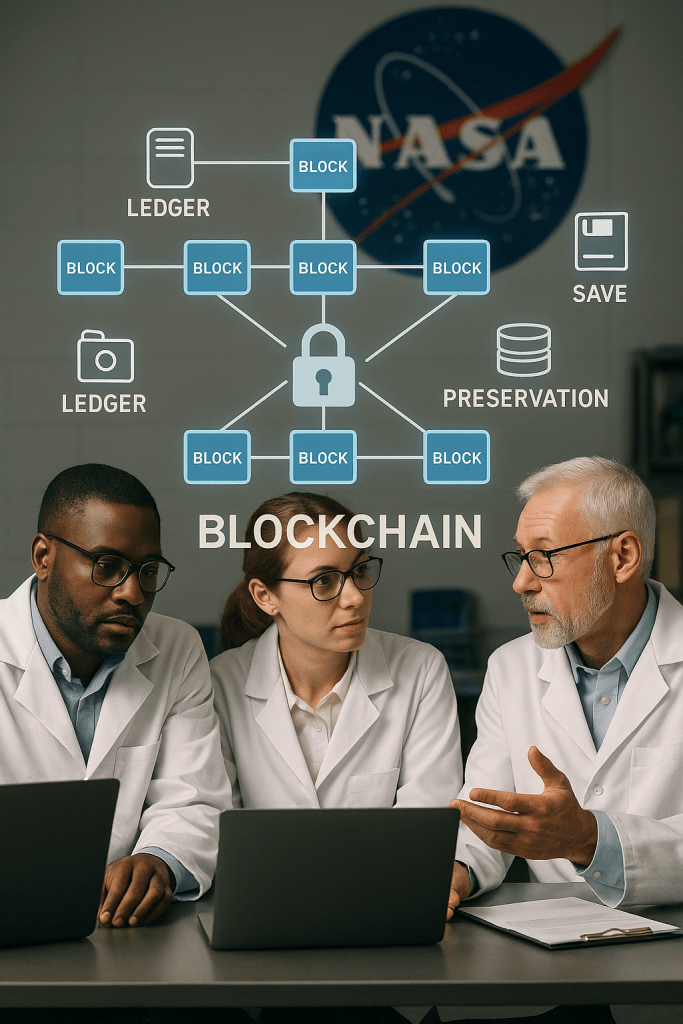
In this article I’ll focus on NASA’s version of open science—the idea that data, methods, and findings should be openly shared—is critical to global progress. Keep in mind NASA is a USA government agency so their idea of open science might be …. Nevertheless let’s dig in. This article will rely on NASA’s recent technical memorandum, Blockchain for Supporting Open Science Practices, which highlights how blockchain technology can solve these issues by bringing data provenance, transparency, and immutability to the scientific process.
What is Blockchain and Why Does it Matter for Science? 🔗
Blockchain is essentially a distributed ledger that records transactions in a tamper-proof way. Once data is added, it’s nearly impossible to alter without detection. This technology has already transformed the finance and supply chain industries, and now NASA is exploring how it can protect research data.
For science, blockchain could:
– Verify data authenticity (ensuring no one alters findings after publication).
– Track contributions to projects, providing fair credit for datasets, analyses, and results.
– Facilitate reproducibility, which is essential for scientific trust.
Data Provenance: The Heart of the Challenge 📂
Data provenance—the full history of where data came from, who handled it, and how it evolved—is often missing from modern science repositories. NASA’s report notes that incomplete provenance records make it hard for researchers to reproduce findings.
Recording data events on a blockchain, creates a transparent and traceable chain of custody for every dataset. Scientists can see every step and that creates a transparent and traceable chain of custody for every dataset.
1. Who collected the data.
2. When it was collected.
3. How it was processed.
4. Which algorithms or models were applied.
Supporting Global Scientific Collaboration
NASA operates large international missions like the Earth Observing System and the James Webb Space Telescope. These projects involve thousands of researchers and terabytes of data. Without secure, automated systems, maintaining integrity across partners is challenging.
Blockchain can help by:
– Creating a common ledger shared among all research partners.
– Reducing the risk of tampering by a single actor.
– Automating permissions and access rights using smart contracts, so only authorized individuals can edit or annotate data.
Enhancing Credit and Recognition 🏆
One of the frustrations in science is lack of recognition for data curators, software developers, and other contributors who aren’t listed as lead authors. NASA’s memorandum highlights that blockchain could link each contribution to a unique digital identity, ensuring everyone receives proper credit. Researchers could even receive digital tokens or certifications for their work, providing a transparent record for resumes, tenure committees, and funding agencies.
Addressing Challenges and Limitations ⚡
Blockchain isn’t a magic bullet. NASA’s report acknowledges some hurdles:
– Scalability: Storing massive datasets directly on blockchain is impractical. Instead, the blockchain should store references and hashes, while the data itself remains in traditional repositories. DeSCI would say use decentralized file space, such as FileCoin.
– Energy use: Some blockchains consume significant energy. NASA emphasizes the need for green blockchain protocols suitable for science.
– User adoption: Researchers must be trained to use blockchain tools effectively, which requires cultural change.
NASA’s Next Steps 🚀
The memorandum outlines pilot projects where NASA plans to test blockchain tools in open science contexts. By leading these experiments, NASA hopes to set the standard for how blockchain can enable a trusted and transparent scientific ecosystem. These pilots will likely focus on:
– Metadata tracking for large Earth science datasets.
– Smart contracts for automating data-sharing agreements.
– Prototypes for tracking software versions in complex modeling projects.
What This Means for the Future of Science 📢
The push for open science is gaining momentum worldwide, and blockchain could be the infrastructure that makes it possible at scale. NASA’s leadership in this field signals that blockchain could soon be as essential to science as telescopes and satellites. Imagine a world where:
– Every dataset is verifiable and traceable back to its source.
– Data-sharing agreements are automatically enforced by smart contracts.
– Researchers can confidently build on others’ work without worrying about data corruption or ownership disputes.
Final Thoughts 📝
NASA’s Blockchain for Supporting Open Science Practices (2023) is more than just a technical memorandum—it’s a blueprint for how blockchain can enhance scientific integrity and collaboration. While challenges remain, the potential to revolutionize data sharing and reproducibility is undeniable.
Remember to check out Unbound Science. Until next time,
Yogi Nelson
Sources:
NASA Technical Reports Server (2023). Blockchain for Supporting Open Science Practices. NTRS Report Number 20230009029.
Citation: NASA Technical Reports Server (2023). Blockchain for Supporting Open Science Practices. [NTRS 20230009029]



 Blockchain & AI Forum