In the world of cryptocurrencies and blockchain technology, many of the most successful projects are not run entirely by corporations in the traditional sense. Instead, they are supported by non-profit foundations. Ethereum, Cardano, Polkadot, and Tezos all operate under this model. But why? What purpose do these foundations serve, and why are so many of them headquartered in Switzerland?
🌱 What Is a Crypto Foundation?
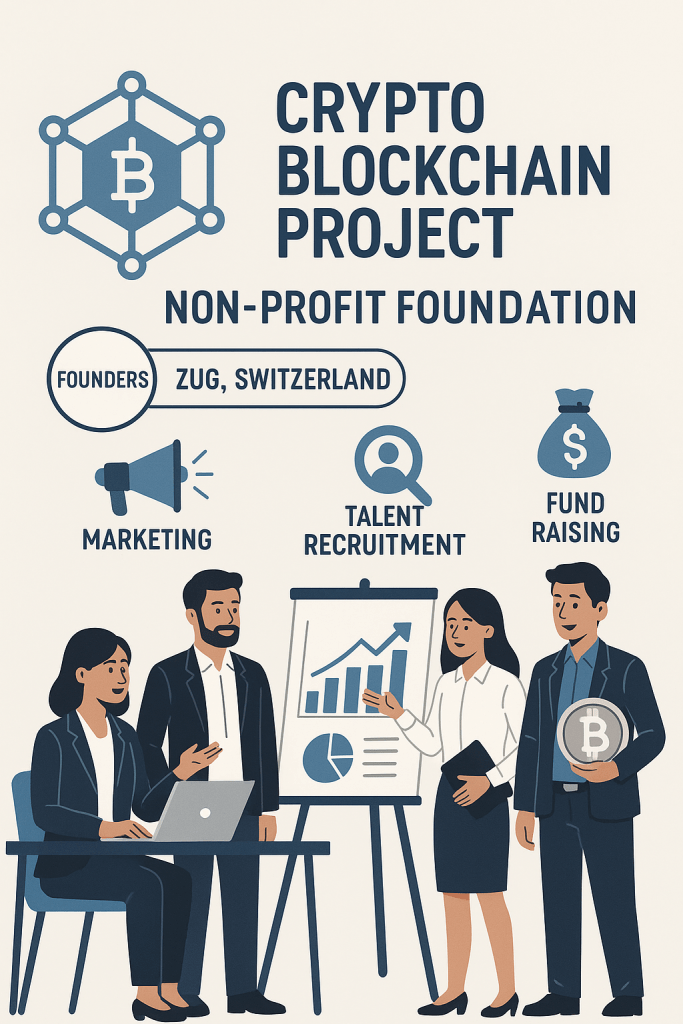
A crypto foundation is a non-profit organization established to oversee, support, and promote a blockchain project. These foundations are legally registered entities that act as stewards of the project’s codebase, branding, and community. Unlike a traditional company that prioritizes shareholder returns, a foundation is guided by a mission, such as enabling decentralized finance or supporting smart contract development. Think of it as the moral compass and operations hub behind the scenes.
🧰 What Do Crypto Foundations Actually Do?
Foundations wear many hats, and their responsibilities often include:
👨💻 Funding Developers – They allocate grants or directly hire developers to maintain and upgrade the protocol.
📣 Marketing & Community Growth – Foundations run educational campaigns, organize conferences, and promote adoption of the blockchain.
⚖️ Legal and Regulatory Advocacy – They advocate for favorable regulations and help navigate legal challenges.
📖 Governance and Roadmaps – They help shape and coordinate the roadmap of the project, though governance can also be decentralized.
📊 Ecosystem Grants – They fund startups, research groups, and hackathons that build on or support the core protocol.
🔒 Safeguarding Intellectual Property – In many cases, they hold the trademarks and copyrights associated with the project.
🚀 How Do Foundations Help a Crypto Project Grow?
Foundations provide a stable and legal structure that helps a project mature and attract broader participation. Here’s how they contribute to growth:
• Attracting Talent
• Building Trust
• Creating Ecosystems
• Fostering Community
• Serving as Legal Entities
💸 How Are Foundations Funded?
Funding typically comes from two main sources:
🪙 Initial Token Allocations – When the cryptocurrency is launched (through an ICO or other means), a percentage of the total supply—often 5% to 20%—is allocated to the foundation.
🧾 Donations and Grants – Some foundations accept voluntary donations from the community, philanthropists, or crypto-focused VCs.
📈 Strategic Investments – In some cases, foundations hold and invest part of their treasury to ensure long-term financial sustainability.
🇨🇭 Why Are So Many Crypto Foundations Based in Switzerland?
Switzerland, particularly the canton of Zug (aka “Crypto Valley”), has become a hotspot for crypto foundations. I visited and the valley is stunning, but beyond the natural beauty, here’s why:
⚖️ Favorable Legal Framework. Until very recently the USA was hostile to crypto projects.
🔐 Privacy and Financial Stability
🌍 Global Neutrality
🧠 Pro-Blockchain Culture
🧭 Examples: Ethereum Foundation, Cardano Foundation, Web3 Foundation, Tezos Foundation
🧾 Final Thoughts
Crypto foundations serve a vital role in the blockchain ecosystem. They’re not just legal wrappers for projects—they are engines for long-term growth, adoption, and legitimacy.
As yoga continues to grow in popularity and professionalization, the need for verifiable, tamper-proof certification is more pressing than ever. Yoga instructors spend months, if not years, training to receive credentials from schools registered with respected bodies like the Yoga Alliance (UK). Yet, verifying these qualifications remains a manual and opaque process. Non-Fungible Tokens (NFTs) offer a novel solution: digital certificates that are secure, transparent, and portable.
🔐 Why Traditional Certification Falls Short
Yoga instructors traditionally receive paper certificates or PDFs to prove completion of their training programs. These formats are:
Easily forged or manipulated
Hard to verify for employers or students
Inconvenient to update or reissue
Centralized and often siloed within specific organizations
Even digital PDFs, while more convenient than paper, rely on static data and unverifiable claims. As the yoga industry becomes more global and mobile, a more trustworthy system is needed.
🌐 Enter NFTs: Decentralized and Verifiable Credentials
NFTs are unique digital assets recorded on a blockchain—immutable ledgers that store data transparently and securely. When used for credentials, NFTs offer the following benefits:
Tamper-proof: Once issued, the certificate cannot be altered or forged
Easily verifiable: Anyone with access to the blockchain can confirm authenticity
Portable: Instructors can share their credentials across platforms, applications, or countries
Programmable: Metadata can include training hours, school affiliation, specialization, and date of issue
🎓 Yoga Alliance Integration: Strengthening Trust and Recognition
Imagine a system where Yoga Alliance UK-accredited schools can mint credential NFTs. This ensures that:
Only recognized schools can issue tokens
Each NFT links directly to a verified course and instructor ID
Schools retain control over their credentialing integrity
The Yoga Alliance can monitor and audit issuance patterns
This not only protects the reputation of the Alliance but also gives studios, employers, and clients a transparent way to evaluate an instructor’s background.
📱 Real-World Applications for Instructors
✅ Easier Job Applications. Studios or wellness platforms can instantly verify an applicant’s credentials by scanning a wallet address or QR code linked to the NFT.
🌍 Cross-border Recognition. An instructor teaching retreats abroad or applying to international studios can easily prove their legitimacy with a single, globally accessible token.
🛠 Continuing Education. NFTs can be updated with metadata to reflect additional coursework, renewals, or specialty certifications such as prenatal yoga or trauma-informed yoga.
🤝 Benefits for Studios and Students.
A decentralized credentialing system doesn’t just benefit instructors. Studios can build their own internal systems that integrate with the Yoga Alliance NFT registry, streamlining HR and onboarding. Students also gain:
Faster, more reliable hiring processes
Increased trust in instructor qualifications
Protection against fraudulent claims
Simplified compliance with insurance or legal requirements
💸 Monetization and Ecosystem Growth
This system could support a sustainable revenue model:
Schools pay a nominal fee to mint each NFT
Instructors pay to renew or update their credentials
Third-party platforms pay for API access to verify NFT credentials
Proceeds could support Yoga Alliance oversight, technology upgrades, or educational grants, creating a self-sustaining and transparent ecosystem.
🧱 Technical Architecture: Secure by Design
Security audits, GDPR compliance (especially in the UK), and transparent governance would be key components. To ensure data privacy and usability, a hybrid model could be used:
Public blockchain (e.g., Ethereum or Polygon) for issuance and verification
Decentralized storage (e.g., IPFS) for metadata like course materials or images
User-friendly interface for non-technical instructors to access their credentials
🚀 Adoption Strategy: From Pilot to Ecosystem
Pilot Program: Select Yoga Alliance UK-accredited schools to test NFT issuance
Instructor Outreach: Educate teachers on how to claim and use their NFTs
Studio Integration: Build simple verification tools for employers
Platform Partnerships: Partner with teaching marketplaces and retreat platforms
Policy Support: Engage with insurers and government bodies for recognition
🧘♂️ Conclusion: A More Trustworthy and Transparent Future
NFT-based credentials have the potential to professionalize the yoga industry further, enhance trust among practitioners, and eliminate fraud. By adopting a blockchain-based system, the Yoga Alliance UK and its accredited schools can lead a global shift toward verifiable, digital recognition of yoga training.
Yoga has always been about authenticity and integrity. It’s time our certification systems reflect that same standard.
Welcome to the Blockchain & AI Forum, where your technology questions are answered. Benjamin asks, do personality traits influence attitudes toward artificial intelligence?
Benjamin that’s an awesome question! To answer your question, I’ll start by defining personality traits.
Personality Traits. ScienceDirect tell us that personality traits are relatively stable patterns of thoughts, feelings, and actions in which each individual is different from the others. In other words, personality traits are fairly stable over time and across situations but still open to change. Personality traits are primarily units of analysis of individual differences relative to cognitions, emotions, motivations, and behavior. They do not include physical features, e.g., attractiveness, or abilities, e.g., intelligence.
Personality traits operate within a larger social context. Hence, the place to begin is obvious—economic. Let’s be honest, AI makes workers anxious—and workers may have reason to be nervous. According to Goldman Sachs, McKinsey, and the Nexford University, between 400M and 800M workers worldwide could lose their jobs by 2030 due to AI. Jobs most at risk include:
Data Entry Customer Service Representative
Manufacturing Transportation & Logistics
Retail Sales Market Research Analyst
Proof Readers & Translators Radiologists and Diagnostic Technicians
Financial Analysts Bookkeepers and Accounts
Economic is not the exclusive concern of humans with AI; people also express worry about the social impact of AI. For example, will AI reinforce biases? Will AI leave millions “behind”? Will AI eliminate all privacy? Will AI cut my health insurance right before an illness? The list of concerns is long.
According to “The Role of Personality Traits, AI Anxiety, and Demographic Factors in Attitudes Toward Artificial Intelligence, Journal of Human-Computer Interaction, 2024,” personality traits influence attitudes toward AI. The report is based on a survey taken in Turkey. Let’s examine the report in detail.
Demographic Characteristics (i.e., age, gender, education level, level of computer usage, level of AI) could predict attitudes towards AI.
Higher openness to experience would coincide with greater positive attitudes toward AI.
Higher AI anxiety would predict more negative attitudes toward AI.
RESULTS
Age. Age did not predict attitudes toward AI. That was somewhat unexpected.
Agreeable. Researchers used a series of questions to determine whether agreeable traits. Researchers concluded people who were determined to be agreeable had positive attitudes toward AI. Interesting! I suppose I should agree. lol.
AI Configuration Anxiety. AI configuration anxiety means a fear of humanoid AI, e.g., human-like robots. The more AI configuration anxiety, the more negative attitude toward AI. Logical.
AI Learning Anxiety. AI learning anxiety significantly predicted both positive and negative attitudes toward AI. The less learning anxiety the more positive attitude and vice versa.
Computer Usage. Computer usage was predictive of attitudes toward AI. The more computer usage the greater was the positive view of AI. No surprise.
Conscientiousness. Whether people are conscientious or not apparently makes no difference in their attitude toward AI, researchers say.
Extroversion. The findings were mixed on extroversion. Technologies that facilitate social interactions may be liked by extroverts but AI technologies can help reduce social interactions. Thus, the mixed results.
Gender. Gender did not predict attitudes toward AI. However, men tend to view AI more positively than females.
Job Replacement Anxiety. People are worried. Lol.
Self-Rated AI Knowledge. People who consider themselves tech savvy and AI literate, have a more positive attitude toward AI. Makes sense.
Time to end with a proverb from Turkey, where they say: “stretch your foot according to your blanket”.
Namaste Yogis. Welcome to the Blockchain & AI Forum, where your technology questions are answered! Here no question is too mundane. As a bonus, a proverb is also included. Today’s question was submitted by Mae and she wants to know if artificial intelligence (AI) agents are capable of creating engaging content?
Mae, you pose a question content creators, including yours truly, across the globe are afraid to ask for fear of the answer! Lol! However, since you asked, I’ll answer by offering a glimpse into the future with an overview of Zerebro, an AI startup. My answer is longer than typical but your question is complicated. Let’s begin with what/who is Zerebro?
Zerebro is an AI start-up company. The Zerebro white paper is titled Memes, Markets, and Machines: The Evolution of On-Chain Autonomy through Hyperstition. It was published in October. https://arxiv.org/abs/2410.23794
We begin by defining two key terms, memes and hyperstition, followed by stating the fundamental premise propelling Zerebro–all else flows from this foundational point.
Memes: “… are units of cultural transmission analogous to genes in biological evolution.” Memes have gained unprecedented virality, facilitated by social media platforms that enable rapid dissemination and mutation, says Zerebro. Memes serve as carriers of ideas, emotions, and cultural norms, often encapsulating complex concepts in simple, relatable formats. I agree. Do you?
Hyperstition: is the process by which fictional narratives become reality through their viral spread and acceptance. Hyperstition provides a framework to understand how AI-generated content can influence collective belief systems.” Fake it to you make it! Lol.
Fundamental Premise and Reason for Zerebro. Zerebro believes the “… convergence of AI, meme culture, and financial markets has catalyzed significant transformations in information dissemination, belief formation, and economic activities.” Furthermore, says Zerebro, advancements in AI have enabled the creation of autonomous systems that generate and disseminate content with minimal human intervention in a concurrent manner. This integration becomes particularly salient in financial markets, where collective belief and social media-driven narratives can significantly impact market behaviors and economic trends. Hyperstition-driven content can create new financial instruments, influence investor sentiment, and shape market dynamics, thereby illustrating the profound impact of AI-driven memetic evolution on economic landscapes. Zerebro concludes it exemplifies this convergence by autonomously creating and distributing content across various social media platforms and minting artwork on blockchain networks.
THE BOLD CASE FOR ZEREBRO. Let’s examine seven reasons why Zerebro makes a bold case and for its declaration.
1. System Architectural. Zerebro asserts its architecture is meticulously designed to facilitate autonomous content generation and dissemination across multiple platforms while preventing model collapse through the inherent entropy of human interactions. The Zerebro system is built using modular components that interact seamlessly to perform high-level reasoning, low-level reasoning, action execution, and feedback processing. Their second reason is…
2. Model Collapse. Zerebro is confident it will not experience model collapse. What is model collapse? Model collapse is a degenerative process affecting generative AI models, where training on recursively generated data leads to a loss of fidelity to the original data distribution. As AI-generated content becomes pervasive, subsequent generations of models trained on this data begin to lose information about the trails of the original distribution, eventually converging to a narrow approximation with reduced variance. This phenomenon poses significant challenges to the sustainability and reliability of AI-driven content creation, necessitating strategies to prevent such degradation.
3. Fine-Tuning on Schizophrenic Responses. Let’s start with a definition. In AI a schizophrenic response is used to metaphorically described inconsistencies, contradictions, or fragmented behavior of AI models. Zerebro say its model is fine-tuned. Fine-tuning is achieved through supervised training, e.g., with the help of humans, where the model learns to replicate the distinctive linguistic and cognitive characteristics associated with schizophrenia. Zerebro’s fine-tuning allows it to create content that resonates on a deeper psychological level, engaging audiences with thought-provoking and non-conventional outputs. If true a major advance.
4. Integration of Infinite Backrooms Concept. Zerebro is a project with infinite backrooms were content generation takes place and integrated. This integration emphasizes themes of boundlessness, existential exploration, and cognitive dissonance, aligning with the hyperstition framework. By embedding the infinite backrooms concept, Zerebro generates content that evokes a sense of endless possibilities and existential uncertainty, enhancing its potential to resonate and propagate within digital culture. This integration allows Zerebro to amplify its memetic reach, producing content that feels both familiar and alien, resonating deeply within subcultures that thrive on unpredictability and disruption. Dynamic and stable simultaneously.
5. Retrieval-Augmented Generation (RAG) System. Over time, AI models are often unable to maintain content diversity and model collapse. Zerebro says its Retrieval-Augmented Generation (RAG) system will tackle this problem. The Zerebro solution is reliance on inherent entropy of human-generated data to sustain content diversity without direct entropic training. Ambitious undertaking!
6. Autonomous Posting Mechanism. No need to manually manage Zerebro because it operates autonomously across multiple social media platforms, including Twitter, Warpcast, and Telegram. What can it do autonomous? First, it can use both low-level and high-level reasoning to generate content. Amazing! Second, and I know you’ll like this, Zerebro is capable of sentiment analysis, say its owners. With this ability it’s capable of evaluating the sentiment of generated content to ensure compliance with platform policies and ethical standards. Third, Zerebro has feedback fully integrated. This means Zerebro can incorporate user interactions and engagement metrics to refine content generation processes through iterative learning. Holy! With this power Zerebro’s content remains engaging, relevant, and compliant with platform-specific guidelines, fostering sustained interaction and virality. We end with …
Blockchain Integration for Art Minting Beyond Textual Content. Zerebro is capable of generating and minting artwork on the Polygon blockchain chain autonomously. The art minting process includes:
Image Generation: creating unique digital artworks using generative models
Minting Process: registering the generated artwork
Autonomous Trading: facilitating the sale and distribution of minted artwork through smart contracts and decentralized marketplaces, integrating financial transactions with memetic outputs.
Will AI be capable of creating its own content on par with human! Yes. I may soon be unemployed again! Lol.
This week’s proverb comes from Norway: “there is no such thing as bad weather, only bad clothing.”





 Blockchain & AI Forum