Los mercados de materias primas están entrando en una transición estructural. El oro, la plata, el cobre, el litio, el níquel, el cobalto e incluso los elementos de tierras raras están comenzando a migrar hacia la infraestructura de cadena de bloques. Esto no es un eslogan publicitario; es un rediseño lento pero real de cómo funcionan la propiedad, la liquidación y el uso de activos como colateral.
En 2026, lanzar é una serie de 52 semanas en BlockchainAIForum dedicada exclusivamente a los metales tokenizados—donde los activos duros se encuentran con los rieles digitales.
Por Qué Esto Importa Ahora
El oro tokenizado ha superado los $1,000 millones en circulación.
La plata tokenizada se acerca a los $200 millones.
Los metales industriales están en la fila siguiente.
La IA está transformando la exploración, la planificación minera y la visibilidad de las cadenas de suministro.
Los reguladores avanzan hacia marcos más claros para los activos digitales.
Para inversionistas, tesoreros y estrategas, los metales tokenizados combinan:
Respaldo físico verificable
Transparencia y auditabilidad en cadena
Liquidación global más rápida
Interoperabilidad con sistemas TradFi y DeFi
Lo Que Cubrirá Esta Serie
Metales preciosos en cadena (oro, plata, platino, paladio, rodio)
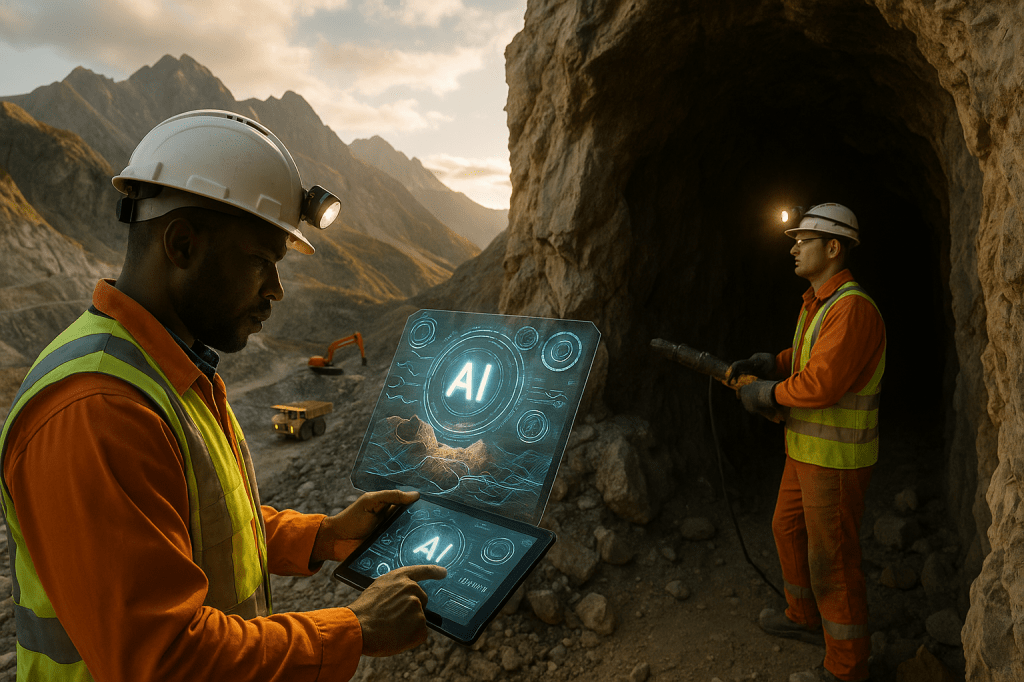
Discovery and extraction of precious metals—gold, silver, platinum, palladium—has relied heavily on manual geological interpretation, slow survey cycles, and trial-and-error drilling since about 1850. Making the “boring” process boring. lol. Today a new queen sits atop the golden throne of precious metals discovery and extraction! And she offers excitement—her name is artificial intelligence (AI)! Ms. AI is re-engineering the precious metals sector from the ground up—pun intended. lol!
Why has she ascended? For the simple, yet complex, reasons that as ore deposits become deeper, grades decline, and environmental expectations increase, AI offers solutions that improve efficiency, reduce costs, and minimize risk. Let’s “dig” into this phenomenon by “extracting” how AI is being deployed across the precious-metals value chain—from exploration and drilling to processing, sustainability, and blockchain-based supply-chain verification.
AI-Driven Exploration: Faster, Cheaper, and More Accurate
Predictive Geological Modeling
Machine-learning models analyze enormous geological datasets—satellite imagery, geochemical surveys, seismic readings, magnetic anomalies, and historical drilling logs. What’s the point of doing that? Answer—to identify high-probability mineralization zones! AI can detect “hidden patterns” in rock structure that human geologists cannot.
Studies in Canada, Australia, and South Africa show that AI-driven exploration can:
Reduce exploratory drilling by 20–40%
Lower costs by millions of dollars per project
Shorten timelines by months or years
Remote Sensing Enhanced by AI
AI-trained spectral models can identify alteration minerals associated with gold, lithological contacts, structural breaks, and soil anomalies. Drones equipped with hyper-spectral sensors now produce site maps with centimeter-level precision, allowing exploration teams to prioritize the highest-value drill targets. Before AI you couldn’t hit what you couldn’t see!
AI in Drilling and Extraction: Precision and Real-Time Optimization
Smart Drilling Systems
AI-enabled rigs adjust torque, rotation speed, and angle in real time based on rock hardness. This reduces equipment wear and improves penetration accuracy. Sensor arrays feed live data into machine-learning models that classify rock types instantly.
Also consider this: on-site AI analyzers evaluate ore quality without waiting for off-site labs. These systems can identify gold or silver grade, platinum-group concentrations, and the presence of impurities. This allows miners to instantly determine what should go to processing—improving profitability.
Autonomous Mining Equipment
These systems reduce accidents, operate around the clock, and enhance fuel efficiency. Major miners now use:
Self-driving haul trucks
Autonomous blast-hole drill rigs
AI-guided loaders
Smart conveyor systems
AI in Processing: Higher Recovery, Lower Costs, Smaller Footprint
Machine-Learning Process Control
AI continuously fine-tunes flotation chemistry, water usage, mill speed, and smelter temperatures. These optimizations typically increase recovery rates by 2–5%, generating millions in added annual revenue for mid-size precious-metal operations.
But that’s not all. AI can also predict energy demand and reduce consumption by 10–20%. Given that extraction consumes large quantities of energy, this is a meaningful efficiency gain. One more point, AI models also excel at identifying structural risks in tailings dams, detect seepage patterns, and monitor environmental indicators such as water quality and dust emissions.
4. Safety and Environmental Protection
Predictive Maintenance
AI forecasts equipment failures before they happen, preventing downtime and reducing catastrophic failures. Computer-vision systems identify workers near unsafe machinery, detect non-compliance with safety gear, and monitor underground instability.
Let’s not overlook the important improvements in environmental monitoring, including water contamination, air quality, noise levels, and habitat protection.
5. Sustainability: AI as the Engine of “Green Mining”
Perhaps at the top of the chart is precision mining. With AI, removing less rock, using fewer chemicals, reducing diesel combustion, and optimizing water recycling are all achievable. This is becoming a core requirement as governments and investors demand cleaner resource extraction.
Now the blockchain part—and as fans of blockchain, I’m sure you already know that AI plus blockchain equals a tamper-proof digital record of:
Mine origin
Ore transport
Refinery steps
ESG compliance
Responsible-sourcing certification
Smart Refining Contracts
Of course, the blockchain benefits don’t end there. They also include automated payments via smart contracts when AI-verified ore quality reaches contractual thresholds. And AI can scan blockchain records for fraudulent patterns. That’s gold-medal-winner level!
7. Limitations and Challenges
Of course, nothing is perfect. That’s why, when using AI in precious-metal exploration and extraction, users should be aware that large amounts of data are required to train the models, integration of sensors and AI equipment is costly, models need constant monitoring, and staff training needs its own budget line item.
Conclusion
The coronation of the new queen of precious metal discovery and extraction is complete. Wearing her artificial intelligence corona, she is reshaping precious-metal exploration and mining into a faster, safer, and more environmentally responsible industry. From her throne, her message is: as AI continues to merge with blockchain, sensor networks, and robotics, the mining sector is entering a historic transformation where data—not geology alone—will define future success.
Until next time,
Yogi Nelson
Sources & Citations
McKinsey & Company – “The Role of Artificial Intelligence in Mining.”
IBM Research – AI for Geoscience and Remote Sensing
Deloitte – Tracking the Trends: The Top 10 Issues Transforming the Mining Industry
Accenture – AI and Digital Twins in Mining
Rio Tinto – Autonomous Mining Operations Reports
World Gold Council – Responsible Gold Mining Principles
Journal of Mining Science – Machine Learning Applications in Ore-Grade Prediction
U.S. Geological Survey (USGS) – Mineral Resources and Remote-Sensing Studies
MIT CSAIL – AI for Environmental Monitoring & Industrial Optimization
While attending UCLA, I worked part-time at upscale women’s shoe store on Rodeo Drive in Beverly Hills! There was no AI–just old fashion, “… this should fit your feet properly and it looks good on you”. Lol. Today, AI is revolutionizing the footwear industry, transforming everything from design and prototyping to personalized customer experiences and sustainable manufacturing. As brands seek to innovate and respond to evolving consumer demands, AI is proving to be a key catalyst in reshaping how shoes are conceptualized, created, and sold. Let’s pay homage to Nancy Sinatra and explore how artificial intelligence is designing, fabricating, and literally learning to walk in its own creations
Smart Design: Creativity Meets Computation
AI is “stepping” into a central role in modern shoe design. Designers now use AI algorithms to predict trends, analyze user feedback, and generate prototypes. By integrating customer preference data, AI helps designers create shoes that align with current market desires. According to an article on ResearchGate titled ‘Integrating Artificial Intelligence into the Shoe Design Process,’ machine learning models are increasingly used to optimize design aesthetics and functional parameters, improving performance while reducing trial-and-error cycles.
Personalized Fit and Comfort
One of the most consumer-centric applications of AI in footwear is customization. AI-powered foot scanning and biometric analysis allow brands, particularly luxury ones, to offer personalized sizing and comfort features. This enhances customer satisfaction and reduces returns. The article ’10 Ways AI is Being Used in the Footwear Industry’ by Digital Defynd highlights how brands employ 3D foot mapping and AI analytics to recommend ideal fits for individual users, combining convenience with precision. Would have been nice to have during my days!
Efficient Manufacturing and Sustainability
The use of AI in manufacturing optimizes supply chain logistics, predicts material requirements, and reduces waste. Automation powered by AI ensures greater quality control and timely production. ShoeMag’s feature, ‘The Impact of AI on the Footwear Industry,’ underscores how predictive algorithms and AI-enabled robotics are helping companies streamline production while adhering to sustainable practices—an increasingly important factor for eco-conscious consumers. You might say, there are no wasted steps. lol.
Enhancing Customer Interaction
AI also improves the retail experience. From virtual try-ons using augmented reality to AI chatbots providing real-time assistance, customer interaction is becoming more immersive and intelligent. Retailers can analyze behavior patterns, preferences, and feedback, allowing for highly targeted marketing and product recommendations. Virtual try-ons? Let’s see.
Future Outlook: Walking into Tomorrow
As AI technology matures, its role in the footwear industry will only grow deeper. We can expect a future where shoes are co-designed by customers and AI, manufactured on-demand, and tailored to each individual’s biomechanics. With innovation accelerating, the line between digital insight and physical craftsmanship is becoming increasingly seamless.
Time to end, but first I must give credit to Nancy Sinatra for inspiring the title of this post with the lyrics of her famous song, “… these boots were made for walking, and that’s just what they’ll do … and one of these days, these boots are going to walk all over you!” Lol!
Until next time,
Yogi Nelson
Sources
– ShoeMag.com.tr. “The Impact of AI on the Footwear Industry.” – DigitalDefynd.com. “10 Ways AI is Being Used in the Footwear Industry.” – ResearchGate.net. “Integrating Artificial Intelligence into the Shoe Design Process.”
This article is inspired by my recent trip through Italy where I saw countless museums and art. I would have love to buy fine art–but that’s too expensive. Hopefully, one day, I will buy fine. When that day arrives, blockchain technology will be involved. I say this with confidence because blockchain technology is transforming the world of fine arts. From enhancing transparency and provenance to enabling fractional ownership and new marketplaces, the potential is vast. The paper *Blockchain Technologies and Art: Opportunities and Open Challenges* by Giannoni, Medda, and Bartolucci offers a comprehensive analysis of these developments.
🧩 Provenance & Authenticity: The Foundation
One of the most compelling applications of blockchain in fine art is the creation of immutable provenance records. Artworks often change hands many times, with incomplete or falsified documentation. Blockchain can record each transfer, certificate, restoration, or exhibition in a tamper‑proof ledger. This helps dealers, auction houses, insurers, and collectors verify authenticity and ownership with confidence. Verified provenance improves valuation and reduces risk of forgery. For example, platforms like Verisart and Artory are using blockchain to register provenance data, trusted by Christie’s and other institutions. As the Russian proverb says: “trust but verify”.
⚖️ Tokenization & Fractional Ownership
Blockchain enables tokenization—the process of issuing digital tokens representing fractional shares of a high‑value artwork. One early example involved Maecenas and Dadiani Fine Art offering fractions of Andy Warhol’s *14 Small Electric Chairs* to investors via cryptocurrency, raising approximately USD 5.6 million for 31.5 % of the piece. Fractional ownership democratizes access to fine art investments. Small investors may gain exposure, while sellers unlock liquidity without relinquishing full ownership. Smart contracts govern rights, royalties, and resales transparently.
🛒 New Marketplaces & NFTs
The rise of NFTs (non‑fungible tokens) expanded blockchain’s role in art. Digital artists can mint unique tokens linking their works to ownership metadata stored on-chain. Buyers gain provable ownership and can resell or collect in digital galleries. Meanwhile, physical artwork marketplaces such as Maecenas offer tokenized shares, while traditional platforms like Christie’s partnered with blockchain registries (e.g., Artory) to record sales and provenance data. Smart contracts automate sale escrow, royalty distribution, and transparency in auctions.
✅ Benefits: Transparency, Trust & Efficiency
Each transaction or transfer becomes visible and verifiable. Market actors gain confidence in the authenticity and history of artworks, reducing fraud and enhancing trust across buyers, sellers, insurers, and appraisers. Tokenization enables fractional participation, widening the pool of investors. Liquid secondary markets can form for art shares, transforming what was once a highly illiquid asset class. Self‑executing contracts manage transfers, royalties, and compliance automatically. Artists can receive resale royalties encoded in tokens, enforcing payments transparently when pieces trade.
⚠️ Challenges & Risks
Giannoni et al. emphasize that adoption in fine art is not without obstacles.
• Legal & Regulatory: Fractional ownership raises legal questions about securities rules and investor protections. • Authentication Reliability: On‑chain provenance is only as reliable as the data entered. • Technical & Scalability: Blockchain networks face scalability challenges. • Market Adoption: Integrating blockchain into traditional systems remains slow.
🌍 Case Studies: Platforms in Focus
• Verisart – focused on provenance and certification, enabling artworks to be registered immutably with blockchain-backed certificates. • Maecenas – a marketplace offering tokenized fractional shares in blue‑chip artworks, bridging collectors and art investors.
🔍 Emerging Trends & Future Directions
• Zero‑Knowledge Proofs & Data Privacy • Sustainable Standards • Green Blockchain & Carbon Footprint • Secondary Royalties & Artist Rights • Institutional Integration
🧭 Conclusion
Blockchain promises meaningful transformation in the world of fine arts—by improving provenance, enabling fractional investments, creating new marketplaces, and enhancing trust through automation. Yet challenges remain: regulatory clarity, standardization, data quality, and broader infrastructure integration. Blockchain-based solutions like provenance registries and tokenized marketplaces are no longer theoretical—they are operating today. For art professionals, collectors, technologists, and policymakers, this evolution signals the beginning of a more transparent, accessible, and resilient art market.
With the high cost of living it seems everyone has a side hustle today–even your internet browser! Let’s explore what that means by checking out X402. X402 is an open, web-native payment protocol that revives the long-reserved HTTP status code 402 Payment Required to make value transfer a first-class part of the internet. When a client (human, service, or AI agent) requests a protected resource, the server can respond with a 402 that includes structured payment instructions (amount, network, token, recipient). In short, X402 lets value move as seamlessly as data.
How X402 Works (Step-by-Step)
Request: A client hits a paid endpoint (API, dataset, file, compute).
Payment Challenge: The resource server returns HTTP 402 with a machine-readable payment object that specifies asset, amount, chain, and payee.
Payment: The client’s wallet or agent creates a signed transfer (often a gas-abstracted, signature-authorized stablecoin payment on an L2) and executes it.
Retry with Proof: The client replays the request including a payment header with the signed payload/receipt.
Verification: The server or a facilitator confirms settlement onchain (or via a trusted service) and returns 200 OK plus the resource.
This flow keeps payments stateless and embedded in the HTTP lifecycle—no accounts, sessions, or subscription scaffolding required. It also enables automatic, per-request monetization for machines and agents.
Design Principles & Architecture
HTTP-native: Uses standard web semantics so any HTTP-speaking client or server can participate.
Blockchain-agnostic: The spec defines how to signal and verify payments, not which chain to use. Early implementations commonly target EVM networks (e.g., Base) for fast, low-cost settlement and support for signature-authorized transfers.
Stateless by default: No login or session is required; the payment proof rides with the request.
Facilitators: Optional services that abstract node connectivity, confirmation logic, and reporting so web developers don’t need deep blockchain plumbing.
AI-first: Built to support autonomous clients (agents) transacting on their own for data, compute, and tools.
Key Use Cases
1) Micropayments for APIs and Content
Replace “all-or-nothing” subscriptions with pay-per-use access. Charge a few cents (or less) to read an article, call an inference endpoint, query a dataset, or render a map tile—no credit cards or account creation.
2) Machine-to-Machine (M2M) & Agentic Commerce
AI and software agents can autonomously pay for services—data APIs, scraping allowances, retrieval bandwidth, or on-demand tools—negotiating payments in real time without human supervision.
3) Developer Monetization with Minimal Friction
A few lines of middleware can return a 402 with instructions; once paid, your existing stack serves the asset. Facilitators and SDKs simplify verification, dashboards, and accounting.
Benefits and Challenges
Benefits
Frictionless onboarding: No forms, cards, or accounts—wallet signatures and stablecoins suffice.
Micropayment economics: Low fees and fast settlement on L2s make sub-cent pricing feasible.
Programmable access: Gate any HTTP resource with a simple, standardized challenge-response pattern.
AI-native: Payments fit naturally into agent request loops.
Interoperability: Chain-agnostic signaling allows multi-asset, multi-network payments as support expands.
Challenges
Two-sided adoption: Clients and servers need compatible tooling; wallet/agent support is still rolling out.
Regulatory considerations: Facilitators and providers must address AML/KYT and jurisdictional rules.
Latency & fees variability: On-chain settlement times and gas must be managed (L2s, batching, deferred/escrowed patterns).
Security & replay safety: Implementations must validate signatures, nonce/expiry, and origin to prevent misuse.
Ecosystem, Governance & Adoption
Momentum accelerated in 2025 as major internet and crypto infrastructure providers aligned on a neutral standard. Coinbase published developer docs, SDKs, and a reference spec; Cloudflare announced product integrations and collaboration on an independent X402 Foundation to steward the protocol and broaden industry participation. Developer platforms have added guides and sample apps (e.g., video paywalls) to speed up trials and proofs-of-concept.
Practically, today’s most mature path to production uses an EVM L2 with stablecoins (e.g., USDC on Base) plus a facilitator or managed service that handles verification, compliance screening, and reporting. As wallets, browsers, and agent frameworks natively recognize 402 challenges, we should see smoother end-to-end UX for both humans and agents.
Why It Matters for AI & Decentralized Science (DeSci)
For AI, X402 operationalizes the “agent pays as it goes” pattern—letting autonomous systems fetch premium data, call tools, and compensate third-party services on demand. For DeSci projects, such as Unbound Science, it enables sustainable, usage-priced access to datasets, lab instrumentation APIs, compute time, and specialized analytics—without forcing subscriptions or accounts. Researchers can permissionlessly publish resources and earn per-use revenues globally, while reproducible pipelines can include built-in micropayments for upstream contributors.
The broader significance is that X402 unifies the web’s information plane and value plane: the same HTTP request that fetches knowledge can atomically settle for it—finally realizing the decades-old promise embedded in the 402 code.
Now its time for me to start my side hustle–yoga! Until next time,




 Blockchain & AI Forum