
by Yogi Nelson
Mining SCOREcard™ Series — E for Execution
A junior mining company can have an exceptional mineral deposit, experienced geologists, an attractive investment thesis, and a compelling corporate presentation. Its projected economics may look extraordinary. Its management team may confidently predict that the company is on the verge of something remarkable. Yet, one question remains: Can the company actually deliver?
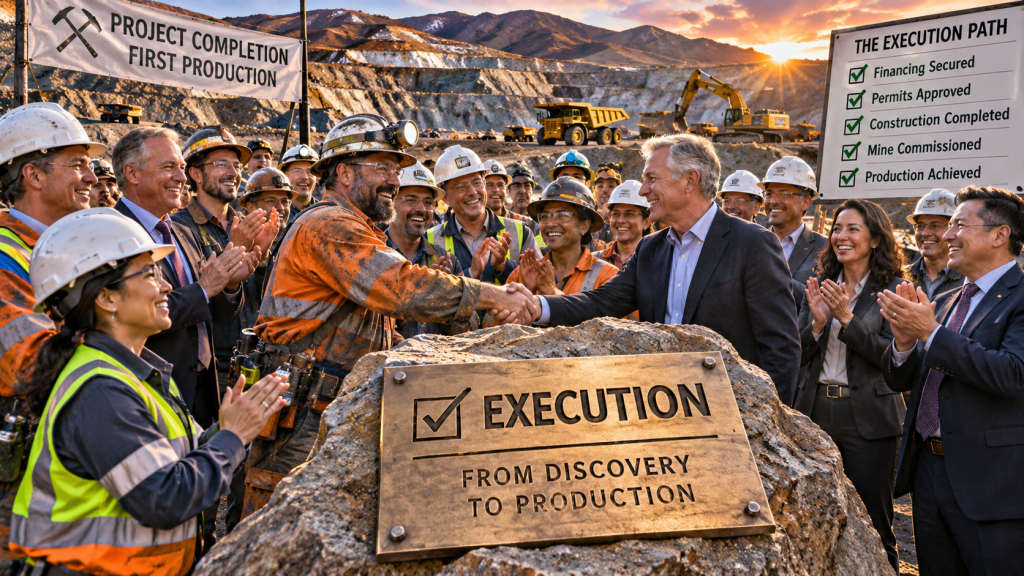
Throughout this series, we’ve examined Strategy & Stewardship, Commodity, Opportunity, and Risk. Each provides an essential perspective on evaluating junior mining companies. Execution is where expectations confront reality. A discovery isn’t a mine. A feasibility study isn’t financing. A construction announcement isn’t production. Production doesn’t automatically translate into profitability.
Between an attractive mineral deposit and a successful mining business lies a complicated journey requiring capital, discipline, technical expertise, and management accountability. That’s what execution is all about.
Show Me the Cash!
Junior mining companies swallow capital long before they generate operating revenue. Exploration programs, engineering studies, environmental assessments, permitting, infrastructure, and corporate administration all eat cash. Without adequate financing, even an outstanding mineral deposit can remain undeveloped indefinitely. That’s why investors should begin with several basic questions:
- How much cash does the company have?
- What is its quarterly cash burn?
- How many months can it operate without additional financing?
- Does it have enough money to reach its next significant milestone?
A company with $20 million in cash may appear financially secure. But if its planned exploration and development expenditures total $30 million over the next year, additional financing will be necessary. Is that a negative? Not automatically. Raising capital is part of the junior mining business. The important distinction is whether financing supports measurable progress, prolongs the company’s existence or worse yet is just a paycheck for management.
Cash is valuable, but what management accomplishes with that cash matters more.
Financing and Dilution: Who Pays for the Dream?
Dilution in one form or another is going to happen. Companies issue new shares to finance exploration, technical studies, acquisitions, and development. Existing shareholders consequently own a smaller percentage of the company. Dilution is not inherently destructive. If new capital creates substantially greater value than the ownership surrendered, shareholders may benefit. It’s repeated financings without meaningful progress where things turn ugly. Consider two hypothetical companies.
Company A raises $15 million, completes a substantial drilling program, expands its mineral resource, and advances its project toward economic assessment.
Company B raises the same amount, spends heavily on corporate overhead and promotional activities, and returns to the market eighteen months later with little technical progress.
Did both companies raise money? Yes, but only one demonstrated meaningful execution. Investors should examine the share count over time, financing terms, warrants, debt obligations, and management’s historical use of capital. The central question is simple: Is management creating more value than it is diluting away?
Milestones: Easy to Say, Hard to Do
Junior mining presentations frequently contain impressive development timelines. A world where everything goes right. Drilling campaigns, resource estimates, preliminary economic assessments, feasibility studies, permits, financing, construction, and production are displayed as a series of milestones. However, a timeline is not an accomplishment.
Investors should compare what management promised twelve or twenty-four months ago with what it actually delivered. Were drilling programs completed as scheduled? Were technical reports published? Were permits obtained? Did the company meet its stated budgets?
Delays aren’t necessarily evidence of incompetence. Mining projects encounter geological surprises, regulatory complications, equipment shortages, and market disruptions. What matters is how management responds.
Effective executives explain problems, revise schedules realistically, disclose additional costs, and establish credible corrective actions. Poor executives repeatedly announce ambitious targets, quietly miss them, and replace yesterday’s promises with tomorrow’s projections.
The most revealing corporate presentation may be the one published two years ago.
Compare it with today’s results.
From Discovery to Development: Different Skills, Different Challenges
Discovering a mineral deposit and building a profitable mine require different capabilities. An excellent exploration geologist may identify a valuable resource without possessing the experience needed to manage construction, procurement, financing, or commercial production. As companies advance, their management requirements change. I can attest to this from personal experience where I was hired to help shut down the Santa Monica Airport, not operate it!
Exploration-stage companies need geological expertise, disciplined drilling programs, sound resource modeling, and careful capital allocation. Development-stage companies on the other hand, increasingly require engineers, project managers, financial specialists, permitting professionals, and executives experienced in mine construction. Producing companies must demonstrate operational reliability, cost control, safety, metallurgical performance, and effective maintenance.
Investors should therefore ask whether management’s experience matches the company’s current stage of development. Has the leadership team previously built a mine? Brought a processing facility into operation? Managed a significant construction budget? Delivered a project on schedule? If management lacks those capabilities, has it recruited professionals who possess them?
A company should not be penalized simply because its founder is an exploration geologist. It should be questioned when that founder assumes geological expertise automatically translates into construction and operating expertise. The skills required to discover a mine are not necessarily the skills required to build one.
Time and Cost: The Silent Enemies of Shareholder Returns
Mining projects are capital-intensive undertakings. Delays and cost overruns can significantly damage their economics. Construction expenses may increase because of inflation, engineering changes, labor shortages, infrastructure requirements, or inadequate initial estimates.
A project initially expected to cost $300 million might ultimately require $450 million. The additional $150 million must come from somewhere. Where? If you said: more debt, additional equity, royalty agreements, or streaming arrangements may be necessary, you would be right. Each can affect the returns ultimately available to shareholders.
Delays carry their own costs. A mine that begins production two years late postpones revenue, extends corporate overhead, and may encounter an entirely different commodity-price environment. Execution discipline therefore requires realistic capital estimates, contingency allowances, reliable contractors, procurement planning, and transparent reporting.
Investors should be skeptical of projects whose economics depend on everything proceeding perfectly. In mining, perfection is a dangerous financial assumption. Just follow the bumper sticker rule- xxxx happens!
The Execution Test: Follow the Evidence
Within the Mining SCOREcard™, the Execution pillar examines twelve interconnected criteria, including cash position, cash runway, debt, financing capacity, project management, construction readiness, development timelines, operational history, share structure, management’s execution record, near-term milestones, and production readiness.
Not every criterion carries equal relevance at every development stage. An early-stage explorer should not receive a poor assessment simply because it isn’t ready to construct a mine. Instead, investors should evaluate whether the company is successfully accomplishing what its particular stage requires.
The evidence should come from financial statements, management discussion and analysis, technical reports, historical corporate presentations, regulatory filings, and documented operating results.
The goal is not to predict the future with certainty. That’s mission impossible. The goal is to distinguish companies that consistently convert capital and promises into measurable accomplishments from those that merely generate expectations.
The rocks may hold the riches. Execution determines whether shareholders are rewarded.
Until next time,
Yogi Nelson


