
Today, gold is once again being repositioned—not as a domestic currency, but as international settlement infrastructure. This time, however, it is being paired with something previous systems lacked: blockchain-based verification and settlement rails.
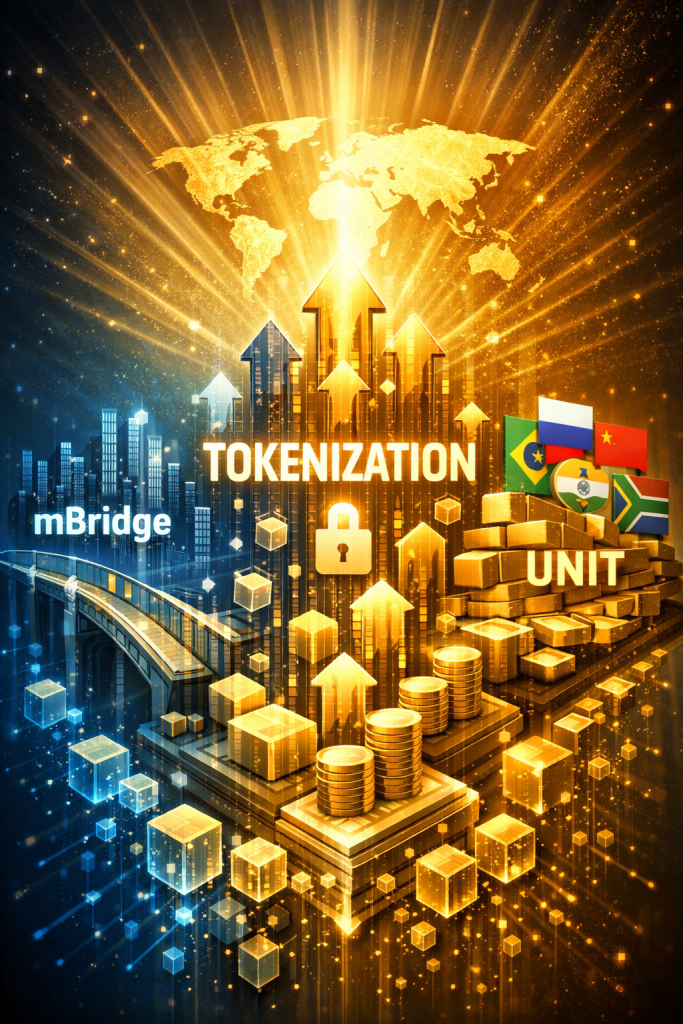
The emerging combination of gold, the proposed UNIT, and the mBridge settlement system, strengthened by tokenization, represents a new and potentially powerful evolution of gold-backed money—one designed for a multipolar, digital world.
This is not a return to the gold standard. It is something more modern, more flexible, and more structural.
Gold’s Role Has Always Been About Trust
Gold earned its monetary role long before central banks existed. Its appeal was never ideological. Gold worked because it was scarce, durable, and politically neutral. It allowed settlement between parties that did not trust one another.
As economies expanded, gold’s form changed. Coins gave way to paper claims redeemable for metal. Later, convertibility faded, but gold remained central as a reserve asset—anchoring confidence rather than enforcing discipline.
Each transition reflected the constraints of the era. What remained constant was gold’s function as trust infrastructure. That function is being revisited today.
Why the Current System Is Being Questioned
The modern global monetary system is built around two pillars:
- The U.S. dollar as the dominant settlement and reserve currency
- SWIFT as the primary global financial messaging network
This system is efficient, liquid, and deeply entrenched. But it also creates structural asymmetries. Nations that do not control the system (90%+ of the world) remain dependent on it for trade settlement, reserves, and cross-border payments.
For the BRICS nations—Brazil, Russia, India, China, and South Africa—those asymmetries have become increasingly visible:
- Trade volumes have grown faster than monetary influence
- Sanctions and payment restrictions have highlighted vulnerability
- Correspondent banking adds cost, delay, and political exposure
The response has not been to abandon fiat currencies or dismantle existing systems. Instead, BRICS policymakers have explored parallel architectures—systems that coexist with the current order but reduce dependency on it. Gold naturally reenters the picture here.
The UNIT: Gold-Referenced Settlement Money
The proposed UNIT is not a retail currency and not a replacement for national money. It is best understood as a trade settlement and accounting unit, designed primarily for use within BRICS trade corridors.
Publicly discussed models describe the UNIT as being backed by a hybrid structure:
- 40% gold
- 60% fiat currency, divided evenly among the five founding members
This design is intentional. Gold provides neutrality and credibility. Fiat components preserve flexibility and continuity with existing monetary systems.
The UNIT does not seek to dethrone the dollar globally, at least not yet. Instead, it challenges the dollar’s default role in BRICS trade settlement, offering an alternative reference unit that reduces reliance on any single sovereign currency. But money alone does not create a system. Settlement requires infrastructure. This is where mBridge enters the story.
mBridge: The Settlement Rail
mBridge is not money. It is infrastructure—a blockchain-based, multi-CBDC settlement platform designed to enable direct value transfer between central banks and large institutions.
Unlike SWIFT, which transmits payment instructions, mBridge is designed to settle value itself. It reduces the need for correspondent banks, shortens settlement times, and increases transparency.
The distinction is critical:
- SWIFT answers the question: Who should pay whom?
- mBridge answers the question: Has payment occurred?
mBridge does not replace SWIFT outright. But it introduces a parallel settlement pathway, particularly attractive to countries seeking to reduce exposure to existing financial chokepoints.
On its own, mBridge is a powerful tool. Combined with a gold-referenced unit like the UNIT, it becomes something more and when tokenization is dropped into the mix, a challenger appears on the horizon.
Tokenization: The Force Multiplier
Gold-backed systems historically failed for predictable reasons: opacity, centralized control, and political override. Trust depended on promises rather than proof. Tokenization changes that equation.
Tokenization allows physical gold held in sovereign vaults to be:
- Digitally represented
- Cryptographically verified
- Independently audited
- Programmatically referenced in settlement
In a UNIT–mBridge framework, tokenization could serve as the verification layer that binds money and infrastructure together. Rather than relying on declarations that gold exists, tokenization allows systems to prove it.
How the System Could Work in Tandem
In combination, the components align naturally:
- Gold provides neutral, non-sovereign credibility
- The UNIT provides a shared settlement and accounting unit
- mBridge provides the blockchain-based settlement rail
- Tokenization provides verification, transparency, and enforcement
Under such a framework:
- Gold remains physically stored within national vaults
- Each nation retains sovereign custody over its reserves
- Tokenized representations confirm the existence and allocation of gold
- mBridge settles obligations using verified balances
- The UNIT functions as the accounting and pricing reference
This structure does not eliminate fiat currencies. It operates above them, coordinating settlement without replacing domestic monetary systems.
Challenge or Revolution?
It is important to be precise. This system does not overthrow the dollar or dismantle SWIFT overnight. Instead, it introduces functional competition:
- Competition to SWIFT in settlement infrastructure
- Competition to the dollar in specific trade corridors
- Competition based on architecture, not ideology
Tokenization is what makes this competition real. Without it, the UNIT is an accounting idea and mBridge is an experiment. With it, they become a coherent, auditable system. This is how monetary systems change—not through abrupt replacement, but through parallel adoption.
Why Gold Fits This Moment
Gold is uniquely suited to this role:
- Central banks already hold it
- Custody practices are established
- It is not consumed or degraded
- It functions naturally as collateral
Unlike other commodities, gold does not need to circulate to be useful. Its credibility increases when it remains immobile and verified. Tokenization allows gold to be digitally active without being physically mobile.
Historical Continuity, Not Regression
Seen in historical context, this evolution is logical:
- Gold as physical money
- Gold as paper backing
- Gold as reserve asset
- Gold as digitally verified settlement anchor
Each stage reflects technological capability and political reality. Tokenization does not restore the gold standard. It modernizes gold’s role as trust infrastructure.
The UNIT and mBridge are not anomalies. They are contemporary expressions of an ancient instinct: when trust is uneven, systems seek neutral anchors.
Conclusion: Tokenization as the Enabler
Gold-backed money has always depended on credibility. What has changed is how credibility can be demonstrated. By combining gold, the UNIT, mBridge, and tokenization, BRICS nations are exploring a system where backing is verifiable, settlement is direct, and trust is structural rather than discretionary.
This does not replace existing systems. It pressures them. It offers alternatives. And once alternatives exist, they tend to persist.
Tokenization is not the headline. It is the enabler—the quiet force that allows gold-backed settlement to function in a digital, multipolar world.
That is why this moment matters.
Until next time,
Yogi Nelson

 Blockchain & AI Forum