Artificial Intelligence, blockchain association

IS THE BIS (BANK FOR INTERNATIONAL SETTLEMENTS) AN HONEST SOURCE REGARDING DECENTRALIZED FINANCE?

Artificial Intelligence

WHAT IS THE STATE OF ARTIFICIAL INTELLIGENCE

Namaste Yogis.   Welcome to the Blockchain & AI Forum, where your blockchain and artificial intelligence technology questions are answered!   Here no question is too mundane.  As a bonus, a proverb is also included.  Today’s question, was submitted by Jayesh and he wants to know what is the state of artificial intelligence?

Jayesh, you came to the right place; I have your answer.  Last week Stanford University Institute for Human Centered Artificial Intelligence (HAI) released a 500-page report titled, AI Index: The State of AI in 13 charts. The report contains fascinating findings.  Let’s cover the highlights beginning with foundation models by access types in 2023.

A foundation model serves as the fundamental architecture upon which more specialized models are built.  For instance, ChatGPT is a well-known foundation model.  In 2023, there were 149 foundation models released. Fortunately, 66% were open source, meaning they can be freely used and modified by anyone.  In 2021 and 2022, only 31% and 44% were open sourced.  That’s the good news.  The “bad news” –closed source models outperformed open-source models across 10 benchmarks.  Holy lagging behind, Batman!  What about quantity you ask?

When it comes to quantity of AI foundation models in 2023, Google is the leader.  Google released 18, second place Meta knocked out 11, winning the bronze medal was Microsoft with 9.  OpenAI earned honorable mention with 7 models.  One point to consider is the close relationship between Microsoft and Open AI; Microsoft owns 49% of Open AI.  Hence, perhaps a more precise analysis would be to blend the production of Microsoft and Open AI. 

We move onto foundation model by economic sectors and the result is no thunderbolt. If you guessed industry (private for-profit corporations) dominates foundation models, Bingo, move to the head of the class.  With 108 foundation models released in 2023, industry is the epicenter of activity.  Academia lags far behind at only 28, and government is microscopic with only 4 models. 

Building foundation models is expensive.  HAI reports Google spent about $191B, yes, $191B with a “B” to build the Gemini foundation model.  OpenAI, and its ChatGPT came in second with an estimated $78B price tag.  Given these are industry models, investors will expect a return on investments.  Will free models to fade into oblivion in the future?  Let’s see. Speaking of money, private investment in AI is down from the 2021 peak.  Perhaps this explains why ChaptGPT was a sensation in 2022 and 2023 (reaping the results of previous investments?).  Maybe.  HAI reports $96B was spent in 2023, of which 25% went to generative AI.  And of course, private investment dominated in the US. 

What countries are leading the AI race?  Answer:  US and China.  According to HAI, the US released 61 notable foundation models, whereas China had only 15 and the UK 8. 

Let’s wrap up with three more findings, starting with the top five AI corporate adoption use cases.  HAI reports the high flying five are:  contact center automation (26%); personalization (23%); customer acquisition (22%); AI based enhancements of products (22%) and creation of new AI-based products (19%).  When it comes to global opinion, 57% believe AI will change their job in the next five years, 35% say AI is unlikely to impact their job, and 8% are clueless.  Ha, ha! Nervous about AI?  Join the 69% of British nervous Nellies; or perhaps instead chill with South Koreans, where only 44% are nervous.

Time to say goodbye, but first a proverb from Cameroon: Rain does not fall on one roof alone.

Until next time,

Yogi Nelson

Artificial Intelligence, Blockchains, France, Yogi Nelson

A GLIMPSE AT MISTRAL—THE FRENCH LEADER IN THE AI REVOLUTION

Namaste Yogis.   Welcome to the Blockchain & AI Forum, where your blockchain and artificial intelligence technology questions are answered!   Here no question is too mundane.  As a bonus, a proverb is also included.  Today’s question, was submitted by Luis from Malibu and he wants to know is Mistral leading the French AI revolution?

Luis, you came to the right place. Your question has perfect timing. I just returned from France and am feeling the French vibe! Rather than covering the entire waterfront of AI developments in France, I’ll limit myself to a French company named Mistral.  Let’s start with a bit of background on Mistral, including its name which is French to the core–c’est la vie!

The word mistral has multiple uses in French.  Not only does Mistral mean a cold northwesterly wind, but it’s also not uncommon for companies in industries related to wind energy, sailing, or the environment to use it in their name. The French say it evokes a sense of power, speed, and a connection to the natural world. It can also mean masterly.  While traveling in France, I noticed Mistral as a last name as we say in the USA or as they say in France, the family name.  Holy multi-tasking word, Batman!  Now a word about the Mistral team and company mission.

With fewer than two dozen members, the Mistral team is small.  According to Mistral, their mission is to make frontier AI ubiquitous, and to provide tailor-made AI to all developers.  Mistral says, their mission requires fierce independence, strong commitment to open, portable, and custom solutions, and an extreme focus on shipping the most advanced technology in limited time.  How I discovered Mistral comes next, followed by what Mistral does, and what it offers.

Approximately three months ago I discovered Mistral while researching AI projects for this blog.  I attempted access but was denied.  Instead, Mistral put me on a waiting list of interested users and recently granted me access with a full disclosure that their large language model (LLM) is in beta testing status. 

Today, I put Mistral’s LLM, Le Chat, to the test against, two American companies—Open AI’s ChatGPT and Microsoft’s Co-Pilot– by asking all three identical questions.  All three-offer free access to their LLM services.  I won’t detail the contest; it’s not necessary.  Essentially, Mistral is lacking behind the competition.  Why Mistral trails, is a matter of speculation.  Perhaps its funding related?  Or maybe Mistral team size means it’s too small to compete with the titans? Could be they started later?  I don’t know, but I do know the competition is ahead.  Okay, now we go beyond their LLM to a preview of Mistrals AI products. 

On their website, Mistral has a click option labeled La Plataforme (the Platform).  This is where you’ll find the heart of their offerings and services.  Basically, La Plataforme is a subscription service.  For a fee, Mistral offers access to their AI developer tools. Mistral claims the tools permits users to develop AI agents and other related products.  The subscription grants access to the latest Mistral models and to pay based on what you use.  That’s a good feature.  Moreover, users can set monthly spending limits and if there are multiple users with an enterprise, Mistral will centralize billing.  The subscription grants access to the corresponding documentation and of course users can create API keys to access Mistral AI.

Time to say “au revoir” (goodbye) but not before sharing this French proverb:  Only imbeciles don’t change their opinions.”   Well said, my French friends!

Sincerely,

Yogi Nelson

Artificial Intelligence, Blockchains, China, international aid

IS CHINA USING ITS INTERNATIONAL AID TO PROMOTE ITS ARTIFICIAL INTELLIGENCE TECH AND GAIN MARKET DOMINANCE IN DEVELOPING COUNTRIES?

Namaste Yogis.   Welcome to the Blockchain & AI Forum, where your technology questions are answered!   Here no question is too mundane.  As a bonus, a proverb is also included.  Today’s question, was submitted by Marcia in Palmdale, CA and she wants to know is China using its international aid to advance use of its artificial intelligence technology and gain market dominance in developing countries?

Marcia, you came to the right place.  You ask a tough question, fortunately there is an organization headquartered in Santa Monica, CA that researches the subject and their name is RAND.  RAND stands for Research and Development Corporation. Let’s understand RAND then answer your specific question.  

RAND is a non-profit public policy research organization.  RAND was established in 1948 with the intent of providing non-partisan policy research and analysis.  Almost 100% of RAND’s 1,800 research staff members have either a Ph.D. or master’s degree.   With seven offices spread across the globe in the USA, UK, and Australia, RAND has a worldwide audience.  Last year RAND launched 800+ new research projects funded by more than 350 clients.  RAND conducts policy research across 10 subjects, including national security.  Bottom line–RAND is an impressive research organization consisting of brainy people.  Holy nerds, Batman!  Now let’s turn to the question asked by Marcia.

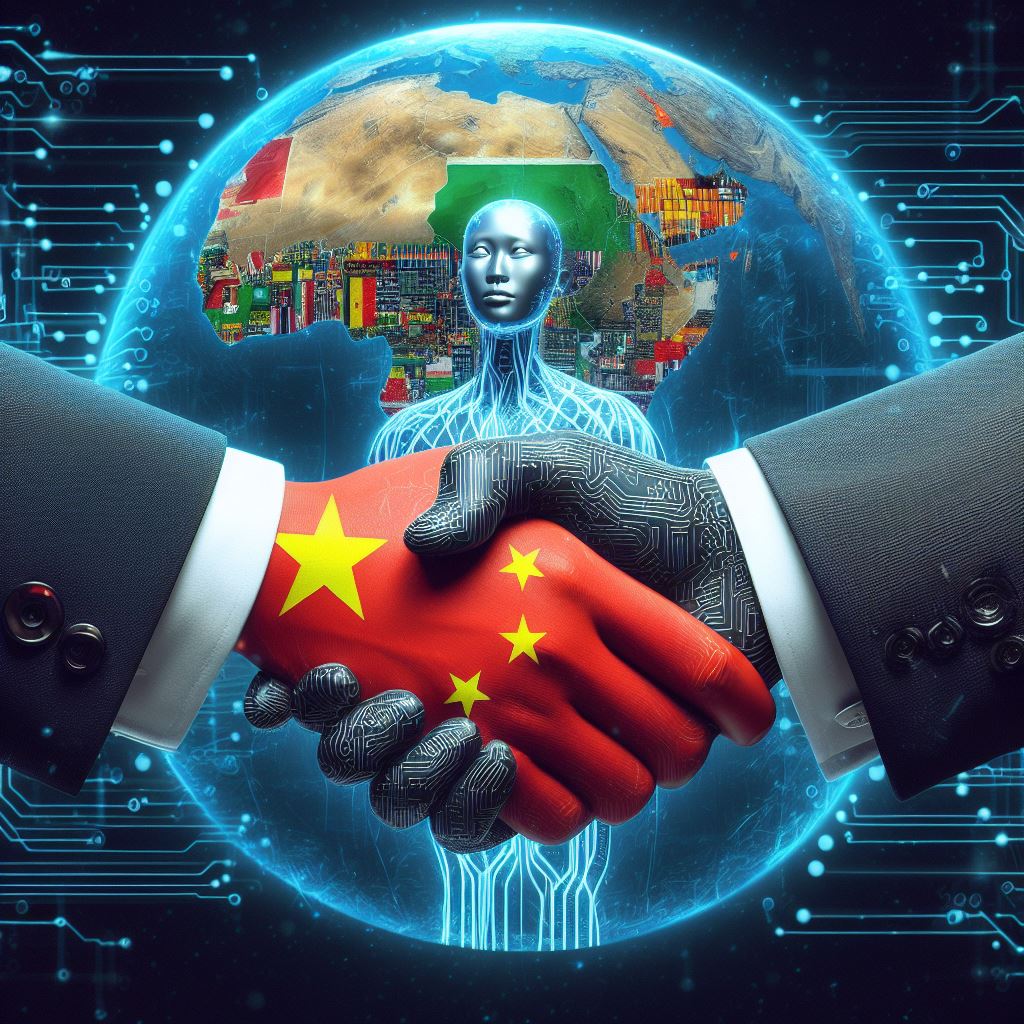
According to RAND, at $85B per year, China is the world leader in development finance.  USA development finance falls a far second at only $45B per year.  RAND says, Chinese tech companies can use this large government funding support to deploy state-of-the-art artificial intelligence (AI) tools in development contracts in recipient countries. And therefore, the AI exports facilitated by these arrangements are likely to bolster China’s growing global AI technology-related supply chains, trade flows, technology standards, and regulatory systems.  In other words, when China provides development finance (aid) to Pakistan, for example, the contract with Pakistan, will include conditions that require Pakistan to use Chinese AI technology.  Holy foot in the door, Batman! 

Given the situation, RAND’s national security team was contracted (they don’t say by whom, but you can safety assume a branch of the U.S. government) to explore two questions:

1.  How can China’s AI exports be systematically tracked and analyzed using reliable data sources?

2.  What would promote a better understanding of the global landscape of China’s AI exports?

China does not participate in the International Aid Transparency Initiative.  Hence, researchers tracked Chinese development finance by receiving countries. Researchers used OCED (Organization for Economic Cooperation and Development) data in their research. The dataset captured all official financial and in-kind commitments from China from 2000–2021 to developing countries.

First, let’s look at the published findings of the 33-page report.   https://www.rand.org/pubs/research_reports/RRA2696-1.html  followed by a few words regarding unpublished findings, as perhaps those too are interesting. 

Reported Findings:

  • Researchers discovered 155 AI applications and AI infrastructure projects that were exported to 64 countries
  • The researchers used GIS to map their findings.  Although Pakistan was the largest beneficiary, the map clearly shows most Chinese aid was dedicated to African nations.   

Unreported Findings:

The report has six blank pages and no explanation for the blank pages is offered. The blank pages are not labeled, “Intentionally Left Blank”.  The pages are simply blank with no explanation whatsoever.  And no mention of what who paid for the report!  Holy mystery, Batman!

I end with a proverb from Pakistan:  The friend appears in hard times, not at big dinners.

Until next time,

Yogi Nelson

Artificial Intelligence, blockchain association, Blockchains, China

WHAT ARE BLOCKCHAIN ASSOCIATIONS?

Namaste Yogis.   Welcome to the Blockchain & AI Forum, where your technology questions are answered.   Here no question is too mundane.  As a bonus, a proverb is also included.  Today’s question was submitted by Kandy, and she wants to know what are blockchain associations?

Kandy, you came to the right place.  Although the definition may vary depending on the country, an association is generally defined as an organization comprised of businesses or individuals in a specific industry or trade collaborating to address common issues, set standards, and advocate for their shared interests and goals.  Members pay dues, and the association’s professional staff work on their behalf.  On to the blockchain association located in Washington, D.C.

Washington D.C. is not only the USA capital, it’s also the headquarters of associations.  Government capitals and associations are congenital twins.  Where one goes, so does the other.  As of 2022, over 3,400 associations were registered in Washington, including an association of associations.  Lol!  That is not a joke! 

The Blockchain Association in Washington has 100+ members.  Membership is restricted.  Individuals cannot join, only organizations.  Their mission is “… to advance the future of crypto in the United States, promoting potential of blockchain technology and shaping policy that ensures its success. We work with our members to educate policymakers about blockchain technology and its ability to pave the way for a more secure, competitive, and consumer-friendly digital marketplace.”  Holy shared interest, Batman! Let’s discuss blockchain associations around the world. 

As noted above blockchain associations basically function in a universal manner—they all advocate, educate, promote, hold events, etc.  Hence, I will only highlight one or two unique facts for a select few blockchain associations.

Canada—Blockchain Association of Canada.  Two fun facts about BAC.  First, BAC sponsors innovation challenges.  Second, BAC is headquartered in Vancouver not Ottawa (Canada’s capital).

Cayman Islands.  The Cayman Islands is an international banking center.  Therefore, we should not be shocked to discover the country is embracing blockchain technology.

China.  Several years ago, China declared blockchain a national priority technology and not surprisingly there are numerous national and international blockchain associations, including the UK-China Blockchain Association, the Hong Kong Blockchain Society, French-Chinese Blockchain Association.

Germany—Blockchain Bundersverband.  The German blockchain association has a working group focused on decentralized autonomous organizations. 

Mexico—Blockchain Association of Mexico.  We Latinos are known for coming late.  Lol. The Mexican Blockchain Association arrived early!  Lol!

Singapore–Blockchain Association Singapore (BAS).  The BAS has six working groups including one dedicated to stable coins and central bank digital currency.  If you know Singapore, you are not surprised.

Swiss Blockchain Federation.  Located in Bern (the capital) the SBF works across a range of topics, including bringing blockchain technology to the public sector.

United Arab Emirates—Government Blockchain Association of UAE. 

United Arab Emirates–Middle East, Africa & Asia Crypto & Blockchain Association (MEAACBA).  This is an international blockchain association.  Members hail from the Middle East, Africa, and Asia and the headquartered is in Dubai, UAE.  

United Kingdom–International Blockchain Association (IBA).  The IBA has offices in London, New York, and Dubai. 

Kandy, the research reveals an emerging picture.  First, blockchain adoption is growing fast.  Second adoption is increasingly international.  Third, beyond the USA, Dubai, China, and Singapore are blockchain hot spots. Fourth, crypto does not equal blockchain.  Blockchain is a technology with countless use cases that extends far beyond just crypto.  Five, policy makers are being educated around the world and that portends a brighter future.

I end with a proverb from Tunisia:  Like salt, he doesn’t miss any meal.

Until next time,

Yogi Nelson