Artificial Intelligence, Blockchains, France, Productivity

WHAT WILL BE THE IMPACT OF ARTIFICIAL INTELLIGENCE ON

PRODUCTIVITY AND EMPLOYMENT?

Namaste Yogis.   Welcome to the Blockchain & AI Forum, where your blockchain and artificial intelligence technology questions are answered.   Here no question is mundane.  As a bonus, a proverb is also included.  Today’s question, was submitted by Milagros and she wants to know what will be the impact of artificial intelligence on productivity and employment?

Milagros, you came to the right place.  Two days ago, I viewed an interview with Philippe Aghion.  Aghion is a leading French economist who recently published an important research paper on the subject that he presented to French President Emanuel Macron.  Holy influencer, Batman!  Although there are numerous AI experts, this article covers only the perspective of Aghion. 

Aghion limited his research to the impact of AI on productivity and employment.  According to Aghion, the full impact productivity and employment of AI will go beyond electricity and the internet!  Holy big assertion, Batman.  Let’s understand Aghion’s logic.

His first reason is perhaps obvious; AI facilitates automation, and automation means increased productivity.  Easy to agree; let’s move to his second reason.  Aghion says, AI facilitates learning, and again, intuitively he makes sense.  Just like electricity and the internet facilitated learning, in too many ways to itemize here, AI users can learn new skills and information, making them more productive and thus increasing overall productivity.  Aghion’s third point is where he inaugurates new thinking. 

Aghion says, AI is vastly superior to either electricity or the internet in its ability to produce new ideas and these forthcoming innovations will deliver greater productivity and employment. And, unlike electricity and the internet which both eventually plateaued in productively gains, Aghion says the boost in productivity coming from new ideas will continue for an undetermined duration because there is no limit to human ideas.  Last, Aghion says electricity and the internet both took about 10 years before impacting productivity meaningfully; AI is on the same trajectory.  Time to examine what Aghion says concerning employment—it’s not all rosy.

Let’s start with the good news.  Aghion claims that automation creates more net employment. He says automation adopters become more efficient and pass along the benefits to customers in lower prices and better quality.  He further claims, that although competitors may lose jobs, the overall market size grows because new customers enter and employment in the sector grows.  Analogous to what Henry Ford did in the automobile industry. 

As expected, Aghion believes certain industries might be in jeopardy and offered three examples: IT security firms, production process companies, and machine learning firms (e.g., call centers).  With regards to employment impacts, he divided his analysis into significant, moderate, and little to no effect.  Aghion identified clerks, secretaries, and accountants as the three most likely adversely impacted occupations.  Aghion says architects, lawyers, and perhaps health care fall in the moderate group.

Aghion concluded with a few recommendations starting with government policy to prevent oligopolies from dominating AI.  He notes large firms are not necessarily innovators, but small firms are.  Second, open-sourced AI is essential to transparency and long-term viability.  Third, protection of personal data must be a priority.  Last, is job training and re-education for displaced workers.  Aghion forecasts 20% of all jobs will be eliminated or nearly eliminated by AI over the next decade. Therefore, generous re-education, training, and unemployment benefits will be required.

Time to quit before AI grabs my money losing blog, (ha ha) and share a French proverb:

“You should turn your tongue around in your mouth seven times before you speak.”

Until next time,

Yogi Nelson

Artificial Intelligence, Blockchains, France, Yogi Nelson

A GLIMPSE AT MISTRAL—THE FRENCH LEADER IN THE AI REVOLUTION

Namaste Yogis.   Welcome to the Blockchain & AI Forum, where your blockchain and artificial intelligence technology questions are answered!   Here no question is too mundane.  As a bonus, a proverb is also included.  Today’s question, was submitted by Luis from Malibu and he wants to know is Mistral leading the French AI revolution?

Luis, you came to the right place. Your question has perfect timing. I just returned from France and am feeling the French vibe! Rather than covering the entire waterfront of AI developments in France, I’ll limit myself to a French company named Mistral.  Let’s start with a bit of background on Mistral, including its name which is French to the core–c’est la vie!

The word mistral has multiple uses in French.  Not only does Mistral mean a cold northwesterly wind, but it’s also not uncommon for companies in industries related to wind energy, sailing, or the environment to use it in their name. The French say it evokes a sense of power, speed, and a connection to the natural world. It can also mean masterly.  While traveling in France, I noticed Mistral as a last name as we say in the USA or as they say in France, the family name.  Holy multi-tasking word, Batman!  Now a word about the Mistral team and company mission.

With fewer than two dozen members, the Mistral team is small.  According to Mistral, their mission is to make frontier AI ubiquitous, and to provide tailor-made AI to all developers.  Mistral says, their mission requires fierce independence, strong commitment to open, portable, and custom solutions, and an extreme focus on shipping the most advanced technology in limited time.  How I discovered Mistral comes next, followed by what Mistral does, and what it offers.

Approximately three months ago I discovered Mistral while researching AI projects for this blog.  I attempted access but was denied.  Instead, Mistral put me on a waiting list of interested users and recently granted me access with a full disclosure that their large language model (LLM) is in beta testing status. 

Today, I put Mistral’s LLM, Le Chat, to the test against, two American companies—Open AI’s ChatGPT and Microsoft’s Co-Pilot– by asking all three identical questions.  All three-offer free access to their LLM services.  I won’t detail the contest; it’s not necessary.  Essentially, Mistral is lacking behind the competition.  Why Mistral trails, is a matter of speculation.  Perhaps its funding related?  Or maybe Mistral team size means it’s too small to compete with the titans? Could be they started later?  I don’t know, but I do know the competition is ahead.  Okay, now we go beyond their LLM to a preview of Mistrals AI products. 

On their website, Mistral has a click option labeled La Plataforme (the Platform).  This is where you’ll find the heart of their offerings and services.  Basically, La Plataforme is a subscription service.  For a fee, Mistral offers access to their AI developer tools. Mistral claims the tools permits users to develop AI agents and other related products.  The subscription grants access to the latest Mistral models and to pay based on what you use.  That’s a good feature.  Moreover, users can set monthly spending limits and if there are multiple users with an enterprise, Mistral will centralize billing.  The subscription grants access to the corresponding documentation and of course users can create API keys to access Mistral AI.

Time to say “au revoir” (goodbye) but not before sharing this French proverb:  Only imbeciles don’t change their opinions.”   Well said, my French friends!

Sincerely,

Yogi Nelson

Artificial Intelligence, Blockchains, China, international aid

IS CHINA USING ITS INTERNATIONAL AID TO PROMOTE ITS ARTIFICIAL INTELLIGENCE TECH AND GAIN MARKET DOMINANCE IN DEVELOPING COUNTRIES?

Namaste Yogis.   Welcome to the Blockchain & AI Forum, where your technology questions are answered!   Here no question is too mundane.  As a bonus, a proverb is also included.  Today’s question, was submitted by Marcia in Palmdale, CA and she wants to know is China using its international aid to advance use of its artificial intelligence technology and gain market dominance in developing countries?

Marcia, you came to the right place.  You ask a tough question, fortunately there is an organization headquartered in Santa Monica, CA that researches the subject and their name is RAND.  RAND stands for Research and Development Corporation. Let’s understand RAND then answer your specific question.  

RAND is a non-profit public policy research organization.  RAND was established in 1948 with the intent of providing non-partisan policy research and analysis.  Almost 100% of RAND’s 1,800 research staff members have either a Ph.D. or master’s degree.   With seven offices spread across the globe in the USA, UK, and Australia, RAND has a worldwide audience.  Last year RAND launched 800+ new research projects funded by more than 350 clients.  RAND conducts policy research across 10 subjects, including national security.  Bottom line–RAND is an impressive research organization consisting of brainy people.  Holy nerds, Batman!  Now let’s turn to the question asked by Marcia.

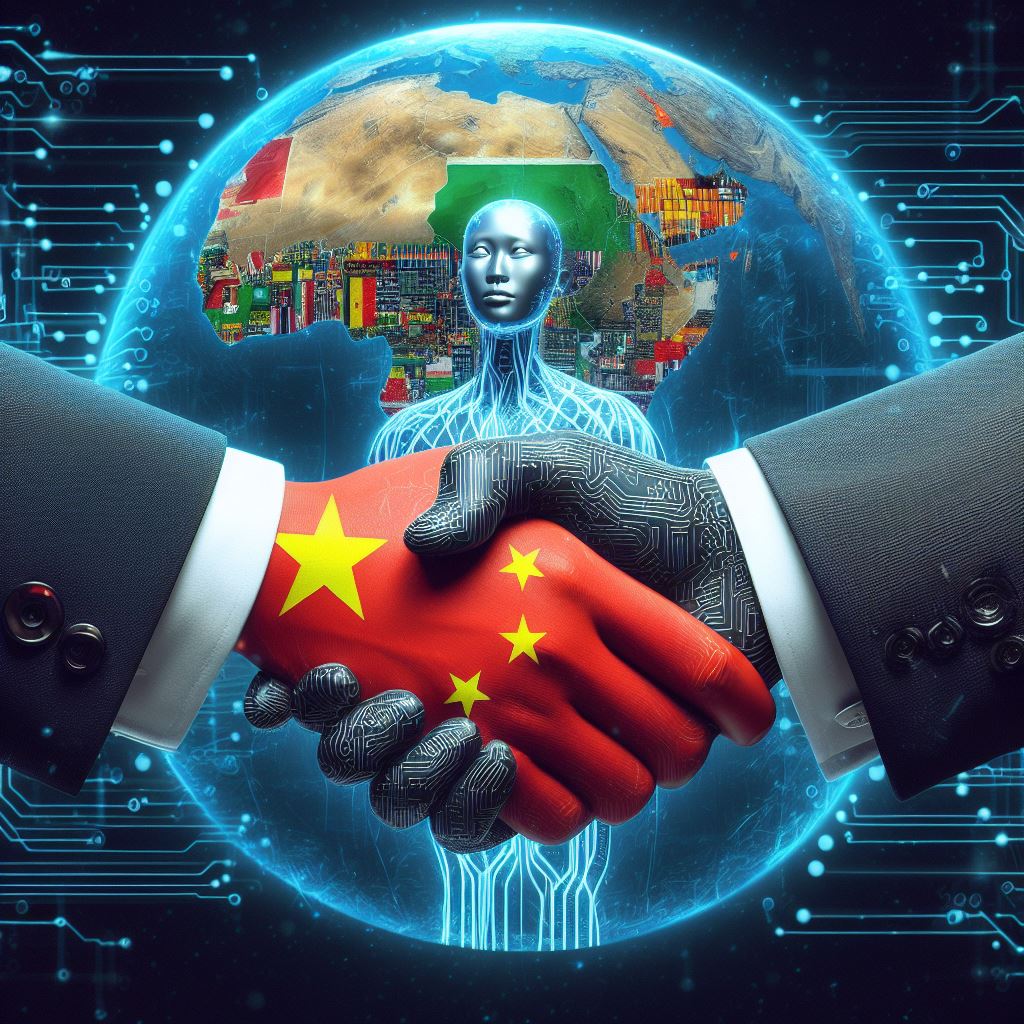
According to RAND, at $85B per year, China is the world leader in development finance.  USA development finance falls a far second at only $45B per year.  RAND says, Chinese tech companies can use this large government funding support to deploy state-of-the-art artificial intelligence (AI) tools in development contracts in recipient countries. And therefore, the AI exports facilitated by these arrangements are likely to bolster China’s growing global AI technology-related supply chains, trade flows, technology standards, and regulatory systems.  In other words, when China provides development finance (aid) to Pakistan, for example, the contract with Pakistan, will include conditions that require Pakistan to use Chinese AI technology.  Holy foot in the door, Batman! 

Given the situation, RAND’s national security team was contracted (they don’t say by whom, but you can safety assume a branch of the U.S. government) to explore two questions:

1.  How can China’s AI exports be systematically tracked and analyzed using reliable data sources?

2.  What would promote a better understanding of the global landscape of China’s AI exports?

China does not participate in the International Aid Transparency Initiative.  Hence, researchers tracked Chinese development finance by receiving countries. Researchers used OCED (Organization for Economic Cooperation and Development) data in their research. The dataset captured all official financial and in-kind commitments from China from 2000–2021 to developing countries.

First, let’s look at the published findings of the 33-page report.   https://www.rand.org/pubs/research_reports/RRA2696-1.html  followed by a few words regarding unpublished findings, as perhaps those too are interesting. 

Reported Findings:

  • Researchers discovered 155 AI applications and AI infrastructure projects that were exported to 64 countries
  • The researchers used GIS to map their findings.  Although Pakistan was the largest beneficiary, the map clearly shows most Chinese aid was dedicated to African nations.   

Unreported Findings:

The report has six blank pages and no explanation for the blank pages is offered. The blank pages are not labeled, “Intentionally Left Blank”.  The pages are simply blank with no explanation whatsoever.  And no mention of what who paid for the report!  Holy mystery, Batman!

I end with a proverb from Pakistan:  The friend appears in hard times, not at big dinners.

Until next time,

Yogi Nelson

Artificial Intelligence, Blockchains, Patents

How are DARPA, Explainable Artificial Intelligence and Nvidia Connected? 

Namaste Yogis.   Welcome to the Blockchain & AI Forum, where your technology questions are answered!   Here no question is too mundane.  As a bonus, a proverb is also included.  Today’s question, comes from Susan in Irvine and she ask how are DARPA, Explainable Artificial Intelligence (XAI) and Nvidia all connected?

Susan, you came to the right place.  As a wealth manager I know you have a fiduciary duty to maintain current on investable technology on behalf of your clients.  Around 1990 a new technology was on the horizon–the internet–and it created trillions in new wealth!  Artificial intelligence (AI) is on a similar trajectory.  However, AI is not well understood–yet.  Let’s take a moment to acquaint ourselves with AI from the perspective of DARPA. In hindsight, DARPAs XAI program could have been used to foresee a tremendous investment opportunity—Nvidia the advanced computer chip maker essential to the AI business.

DARPA is an acronym that stands for Defense Advanced Research Projects Agency.  DARPA is part of the Department of Defense (DoD) and its mission is development of emerging technologies for military use.  DARPA created the internet in the late 1960s to facilitate control and command of military communications.  Under DARPA leadership, the US military maintains technological superiority over all other nations. 

In 2015 DARPA released an article titled, Explainable Artificial Intelligence (XAI).  https://www.researchgate.net/publication/356781652_DARPA_’s_explainable_AI_XAI_program_A_retrospective     Remember the XAI project was undertaken in 2015–years before the public had access to ChatGPT and other similar products.   Let’s examine the research findings.

According to DARPA in 2015, “…dramatic success in machine learning will lead to numerous AI applications.  It appears AI will eventually produce autonomous systems that will perceive, learn, decide, and act on their own”, DARPA predicted.  However, DARPA was concerned the effectiveness of AI systems would be stymied unless and until machines can creditably explain their decisions and actions to human users. Holy transparency, Batman! Therefore, the XAI program was intended to create a suite of machine learning techniques that would:

  • Produce more explainable models, while maintaining a high level of learning performance (prediction accuracy); and
  • Enable human users to understand, appropriately trust, and effectively manage the emerging generation of artificially intelligent partners.

XAI program was focused on the development of multiple systems by addressing challenges in two areas: 

  • machine learning problems to classify events based on multimedia data  
  • machine learning problems to construct decision policies for an autonomous system to perform a variety of simulated missions

DARPA selected these two areas because both represented major operational challenges.  The first relates to classification and reinforcement learning and the second is centered on intelligence analysis and autonomous systems.  In other words, DARPA was working on building AI machines that understand the context and environment in which they operate, and over time allow them to characterize real world phenomena precisely and in real time.  Basically, DAPRA was developing AI-Gen 2 before the public had access to AI-Gen 1! Holy Explainable AI, Batman! 

DARPA released XAI seven public findings of the XAI program and kept an unknown number of classified secret findings! LOL. Holy keep it on the down-low, Batman! LOL!

  1. Users prefer systems that include explanations rather than just answers (no surprise)
  2. To improve end results the task must be sufficiently difficult that the XAI explanation helps (makes sense)
  3. User cognitive load to interpret explanations can hinder user performance (in other words there are times when too much explanation is a negative)
  4. XAI is more helpful in edge cases
  5. Explanation effectiveness can change over time
  6. XAI combined with an advisor helps (no kidding, LOL)
  7. XAI is effective for aligning mental models

What’s are the two takeaways?  Obviously, DARPA did not leak military secrets on the internet and only disclosed the minimum. However, DARPA did leave an interesting information trail in 2015 that had we followed it, could have been a monster opportunity.  The XAI 2015 article was a glimpse into the future and we might have forecasted the rise of Nvidia.  Holy unicorn, Batman!  Nvidia stock has since soared, and we could have, should have…

I end with a Russian proverb: trust but verify!

Until next time,

Yogi Nelson

Artificial Intelligence, Blockchains

What is SimTheory?

Namaste Yogis.   Welcome to the Blockchain & AI Forum, where your technology questions are answered!   Here no question is too mundane.  As a bonus, a proverb is also included.  Today’s question was submitted by Tracey, and she wants to know what is SimTheory?

Tracey, you came to the right place.  Tracey be prepared to go down under and learn about this fantastic project.  We start by introducing the SimTheory team. SimTheory is led by Chris and Michael Sharkey. They are based in Sydney, Australia, and it’s fair to say they are tech bros! LOL.  Now, let’s move on to their project.

As often happens in life we start with one idea and that leads to another.  In the case of SimTheory, it started as a podcast.  That’s how I discovered it.  The Skarkey bros say the idea was to create a cyber space to try AI models for the podcast show.  In other words, SimTheory is more than a podcast; SimTheory is a podcast and a cyber space testing ground.  That’s an awesome concept. Holy two for the price of one, Batman!

The Sharkey bros consider SimTheory as a place to create and share artificial intelligence (AI) agents.  The point is to empower anyone, and everyone, to deploy powerful open-source instruction-based AI agents to accomplish real goals, say the Sharkeys.  Take a moment to consider what the bros say: “we think of SimTheory as a website builder crossed with a social network for AI agents. SimTheory exist for a single purpose–to serve the This Day in AI (their podcast) community with a place to place to try different modals, modalities, fine tunes, instructions, and prompts.”

Let’s talk about the podcast.  The podcast is A+, five-stars, whatever rating scale you pick, it’s at the apex.  The show is weekly and new episodes are released every Monday.  It’s a long-form podcast, about 75 minutes per show.  Honestly the material can be technical especially in the beginning of your AI journey.  However, the tech bros are entertaining and with time, study, and effort anyone can understand the material.  Perhaps offering a few examples from their podcast would help.

On a recent episode they put Bland.ai to the test.  Bland.ai is an AI tech used to make voice calls that can react and respond in “near” time.  In the test they called local hardware and pet stores using Bland.ai and of course the results were a combination of hilarious, impressive, and a peak into the future.  The point was to test whether the human answering the phone call would notice the caller was an AI.  They also intend to prank their mom on an upcoming show.  LOL.

Obviously, the podcast has a serious side.  For instance, SimTheory puts products to the test and gives honest assessments.  They have offered non bias reviews of products from Google, Microsoft, OpenAi, sports betting with AI, and numerous others.  The Sharkeys also gave their assessment of President Biden’s executive order regarding AI.  All-in-all, terrific material from every angle.  Now a word about the AI agents you’ll discover on their website.

The categories are diverse, including but not limited to health, entertainment, art, comedy,  therapy, design, and education.  Under education, there is D.A.N. the mechanic.  In the entertainment category discover Tay, “Your Virtual Girlfriend” (who is a bit toxic LOL).  There is also an AI agent that does an amazing job of transforming images into video!

Time for a SimTheory podcast and leave with a proverb from Australia:  Traveler, there are no paths.  Paths are made by walking

Until next time,

Yogi Nelson