
by Yogi Nelson
Why Junior Mining Companies Must Manage Conflicts of Interest with Transparency and Structure
The junior mining industry is built on relationships; is that a blessing or a curse? It all depends. Geologists, financiers, promoters, engineers, and investors often work together across multiple ventures over the course of their careers. It’s not unusual for yesterday’s successful exploration team to reunite to create tomorrow’s even bigger hit! Therefore, the challenge is not the existence of these relationships. The challenge is managing them with discipline.
In the mining sector, an interconnected ecosystem is generally a strength. Experience travels with people, and seasoned professionals often bring trusted partners with them when launching new ventures. For early-stage mining companies, those relationships can accelerate exploration programs, attract capital, and help advance projects efficiently. Unfortunately, the same relationships that make the industry effective can also introduce governance risks today and beyond.
For junior mining companies seeking credibility in capital markets, the careful oversight of related-party transactions is essential. Investors must be confident that decisions involving insiders are evaluated objectively and that the interests of the company—and its shareholders—come first. When directors, officers, or major shareholders conduct business with the company itself, the transaction becomes what regulators and investors refer to as a related-party transaction. These arrangements are common in junior mining companies and are not inherently improper. When managed properly, such arrangements may be legitimate and even beneficial to the company. When poorly governed, they undermine investor trust, damage corporate credibility, and create regulatory scrutiny. For junior mining companies operating in the exploration and development stages, disciplined oversight of related-party transactions is not optional. It is an essential element of responsible governance.
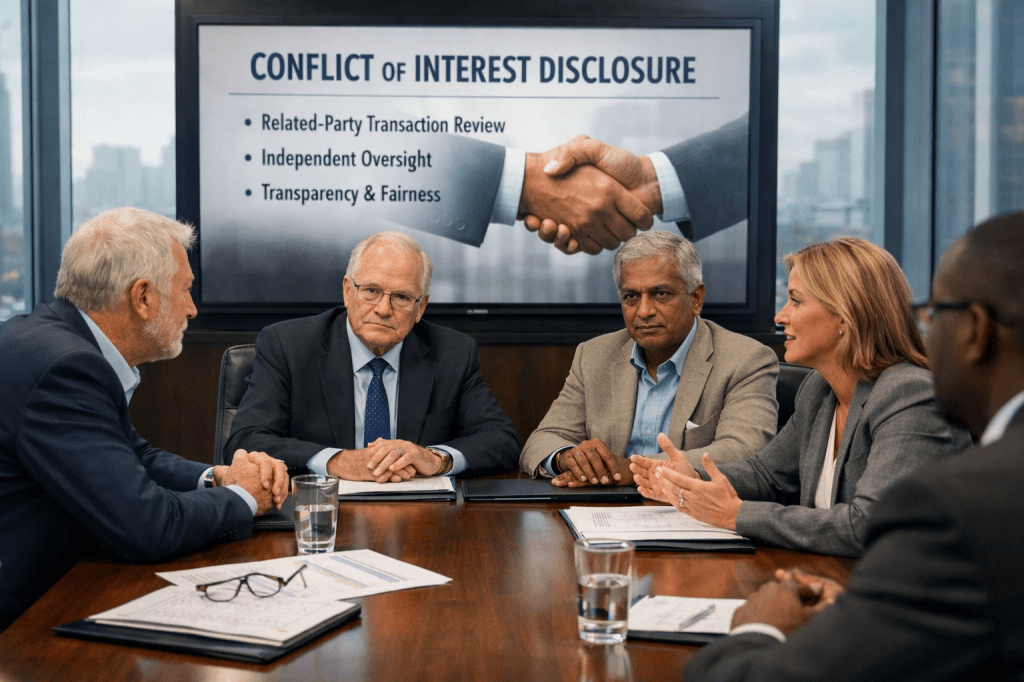
Independent board oversight ensures related-party transactions are evaluated objectively for shareholders' best interests.
Understanding Related-Party Transactions
A related-party transaction occurs when a company conducts business with individuals or entities that have a close relationship with the organization. These relationships can include directors, officers, major shareholders, or businesses controlled by them.
Examples commonly seen in junior mining companies include:
- Consulting agreements with directors or executives
- Technical services provided by companies owned by insiders
- Office leases involving board members or founders
- Financing arrangements with major shareholders
- Equipment or service contracts with affiliated firms
These transactions are not inherently improper. For some investors, these transactions could signal a positive indicator because it may mean insiders believe in the company. But as noted twice, it all depends. The governance challenge lies not in avoiding these transactions entirely, but in ensuring that they are conducted transparently, fairly, and in the best interests of the company.
The Importance of Conflict Discipline
Effective governance requires conflict-of-interest discipline. This means recognizing when personal interests intersect with corporate decision-making and establishing procedures that prioritize the company’s integrity rather than personal interests. Conflict discipline is focused on four considerations:
- Decisions are made in the best interests of the company
- Financial terms are fair and reasonable
- Independent oversight is applied where appropriate
- Investors receive transparent disclosure
Without these safeguards, related-party transactions can create the perception—whether accurate or not—that insiders are benefiting at the expense of shareholders. In capital markets, perception matters—a lot. Investors evaluating junior mining companies are not only assessing geology and project potential. They are also evaluating governance quality. Weak conflict management can raise concerns about transparency and accountability, ultimately affecting investor confidence.
The Role of Independent Directors
Why and how do independent directors play a critical role in reviewing and approving related-party transactions? First, they are not directly involved in management or financially tied to the proposed transaction. Their independence translates into being better positioned to evaluate whether a particular arrangement is fair to the company. Emphasis added—the company.
Typical governance practices include:
- Requiring full disclosure of potential conflicts
- Recusal of interested directors from decision-making
- Independent review by the board or a committee
- Documentation of the evaluation process
Companies that adopt best practices often empower the audit committee or a special committee of independent directors to review and approve related-party transactions before full board action. This process protects both the company and the individuals involved. It ensures that decisions are evaluated objectively and that governance standards remain intact.
Transparency and Disclosure
As sunshine is a great disinfectant, transparency is one of the most effective safeguards in managing conflicts of interest. Public mining companies are typically required to disclose related-party transactions in their financial statements and regulatory filings. Private companies should do so as well. These disclosures allow investors to understand the nature of the transaction and evaluate whether appropriate governance procedures were followed.
Clear disclosure generally includes:
- The parties involved in the transaction
- The financial terms of the arrangement
- The nature of the relationship
- The governance process used to approve the transaction
When companies provide clear and transparent disclosure, investors are better able to evaluate the transaction on its merits. Opacity, on the other hand, often raises more concerns than the transaction itself.
Protecting Investor Confidence
Junior mining companies, by definition, depend heavily on investor capital to finance exploration programs and project development. As a rule, exploration companies operate without revenue for extended periods; thus investor trust becomes one of the company’s most valuable assets. Lose it; lose investors.
Strong governance practices—including disciplined oversight of related-party transactions—help protect that trust. Investors are far more comfortable supporting companies that demonstrate:
- Clear governance policies
- Independent board oversight
- Transparent disclosure practices
- Documented decision-making processes
These practices signal that the company is committed to protecting shareholder interests.
Establishing Clear Policies Early
Many governance challenges in junior mining companies arise not from bad intentions but from the absence of clear procedures. However, good intentions are not sufficient when it comes to capital. Establishing formal policies early in the life of the company is what counts and can prevent confusion and reduce governance risks.
Effective related-party transaction policies typically include:
- Formal disclosure requirements for directors and officers
- Independent review of potential conflicts
- Recusal procedures for interested parties
- Board documentation of transaction approvals
These policies do not prevent companies from working with experienced insiders or affiliated firms. Instead, they provide a structured framework for evaluating such relationships responsibly. In other words, the objective is not to eliminate relationships—it is to govern them properly.
Governance as a Signal to the Market
In the competitive world of junior mining, governance quality increasingly influences how investors, partners, and strategic acquirers evaluate companies. Moreover, initial quality capital often attracts even stronger investors. Strong conflict management practices send a clear signal to the market: the company understands the importance of transparency, fairness, and disciplined decision-making.
That signal can strengthen investor confidence, reduce perceived governance risk, and ultimately support capital formation. Conversely, poorly managed related-party transactions can create lasting reputational damage that is difficult to repair.
Final Thoughts
Relationships are common in the junior mining sector. Industry participants often collaborate across multiple projects and companies over many years. These relationships can bring valuable expertise and capital to early-stage mining ventures. However, these relationships must be managed with care lest they become a hindrance.
Related-party transactions require clear disclosure, independent oversight, and disciplined governance processes. When handled properly, they can support the growth of a company while maintaining investor trust. When handled poorly, they can erode the very confidence that junior mining companies depend upon.
Governance before revenue is ultimately about stewardship. Stewardship begins with the discipline to manage conflicts of interest with transparency and integrity.
Until next time,
Yogi Nelson

 Blockchain & AI Forum