Uncategorized

STRONG ARTIFICIAL INTELLIGENCE, WEAK ARTIFICIAL INTELLIGENCE, WHATS THE DIFFERENCE?

Uncategorized

WHAT MONETARY SYSTEM DOES THE CARDANO BLOCKCHAIN USE?

Namaste Yogis. Welcome to the Blockchain & AI Forum, where your questions are answered, mostly correct! Here no question is too mundane. As a bonus, a proverb is also included. Today’s question is from Bhante Chandra from Kandy, Sri Lanka, and he wants to know what monetary system does the Cardano Blockchain use?

Bhante, you came to the right place. Let’s start first with explaining Cardano. Cardano is a decentralized, open source blockchain network that burst onto the scene in 2017. Charles Hoskinson, Cardano’s founder, created Cardano as a third generation blockchain. Bitcoin and Ethereum were generations one and two, respectively. Of course, Bitcoin was released by an anonymous developer (Satoshi Nakamura) in 2008, and Ethereum by a team, including Hoskinson, in 2015.

Cardano is recognized for its research-based approach. Cardano technology is based on nearly 200 peer reviewed academic research reports. Critics say Cardano is slow to the market; Cardano proponents acknowledge the critique. However, Cardano advocates say they are oven cooking not microwaving. Fair point! First and second generation blockchains were energy gluttons because they were constructed with proof of work consensus systems; Cardano was built using a proof of stake consensus system making it extremely energy efficient. Love a green blockchain!

Cardano is focused on solving the blockchain trilemma problem of balancing speed, scalability, and security. Essentially, the trilemma problem in blockchain says the more one or two issues are solved the worse off are the remaining. Holy no way out, Batman! Cardano also is recognized for its smart contract capabilities. Smart contracts facilitate the transfer of value from peer to peer without intermediaries. Now about the monetary system.

The Cardano network uses crypto currency to pay for transactions. Cardano currency is known as ADA, named after the famous British female mathematician and computer programmer, Ada Lovelace. Smaller denominations of ADAs are called Lovelace and they go out six decimal places, .000006. Bust out the calculator!

Cardano began with a total supply of 45B ADA. However, not all were release upon inception; that would be irresponsible. Instead, Cardano has phased in ADA distribution. Cardano is de-inflationary by design, meaning the supply of ADA decreases with time.

Let’s talk about the Cardano treasury and your personal Cardano treasury. Cardano’s treasury has three revenue sources: minting; donations; and taxation from block rewards. Great! Now, how does an individual grow their personal Cardano treasury? Here too there are multiple avenues. You could, for example, purchase ADA on an exchange, such as Coinbase. Suppose you purchased ADA, what next? Well, you could earn additional ADA by “staking it”. Staking is blockchain/crypto jargon for earning rewards. Think of it as interest payments for locking up and “lending” your ADA. Or you can operate your own stake pool and earn ADA directly. Operating a skating pool requires technical computer skills; learn and earn!

Once you have a bag of ADA, where to keep the stash is the question. Here again you have options. You can store your ADA on a centralized exchange, e.g., Coinbase. There are pros and cons to centralized exchanges, that go beyond this post. Or you can self-custody your stack; that too comes with advantages and disadvantages. Several self-custody wallets are available, including Typhon Wallet, Flint Wallet, or Yoroi Wallet.

A special thanks to Cardano and Emurgo Academy for supplying the information for today’s post. Time to go, but not before sharing an Egyptian proverb: “You can tell whether a man is clever by his answers. You can tell a man is wise by his questions.

Until next time,

Yogi Nelson

Uncategorized

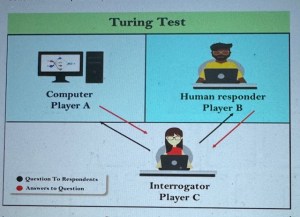
WHAT IS THE TURING TEST?

Uncategorized

WHAT IS THE FUTURE OF BLOCKCHAIN?

Namaste Yogis. Welcome to the Blockchain & AI Forum, where your questions are answered, mostly correct! Here no question is too mundane. As a bonus, a proverb is also included. Today’s question comes from Ashley in Texas, who wants to know, what is the future of blockchain?

Ashley, you came to the right place. Blockchain technology has enormous potential; however, it must conquer immediate challenges. Let’s begin with five challenges facing blockchain technology today: 1) scalability; 2) initial set-up costs; 3) smooth transition; 4) consensus mechanisms; and 5) privacy and security. I’ll focus on a few solutions, commencing with “sharding”

Sharding is a process for handling large data sets. Sharding accelerates processing by dividing the computational workload and storage space issues. It ensures no single mode (computer) is responsible for processing the network’s transactional load. Sharding increases security through transparent processing on a decentralized network. Sharding is not alone; it has a friend known as sidechains; not to be confused with 2Chainz the rapper! Lol.

Sidechains are separate blockchains attached to the mainchain. Often, sidechains are deployed to test new software before joining the mainchain. Sidechains offer more security when moving digital assets from one blockchain to another and reduce the mainchain’s workload; hence, making the blockchain faster and more reliable. What else is under construction? Answer—state channels.

Despite their Orwellian name, state channels are not spooky. State channels basically “lock” the blockchain while participants agree amongst themselves off-chain. Once participants reach consensus the transaction is uploaded onto the mainchain for processing. Let’s keep rolling with “Roll-Ups”.

Rollups are scaling solutions. Roll-ups move computation off-chain while keeping transaction data on-chain. Keeping the data on-chain allows anyone to locally process all computation in the roll-up and detect fraud. There are two types of roll-ups: Optimistic and ZK. Optimistic roll-ups assume the data/transactions are correct. However, to ensure accuracy, transactions are not final for one week. During the data verification week anyone may submit fraud proof. If no honest individual spots an error, transactions are final. If errors are spotted the transactions can be reversed. What about ZK-Rollups? ZK-Rollups stands for zero knowledge. No, it does not mean the protocol is a know nothing, lol! It means every rollup batch contains a cryptographic hash, thus making transaction more secure. In other words, possession of the private key opens the file and nothing else is required. However, with the increase in security also comes computationally intensive processes. Time, money, and energy consumption.

Charles Hoskinson, Cardano founder, is fond of saying blockchains need their “wi-fi” moment. Said differently, blockchains must achieve interoperability. Imagine having to switch providers every moment to access wi-fi. What a mess! Blockchain interoperability equals users having a seamless integration of capabilities, communication with and between intermediaries, and greater decentralization. Get it done!

Let’s wrap it up with Ricardian contracts. A Ricardian contract is a mechanism to record a document as law and link it to other sectors, i.e., accounting. A Ricardian contract is responsible for executing contracts between two parties and recording the details in forms that are readable by humans and machines. Moreover, the dual abilities of Ricardian contracts equal superior user experiences when compared to smart contracts. Holy dual use!

Yogi Nelson

Uncategorized

WHAT ARE THE 10 TERMS IN ARTIFICIAL INTELLIGENCE YOU SHOULD KNOW?

Photo by Pixabay on Pexels.com