
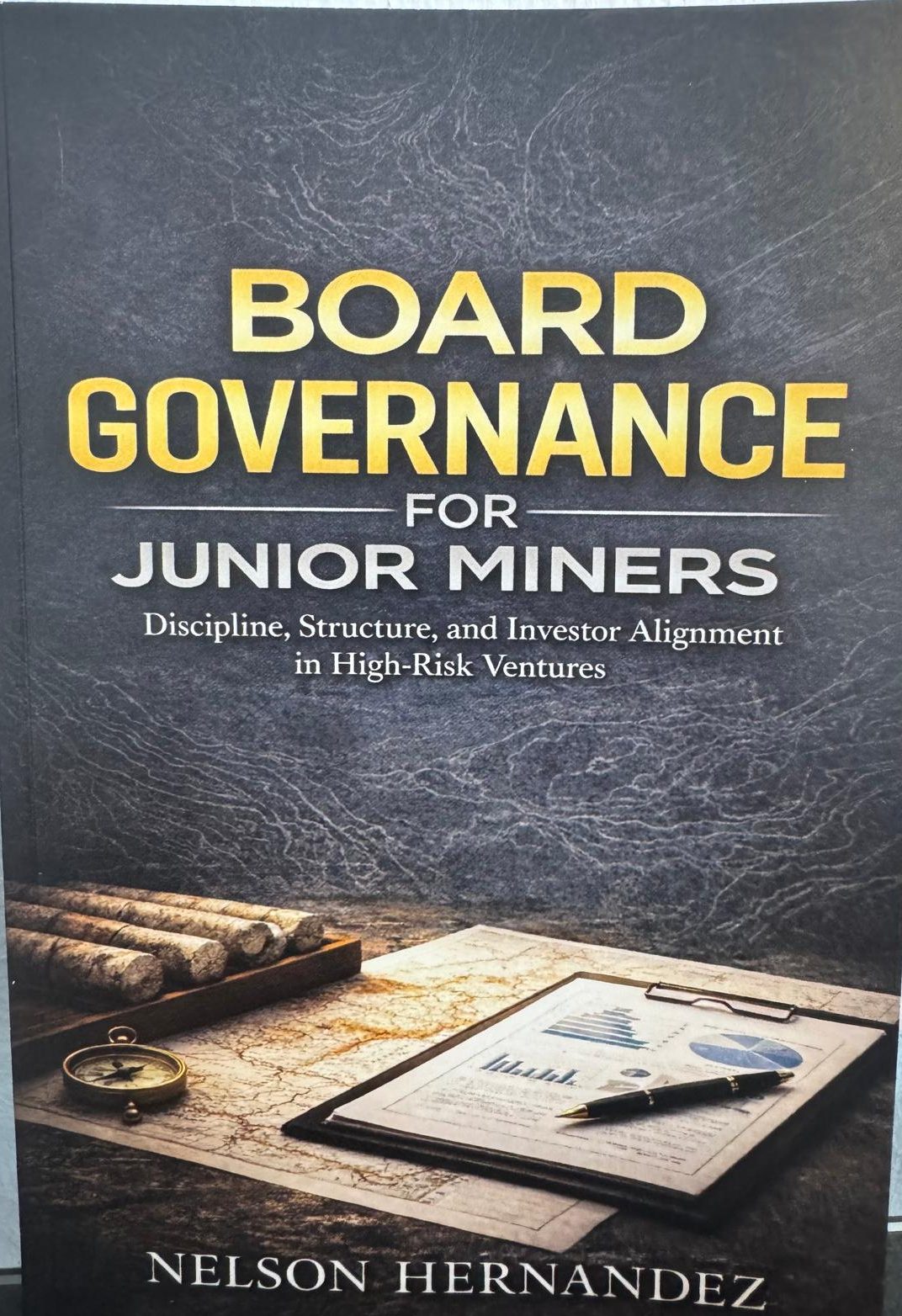
by Yogi Nelson
Governance Before Revenue: Board Composition — Skills, Not Friendships
Why the Right Directors Matter in Junior Mining
Do junior mining companies often begin by assembling a board of directors informally? Generally yes. Founders invite trusted colleagues, longtime associates, and industry friends to join the board. These individuals may have worked together successfully in the past, and their familiarity can create a sense of cohesion during the early stages of a company’s development. None of this should be surprising, but is it a good idea?
While trust and familiarity can be valuable, the purpose of the board of directors is not to reinforce existing friendships. The purpose of a board is to provide oversight, expertise, and independent judgment. Are those notions conflicting? Not necessarily. But is it worth the risk? That is the better question.
In junior mining companies—where capital is scarce, risks are ubiquitous, and investor confidence is essential—the composition of the board becomes a critical governance decision. Hence, governance built primarily on personal relationships carries more risk—much more risk. While it may come across as harsh, the clear-eyed, hard-nosed approach is to assemble a board built on skills, not friendships.
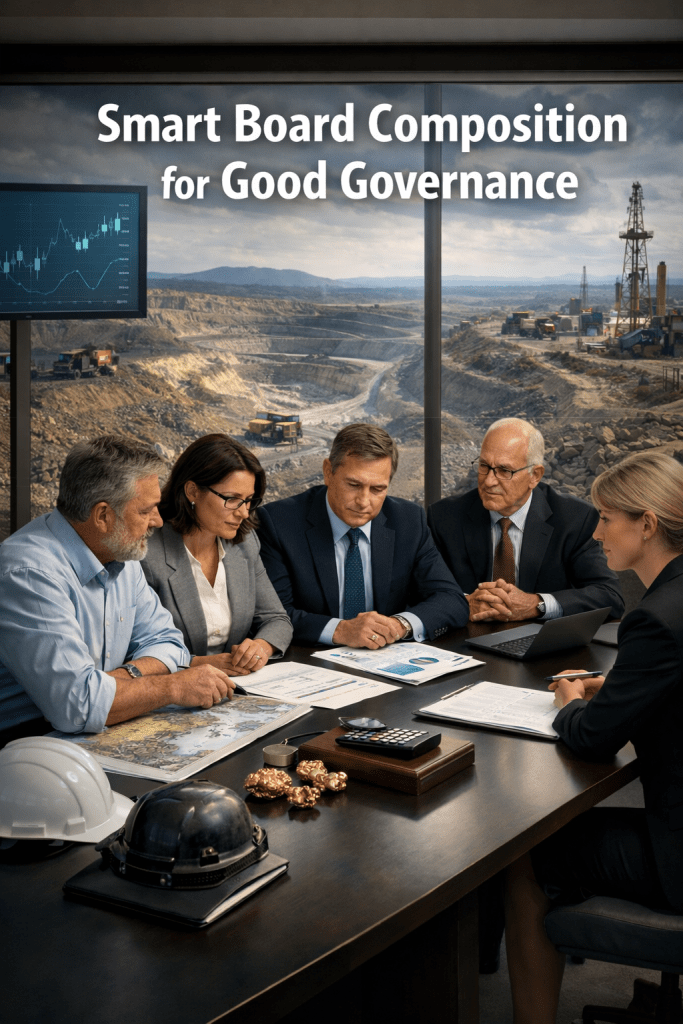
Skills, Not Friendships: Building Boards That Earn Investor Confidence
The board of directors serves as the central governance body of the company. Its responsibilities include overseeing management, safeguarding shareholder interests, approving major strategic decisions, and ensuring that appropriate financial and governance controls are in place. To carry out this mission effectively, composition is the place to start.
For junior mining companies, the board’s role is particularly important because the company often operates without revenue for extended periods. Investor capital funds exploration programs, technical studies, and administrative operations. During this stage of development, the board acts as a steward of shareholder resources. This responsibility requires directors who can exercise independent judgment and provide meaningful oversight.
A board composed primarily of personal acquaintances may struggle to provide the level of independence necessary for effective governance. Hence, why risk credibility with investors by assembling a board whose independence can easily be questioned when it is obvious that investors would not be impressed? A wiser decision would be to assemble a board whose skills match the moment.
The Skill Sets That Matter
An effective board brings together individuals with complementary expertise—not clones. Junior mining companies operate at the intersection of geology, engineering, finance, capital markets, and regulatory compliance. A well-structured board reflects that complexity. In other words, there is no need to duplicate; there is a need to differentiate.
Directors who bring valuable skills often have backgrounds in areas such as:
- Mining and geological expertise
- Capital markets and investment experience
- Financial reporting and accounting
- Project development and operations
- Legal and regulatory compliance
- Corporate governance
Not every director must possess all of these skills. In fact, no director will have every skill needed. And that is exactly the point. The board should not be ten versions of the same professional profile. Instead, the board as a whole should collectively provide the expertise necessary to oversee the company’s activities effectively.
When boards are assembled primarily through personal networks, skill gaps emerge. A board filled with well-intentioned supporters may lack the technical, financial, or governance expertise needed to guide the company during critical decisions. Again, skills, not friendships is the operative principle.
Independence Matters
Beyond expertise, independence is a critical component of board composition. Investors often zero in on independent directors to assess how truly independent members will be—especially during financing rounds and periods of stress.
Independent directors are individuals who are not members of management and do not have significant financial relationships with the company. Their role is to bring objective judgment to board deliberations and ensure that decisions are evaluated from the perspective of shareholders. Independent board members can afford to be objective; other directors may face conflicts of interest that compromise their independence.
As noted above, in junior mining companies independence becomes especially important when boards must evaluate issues such as:
- Executive compensation
- Related-party transactions
- Financing arrangements
- Strategic partnerships
- Mergers or acquisitions
Without independent voices, boards may find it difficult to challenge management decisions or address conflicts of interest appropriately. Independence does not mean hostility toward management. It means the ability to evaluate decisions objectively.
The Founder’s Challenge
Founders of junior mining companies often face a difficult governance challenge. In the early stages of building a company, founders rely heavily on trusted colleagues who are willing to support the venture. These individuals may provide introductions to investors, technical advice, or operational support—all essential characteristics of an outstanding board member. Hence, inviting such individuals onto the board can seem like a natural extension of those relationships.
However, as the company grows and begins raising capital from outside investors, expectations surrounding governance begin to change. Institutional investors and professional market participants often evaluate board composition carefully before committing capital.
They ask questions such as:
- Does the board have financial expertise?
- Are there independent directors?
- Do directors possess relevant mining industry experience?
- Can the board provide effective oversight of management?
Boards that appear overly insular or dominated by founders and their associates raise governance concerns among prospective investors.
Governance and Investor Confidence
Capital markets reward companies that demonstrate strong governance practices. For junior mining companies seeking to raise capital repeatedly over the life of a project, investor confidence is essential—not optional.
Board composition sends an important signal to the market. A board composed of experienced, independent directors with relevant expertise suggests that the company takes governance seriously. It indicates that oversight structures are in place to protect shareholder interests. Fiduciaries are in place—not cheerleaders.
Conversely, boards that appear to be composed primarily of friends, promoters, or insiders may raise concerns about whether meaningful oversight exists. The bottom line is that investors are not merely evaluating geological potential. They are evaluating management credibility and governance discipline.
Balancing Experience and Independence
Just as a bird needs both wings to fly, the most effective boards achieve a balance between industry experience and independent oversight.
Directors with deep mining experience help the board understand the technical and operational realities of exploration and project development. At the same time, directors with financial or governance expertise provide valuable oversight regarding capital allocation, financial reporting, and strategic decision-making.
Together, these perspectives create a stronger governance structure. Boards that include both experienced industry professionals and independent governance voices are better equipped to navigate the many challenges facing the junior mining sector.
Avoiding the “Rubber Stamp” Board
One of the risks associated with friendship-based boards is the emergence of what governance experts often call a “rubber stamp” board. A definite no-no.
In these situations, directors may hesitate to question management decisions out of loyalty or personal relationships. Meetings become procedural rather than substantive. Strategic decisions receive limited scrutiny. This dynamic weakens governance.
A well-functioning board should ask difficult questions, challenge assumptions, and engage actively in oversight discussions. Healthy disagreement is not a sign of dysfunction—it is a sign that governance is working. Healthy tension based on a shared mission and respect for divergent views is the ideal.
Building Boards for the Long Term
Junior mining companies that aspire to grow into development and production stages must think about board composition early. Governance structures built during the exploration phase often remain in place for many years and shape organizational culture.
Boards that begin with the right mix of expertise and independence are better positioned to support the company as it evolves. Moreover, it sets the tone from the outset: the company does not avoid tough questions—it welcomes them.
Replacing directors later can be difficult and sometimes disruptive. Establishing strong governance foundations early is therefore far more effective than attempting to retrofit governance structures later.
Final Thoughts
Board composition is one of the most consequential governance decisions a junior mining company will make. Do it right and thrive; do it wrong and you might dive.
While friendships and personal networks may help launch a company, they should not define its governance structure. Effective boards are built on expertise, independence, and the ability to provide disciplined oversight.
Junior mining companies operate in an environment defined by risk, capital dependence, and market scrutiny. Under those conditions, the quality of board leadership becomes a defining factor in whether a company earns investor confidence.
In governance—as in mining itself—the foundation matters. Boards built on skills build stronger companies. Boards built on friendships struggle to provide the oversight that capital markets demand.
Until next time,
Yogi Nelson


