

by Yogi Nelson
Why Junior Mining Companies Must Establish Financial Oversight Early
In the early life of a junior mining company, nearly every ounce of energy goes toward geology, exploration programs, and financing the next drilling campaign. Teams are small, budgets are tight, and leadership is focused on proving the resource. Governance structures—particularly formal committees—often seem like something that can wait until the company becomes larger or begins generating revenue. In 2026, that assumption is outdated.
One of the most important governance structures a junior mining company can establish early in its development is the Audit Committee. While traditionally associated with large, revenue-producing corporations, audit committees are just as critical—perhaps even more so—for early-stage resource companies.
In fact, establishing an audit committee before revenue begins sends a powerful signal to investors, potential acquisition suitors, and merger candidates: the company takes financial discipline, transparency, and accountability seriously. For junior miners seeking credibility in capital markets, that signal can make a meaningful valuation difference.
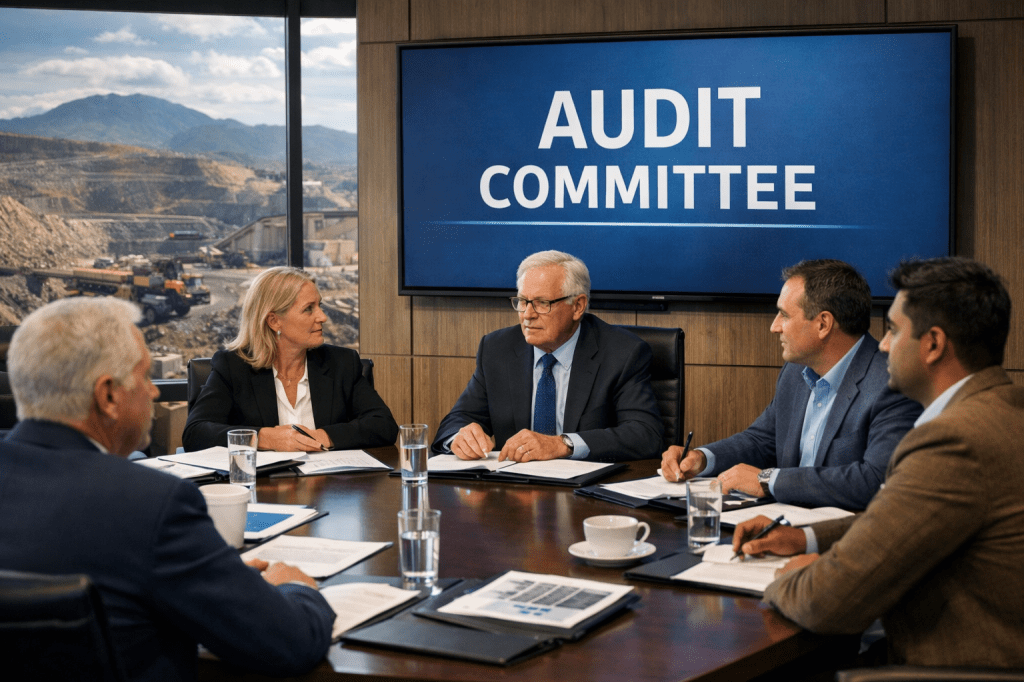
Effective audit committees provide independent financial oversight that strengthens investor confidence in junior mining companies
Why Early Governance Matters in Exploration Companies
Junior mining companies operate in a unique financial environment. Unlike traditional operating businesses, exploration companies often spend years—sometimes a decade or more—raising capital and deploying it into exploration activities before generating any revenue.
During this time, investors are funding geological risk, operational risk, and management execution. With little or no operating income to measure success, investors are compelled to rely heavily on trust across three fundamental factors:
- Effective and efficient use of funds
- Accurate financial reporting
- Management decisions that are subject to appropriate oversight
Without these safeguards, even promising exploration programs can struggle to attract sustained investor support.
Below I will explain why an effective audit committee is the best tool available to reinforce that trust. But first, it is useful to understand the work of an audit committee.
What an Audit Committee Actually Does
An audit committee is a specialized committee of the board of directors responsible for overseeing the company’s financial reporting, internal controls, and relationships with external auditors.
While the responsibilities vary by jurisdiction and listing exchange, the core functions generally include:
- Overseeing financial statements and disclosures
- Monitoring internal financial controls
- Supervising the relationship with independent auditors
- Reviewing risk management practices
- Ensuring compliance with regulatory reporting requirements
For larger companies, these duties are often supported by internal finance teams and internal audit departments. Junior mining companies, however, typically operate with much leaner administrative resources. Consequently, audit committees of the board are essential to maintaining the financial integrity of the organization.
Preventing Problems Before They Start
One of the greatest advantages of establishing an audit committee early is that it helps prevent financial problems before they arise. As the old proverb reminds us, an ounce of prevention is worth a pound of cure.
Exploration companies regularly handle significant capital inflows from equity financings. These funds must be allocated across drilling programs, geological studies, environmental compliance, and administrative costs. Without structured oversight, financial reporting processes can become informal or inconsistent—especially during periods of rapid growth or multiple financings.
An engaged audit committee helps ensure that:
- Financial controls are implemented early
- Accounting policies are applied consistently
- Disclosure practices meet regulatory standards
- Financial risks are identified quickly
This proactive oversight can prevent small issues from becoming major problems. In capital markets, credibility lost is difficult to regain. Early governance safeguards help preserve that credibility.
Building Investor Confidence
Institutional investors increasingly evaluate governance structures when considering investments in junior resource companies. Typically, professional investors analyze three key questions—among others—before committing capital:
- Is the geology promising?
- Is the management team capable?
- Is the governance structure trustworthy?
The presence of a well-structured audit committee directly addresses the third question.
Investors want reassurance that the financial reporting process is independent from management and that qualified directors are overseeing financial matters. When an audit committee includes members with accounting, financial, or capital markets experience, it signals that the company understands the importance of financial transparency.
This can make fundraising significantly easier, particularly when seeking larger institutional investors rather than relying solely on generalist capital.
Exchange Requirements and Best Practices
Many stock exchanges already require listed companies to maintain audit committees composed largely of independent directors. Companies listed on exchanges such as the TSX Venture Exchange, the Toronto Stock Exchange, and U.S. markets must comply with governance rules that include audit committee structures and financial expertise requirements.
However, merely complying with minimum regulatory requirements is not enough.
Best-practice junior miners treat the audit committee not as a regulatory checkbox, but as a strategic governance asset. That means selecting committee members carefully, ensuring they possess relevant financial expertise, and empowering them to actively oversee financial reporting and risk management.
The Value of Financial Expertise
An effective audit committee typically includes at least one member who qualifies as a financial expert—someone with deep experience in accounting, finance, or financial oversight. In the junior mining sector, this expertise can be invaluable.
Exploration companies face complex accounting questions related to:
- Capitalization of exploration expenses
- Impairment of mineral assets
- Share-based compensation structures
- Flow-through financing arrangements
- Regulatory reporting obligations
Directors with financial expertise can help the board navigate these complexities and ensure the company’s disclosures remain accurate and compliant. This expertise also strengthens the company’s relationship with external auditors, who rely on audit committees to provide oversight and independence.
Strengthening Internal Controls
One of the most overlooked aspects of junior mining governance is the importance of internal financial controls. Even small organizations must ensure that financial responsibilities are properly separated, documented, and reviewed. Without these safeguards, errors—or worse, financial mismanagement—can occur.
An audit committee plays a critical role in evaluating and strengthening these controls. Typical oversight areas include:
- Cash management procedures
- Authorization of expenditures
- Financial reporting processes
- Budget monitoring
- Risk assessment practices
By reviewing these systems regularly, the audit committee helps ensure that the company’s financial operations remain transparent and accountable.
Preparing for Future Growth
Junior mining companies that eventually transition from exploration to development and production face a dramatic increase in operational complexity. Project financing, construction budgets, joint ventures, and revenue recognition—just to name a few—introduce new layers of financial reporting.
Companies that establish strong governance structures early—including an effective audit committee—are far better prepared for this transition. Instead of scrambling to build governance systems during periods of rapid growth, they already have established frameworks for financial oversight and risk management. In other words, early governance creates organizational resilience.
Governance as a Strategic Advantage
In competitive capital markets, governance can become a meaningful differentiator. Hundreds of junior mining companies compete for investor attention each year. While geology and project potential remain primary drivers of valuation, governance quality increasingly influences investor confidence.
Companies that demonstrate disciplined oversight, transparent reporting, and strong board committees stand out from peers that operate with minimal governance infrastructure. Establishing an audit committee before revenue generation sends a clear message:
This company intends to operate with the same financial discipline as much larger organizations.
That message resonates with investors, lenders, and strategic partners alike.
Final Thoughts
Junior mining companies often view governance structures as something to implement later—after discovery success, after financing growth, or after revenue begins. But the companies that build credibility in capital markets are usually the ones that implement governance early, not late.
An effective audit committee strengthens financial oversight, improves transparency, and enhances investor trust during the most fragile stages of a company’s development. For junior mining companies—whether explorers, developers, or producers—operating in high-risk, capital-intensive environments, those advantages are invaluable.
Establishing an audit committee before revenue is not simply a compliance exercise. It is a strategic decision that signals maturity, discipline, and a commitment to responsible stewardship of investor capital.
In the crowded junior mining sector, that commitment can make all the difference.
Until next time,
Yogi Nelson

 Blockchain & AI Forum