
by Yogi Nelson
For most of modern history, gold-backed money has been declared obsolete. And yet, whenever trust in global monetary architecture becomes strained, gold has a way of quietly re-entering the conversation.
That appears to be happening again—this time through the combined emergence of mBridge, the proposed UNIT, and tokenization.
The distinction matters:
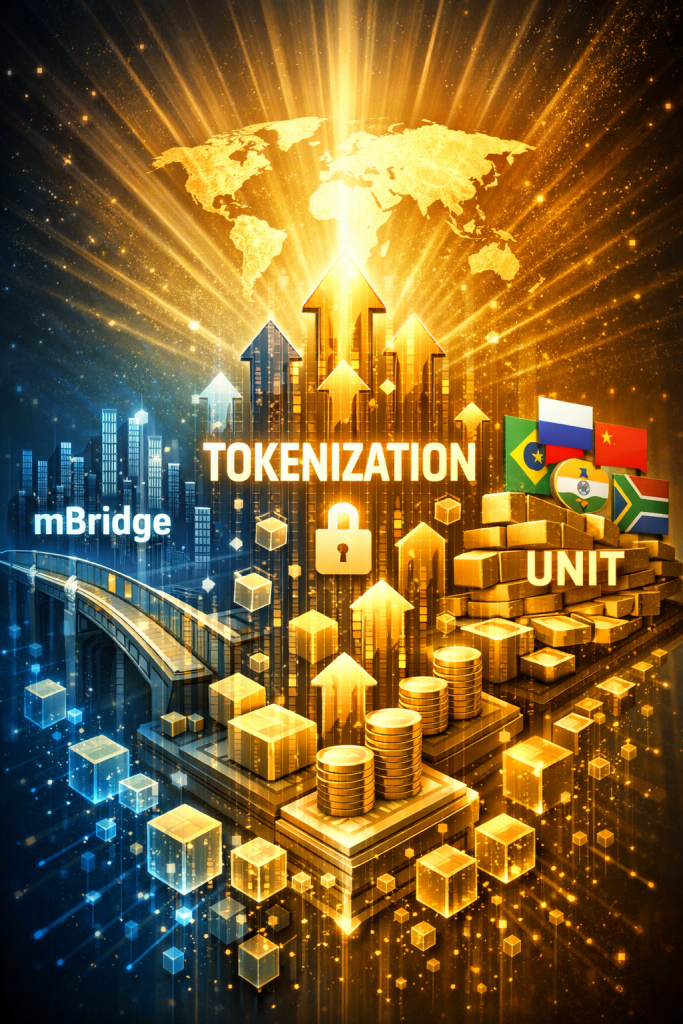
- The UNIT is best understood as a trade settlement and accounting unit, reportedly backed by a mix of gold and participating fiat currencies within the BRICS bloc.
- mBridge is not money at all. It is infrastructure—a blockchain-based settlement rail designed to move value directly between central banks without relying on correspondent banking networks like SWIFT.
- Tokenization is the force multiplier. It enables verification, transparency, and enforceability—turning gold backing from a political promise into something that can be digitally confirmed.
Individually, each is interesting. Together, they suggest a system-level shift.
This does not overthrow the U.S. dollar. It does not replace SWIFT overnight. But it does introduce functional competition:
- Alternative settlement rails
- A gold-referenced unit for trade
- A verification layer previous gold-backed systems never had
Historically, gold-backed money failed not because gold was flawed—but because trust was discretionary and opaque.
Tokenization changes that.
Whether or not the UNIT is ever fully tokenized remains to be seen. But the direction is clear: in a multipolar, digital world, global settlement may increasingly depend on systems that are verifiable, programmable, and less reliant on political assurances.
Tokenization may not be the headline—but it may be what rewires the system.
—
Yogi Nelson

 Blockchain & AI Forum