

by Yogi Nelson
Welcome to the BlockchainAIForum
Cryptography is the secret ingredient that makes cryptocurrencies work. Without it, Bitcoin, Ethereum, Cardano, and every other blockchain would simply not be secure or trustworthy. In this article, we will explore how cryptography works in the world of cryptocurrencies, explained in simple terms.
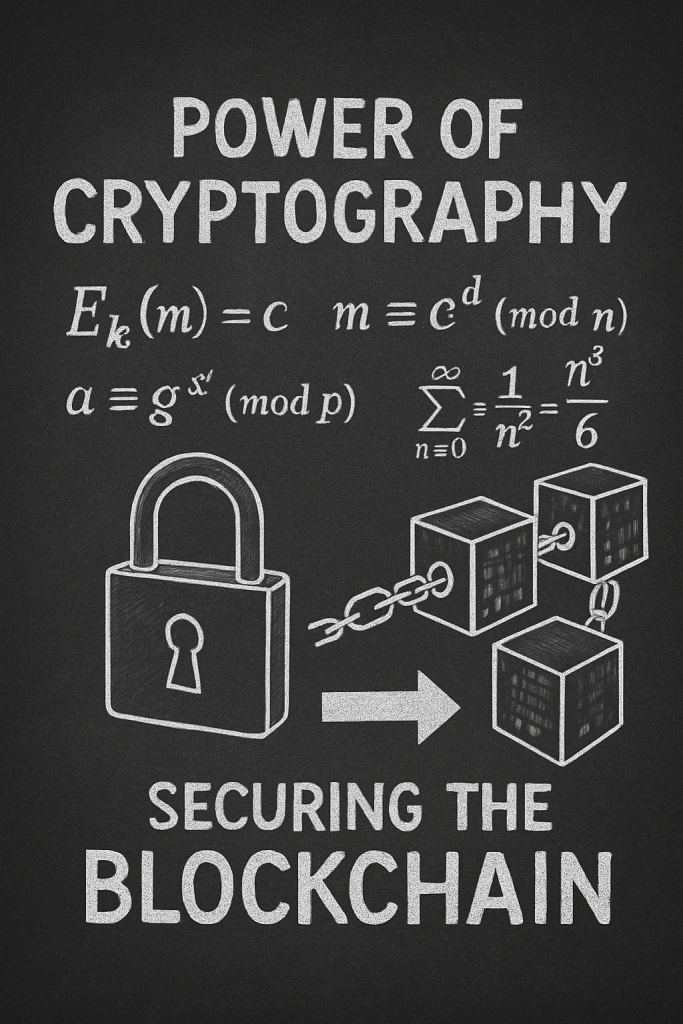
🧩 What is Cryptography?
Cryptography is the science of securing information so that only intended recipients can read it. Think of it like writing a message in code. If you know the code, you can read it. If you don’t, it remains a secret. In the digital world, cryptography relies on mathematical formulas and algorithms that are nearly impossible to break without the right key.
🏦 Why Cryptography Matters for Crypto
You may wonder: Why do we need all this math? Cryptocurrencies are decentralized, meaning no single person or bank controls them. Instead, people all over the world maintain the blockchain—the public ledger that records every transaction. Cryptography ensures that:
- ✅ Transactions can’t be faked.
- ✅ Coins can’t be spent twice.
- ✅ Users can keep their private keys safe.
- ✅ Everyone agrees on the ledger’s state without trusting anyone else.
🔑 Public and Private Keys
At the heart of crypto lies the concept of public and private keys.
- Public Key: Like your email address. You can share it with anyone so they can send you crypto.
- Private Key: Like your password. Only you should know it. It lets you spend or move your crypto.
These keys are mathematically related but it is impossible to figure out the private key from the public key. When you want to send crypto, you “sign” the transaction with your private key. Others can verify your signature with your public key to confirm it is valid.
✉️ Digital Signatures
Digital signatures are crucial. A digital signature is created using your private key and the transaction data. Anyone can check it with your public key. This ensures no one can forge your signature or alter your transaction. They prove that:
- ✅ You authorized the transaction.
- ✅ The transaction hasn’t been changed.
🛡️ Hash Functions
Another critical tool in cryptography is the hash function (I don’t mean potatoes, lol). A hash function takes any input (like a document or transaction) and turns it into a short or long, fixed-length string of numbers and letters.
- ✅ The same input always gives the same hash.
- ✅ Even tiny changes in input produce completely different hashes.
- ✅ It is impossible to figure out the original input just by looking at the hash.
In blockchains, hashes are used to:
- Create unique “fingerprints” of transactions and blocks.
- Link blocks together securely in a chain.
- Ensure no one can change past records without detection.
⛓️ Blockchain Integrity: Chaining Blocks with Hashes
The term blockchain comes from linking blocks using cryptographic hashes. Here’s how it works:
- Each block contains a list of transactions.
- The block also includes the hash of the previous block.
- This forms an unbreakable chain.
If anyone tries to change a single transaction in an old block, its hash changes. That breaks the chain, making tampering obvious to everyone.
🧪 Zero-Knowledge Proofs
Some modern blockchains also use zero-knowledge proofs. These allow someone to prove they know something (like a secret or password) without revealing it. By the way, zero-knowledge proofs can improve privacy and security.
For example:
- ✅ You prove you own funds without revealing your private key.
- ✅ You prove you have enough balance without showing your entire account.
🏛️ Example: Cardano’s Use of Cryptography
Let’s look briefly at Cardano, a popular blockchain project. Cardano is an example of how blockchains go beyond simple signatures and hashes, using cutting-edge cryptography to enhance security and efficiency. Cardano uses advanced cryptography to secure its blockchain:
- ✅ It uses Ed25519 for digital signatures, known for being secure and fast.
- ✅ It employs Ouroboros, a proof-of-stake protocol that relies on cryptographic randomness to select who adds new blocks.
- ✅ It explores zero-knowledge proofs to improve privacy and scalability in the future.
🌍 Why It All Matters
Without cryptography, there would be no cryptocurrencies.nnBanks have vaults and guards to protect money. Cryptocurrencies have cryptography. It lets people all over the world:
- ✅ Exchange value securely.
- ✅ Trust a shared ledger without intermediaries.
- ✅ Protect their digital assets from theft or fraud.
✅ Key Takeaways
- Cryptography secures cryptocurrencies without needing banks or middlemen.
- Public and private keys enable secure ownership and transactions.
- Digital signatures prove authenticity.
- Hash functions link blocks in a tamper-evident chain.
- Advanced tools like zero-knowledge proofs add privacy and efficiency.
💡 Conclusion
Cryptography is the secret sauce of cryptocurrencies. It ensures that people can use decentralized digital money safely, securely, and confidently. Understanding the basics helps you see why crypto is revolutionary—and why it will continue to evolve with even better cryptographic tools in the future.
Until next time,
Yogi Nelson
Sources:
- Antonopoulos, Andreas M. “Mastering Bitcoin.”
- Narayanan et al., “Bitcoin and Cryptocurrency Technologies.”
- IBM Blockchain Essentials – Cryptography Basics
- CoinDesk or Blockgeeks articles on cryptographic techniques in blockchain

 Blockchain & AI Forum