
Namaste Yogis. Welcome to the Blockchain & AI Forum, where your questions are answered, mostly correct! Here no question is too mundane. As a bonus, a proverb is also included. Today’s question, comes from Tiago, in Sao Paulo, and he wants to know what is the Turing test?
Tiago, you came to the right place. Before describing and explaining the test, let’s understand who was Alan Turing? Turing was a British mathematician and computer scientist. The Big Papi of computer science! In 1936 Mr. Turing published “On Computable Numbers”. His research paper laid down the core concepts of a computer 10 years before the computer was invented! The machine became known as the Turing Machine. Turing went further and published “Computing Machinery and Intelligence”, in 1950. Here is the link: https://academic.oup.com/mind/article/LIX/236/433/986238 Turing’s research was focused on machine intelligence–can machines think. No easy task and begs the questions, how to determine and measure whether a machine is intelligent. Turing’s solution, known today as the Turing Test, was to modify a popular game at the time known as the “imitation game”.
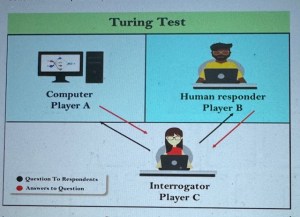
The game works as follows: a computer and a human receive typed questions from a human judge called the interrogator. If the interrogator cannot accurately identify the answers of the computer, the computer wins. According to Turing, if the computer wins, we cannot say it’s unintelligent thus it must have some degree of intelligence. Given Turing defined thinking as the ability to solve problems, a computer could therefore develop intelligence. Turing anticipated his critics and refuted their nine most probable and powerful arguments, which I summarize below.
Turing starts with and destroys theological objections, citing bible passages where the earth revolves around the Sun and resulting Galileo situation. He moves to objection two labeled “head in the sand”. According to Turing, this position stems from humans unwilling to consider losing intellectual supremacy. The third objection is mathematical, and in full disclosure I did not completely understand. However, I did understand Turing said man can be smarter than a machine but cannot be smarter than every machine. Let’s turn to objection 4, consciousness.
Turing readily admits the consciousness is mysterious. Nevertheless, he says “I do not think these mysteries necessarily need to be solved before we can answer the question with which we are concerned in this paper.” In other words, we don’t need to know it all to know some of it. Objection five relates to “various disabilities”. By disabilities Turing means machines are limited to narrow tasks. I’ll quote Turing’s rebuttal, “… the criticism that a machine cannot have much diversity of behavior, is just a way of saying that it does not have much storage capacity.” Fair point in 1950.
Critics say computer are incapable of surprises and thus don’t think. I’ll paraphrase Turing’s answer: “… this assumes that as soon as a fact is presented the mind fully comprehends all the consequences. While that may be a useful assumption, and sometimes correct, it is false. A natural consequence of doing so is one assumes there is no virtue in the working out consequences from data and general principles. In other words, a machine can surprise you if you give it a chance.
Continuity in the nervous system is objection seven. Turing acknowledged differences in the nervous systems between a discrete state machine (computer) and continuous machines (humans). However, for the Turing test the differences do not affect the interrogator in either direction, says Turing; hence, irrelevant.
The informality of behavior is objection eight. Critics point out humans don’t need rules for every conceivable situation whereas computers do. Turing counters by claiming computer could reach similar status given enough time and computing power. He gives a small example of what had been achieved using what was available at the time.
We conclude with objection nine, extra sensory perception, which Turing defined as telepathy, clairvoyance, pre-cognition, and psychokinesis. Turing had a somewhat dismissive rebuttal–put all Turing test participants into telepathy-proof rooms. Lol!
We reached the end with a proverb from Brazil, “Never poke a jaguar with a short stick”.
Until next time,
Yogi Nelson
 Blockchain & AI Forum