Artificial Intelligence, Blockchains, Patents

How are DARPA, Explainable Artificial Intelligence and Nvidia Connected? 

Namaste Yogis.   Welcome to the Blockchain & AI Forum, where your technology questions are answered!   Here no question is too mundane.  As a bonus, a proverb is also included.  Today’s question, comes from Susan in Irvine and she ask how are DARPA, Explainable Artificial Intelligence (XAI) and Nvidia all connected?

Susan, you came to the right place.  As a wealth manager I know you have a fiduciary duty to maintain current on investable technology on behalf of your clients.  Around 1990 a new technology was on the horizon–the internet–and it created trillions in new wealth!  Artificial intelligence (AI) is on a similar trajectory.  However, AI is not well understood–yet.  Let’s take a moment to acquaint ourselves with AI from the perspective of DARPA. In hindsight, DARPAs XAI program could have been used to foresee a tremendous investment opportunity—Nvidia the advanced computer chip maker essential to the AI business.

DARPA is an acronym that stands for Defense Advanced Research Projects Agency.  DARPA is part of the Department of Defense (DoD) and its mission is development of emerging technologies for military use.  DARPA created the internet in the late 1960s to facilitate control and command of military communications.  Under DARPA leadership, the US military maintains technological superiority over all other nations. 

In 2015 DARPA released an article titled, Explainable Artificial Intelligence (XAI).  https://www.researchgate.net/publication/356781652_DARPA_’s_explainable_AI_XAI_program_A_retrospective     Remember the XAI project was undertaken in 2015–years before the public had access to ChatGPT and other similar products.   Let’s examine the research findings.

According to DARPA in 2015, “…dramatic success in machine learning will lead to numerous AI applications.  It appears AI will eventually produce autonomous systems that will perceive, learn, decide, and act on their own”, DARPA predicted.  However, DARPA was concerned the effectiveness of AI systems would be stymied unless and until machines can creditably explain their decisions and actions to human users. Holy transparency, Batman! Therefore, the XAI program was intended to create a suite of machine learning techniques that would:

  • Produce more explainable models, while maintaining a high level of learning performance (prediction accuracy); and
  • Enable human users to understand, appropriately trust, and effectively manage the emerging generation of artificially intelligent partners.

XAI program was focused on the development of multiple systems by addressing challenges in two areas: 

  • machine learning problems to classify events based on multimedia data  
  • machine learning problems to construct decision policies for an autonomous system to perform a variety of simulated missions

DARPA selected these two areas because both represented major operational challenges.  The first relates to classification and reinforcement learning and the second is centered on intelligence analysis and autonomous systems.  In other words, DARPA was working on building AI machines that understand the context and environment in which they operate, and over time allow them to characterize real world phenomena precisely and in real time.  Basically, DAPRA was developing AI-Gen 2 before the public had access to AI-Gen 1! Holy Explainable AI, Batman! 

DARPA released XAI seven public findings of the XAI program and kept an unknown number of classified secret findings! LOL. Holy keep it on the down-low, Batman! LOL!

  1. Users prefer systems that include explanations rather than just answers (no surprise)
  2. To improve end results the task must be sufficiently difficult that the XAI explanation helps (makes sense)
  3. User cognitive load to interpret explanations can hinder user performance (in other words there are times when too much explanation is a negative)
  4. XAI is more helpful in edge cases
  5. Explanation effectiveness can change over time
  6. XAI combined with an advisor helps (no kidding, LOL)
  7. XAI is effective for aligning mental models

What’s are the two takeaways?  Obviously, DARPA did not leak military secrets on the internet and only disclosed the minimum. However, DARPA did leave an interesting information trail in 2015 that had we followed it, could have been a monster opportunity.  The XAI 2015 article was a glimpse into the future and we might have forecasted the rise of Nvidia.  Holy unicorn, Batman!  Nvidia stock has since soared, and we could have, should have…

I end with a Russian proverb: trust but verify!

Until next time,

Yogi Nelson

Artificial Intelligence, Blockchains

What is SimTheory?

Namaste Yogis.   Welcome to the Blockchain & AI Forum, where your technology questions are answered!   Here no question is too mundane.  As a bonus, a proverb is also included.  Today’s question was submitted by Tracey, and she wants to know what is SimTheory?

Tracey, you came to the right place.  Tracey be prepared to go down under and learn about this fantastic project.  We start by introducing the SimTheory team. SimTheory is led by Chris and Michael Sharkey. They are based in Sydney, Australia, and it’s fair to say they are tech bros! LOL.  Now, let’s move on to their project.

As often happens in life we start with one idea and that leads to another.  In the case of SimTheory, it started as a podcast.  That’s how I discovered it.  The Skarkey bros say the idea was to create a cyber space to try AI models for the podcast show.  In other words, SimTheory is more than a podcast; SimTheory is a podcast and a cyber space testing ground.  That’s an awesome concept. Holy two for the price of one, Batman!

The Sharkey bros consider SimTheory as a place to create and share artificial intelligence (AI) agents.  The point is to empower anyone, and everyone, to deploy powerful open-source instruction-based AI agents to accomplish real goals, say the Sharkeys.  Take a moment to consider what the bros say: “we think of SimTheory as a website builder crossed with a social network for AI agents. SimTheory exist for a single purpose–to serve the This Day in AI (their podcast) community with a place to place to try different modals, modalities, fine tunes, instructions, and prompts.”

Let’s talk about the podcast.  The podcast is A+, five-stars, whatever rating scale you pick, it’s at the apex.  The show is weekly and new episodes are released every Monday.  It’s a long-form podcast, about 75 minutes per show.  Honestly the material can be technical especially in the beginning of your AI journey.  However, the tech bros are entertaining and with time, study, and effort anyone can understand the material.  Perhaps offering a few examples from their podcast would help.

On a recent episode they put Bland.ai to the test.  Bland.ai is an AI tech used to make voice calls that can react and respond in “near” time.  In the test they called local hardware and pet stores using Bland.ai and of course the results were a combination of hilarious, impressive, and a peak into the future.  The point was to test whether the human answering the phone call would notice the caller was an AI.  They also intend to prank their mom on an upcoming show.  LOL.

Obviously, the podcast has a serious side.  For instance, SimTheory puts products to the test and gives honest assessments.  They have offered non bias reviews of products from Google, Microsoft, OpenAi, sports betting with AI, and numerous others.  The Sharkeys also gave their assessment of President Biden’s executive order regarding AI.  All-in-all, terrific material from every angle.  Now a word about the AI agents you’ll discover on their website.

The categories are diverse, including but not limited to health, entertainment, art, comedy,  therapy, design, and education.  Under education, there is D.A.N. the mechanic.  In the entertainment category discover Tay, “Your Virtual Girlfriend” (who is a bit toxic LOL).  There is also an AI agent that does an amazing job of transforming images into video!

Time for a SimTheory podcast and leave with a proverb from Australia:  Traveler, there are no paths.  Paths are made by walking

Until next time,

Yogi Nelson

Artificial Intelligence, computer vision, Patents

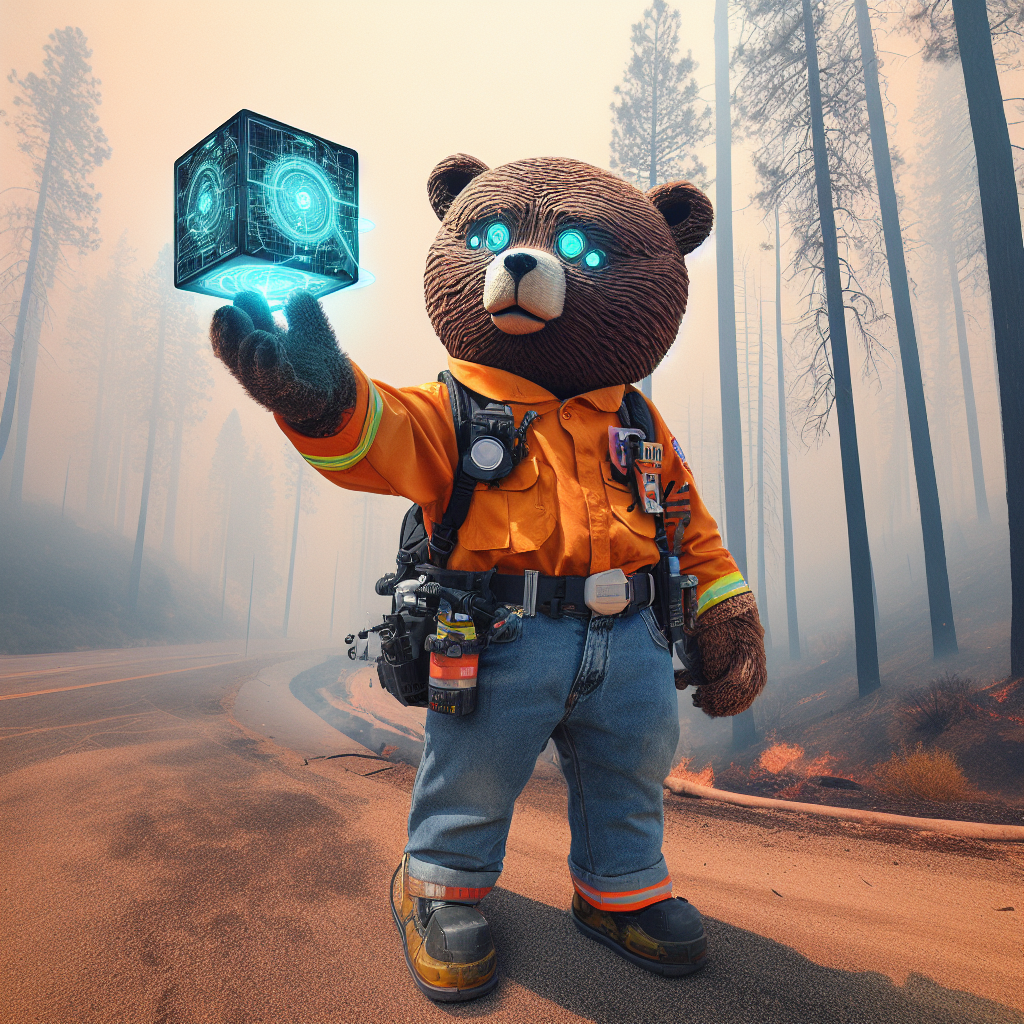
IS SMOKEY BEAR USING ARTIFICIAL INTELLIGENCE TO FIGHT FOREST FIRES?

Namaste Yogis.   Welcome to the Blockchain & AI Forum, where your technology questions are answered. As a bonus, a proverb is also included!  Today’s question, submitted by Mike, a former Fire Chief, and he asks if Smokey Bear is using artificial intelligence to fight forest fires?

Mike, you came to the right place.  Let’s converse about how AI protects the forest using California as an example, but first we start with a definition.  According to CAL FIRE, California Fire Fighting Agency, wildfires are uncontrolled fires that rapidly spread through vegetation, such as forest, grasslands, etc. https://www.fire.ca.gov/  CAL FIRE notes wildfires can be natural occurrences or resulting from human activity.  Holy burning bush, Batman!

Wildfires in California are an enormous problem.  Between 2019 – 2022, wildfires caused more than $25B in property damage, millions of acres of forest were burned, thousands of homes were destroyed and hundreds of deaths!  Moreover, wildfires are increasing in numbers and intensity.  Bottom line—it’s an enormous problem. 

Firefighting is a mammoth human coordination challenge.  AI is, in part, a human coordination technology.  California created the Alert California Initiative to coordinate the wildfire challenge.  The initiative has numerous partners.  The purpose is to use AI technology to make data driven decisions regarding wildfires. 

Alert California had a predecessor–Cameras on Mountain Tops (CMT) program.  Program administrators wanted to fix the shortcoming of CMT.  What was the shortcoming?  Essentially, too much data!  CMT system covered 90% of high fire risk areas, as defined by CAL FIRE. The deluge of data generated from the 1,000+ cameras spread throughout the state generated 8 – 16M images per day!  CAL FIRE could not manage the data in time to take effective action.  A human coordination problem.  The solution?   Add artificial intelligence service partner, DigitalPath!

DigitalPath started by implementing computer vision to help humans deal with massive data sets.  Just imagine, cameras were picking up 100,000 smoke images per day.  California operations centers were inundated with 7K – 10K fire alert emails/text/voicemail per day.  The goal was one alert per fire.  Holy efficiency, Batman!

Using a combination of AI computer vision and algorithms, Alert California has dramatically augmented its ability to determine whether an image is relevant, timely, duplicative, etc. and to classify the importance. With AI, firefighters work more effectively, by for example, positioning equipment in ideal locations and of course, under safer conditions!  Here is how it works:

When the AI spots a potential fire on the Alert California network of cameras, the AI system alerts firefighters and provides a percentage of certainty and estimates the incident location.  If the incident is confirmed by trained personnel, firefighters respond. AI is also used to estimate what resources are required, location, and quantity.  Moreover, the AI is also deployed to map out evacuations!  Smokey Bear is ecstatic, Batman!

Ironically extinguishing fires early today means more fuel for blazing infernos tomorrow.  Think of it as a dam that burst at maximum capacity!  However, on the horizon there are positive developments.  For example, with computer vision 40% of all wildfires are being detected by the AI system prior to 911 alerts, and the number is increasing.  With AI, controlled fires become more manageable.  AI is also improving firefighters’ ability to identify where fires are likely to occur and/or when they are occurring.  Simulations are working faster thus increasing the reliability of predictive models to give warnings.  In other words, there is reason for optimism.

I conclude with an Estonian proverb: The stomach never gets full by only licking.

Until next time,

Yogi Nelson

Artificial Intelligence, Blockchains, cryptography, Patents

WHAT IS THE NATIONAL INSTITUTE OF STANDARDS AND TECHNOLOGY?

Namaste Yogis.   Welcome to the Blockchain & AI Forum, where your technology questions are answered!   As a bonus, a proverb is also included.  Today’s question, was submitted by Jose in Miami and he asks what is the National Institute of Standards and Technology (NIST)?

Jose, you came to the right place.  NIST is not a well-known federal agency, nevertheless it has an important function.  Let’s quickly review its history, mission, organization, followed by an overview of its six laboratories. 

NIST BACKGROUND

I was surprised to learn NIST was established in 1901.  Holy foresight, Batman!  NIST is an independent agency, meaning it has its own Administrator, but falls within the U.S. Department of Commerce.  NIST says its mission is to “… promote U.S. innovation and industrial competitiveness by advancing measurement science, standards, and technology in ways that enhance economic security and improve our quality of life.”  

We should not be surprised to learn NIST is among the nation’s oldest physical science laboratories. Furthermore, it’s no surprise that Congress established NIST in 1901.  Why? At the time the USA was a rising industrial star with an eye on catching and surpassing the UK and Germany. For our factories and industries to effectively compete, the USA required standardized measurements and technology.  Understanding the moment, USA leaders used public policy to push industrialization, akin to what China does today and we continue to do with the CHIPS Act as the most recent example.  Nothing new, Batman!

Of course, the agency has evolved and today NIST functions with a core competency of measurement science, rigorous traceability, and development and use of standards. NIST received an enormous vote of confidence from President Biden when he issued Executive Order (EO) 14110:

https://www.federalregister.gov/documents/2023/11/01/2023-24283/safe-secure-and-trustworthy-development-and-use-of-artificial-intelligence

The EO assigned NIST a prominent role in artificial intelligence policies and programs, specifically related to research, development, and implementation. 

NIST Six Laboratories:

Communications Technology Laboratory (CTL).  According to NIST, the Communications Technology Lab was established in 2014 to unite their many wireless communications efforts. CTL focuses on developing precision instrumentation and creating test protocols, models, and simulation tools to enable a range of emerging wireless technologies. Is that your Bat-Phone ringing?!

Engineering Laboratory.  The Engineering Laboratory has a broad mandate of promoting U.S. innovation and industrial competitiveness by advancing measurement science, standards, and technology.  Using its discretion, EL built the following portfolio:  1) advanced manufacturing; 2) disaster resistant buildings, infrastructure, and communities; and 3) sustainable and energy efficient manufacturing, materials, and infrastructure.  Holy resistant to hurricanes, Batman!

Information Technology Laboratory.  ITL claims its mission is to cultivate trust in information technology and metrology.  ITL uses, its non-regulatory influence, and world-class measurement and testing facilities, computer science, mathematics, statistics, and systems engineering to achieve the mission.

Material Measurement Laboratory (MML) conducts measurement science research.  MML is focused on research related to industries in the chemical, biological and material sciences fields. MML researchers perform fundamental and applied research, evaluate data, and create other programs and tools to assure the quality of measurement results.

Physical Measurement Laboratory (PML).  PML is dedicated to measuring.  PML’s activities range from fundamental measurement research through provision of measurement services, standards, and data across the following areas:

  • length, mass, force and shock, acceleration
  • time and frequency
  • electricity, temperature, humidity
  • pressure and vacuum
  • liquid and gas flow
  • electromagnetic, optical, microwave, acoustic, ultrasonic, and ionizing radiation

I wrap it up with a proverb from Finland:  There are always people to grab the branches when there are people to carry the spruce.

Until next time,

Yogi Nelson

Artificial Intelligence, Blockchains

AND NOW A WORD ABOUT AIRDROPS?

Namaste Yogis.   Welcome to the Blockchain & AI Forum, where your technology questions are answered, mostly correct!   Here no question is too mundane.  As a bonus, a proverb is also included.  Today’s question, submitted by Danny in Los Angeles, and he wants to know about airdrops.

Danny, you came to the right place.  If you take the term literally, you might think someone is dropping air on your head which would be absurd!  Let’s start with a definition.

Airdrops is a term native to and used exclusively in crypto.  You won’t find reference to airdrops in any other market or industry.  Best of all, airdrops are free!  No charge.  Nada.  Zero.  However, nothing is truly free, meaning we must dig a little deeper.

Let’s start with the obvious; airdrops are a marketing strategy.  The point is to raise awareness and adoption of the project doing the airdrop.  Holy obvious, Batman! Generally, start-up blockchain companies are most likely to engage in airdrops.  The first airdrop occurred in 2014 by AuroraCoin, in Iceland.  El Salvador gave every citizen $30 of Bitcoin to those who installed the government built crypto wallet.  A government-built wallet from a corrupt government to encourage a decentralized money system.  Holy, are you serious, Batman!

Airdrops vary.  I’ll explain a few staring with Standard.

Standard Airdrop.  Standard Airdrop is the simplest.  Participants need only provide their wallet address and basic information. The airdrop quantity may vary depending on several factors, including number of participants, and the amount available, to name just two.

Bounty Airdrop.  To earn bounty airdrops, users must perform certain tasks.  Tasks vary, but generally revolve around raising project awareness, e.g., posting on social media, tagging a company, retweeting a post.  Some projects award airdrops for recruiting other users, think multi-layer marketing, Batman!

Holder Airdrop.  Holder airdrops are often automatic and based on a formula of quantities of tokens a holder possesses, and duration held. It is a way to reward commitment and loyalty.  Only the financially faithful, Batman!

Exclusive Airdrop.  As the name suggest, exclusive airdrops are reserved for selected individuals.  Who are the exclusive?  Generally, they are people who spend the most time on the project, contribute to the project, post about the project, and/or stake their holdings with the project.  Staking is generally the most effective way to get airdrops.  Holy, hoity-toti, Batman! 

Raffle Airdrops.  Raffle airdrops occur when a project decides to give away X number of tokens, based on a lottery.  However, the lottery may not be completely random.  The lottery may be weighted to give advantage to holders.     

If nothing is free nor perfect, what are the downside of airdrops.  In a word–SCAMS!  I’ll give you two scam types, starting with dusting.

In a dusting scam, the thief will send micro amounts of a valuable coin, e.g., Bitcoin, to a recipient.  The idea is to entice the victim to attach their wallet to a crooked phishing website, via a legit service such as Metamask, to claim their airdrop.  After a user connects their wallet and enters their password the scammer drains the stash!  Holy, where is my money Batman!  The second is enticing market participants to invest in a fraudulent, or non-existent project.  Either way your money is vaporized!  Two more quick points.  Tokens from airdrop projects might be worthless because the project fails, and/or token illiquidity.  Hence, keep the champagne on ice but the cork in the bottle!  Lol!

I end with a proverb from Niger:  Ashes fly back into the faces of those who throws them.

Until next time,

Yogi Nelson