
Artificial Intelligence, computer vision, Patents

IS SMOKEY BEAR USING ARTIFICIAL INTELLIGENCE TO FIGHT FOREST FIRES?

Namaste Yogis.   Welcome to the Blockchain & AI Forum, where your technology questions are answered. As a bonus, a proverb is also included!  Today’s question, submitted by Mike, a former Fire Chief, and he asks if Smokey Bear is using artificial intelligence to fight forest fires?

Mike, you came to the right place.  Let’s converse about how AI protects the forest using California as an example, but first we start with a definition.  According to CAL FIRE, California Fire Fighting Agency, wildfires are uncontrolled fires that rapidly spread through vegetation, such as forest, grasslands, etc. https://www.fire.ca.gov/  CAL FIRE notes wildfires can be natural occurrences or resulting from human activity.  Holy burning bush, Batman!

Wildfires in California are an enormous problem.  Between 2019 – 2022, wildfires caused more than $25B in property damage, millions of acres of forest were burned, thousands of homes were destroyed and hundreds of deaths!  Moreover, wildfires are increasing in numbers and intensity.  Bottom line—it’s an enormous problem. 

Firefighting is a mammoth human coordination challenge.  AI is, in part, a human coordination technology.  California created the Alert California Initiative to coordinate the wildfire challenge.  The initiative has numerous partners.  The purpose is to use AI technology to make data driven decisions regarding wildfires. 

Alert California had a predecessor–Cameras on Mountain Tops (CMT) program.  Program administrators wanted to fix the shortcoming of CMT.  What was the shortcoming?  Essentially, too much data!  CMT system covered 90% of high fire risk areas, as defined by CAL FIRE. The deluge of data generated from the 1,000+ cameras spread throughout the state generated 8 – 16M images per day!  CAL FIRE could not manage the data in time to take effective action.  A human coordination problem.  The solution?   Add artificial intelligence service partner, DigitalPath!

DigitalPath started by implementing computer vision to help humans deal with massive data sets.  Just imagine, cameras were picking up 100,000 smoke images per day.  California operations centers were inundated with 7K – 10K fire alert emails/text/voicemail per day.  The goal was one alert per fire.  Holy efficiency, Batman!

Using a combination of AI computer vision and algorithms, Alert California has dramatically augmented its ability to determine whether an image is relevant, timely, duplicative, etc. and to classify the importance. With AI, firefighters work more effectively, by for example, positioning equipment in ideal locations and of course, under safer conditions!  Here is how it works:

When the AI spots a potential fire on the Alert California network of cameras, the AI system alerts firefighters and provides a percentage of certainty and estimates the incident location.  If the incident is confirmed by trained personnel, firefighters respond. AI is also used to estimate what resources are required, location, and quantity.  Moreover, the AI is also deployed to map out evacuations!  Smokey Bear is ecstatic, Batman!

Ironically extinguishing fires early today means more fuel for blazing infernos tomorrow.  Think of it as a dam that burst at maximum capacity!  However, on the horizon there are positive developments.  For example, with computer vision 40% of all wildfires are being detected by the AI system prior to 911 alerts, and the number is increasing.  With AI, controlled fires become more manageable.  AI is also improving firefighters’ ability to identify where fires are likely to occur and/or when they are occurring.  Simulations are working faster thus increasing the reliability of predictive models to give warnings.  In other words, there is reason for optimism.

I conclude with an Estonian proverb: The stomach never gets full by only licking.

Until next time,

Yogi Nelson

Artificial Intelligence, Blockchains, cryptography, Patents

WHAT IS THE NATIONAL INSTITUTE OF STANDARDS AND TECHNOLOGY?

Namaste Yogis.   Welcome to the Blockchain & AI Forum, where your technology questions are answered!   As a bonus, a proverb is also included.  Today’s question, was submitted by Jose in Miami and he asks what is the National Institute of Standards and Technology (NIST)?

Jose, you came to the right place.  NIST is not a well-known federal agency, nevertheless it has an important function.  Let’s quickly review its history, mission, organization, followed by an overview of its six laboratories. 

NIST BACKGROUND

I was surprised to learn NIST was established in 1901.  Holy foresight, Batman!  NIST is an independent agency, meaning it has its own Administrator, but falls within the U.S. Department of Commerce.  NIST says its mission is to “… promote U.S. innovation and industrial competitiveness by advancing measurement science, standards, and technology in ways that enhance economic security and improve our quality of life.”  

We should not be surprised to learn NIST is among the nation’s oldest physical science laboratories. Furthermore, it’s no surprise that Congress established NIST in 1901.  Why? At the time the USA was a rising industrial star with an eye on catching and surpassing the UK and Germany. For our factories and industries to effectively compete, the USA required standardized measurements and technology.  Understanding the moment, USA leaders used public policy to push industrialization, akin to what China does today and we continue to do with the CHIPS Act as the most recent example.  Nothing new, Batman!

Of course, the agency has evolved and today NIST functions with a core competency of measurement science, rigorous traceability, and development and use of standards. NIST received an enormous vote of confidence from President Biden when he issued Executive Order (EO) 14110:

https://www.federalregister.gov/documents/2023/11/01/2023-24283/safe-secure-and-trustworthy-development-and-use-of-artificial-intelligence

The EO assigned NIST a prominent role in artificial intelligence policies and programs, specifically related to research, development, and implementation. 

NIST Six Laboratories:

Communications Technology Laboratory (CTL).  According to NIST, the Communications Technology Lab was established in 2014 to unite their many wireless communications efforts. CTL focuses on developing precision instrumentation and creating test protocols, models, and simulation tools to enable a range of emerging wireless technologies. Is that your Bat-Phone ringing?!

Engineering Laboratory.  The Engineering Laboratory has a broad mandate of promoting U.S. innovation and industrial competitiveness by advancing measurement science, standards, and technology.  Using its discretion, EL built the following portfolio:  1) advanced manufacturing; 2) disaster resistant buildings, infrastructure, and communities; and 3) sustainable and energy efficient manufacturing, materials, and infrastructure.  Holy resistant to hurricanes, Batman!

Information Technology Laboratory.  ITL claims its mission is to cultivate trust in information technology and metrology.  ITL uses, its non-regulatory influence, and world-class measurement and testing facilities, computer science, mathematics, statistics, and systems engineering to achieve the mission.

Material Measurement Laboratory (MML) conducts measurement science research.  MML is focused on research related to industries in the chemical, biological and material sciences fields. MML researchers perform fundamental and applied research, evaluate data, and create other programs and tools to assure the quality of measurement results.

Physical Measurement Laboratory (PML).  PML is dedicated to measuring.  PML’s activities range from fundamental measurement research through provision of measurement services, standards, and data across the following areas:

  • length, mass, force and shock, acceleration
  • time and frequency
  • electricity, temperature, humidity
  • pressure and vacuum
  • liquid and gas flow
  • electromagnetic, optical, microwave, acoustic, ultrasonic, and ionizing radiation

I wrap it up with a proverb from Finland:  There are always people to grab the branches when there are people to carry the spruce.

Until next time,

Yogi Nelson

Artificial Intelligence, Blockchains, Sports AI

IS THERE A ROLE FOR ARTIFICIAL INTELLIGENCE (AI) IN SPORTS?

Namaste Yogis.   Welcome to the Blockchain & AI Forum, where your technology questions are answered, mostly correct!   Here no question is too mundane.  As a bonus, a proverb is also included.  Today’s question, was submitted by Riezl in Las Vegas and she wants to know is there a role for AI in sports?

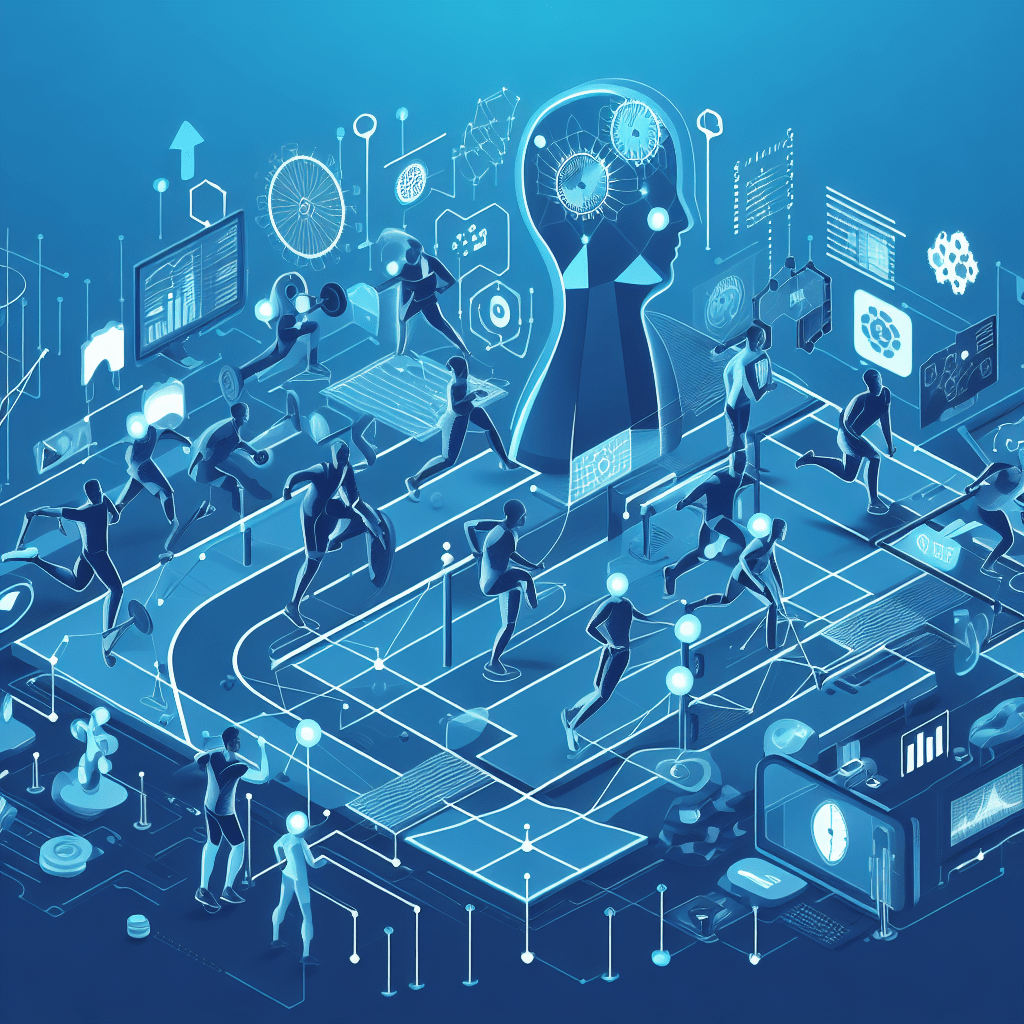
Riezl, you came to the right place.  You pose a fascinating question worthy of a thorough answer. The answer is yes!  I will discuss how AI may impact sports betting, sport analytics, and sports medicine.  Let’s start with sports betting, but first a disclosure. I do not endorse gambling, nor any company mentioned in this article.   

SPORTS BETTING

MySports.AI is an application that uses advanced machine learning algorithms, to predict outcomes. A unique feature of Mysports.AI, is its ability to customize different betting strategies for each player, catering to various funds and betting cycles. The platform provides back-tested records, allowing players to analyze the profitability of various events under each betting strategy. Mysports.AI backers say the model has undergone tens of thousands of machine learning training sessions.

SPORTS ANALYTICS

Sport analytics was popularized by the movie, Money Ball.  Sports analytics involves collecting and analyzing relevant statistics to facilitate decision making.  Acceptance of analytics in sports is commonplace and soon AI will join the club.  New York University offers a sports analytics certificate https://www.sps.nyu.edu/professional-pathways/certificates/sports-management/sports and a required course is artificial intelligence and machine learning!

Sports are competitions set within a multi-billion-dollar business milieu.  Not surprisingly there are on-field and off-field analytics. On-field refers to improving the performance of teams and players.  For example, in the NBA the analytics indicate superior three-point shooting is essential.  No team can expect to hoist a championship trophy if they are dearth of three-point shooters. Holy Stephon Curry, Batman!  AI algorithms are being used in Formula 1 to improve racing tactics and to automated tire replacement strategies. Piccinotti (2021).  Even tennis racquets are going high-tech with the advent of rackets based on Real HawkEye computer vision system data! There are several on-field analytics AI firms including  GeminiSports.com.

Last, certain sports require considerable human judgment to determine the winner, i.e., gymnastics and ice skating. Recently, Fujitsu created an AI to analyze the performance of a gymnast’s movements using 3D laser sensors (Atiković et al., 2020).

Off-field analytics is concerned with the business of sports. Teams have multiple revenue sources, including ticket sales, merchandise, parking, television broadcast, etc. and expense centers. AI powered sports business analytics can discover ways to maximize revenues, reduce costs, improve fan acquisition, marketing strategies, and perhaps the financial impact of a new sponsorship.  As shown by Chmait et al. (2020a), the relationship between the success of athletes and their salaries is an important value proposition to explore. GWI.Com and others are focused on AI in sports business.

Sports Medicine Analytics and AI

If we enter the time machine and travel to 1995, we discover researchers such as Bartlett discussing potential applications of artificial intelligence in sports performance! In 2006, Bartlett published Artificial Intelligence in Sports Biomechanics: New Dawn or False Hope, wherein he correctly predicted multi-layer artificial neural networks (aka Deep Learning) will take center stage in sports technique analysis.  Other researchers such as Brockett, are using AI to detect patterns that lead to injuries. Fister et al. (2015) has researched whether nature-inspired AI algorithms can investigate safe and effective training programs since 2015.

I end with a proverb from Rwanda:  All proverbs have a good reason for existing.

Until next time,

Yogi Nelson

Artificial Intelligence, Blockchains, cryptography, Yogi Nelson

WHAT IS CRYPTOGRAPHY?

Namaste Yogis.   Welcome to the Blockchain & AI Forum, where your technology questions are answered, mostly correct!   Here no question is too mundane.  As a bonus, a proverb is also included.  Today’s question, was submitted by William from La Puente, CA and he wants to know what is cryptography?

William, you came to the right place.  William the only reasonable place to start is with a definition.  Let me answer by referring to an awesome movie called My Big Fat Greek Wedding.  In the movie the father of the bride would constantly say, “… the Greeks invented that, the Greeks did that first, etc.”  Well perhaps the old man had a point because in the case of cryptography the word comes from the Greeks.  Kryptos means hidden and graphein is to write; hence, cryptograph is to write in a hidden manner.  Holy hidden message, Batman!

Okay the word has its origin in Greece, but what does cryptography do?  Essentially, cryptography provides information protection/security.  Using cryptography, data can be transformed by substitution.  For example, an early and primitive form of substitution cryptography was to shift every letter three spots.   A sentence that would normally read like this: “Encrypted using Caesar cipher” becomes Hqfubswhg xvlqj Fdhvdu fiskhu.  The other method, known as transposition, involves moving the order of characters of words by a pre-determined agreement.  No, it’s not pig Latin!  Lol.

Cryptography concepts are likely foreign; hence, we should start slowly. I’ll cover just three topics today and save the rest for later.  Let’s start with the security services of cryptography, there are four. 

First is authentication.  By authentication I mean the assurance the communicating entity is legitimate.  Second, data confidentiality.  In other words, the protection from unauthorized disclosure.  The third is data integrity.  In this context I mean the data has not been altered; it was received exactly as sent.  Last, comes non-reputation.  Non-reputation refers to the notion that the receiver can prove the alleged sender sent the message.  Impressive!

We are off to a fast start.  Let’s try two more topics beginning with cryptographic keys. 

In cryptography there are two types of key systems–symmetric and asymmetric.  Symmetric is where one key is used to encrypt and decrypt messages.  The keys are essentially shared by the two parties and the data is transferred via a secure network.  However, authentication nor non-reputation is provided, and the origin of the message cannot be determined.  Let’s compare that to asymmetric cryptography. 

In asymmetric there are public and private keys.  The public key is derived from the private.  As you can guess, asymmetric was developed due to the problems with symmetric cryptography.  Asymmetric wins the crypto security battle handily.  However, if you lose your private key there is no way to access the data, value, or information that was sent!  You best hold on tight!

Hashing is an ideal spot to end the lesson.  Hashing, (I don’t mean potatoes, although I love hash browns) in cryptography is the process of transforming data or a string of characters into a short and fixed length value.  The value produced is unique; no other record has it.  Hashing algorithms are used to perform the hashing process in three steps:  1) data input; 2) hashing function #; and 3) hash output (of a fixed length). By the way, blockchains make extensive use of hashing.  More on that later.

There is more to say but for now I’ll stop with a proverb from our friends in Tajikistan, where they say:  In every drop of water, there is a grain of gold.

Until next time,

Yogi Nelson

Artificial Intelligence, Yogi Nelson

IS BULGARIA A LEADER IN ARTIFICIAL INTELLIGENCE EDUCATION?

Namaste Yogis. Welcome to the Blockchain & AI Forum, where your technology questions are answered, mostly correct! Here no question is too mundane. As a bonus, a proverb is also included. Today’s question, comes from Fernie, in Las Vegas, and he wants to know if Bulgaria is a leader in artificial intelligence education and research?

Fernie, you came to the right place. Rather than answer directly, I will share information about a certain institute located in Sofia, Bulgaria, and let you decide. Let’s jump right into it by shouting out the Institute for Computer Science and Artificial Intelligence Technology, INSAIT.
https://insait.ai/

INSAIT is a mere toddler; it was founded in April 2022. INSAIT is the first university in Eastern Europe dedicated exclusively to computer science and AI technology education. INSAIT is part of Sofia University, but functions autonomously. Holy independence, Batman!

INSAIT is backed by technology elites, including two of Switzerland’s most prestigious universities and global technology behemoths, i.e., Google, DeepMind, and VMware, etc. INSAIT says its sole focus is on scientific excellence, conducting world-class research, attracting outstanding international scientist, and training the next generation of technology leaders. Let’s peruse their course offerings, beginning with machine learning.

Machine Learning. INSAIT defines machine learning as the area of computer science that focuses on extracting knowledge from large data sets and using this knowledge for making predictions and decision making. INSAIT believes the combination of colossal data sets and increasing access to powerful computation means there are exciting opportunities for data-driven algorithms.

Computer Vision. According to INSAIT, computer vision is an interdisciplinary field that studies algorithms through which computers can comprehend images at a high level. INSAIT says, and with good reason, there are numerous applications for computer vision, including autonomous driving, robotics, object recognition, gesture analysis, tracking, scene understanding, medical images, and embodied AI. Will AI be peeking through my window? LOL.

Quantum Computing (QC). Quantum computing is hyper computing. QC can leverage the properties of quantum states. Look out!!! QC is revolutionary and will make what is now impossible or impractical, possible in seconds. Holy no speed limits, Batman! INSAIT is focused on the software side of QC, including programming languages, optimization, verification, and algorithms.

Cyber Security. INSAIT intends to become a cyber security tour-de-force. INSAIT says it will focus on cryptography and developing new security protocols, including communication systems. Holy bat shield, Batman!

Automated Reasoning. Reasoning is what makes human intelligence and allows us to draw conclusions based on logic, says INSAIT. Not surprisingly, INSAIT has a focus on automated reasoning related to fundamental math and logic questions. Their automated reasoning program examines decision making under uncertain conditions. Fabulous! All of life works under uncertain conditions! LOL!

Natural Language Processing. Speech perception is central to human language. According INSAIT, natural language process is the study of computational techniques for automated processing and analysis of speech and text. INSAIT aims to develop principled algorithms for processing massive amounts of text and speech data and insights based on linguistics. INSAIT keep in mind, the spoken word is only half of all communication!

INSAIT also supports graduate studies in data management, algorithms, and computer programming languages. A complete buffet of AI graduate education for the amazing price of $36,000 per year, including room and board. If I were 22 again I would … but I’m closer to 122 LOL.

Time to end with a proverb from Bulgaria, where they say, “A slip of the foot is not nearly as dangerous as a slip of the tongue.

Until next time,

Yogi Nelson