
Namaste Yogis. Welcome to the Blockchain & AI Forum, where your technology questions are answered, mostly correct! Here no question is too mundane. As a bonus, a proverb is also included. Today’s question, comes from Ming (Netherlands) and he wants to know who wins in a fight, ChatGPT or Bard?
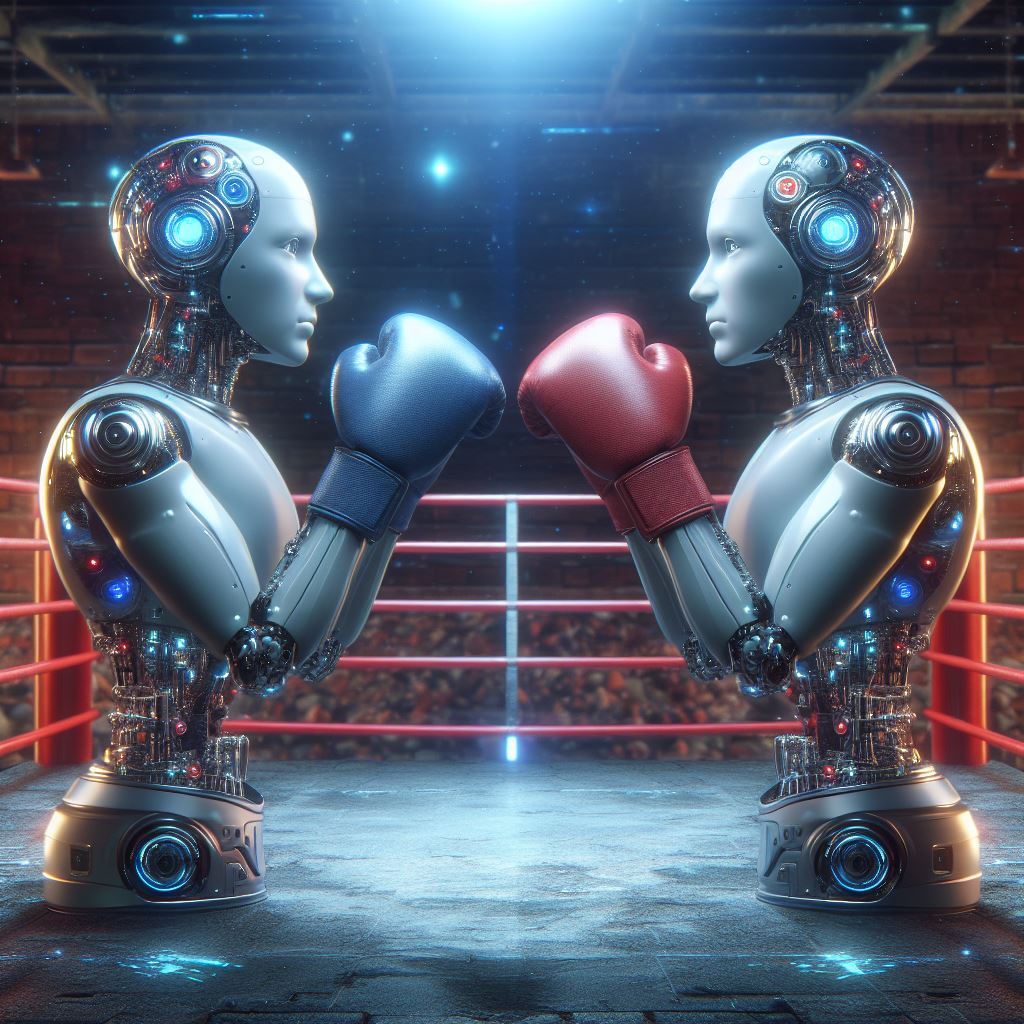
Ming, you are in the right place. As implied in your question, and acknowledged by both parties, ChatGPT and Bard are direct competitors. Let’s put these pugilists into the ring and give each an identical test to determine the peoples’ champ. Holy AI boxing match, Batman! We commence by identifying the warriors, starting with ChatGPT.
In the blue corner is ChatGPT, a product of OpenAI. OpenAI is a California based software company developing artificial intelligence. OpenAI describes ChatGPT as a language model designed to understand and generate human like text based on the input it receives. ChatGPT is now in version 4 and uses GPT3.5 as its underlying technology.
In the red corner is Bard, a product of Google, and Google needs no introduction. Bard is a conversational AI tool that uses Gemini as its underlying technology. Bard allows users to interact with and use chat-like dialogues to ask questions, receive information, and complete tasks.
The warriors are in the ring and ready to rumble! Let’s ask five questions across a range of topics:
- Can you write a 300-word essay describing the four voyages of Christopher Columbus?
- Please give me five Chinese recipes for tofu.
- Why did the USA boycott the 1980 Olympics in Moscow?
- Can you write a 300-word essay describing the Federal Reserve Banking system?
- Explain the physics in aviation that facilitates flight in 300 words.
Round 1: ChatGPT wins by technical disqualification. Although both answered the question fundamentally correct, Bard did not follow instructions. I asked for a 300-word answer. Bard used 370 and ChatGPT 292.
Round 2: ChatGPT wins by technical disqualification because Bard failed to follow instructions. I asked for five recipes; Bard provided four. However, Bard did land punches. For example, it added pictures of every final dish; ChatGPT did not. That’s a big plus. ChatGPT gave me the name of the dishes in Chinese characters; Bard did not. However, given I don’t understand Chinese written characters including them was not value added.
Round 3: Bard wins by adding additional links to the story and including an explanation of what happen after the 1980 boycott. Bard offered links to U.S. State Department documents, a photo, and noted the Soviet Union retaliated in 1984 when it and its allies boycotted the Olympic games held in the USA. Impressive!
Round 4: Bard wins. Great answers were given by both competitors, however, Bard wins the round in a close decision. Bard wins, not due to substance; it wins on style points. Essentially, Bard presented the answer in a format that was superior. Bard made ample use of bullet points and subsections with titles thus making it easier for the reader to follow-along.
After four rounds we are tied. The tension mounts! The winner of round five takes home the championship belt! Hold on to your keyboard!
Round 5: In dramatic fashion ChatGPT takes round five and the title! Although Bard’s format was easier to read, ChatGPT wins using substance. ChatGPT cited two authoritative sources of information and that made the difference.
Ming, I hope you enjoyed the battle of the bots. Today’s proverb comes from Netherlands, where they say, He’s standing there with his mouth full of teeth. (He is speechless).
Until next time,
Yogi Nelson

 Blockchain & AI Forum