

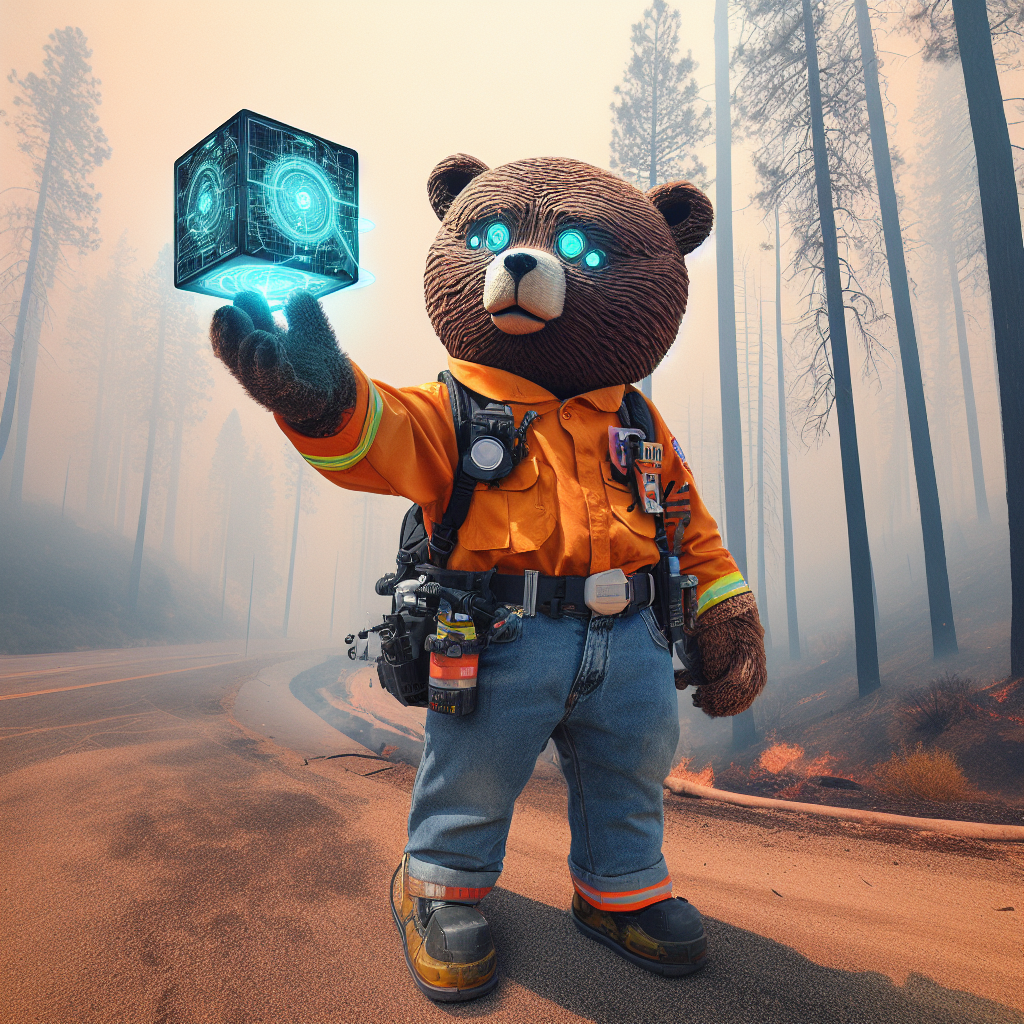
Namaste Yogis. Welcome to the Blockchain & AI Forum, where your technology questions are answered. As a bonus, a proverb is also included! Today’s question, submitted by Mike, a former Fire Chief, and he asks if Smokey Bear is using artificial intelligence to fight forest fires?
Mike, you came to the right place. Let’s converse about how AI protects the forest using California as an example, but first we start with a definition. According to CAL FIRE, California Fire Fighting Agency, wildfires are uncontrolled fires that rapidly spread through vegetation, such as forest, grasslands, etc. https://www.fire.ca.gov/ CAL FIRE notes wildfires can be natural occurrences or resulting from human activity. Holy burning bush, Batman!
Wildfires in California are an enormous problem. Between 2019 – 2022, wildfires caused more than $25B in property damage, millions of acres of forest were burned, thousands of homes were destroyed and hundreds of deaths! Moreover, wildfires are increasing in numbers and intensity. Bottom line—it’s an enormous problem.
Firefighting is a mammoth human coordination challenge. AI is, in part, a human coordination technology. California created the Alert California Initiative to coordinate the wildfire challenge. The initiative has numerous partners. The purpose is to use AI technology to make data driven decisions regarding wildfires.
Alert California had a predecessor–Cameras on Mountain Tops (CMT) program. Program administrators wanted to fix the shortcoming of CMT. What was the shortcoming? Essentially, too much data! CMT system covered 90% of high fire risk areas, as defined by CAL FIRE. The deluge of data generated from the 1,000+ cameras spread throughout the state generated 8 – 16M images per day! CAL FIRE could not manage the data in time to take effective action. A human coordination problem. The solution? Add artificial intelligence service partner, DigitalPath!
DigitalPath started by implementing computer vision to help humans deal with massive data sets. Just imagine, cameras were picking up 100,000 smoke images per day. California operations centers were inundated with 7K – 10K fire alert emails/text/voicemail per day. The goal was one alert per fire. Holy efficiency, Batman!
Using a combination of AI computer vision and algorithms, Alert California has dramatically augmented its ability to determine whether an image is relevant, timely, duplicative, etc. and to classify the importance. With AI, firefighters work more effectively, by for example, positioning equipment in ideal locations and of course, under safer conditions! Here is how it works:
When the AI spots a potential fire on the Alert California network of cameras, the AI system alerts firefighters and provides a percentage of certainty and estimates the incident location. If the incident is confirmed by trained personnel, firefighters respond. AI is also used to estimate what resources are required, location, and quantity. Moreover, the AI is also deployed to map out evacuations! Smokey Bear is ecstatic, Batman!
Ironically extinguishing fires early today means more fuel for blazing infernos tomorrow. Think of it as a dam that burst at maximum capacity! However, on the horizon there are positive developments. For example, with computer vision 40% of all wildfires are being detected by the AI system prior to 911 alerts, and the number is increasing. With AI, controlled fires become more manageable. AI is also improving firefighters’ ability to identify where fires are likely to occur and/or when they are occurring. Simulations are working faster thus increasing the reliability of predictive models to give warnings. In other words, there is reason for optimism.
I conclude with an Estonian proverb: The stomach never gets full by only licking.
Until next time,
Yogi Nelson
 Blockchain & AI Forum